Rulers: Wake Island: History
Wake Island
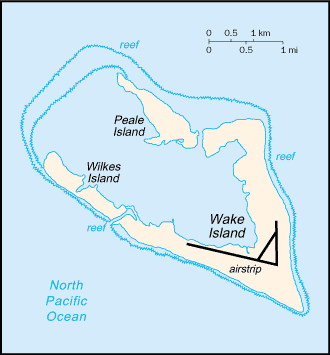 |
Wake Island is a coral atoll consisting of three islets, Wake, Wilkes, and Peale. The atoll, situated on a submerged volcano, lies in the Pacific on the direct route from Hawaii to Hong Kong, about 3,200 km west of Hawaii and 2,060 km east of Guam. The group is 7.2 km long and 2.4 km wide, and covers less than 8 sq km.
Oct. 2, 1568: The island is sighted by a Spanish expedition under Álvaro de Mendaña, who names it San Francisco and claims it for Spain. "We made the circuit of the island," he reports, "and saw that the sea entered it in some parts, and that it was completely deserted, containing nothing but sea birds; brambles were the only vegetation. Finding that it was useless, and that there was no water, we put to sea, and cut down the rations."
September 1796: The island is again discovered by the British vessel Prince William Henry commanded by Captain Samuel (by other sources William) Wake, for whom the main island is named. For some time the name Halcyon is also used.
1823: Captain Edmund Gardner in the Balaena sees Wake and describes it in some detail.
Dec. 20, 1841: The island's exact location, having been lost, is reestablished by a U.S. naval expedition led by the explorer Charles Wilkes, who lands with a survey party including naturalist Titian Peale and stays for several weeks.
March 4, 1866: The German ship Libelle (Captain Anton Tobias), en route from San Francisco to Hong Kong, strikes the eastern reef of the atoll during a powerful gale. Among the ship's passengers is a renowned opera troupe. The castaway passengers are stranded for three weeks before taking off in two small boats to the Mariana Islands. One of the boats makes it safely to Guam where the 22 passengers are welcomed by the Spanish governor, Francisco Moscoso y Lara. The other boat, carrying the captain and eight passengers, is never found. Before leaving the atoll to search for help, Captain Tobias buried flasks of quicksilver, coined money, and other valuables. News reports about the buried cargo cause many expeditions to the uninhabited atoll in 1867-68 in search for the valuable goods.
Aug. 30, 1870: The China tea clipper Dashing Wave (Captain Henry Vandervord), en route from China to Australia, crashes into the reef of the atoll during a gale. After 31 days Vandervord and 12 crew members set off in a boat, search for any inhabited land for 30 days, and finally reach Kosrae (in the modern Federated States of Micronesia), where they are given assistance by the chief.
July 4, 1898: Brig.Gen. Francis Greene of the SS China stops at Wake en route to the Philippines during the Spanish-American War and raises the U.S. flag.
Jan. 17, 1899: The USS Bennington, Commander Edward D. Taussig, acting on orders from Washington, takes formal possession of the island (which is not actively claimed by any other country) for the United States.
1902 and 1904: U.S. expeditions encounter Japanese pearlers, fishermen, and feather hunters.
1922: Lieutenant Commander S. Picking of the USS Beaver reports several deserted huts which were
used by the Japanese.
July 23-Aug. 5, 1923: The USS Tanager visits the island during a famous oceanographic voyage. The two smaller islands are named Wilkes and Peale after the members of the 1841 expedition.
Dec. 29, 1934: Wake Island is placed under the control of the U.S. Department of the Navy.
1935: A commercial (Pan American Airlines) seaplane base is established to service trans-Pacific passenger flights and a 48-room hotel is opened.
January 1941: Construction of military installations begins. On February 14 Wake and other islands are made "defensive sea areas" (Executive Order 8682). The first Marines arrive by August.
Oct. 15, 1941: Maj. James P.S. Devereux arrives on Wake as island commander.
Nov. 29, 1941: Commander Winfield Scott Cunningham becomes island commander.
Dec. 8, 1941: A day after the Japanese attack on Pearl Harbor, Hawaii, which brought the U.S. into World War II, Japan (by a powerful navy flotilla under the command of Rear Adm. Sadamichi Kajioka) attacks Wake Island. At this time its garrison includes 449 Marines, 75 Navy and Army personnel, and 1,146 civilian contractors.
Dec. 23, 1941: The U.S. garrison surrenders and the island is occupied by Japanese forces. It is renamed Otori Jima.
Feb. 24, 1942: The island begins to be repeatedly bombed by aircraft.
September 1942: By this time all but 98 of the about 1,600 captured Americans have been evacuated to Japan or China.
Dec. 13, 1942: Capt. Shigematsu Sakaibara arrives to replace Capt. Susumu Kawasaki as island commander.
Summer 1943: The island is blockaded. No land assault, however, is attempted.
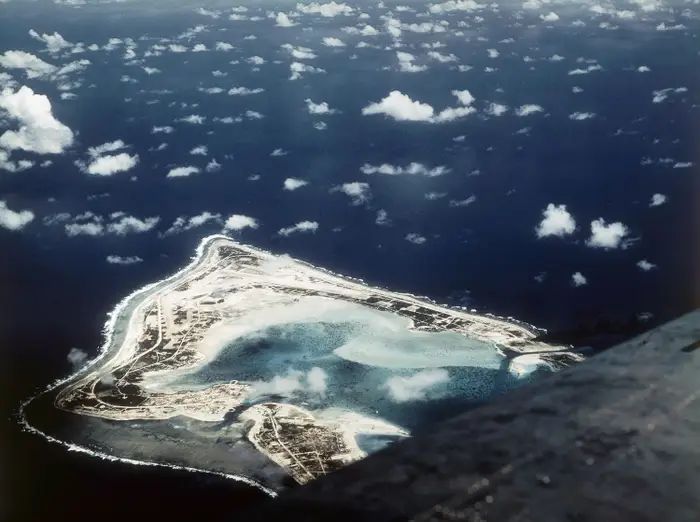
Japanese-held Wake Island under attack by U.S. carrier-based planes, November 1943. |
Oct. 7, 1943: Fearing a U.S. attack, Sakaibara orders the execution of 98 prisoners of war who remain on the island. (Sakaibara is sentenced to death after the war, as is Kawasaki.)
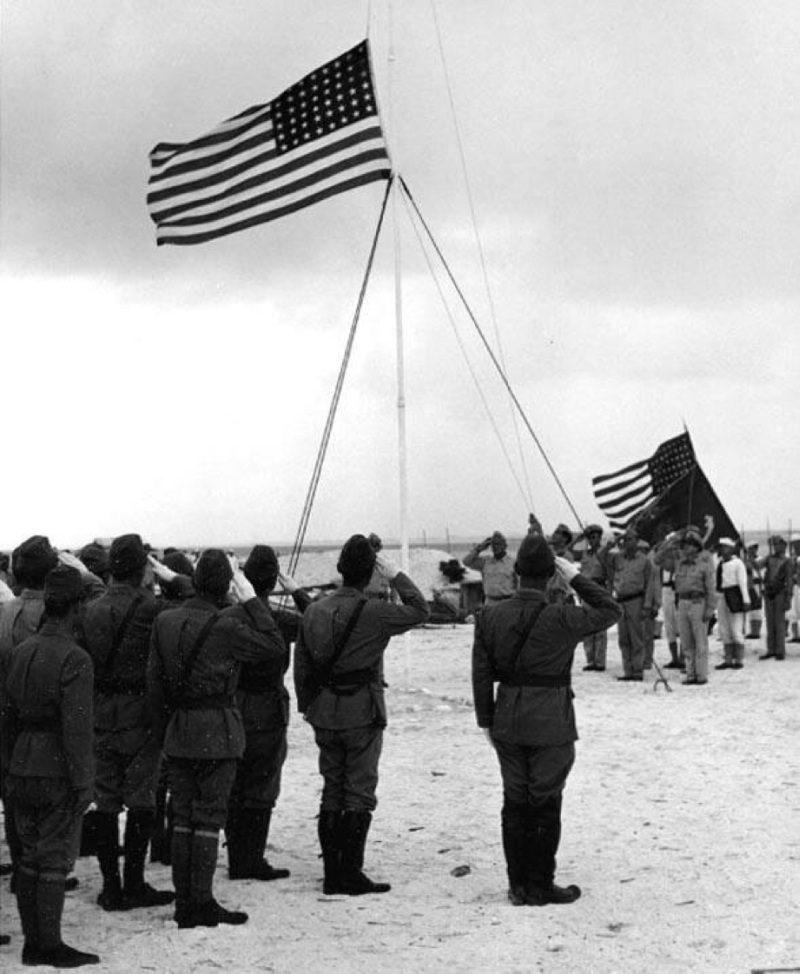
Japanese surrender at Wake, September 1945. |
Sept. 4, 1945: Two days after the overall Japanese surrender, Brig.Gen. Lawson Sanderson accepts the surrender of Japanese forces on Wake.
1949: The U.S. builds a 2,100-m paved runway, in 1959 lengthened to 3,000 m.
June 1950: The Korean War breaks out. Wake Island serves as a major refueling stop for aircraft going to that conflict.
Oct. 15, 1950: Wake is the meeting place for Pres. Harry S. Truman and Gen. Douglas MacArthur, in their discussion of the Korean situation.
Sept. 16, 1952: Typhoon Olive causes significant damage. 550 persons are on Wake at this time. It costs some $1,600,000 to rebuild installations destroyed or damaged by the storm.
Sept. 5, 1962: Administrative responsibility passes to the U.S. Department of the Interior, but the territory is actually administered by the U.S. Air Force.
1963: A Japanese salvage team collects most of the World War II remnants of airplanes, guns, tanks, and landing craft.
1964: An underwater cable is completed linking Wake to Honolulu and Guam.
1966: A Marine war memorial is completed.
Sept. 16, 1967: Typhoon Sarah causes damage to 95% of the structures on the island.
Sept. 24, 1968: An Air Force KC135 flying tanker crashes upon making an emergency landing; 11 persons are killed.
July 1972: The responsibility for civil administration is delegated to the general counsel of the Air Force, the agent being the military commander of Wake Island.
April 25-Aug. 2, 1975: About 15,000 Vietnamese refugees pass through Wake Island.
March 15-16, 1981: Typhoon Freda causes significant damage. A new $7 million seawall is destroyed.
1983: The population is 1,600.
Sept. 16, 1985: Wake Island is designated a National Historic Landmark by the National Park Service.
March 12, 1986: March 22 of each year is proclaimed to be "Wake Island Day" on the island.
1988: Population is estimated to be almost 2,000.
1990: Legislation before the U.S. Congress proposes the inclusion of Wake Island within the boundaries of the territory of Guam. However, the Republic of the Marshall Islands, some 500 km to the south of Wake, then decides to exert its claim to the atoll, known as Enenkio to the Micronesians. President Amata Kabua of the Marshall Islands declares that Wake Island is a site of great importance to the traditional chiefly rituals of his islands and that the Marshall Islands, having achieved a measure of independence from the U.S., can now claim the territory.
Oct. 1, 1994: From this date the Ballistic Missile Defense Organization (within the Office of the Secretary of Defense) funds Wake's actual administration, which the U.S. Army Space and Strategic Defense Command (SSDC) carries out under a use permit issued by the Air Force.
November 1996: Construction of the new launch facility for the Hera target missile is completed.
1998: Plans are announced by a U.S. company to establish a large-scale facility for the storage of nuclear waste on the atoll. They are condemned by environmentalists and politicians in the region.
October 2001: Population has declined to an estimated 200 people (all civilian contractors).
Oct. 1, 2002: At the conclusion of the Theater Missile Defense test program, management of Wake Island returns to the Air Force.
August 2006: Hurricane Ioke severely damages much of the island's infrastructure. The Air Force evacuated all 188 residents on August 28.
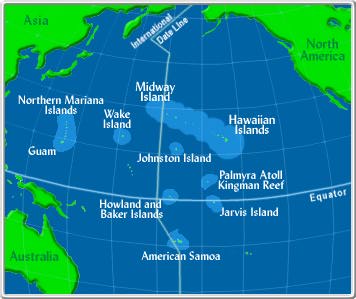
Wake Island shown among all U.S. Pacific territories. |
Jan. 6, 2009: The Pacific Remote Islands Marine National Monument is established, including Wake Island along with the Howland and Baker Islands, Jarvis Island, Johnston Atoll, Kingman Reef, and Palmyra Atoll.
Sept. 25, 2014: Pres. Barack Obama enlarges the Monument by proclamation, expanding the protected areas around Jarvis Island, Johnston Atoll, and Wake Island to encompass the entire U.S. exclusive economic zone.
Sept. 17, 2017: It is reported that Secretary of the Interior Ryan Zinke has recommended that Pres. Donald Trump amend Obama's proclamation or revise the expanded boundary of the Monument to allow the possibility of commercial fishing in the enlarged area.
Jan. 2, 2025: The Monument is renamed Pacific Islands Heritage Marine National Monument by Pres. Joe Biden.
April 17, 2025: President Trump allows commercial fishing between 50 and 200 nautical miles from the landward boundaries of the Monument.