Rulers: South Georgia and South Sandwich Islands: History
South Georgia and South Sandwich Islands
 |
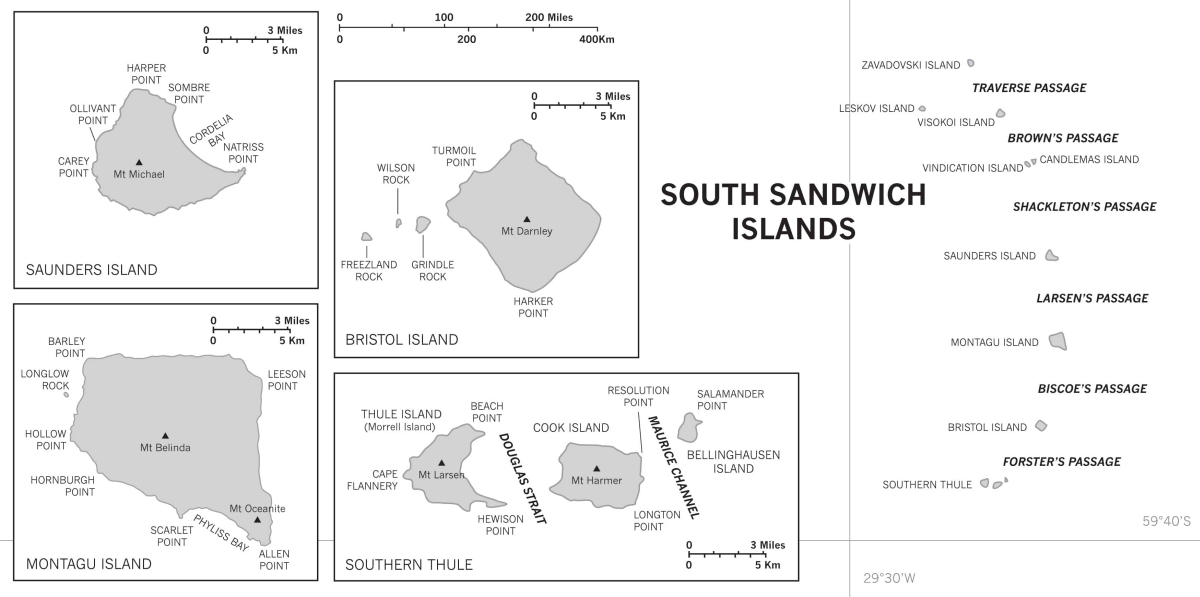 |
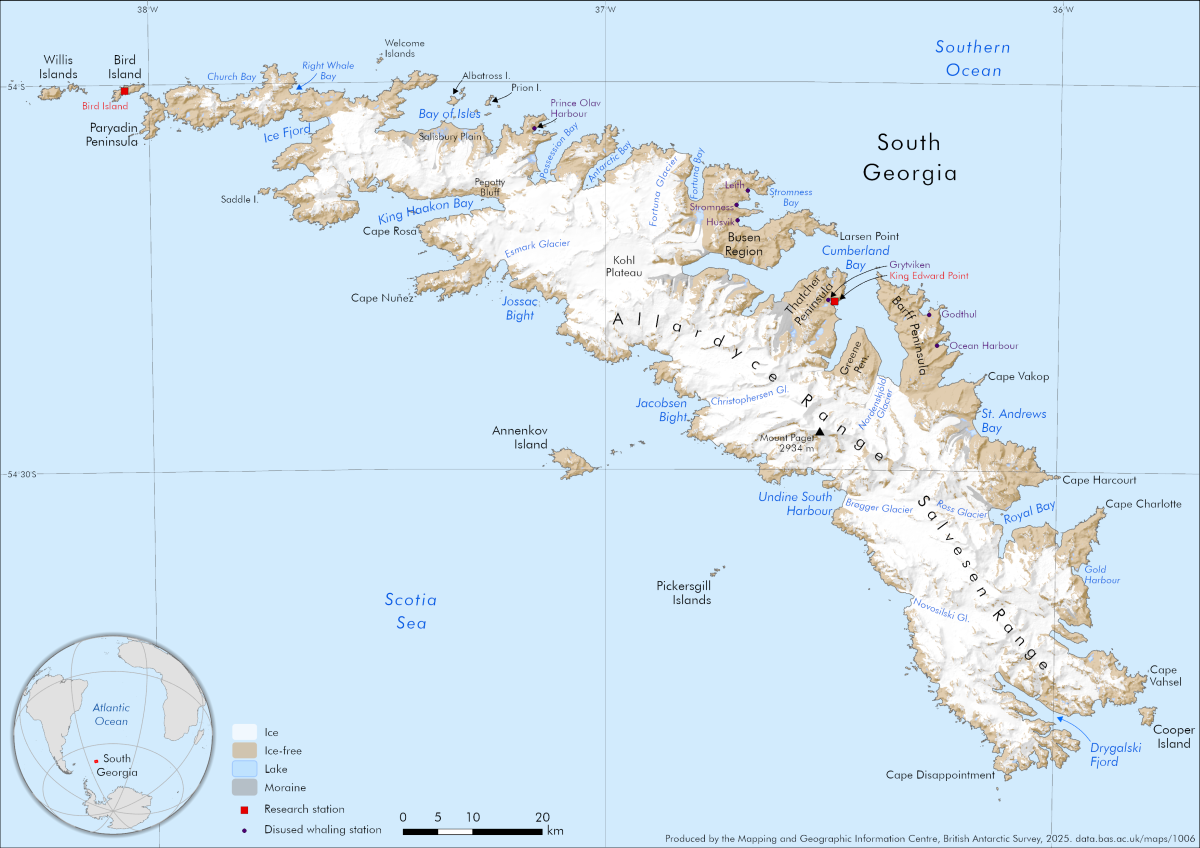
South Georgia is an island in the South Atlantic Ocean, about 1,300 km east-southeast of the Falkland Islands; the South Sandwich Islands lie about 750 km southeast of South Georgia. As the islands lie south of the Antarctic Convergence, they can by that definition also be located within the Southern Ocean; not, however, if the latitude 60° S is used as the boundary.
April 1675: London merchant Antoine de la Roché, while on a journey from Peru to Europe and trying to pass the Le Maire Strait (Tierra del Fuego), is blown off course and sights an island that almost certainly is South Georgia.
June 29, 1756: Another merchant vessel assailed by storms, the León of Spain, sights South Georgia, and the island's naming after St. Peter is recorded. The name Isla San Pedro remains in use in Spanish.
Jan. 17, 1775: Captain James Cook lands on South Georgia, taking possession for King George III in Possession Bay. He discovers the South Sandwich Islands on January 30.
1786: Sealing at South Georgia begins probably at this time.
Dec. 27 (Dec. 15, O.S.), 1819: Russian explorer Faddey Bellinsgauzen (Fabian Gottlieb von Bellingshausen) sights South Georgia. He surveys the southwestern coast, complementing Cook's northeastern survey.
Aug. 20, 1882-Sept. 6, 1883: The German International Polar Year Expedition remains for more than a year at Royal Bay, South Georgia, where they establish a station with some eight buildings. It is the first land-based scientific exploration of the island.
Nov. 16, 1904: The first modern whaling expedition, led by Norwegian captain Carl Anton Larsen and sent by the Argentine company Compañía Argentina de Pesca, arrives at South Georgia. Grytviken ("the pot cove," so called because of the large blubber cauldrons left on the shore by sealers) is established as a whaling station, operating from December 22.
January 1905: Larsen establishes a meteorological station.
Nov. 10, 1906: The Fridtjof Nansen is wrecked at South Georgia with the loss of 9 lives.
Dec. 20 and 24, 1907: Whaling stations are established at Stromness and Husvik harbours respectively, in Stromness Bay.
1908: Together with a segment of the Antarctic mainland and other nearby islands (the modern British Antarctic Territory), the islands are constituted as the Falkland Islands Dependencies. Earlier letters patent (1843, 1876, 1892) provided for the government of the Falkland Islands and dependencies but the extent of the latter was undefined.
November 1909: Another whaling station is established at Leith Harbour.
Nov. 20, 1909: James Innes Wilson is appointed as the first magistrate of South Georgia, arriving on November 30 and being first accommodated at Grytviken. A census on December 31 identifies 720 people; 93% are from the Nordic countries.
Sept. 17, 1912: The centre of administration is moved from Grytviken to King Edward Point.
Oct. 8, 1913: The first birth in the Falkland Islands Dependencies takes place at Grytviken.
Dec. 25, 1913: A church, which was dismantled in Strømmen, Norway, and re-erected in Grytviken, is consecrated.
Oct. 19, 1914: Magistrate Innes leaves the island. He is succeeded by Edward Beveridge Binnie.
May 20, 1916: British explorer Sir Ernest Shackleton, with Frank Worsley and Tom Crean, completes the first crossing of South Georgia as the final leg in an epic feat of survival. After some eight months adrift in an Antarctic ice-floe, their ship Endurance was crushed by ice and finally sank Nov. 21, 1915; the crew then took off on lifeboats, reaching Elephant Island (South Shetland Islands) on April 15, 1916. Knowing that this was far from any shipping routes, Shackleton decided their only hope was to reach the whaling stations of South Georgia (wind and current favouring that direction over the geographically shorter alternatives of Tierra del Fuego or the Falkland Islands). Six men accordingly sailed in a modified boat on April 24. Huge southwesterly gales forced them to change course for the uninhabited side of the island on the southwest coast, where they arrived on May 9. Realizing that the boat was in no shape to make a further journey around the island, the only way was to cross the island on foot. Three men departed on May 19 and made the crossing to the Stromness whaling station in 36 hours. The three crew members left behind on the other side of the island are rescued on May 23, while the 22 men left behind on Elephant Island are only rescued on August 30, previous attempts being blocked by ice.
1918-19: Some Russian employees of Grytviken reportedly agitate for South Georgia to become the second Bolshevik republic.
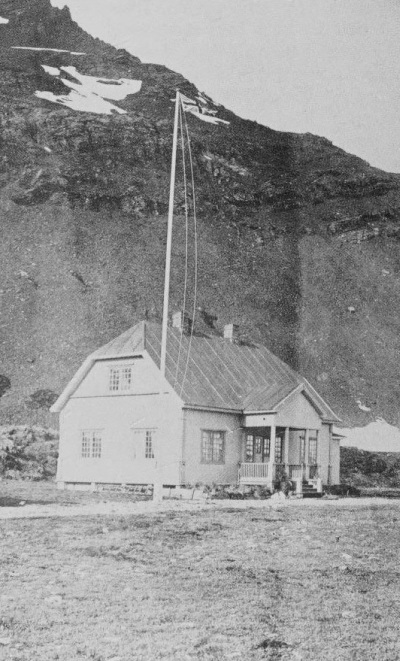
The first magistrate's residence at King Edward Point, c. 1920. |
January 1920: A number of whalers having come out on strike at Grytviken, things become serious when 50 rioting men threaten to attack the magistrate and the settlement at King Edward Point. On January 17 the light cruiser HMS Dartmouth happens to enter King Edward Cove and the commander, learning of the state of things, sends a squad of men ashore to assist the magistrate to restore law and order. The ringleaders are deported to their place of origin in South America.
Jan. 5, 1922: Sir Ernest Shackleton dies aboard Quest while at anchor at Grytviken. His body is first conveyed to Montevideo, but is returned on Lady Shackleton's wish that he be buried at South Georgia; this takes place on March 5 at Grytviken.
1924: A mail service between South Georgia and the Falkland Islands begins.
January 1925: The U.K. establishes a laboratory at King Edward Point, as part of the Discovery Expedition. A new magistrate's residence and a radio station (starting transmissions April 1, 1925) are constructed that same summer.
1927: Argentina makes formal claim to South Georgia in a communication from a delegate of the Argentine post office to the International Postal Bureau at Bern, Switzerland, which, however, takes no regard of this.
Aug. 6-13, 1927: Sir Arnold Hodson visits South Georgia, the first Falkland Islands governor to visit the Dependencies. He is on the island again Feb. 22-26, 1928, unveiling a granite memorial over Shackleton's grave.
Late November 1938: Two Walrus aircraft, deployed from HMS Exeter, take aerial photographs of parts of the island. This is the first time aircraft have flown at South Georgia.
Sept. 2, 1941: The magistrate since 1928, William Barlas, dies from the effects of an avalanche which knocked him into the sea.
Feb. 24, 1944: The first stamps for the Falkland Islands Dependencies are issued at South Georgia.
1948: Argentina makes formal claim to the South Sandwich Islands.
Dec. 24, 1949: The activities of the Falkland Islands Dependencies Survey (FIDS) are extended to South Georgia.
1951-57: The South Georgia Surveys, led by Duncan Carse, map the interior landmass of South Georgia.
May 4, 1955: The U.K. unilaterally submits the dispute over sovereignty to the International Court of Justice. The court decides not to hear the application in view of Argentina's refusal to submit to the court's jurisdiction.
1956: A government naturalist and sealing inspector is appointed; this post exists until 1966.
March 1956: The first landing on the Shag Rocks (about 250 km west of South Georgia) is made by helicopter from the Argentine naval ship Bahía Aguirre.
Jan. 12, 1957: Prince Philip, Duke of Edinburgh, visits South Georgia.
Nov. 24, 1957: The Bird Island station is established on South Georgia.
1960: The Compañía Argentina de Pesca sells the Grytviken whaling station to Albion Star Ltd., registered in the Falkland Islands.
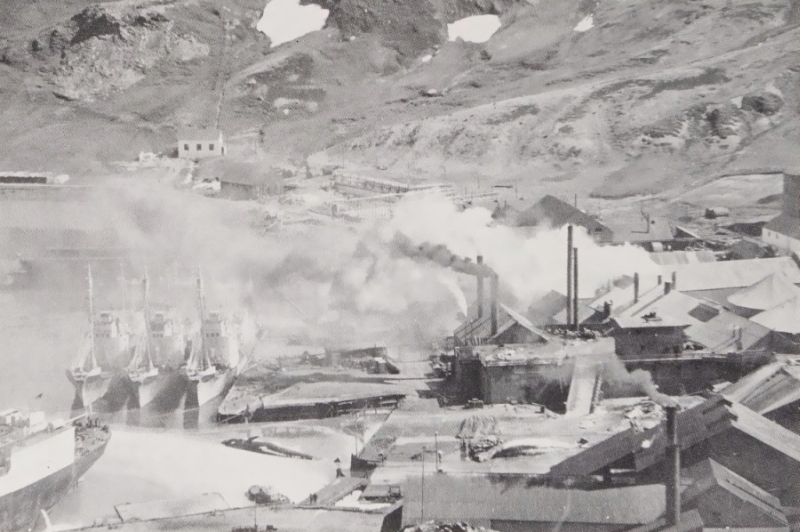
The Grytviken whaling station operating in 1961. |
Jan. 6, 1961: The first landing on the Clerke Rocks (about 70 km east-southeast of South Georgia) is made by the FIDS.
Dec. 4, 1964: Whaling at Grytviken ends. The last whaling, at Leith Harbour, finishes Dec. 15, 1965. Caretakers remain at Leith Harbour to Jan. 15, 1966, and at Grytviken to April 15, 1971, after which the stations are abandoned.
Dec. 30, 1964: The summit of South Georgia's highest peak, Mount Paget (2,934 m), is first climbed.
Nov. 13, 1969: The British Antarctic Survey (BAS, as FIDS became in 1962) establishes a permanent scientific station at King Edward Point and the base commander becomes the magistrate. A handover from Capt. Denis Joseph Coleman (the last magistrate from the Falkland Islands government) to Eric James Chinn of BAS takes place. Coleman and his support staff then leave South Georgia.
December 1970: The first of many visits by tourist ships is made when the Lindblad Explorer arrives.
1971: Nan Brown, wife of a wireless operator, publishes an account of life at King Edward Point, Antarctic Housewife.
Nov. 7, 1976: About 50 Argentines, reported to be scientists, occupy Southern Thule in the previously uninhabited South Sandwich Islands. This is the subject of a British diplomatic protest on Jan. 19, 1977.
Oct. 17, 1977: The King Edward Point station is renamed Grytviken.
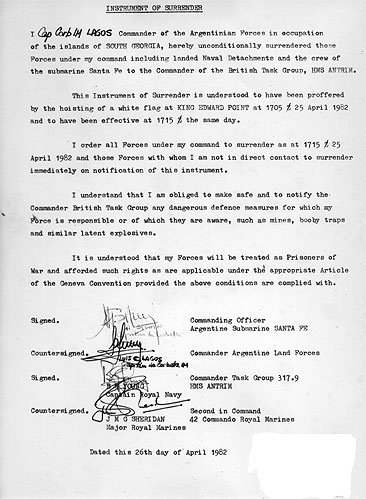
The "Instrument of Surrender" signed among others by Maj. Guy Sheridan after defeating the Argentines on South Georgia, April 26, 1982. |
April 3, 1982: South Georgia is invaded by Argentine forces, following the invasion the day before of the Falklands. The officer commanding the Royal Marines surrenders after a battle lasting almost two hours, with at least 15 Argentines estimated killed and the only casualty on the British side being one wounded man. Nearly all the Royal Marines and 13 BAS staff are forcibly removed to the Argentine ship Bahía Paraíso. Argentina occupies the island until its recapture by British forces (with only one man, an Argentine, being seriously injured) on April 25. A British military garrison then occupies King Edward Point, as it is called again, and its commanding officer becomes magistrate.
June 20, 1982: The Argentine personnel in the South Sandwich Islands are removed by British forces.
Oct. 3, 1985: Under the provisions of the South Georgia and South Sandwich Islands Order, the islands cease to be governed as dependencies of the Falkland Islands. However, the governor of the Falkland Islands becomes, ex officio, commissioner for the territory.
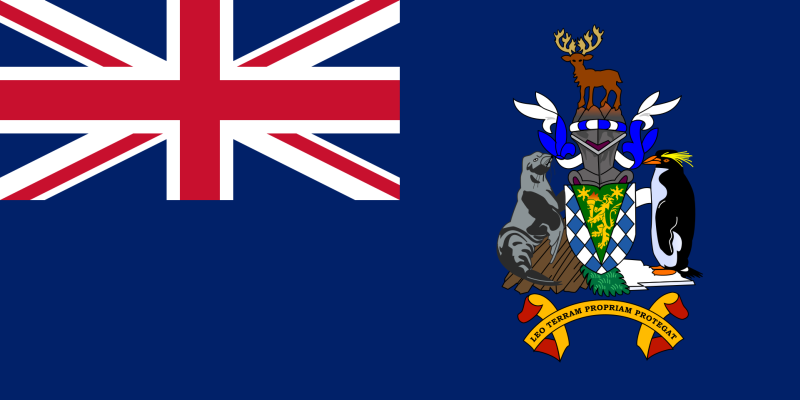
Feb. 14, 1992: A coat of arms for the territory is granted. This is subsequently also used on the British Blue Ensign as the territory's flag. Initially the arms appear in a white roundel, but later directly on the blue background. The coat of arms features a shield with a golden lion rampant (representing the U.K.) holding a torch (representing discovery), and two gold estoiles which are also found in the coat of arms of Captain Cook; the shield is supported by a fur seal on the left and a Macaroni penguin on the right; a reindeer appears above the crest, and below the shield on a scroll is the motto "LEO TERRAM PROPRIAM PROTEGAT" ("Let the lion protect its own land").
May 1993: In response to the Argentine government's decision to commence the sale of fishing licenses for the region's waters, the British government announces an extension, from 12 to 200 nautical miles, of its territorial jurisdiction in the waters surrounding the islands, in order to conserve crucial fishing stocks.
Sept. 17, 1998: The British government announces that it will withdraw its military detachment from South Georgia in 2000, while it will increase its scientific presence on the island with the installation of a permanent team from the BAS to investigate the fisheries around the island for possible exploitation.
2001: Increased volcanic activity on Montagu Island, in the South Sandwich Islands, previously thought to be dormant, begins to be monitored closely by the BAS.
March 2001: The small military detachment finally withdraws from South Georgia, and a new applied fisheries research station is opened at King Edward Point. The British garrison stationed in the Falkland Islands remains responsible for the security of South Georgia and the South Sandwich Islands.
March 2004: In recognition of management practices that have been introduced to maintain sustainability, the South Georgia toothfish fishery becomes the first Southern Ocean fishery to be certified by the independent Marine Stewardship Council.
Late September 2005: Mount Belinda visibly erupts, adding some 20 ha to Montagu Island's land area in just one month. The island is largely ice-covered and the eruption allows scientists the rare opportunity to make direct observations of volcanic activity under ice sheets.
May 2007: During a restructuring of the South Georgia government, Assistant Commissioner and Director of Fisheries Harriet Hall is appointed to the newly created role of chief executive officer; Hall assumes office on July 16, while retaining her responsibilities as director of fisheries.
May 31, 2011: The commissioner ratifies the Wildlife and Protected Areas Ordinance, which outlines new measures to protect the territory's delicate ecosystem and to prevent the introduction of potentially destructive species of flora and fauna.
Feb. 29, 2012: Legislation comes into force that designates South Georgia and South Sandwich Islands' territorial waters a Marine Protected Area (MPA), in an effort to conserve maritime biodiversity.
June 12, 2013: A revised Marine Protected Area Order comes into force, which includes additional measures to protect marine diversity.
2014: An increase in the toothfish fishing quota, to 2,200 metric tons, boosts income from fishing licenses.
January 2015: A reindeer eradication programme is completed; a total of 6,595 non-native reindeer (originally introduced from Norway around 1910) were humanely killed in 2013-15.
March 27, 2015: The territory becomes a signatory to the Convention on Biological Diversity.
Nov. 27, 2015: A five-year strategy to improve environmental standards, as well as to improve governance of the territory, is launched.
2016: There is a recorded budget surplus of £1.9 million, largely owing to revenue from toothfish catches, but also because of growing tourism income. The surplus grows to £3.2 million in 2020.
2016-17: South Georgia receives 15,377 visitors in the season, including a record 8,946 cruise ship passengers.
May 8, 2018: The South Georgia Heritage Trust declares the island to be free from rats, following a 10-year eradication project.
May 29, 2019: An enhanced MPA is signed into law; "No-Take Zones" (areas in which commercial fishing activity is banned) are enlarged to cover 23% of the MPA, in order to protect fish stocks.
March 2020: Due to the COVID-19 pandemic, the government cancels all visits to Grytviken and King Edward Point for the remainder of the 2019/20 tourist season, although landings at other sites in the territory are still permitted. In mid-2020 the authorities announce that vessels will be allowed to land at Grytviken during the upcoming 2020/21 tourist season, although all indoor areas will be closed to visitors. Some restrictions at Grytviken are subsequently relaxed, and the strict entry protocols are suspended in May 2022. The territory remains free of COVID-19.
May 2020: Construction is completed of a new £11 million wharf at King Edward Point.
January 2021: A new strategic framework for 2021-25, "Protect, Sustain, Inspire," is presented. The plan primarily focuses on initiatives to support the sustainable environmental management and protection of the territory and its waters.
April 2021: A British Army bomb disposal team successfully completes an operation in South Georgia to remove unexploded ordnance left on the island after the 1982 conflict.
July 5, 2022: The government announces that the entire landmass of South Georgia and the South Sandwich Islands is designated as a Terrestrial Protected Area. A plan to maintain and manage the ecosystems of the islands is issued on Oct. 30, 2023.
April 22, 2025: New marine protection measures extend No-Take Zones to cover 38% of the MPA.
Late June 2026: With the departure of Laura Sinclair Willis as chief executive, the post is abolished. A new post of deputy head of Government House (functionally, deputy governor of the Falkland Islands), who is also deputy commissioner for South Georgia and the South Sandwich Islands, is assumed in August by Colin Armstrong.
Oct. 7, 2026: A BAS study shows that Zavodovski Island (South Sandwich Islands) is no longer home to the world's largest penguin colony, probably due to climate-driven changes to ocean food chains. The number of chinstrap penguins on Zavodovski fell from around 1.09 million breeding individuals in 2011 to 402,000 in 2025, a 63% decline; the population of a different species, macaroni penguins, rose from 338,000 to 433,000 in the same period.