Rulers: Saint-Pierre and Miquelon: History
Saint-Pierre and Miquelon
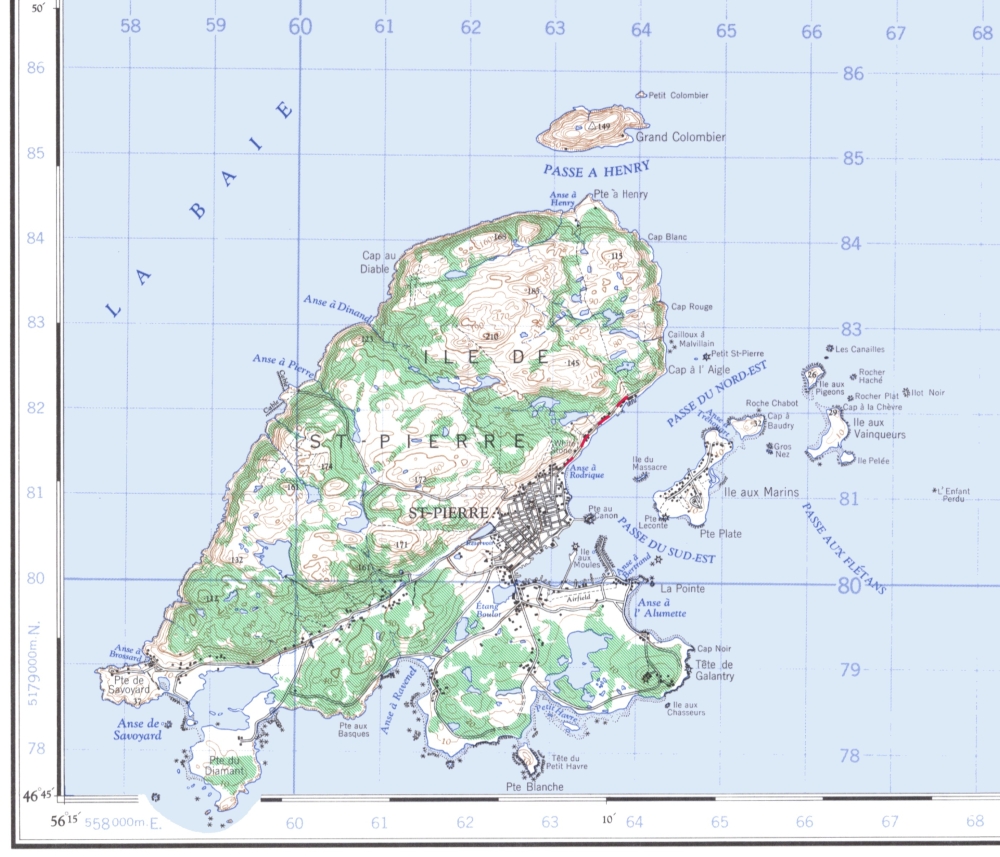
Saint-Pierre and Miquelon (Saint-Pierre-et-Miquelon) is a group of small islands south of the much larger island of Newfoundland in the northwestern Atlantic Ocean. Of the two main islands, Saint-Pierre is the smaller but more populous one. Miquelon is a double island, whose two parts have been known as Grande and Petite Miquelon, but are now more commonly called Miquelon and Langlade.
The area has been the site of a very large number of shipwrecks, only the worst of which are specifically mentioned in this record.
900-100 BCE: Dorset Indians visit the islands, the southernmost settlement of Arctic people.
Oct. 21, 1520: The archipelago is discovered by the Portuguese explorer João Álvares Fagundes, who gives the islands the name Eleven Thousand Virgins (referring to the legend of St. Ursula, whose feast day is October 21). It is possible, however, that Basque and French fishermen were already using the islands before and had given them their modern name. In any case Jacques Cartier, who stops there (June 11-16, 1536) on his return to France during his second voyage, refers to the islands as Saint-Pierre. The rich fishing grounds near the islands attract European fishermen who come and go with the fishing season. (The origin of the name Miquelon is not certain, but it is believed to be derived from Norman or Basque forms of the name Michael.)
1604: The first permanent French fishing settlement is established. A resident population gradually develops when fishing crews begin to overwinter in order to maintain the facilities for the migratory fishery.
1670: The earliest known reference to settlers appears in a document of this year, when the intendant of New France, Jean Talon, stops and records 13 fishermen and four sedentary residents. Gradually, with the encouragement of French outfitters, the French administrators at Plaisance (modern Placentia, on Newfoundland), and the bishop of Québec, Saint-Pierre begins to grow. 76 people living year-round are recorded there in 1687 (including only three families, the others being indentured labourers who return to France after their 36-month contract) and a chapel is constructed in 1689.
1690s: A small fort, armed with six cannons, is built to protect Saint-Pierre, which by this time is the principal supply and service centre for the south coast region from the Burin Peninsula west to Bay d'Espoir. Fortune and Hermitage bays, where small numbers of French fishermen have settled, are described in French manuscripts as "bayes dépendantes" of Saint-Pierre. Such growth also brings the unwelcome attention of France's enemies, with the result that Saint-Pierre is attacked several times during the wars between 1689 and 1713.
April 4, 1702: The fort is destroyed by a squadron commanded by English admiral John Leake.
1707: Two English ships come to plunder the fisheries but do not cause too much damage.
1708: In a more serious English attack, everything is destroyed, and the inhabitants, having run out of food, take refuge in Plaisance. The governor of Newfoundland, who sailed with a 34-gun ship to seize Saint-Pierre, arrives on a deserted island. In Plaisance, in December, the people of Saint-Pierre watch the departure of the third expedition against St. John's. Some of them perhaps are among the group of 170 men who capture the English capital on Jan. 1, 1709, destroying the fortifications and taking 800 prisoners. The prisoners are disposed of by being sent to Quebec, but Plaisance is now overcrowded with soldiers who need to be fed, and supplies are arriving slowly. Under these circumstances, some residents of Saint-Pierre prefer to return home. Despite the pillaging of Saint-Pierre in 1710, they are found back on their island in 1711. Those who remained in Plaisance undoubtedly regret it, because the English, who were never able to capture the fortified French capital, simply decided to blockade it.
1710: The settled population is only about 300.
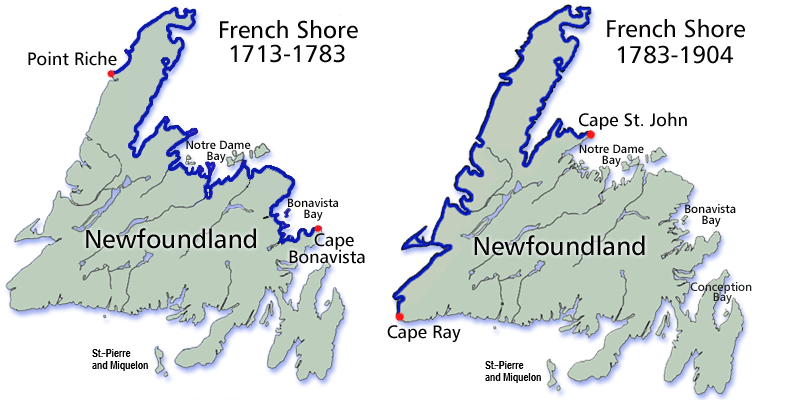
April 11, 1713: When the Treaty of Utrecht brings the wars to an end, France gives up its claims not only to Newfoundland but to Saint-Pierre, Miquelon, and the accompanying islands as well. For the next 50 years, Saint-Pierre is an English possession. Even the name is anglicized to "St. Peter's." The town of Saint-Pierre is named Bourgway. However, France retains the right to fish and to dry fish on certain parts of the littoral of Newfoundland, called French Shore.
1714 and 1716: The British government authorizes two separate surveys of their newly-acquired regions to encourage British fishermen to expand into the region and to exploit the wealth of resources believed to be there. William Taverner, a Newfoundland planter and merchant, surveys the resources and people of the region from Placentia Bay west for the British Board of Trade; Lt. John Gaudy conducts a cartographic survey of the region for the British Admiralty in 1716, beginning at Saint-Pierre. Both surveys reveal that a number of the original French inhabitants have chosen to remain in the region rather than shift their residence to Cape Breton Island, where France was establishing the new fishing colony of Île Royale. Taverner describes Saint-Pierre as "a considerable Place of Trade, especially about Michmas [September 29] where all the Planters & Servants from the Bay de Espère, Capnigro, Grand Bank, Fortune, Courbin &c. bring in their Furrs and Summers Fish to sell for purchasing their Winters Provisions and necessarys."
1722: The island of Miquelon is granted in its entirety to a Massachusetts resident. In the 1750s he sells it to two New Hampshire men.
1757: A channel opens up between the previously linked islands of Miquelon and Langlade.
1759: A census indicates 408 British year-round inhabitants.
Feb. 10, 1763: The Treaty of Paris is signed at the end of the Seven Years' War, formalizing France's loss of its North American colonial empire. To preserve the fisheries, France insists that the fishing privileges guaranteed by the Treaty of Utrecht be restored and an abri or shelter be provided for French migratory metropolitan fishermen. Britain therefore restores Saint-Pierre and Miquelon to France.
July 14, 1763: Charles Gabriel Sébastien, baron de l'Espérance, is tasked with retaking possession in the name of France, and shortly thereafter Governor François Gabriel Dangeac (the baron's uncle) takes command of the islands with a small garrison of 50 officers and soldiers authorized by the treaty. By the following year a small French resident population has been reestablished. Some of the people are from Île Royale, from which they were exiled to France in 1758 following the capture of Louisbourg by the British.
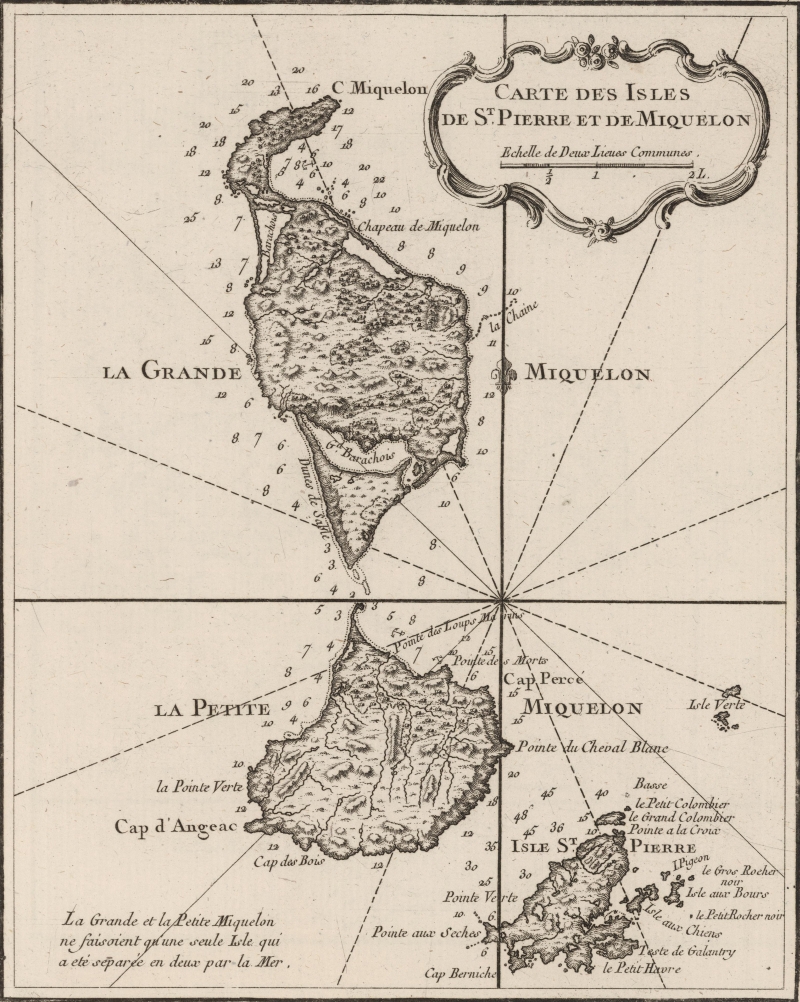
1764 map of Saint-Pierre and Miquelon, showing an open channel between Miquelon and Langlade. |
1764: The engineer Fortin tries to create a well-sheltered port in the Grand Etang of Miquelon by opening a wide canal between the lagoon and the sea, but his canal, destroyed by the first storm, lasts only 15 days.
1764: Louis XV's minister of marine and colonies, Étienne François de Choiseul, sends an official on a mission to convince the Acadians to move to Cayenne in French Guiana. In Miquelon, the Acadians refuse to follow him. About 100 inhabitants (probably from Saint-Pierre) leave for Cayenne, where many are not able to withstand the equatorial climate and die; the survivors are repatriated to France. In 1765, 43 Acadians are also sent back to France. Their compatriots are not discouraged and continue to arrive in the archipelago. Dangeac then ceases distributing food to the Acadians. In 1767 a royal decree orders the return of all Acadians to France. Dangeac carries out this order, excepting those who prefer to return to Acadia under English rule, or to America. After their departure, only 300 year-round residents remain in Saint-Pierre. In 1768 Choiseul changes his mind and allows the Acadians to return to Saint-Pierre; out of 586 who went to France, 322 return. After a few years of fruitless attempts at farming the Acadians turn to the sea, fishing the adjacent waters up to 15 or 20 km away in open shallops. Some of the residents use schooners and brigantines to fish on the Saint-Pierre Bank, about 75 km away, and, to a lesser extent, the more distant Grand Bank; the Banquereau and Green banks are hardly used at all. Fleets of bankers from France also appear and quickly establish an interdependent relationship with the residents of Saint-Pierre. In spring, schooners averaging 50 tons with a crew of around eight men depart from France and make for Saint-Pierre, catching a cargo of fish en route. They unload this first catch at Saint-Pierre for drying, then return to the banks for a second and even a third load of fish, returning each time to Saint-Pierre to unload the fish for drying. These first three loads are delivered to market by vessels other than the banking schooner itself. A fourth trip is made out to the banks, but this time the schooner returns to France with its cargo, delivering it as wet cod to traditional French markets. In this way, Saint-Pierre not only develops its own fishing industry, it becomes a vital element in the metropolitan French bank fishery.
July 31, 1768: The astronomer César-François Cassini de Thury, tasked with a scientific exploration in the waters of Newfoundland, arrives at Saint-Pierre, determining the precise latitude of the main settlement. He is credited with a detailed account of his stay in the colony, in which he describes its miserable conditions and great destitution, not surprising in this era.
July 31, 1773: Governor Dangeac departs. He is succeeded on his own recommendation by the baron de l'Espérance.
1775: The Île aux Chiens is occupied by Basque fishermen; 200 of them winter on the island.
Sept. 21, 1775: A terrible hurricane kills 400 people on the banks and in the surrounding area. Approximately 22 schooners and 50 longboats belonging to the inhabitants of Saint-Pierre and Miquelon are lost. All the fish stages (chaffauds) are destroyed.
1776: A census counts 1,208 inhabitants in Saint-Pierre and 776 in Miquelon.
Sept. 14, 1778: During the American War of Independence, British rear admiral John Montague, governor of Newfoundland, seizes Saint-Pierre and Miquelon. On October 4 the permanent population (an estimated 1,400 people) is expelled to France; the governor, his two or three officers, and his 31 soldiers are embarked on two French ships bound for La Rochelle, the other people are crammed on the 10 remaining ships and sent to various ports in France. 273 houses, 126 fishing huts, 99 stores, 6 bakeries, 79 stables, 38 fish stages, and a number of longboats are then burned.
1781: During a storm the islands of Miquelon and Langlade are joined again by an immense sand bar and dune. Many vessels subsequently run aground there seeking a passage that no longer exists except on outdated maps.
July 23, 1783: The baron de l'Espérance reoccupies Saint-Pierre with 70 military or administrative officers and about 100 soldiers, in accordance with the provisions that will be officially confirmed by the Treaty of Versailles, signed on September 3. The majority of the inhabitants who were forced to leave in 1778 return, the state repatriating 1,223 (510 in 1783 and 713 in 1784). The prohibition against erecting fortifications, stipulated by the 1763 treaty that ended the Seven Years' War, is abolished. The French Shore is relocated, henceforth to be situated between Cape St. John and Cape Ray. The French thus retreat along the north coast of Newfoundland, but in return, they can now fish along the entire west coast, which was always frequented by Basque fishermen.
1784: Severe storms destroy several buildings. The ship Les Trois Sœurs, bringing several inhabitants from France, supplies for the hospital, medicines, and provisions, is lost (May 31) off the coast of Newfoundland. The passengers are rescued, but arrive in Saint-Pierre completely destitute.
August 1784: A group of 80 Micmac (Mi'kmaq) Indians from Cape Breton Island visit Saint-Pierre, where 15 express a desire to settle in the Bay d'Espoir to be close to the French. The French nurture their loyalty by distributing various gifts.
March 13, 1785: The decision is made to abolish the office of governor and transfer his powers to the commandant of the troops (himself placed under the orders of the commandant of the Newfoundland naval station). This is effected in the colony on June 16.
Sept. 25, 1789: François Vigneau, a local resident, manoeuvring his sloop in the Anse à Rodrigue harbour at Saint-Pierre, accidentally collides with the king's corvette L'Espoir. The corvette's commander has Vigneau whipped, stirring up the indignation of the population. Julien Gaune Dumesnil-Ambert, the acting commandant, receives demonstrators and, to buy time, proposes that they appoint 12 deputies to represent them. Unwittingly, he has launched the French Revolution in Saint-Pierre. The inhabitants choose not 12, but 28 deputies: 14 inhabitants and 14 captains, as the opinions of ship captains have always carried weight in the archipelago. Together, they form an assembly modeled on the revolutionary assemblies. Subsequently, the representatives meet regularly to discuss various topics and to make decisions that were previously reserved for the commandant.
June 7, 1791: French writer François René, vicomte de Chateaubriand, who embarked at Saint-Malo on the Saint-Pierre bound for Baltimore on April 8, stops in the colony and stays for two weeks. He portrays the islands in a somewhat unflattering light in his posthumously published Mémoires d'Outre-Tombe ("Memoirs from Beyond the Grave"), mentioning desolate coasts, barren promontories, and rickety woods.
Feb. 12, 1792: Disturbances break out in Saint-Pierre during a demonstration organized by the club "Les Amis de la Constitution" ("Friends of the Constitution"). Commandant Antoine Nicolas Dandasne-Danseville expels nine members of the club from Saint-Pierre; they are received in mainland France as victims of a tyrant, being given a triumphant welcome in Brest, and by August are back in Saint-Pierre.
April 8, 1793: A liberty tree is planted in Saint-Pierre with great ceremony.
April 12, 1793: Several families of Acadian origin established in Miquelon (250 people) leave the island to follow their priest, Jean-Baptiste Allain, who refused to take the constitutional oath, and settle in the Magdalen Islands. Some time later 115 faithful likewise accompany the vicar of Saint-Pierre, François Lejamtel, to Île Madame (off Cape Breton Island).
May 14, 1793: The islands are taken by the British ship Alligator during the war with revolutionary France. At this time the population is stated to be: officers of the administration, and others paid by government, 67; regular troops, including women and children, 50; foreign fishermen and watermen, 444; inhabitants of Saint-Pierre, 761; of Miquelon, 180; total, 1,502. Commandant Dandasne-Danseville, his soldiers, the officials, and the non-resident sailors, a total of 607 people, are sent to Halifax. The settled population, numbering about 1,000, is only deported to Halifax on Sept. 21, 1794, to be evacuated from there to France; the governor of Nova Scotia, John Wentworth, seeks to attract as many of them as possible to settle as British citizens south of Halifax, but only about 150 seem interested in the offer and even they ultimately disperse and mostly end up in France as well. Saint-Pierre is not destroyed as it was in 1778. English fishermen from Newfoundland come to occupy it.
Aug. 28, 1796: A French squadron commanded by Adm. Joseph de Richery annihilates the settlements taken by the British.
May 22, 1799: A decree of the French Directory exempts young men from Saint-Pierre and Miquelon from the obligation to perform their military service.
March 27, 1802: The islands are returned to the French by the Treaty of Amiens. The French take possession on August 20 by Lieutenant de vaisseau Jocet, commanding the Surveillant, who receives the islands from the British commander Harry Folkes Edgell. Shortly afterward, Jean-Philippe Bourilhon arrives as new head of the colony. The government considers moving the capital to Miquelon because this island offers more resources through its produce, although its harbour is worse. Despite concern of seeing the islands fall back into British hands at the first opportunity, plans are made for the return of the families in 1803.
June 30, 1803: War having renewed, Saint-Pierre is taken by surprise by Captain Micajah Malbon of the British ship Aurora, who then also obtains possession of Miquelon, where he finds no inhabitants.
May 30, 1814: The Treaty of Paris restores the islands permanently to France. The return of Napoléon in 1815 brings the renewal of hostilities, and Capt. David Buchan of the Pike takes possession of the islands again (August 26), finding them deserted. The second Treaty of Paris (Nov. 20, 1815) confirms the restoration of the islands to France. During the negotiations, Britain offered to return Île de France (Mauritius) to France in exchange for the relinquishment of Saint-Pierre and Miquelon and its rights to the French Shore, but the French plenipotentiaries rejected this. The transfer is effected June 22, 1816, when Bourilhon receives the islands from British commander John Cookesley. Some of the families deported in 1794 return, but others have settled permanently in France. Makeshift buildings have to be constructed to house an initial contingent of 130 households brought from Bordeaux. At the end of 1816, there are 574 inhabitants.
Aug. 25, 1817: Father Pierre Ollivier inaugurates the new church of Saint-Pierre.
July 10, 1819: The inauguration of a boys' school is celebrated in Saint-Pierre. The teacher is François Hippolyte Coudreville, who already taught in 1785-93.
1820: Population: 800.
c. 1820: Micmac Indians from Newfoundland come quite frequently to the islands to sell caribou meat and various items they made. They also go to see the parish priest of Saint-Pierre or Miquelon to have their marriages registered and their children baptized; a large group comes to Miquelon specifically for this purpose on Aug. 17, 1834.
Nov. 13, 1828: The British ship Fulwood runs aground on the Langlade dune. A legend develops that the ship carried chests of gold, the treasure tempted the crew to mutiny, and they murdered the officers and two passengers; but they were poor navigators, and after the ship struck Langlade, they carried the chests ashore and buried them in the sand.
Sept. 16, 1830: The tricolour flag, restored after the recent revolution in France, is raised on Saint-Pierre with great enthusiasm, and likewise the following day on Miquelon.
1831: Population: 1,100.
Oct. 6, 1841: The French warship La Vedette wrecks near Miquelon, costing the lives of 35 sailors.
1842: Commandant Joseph Alphonse Desrousseaux in a letter to the marine minister reports that a tribal chief named King Michel-Agathe, who went to pray at Saint-Pierre with about 100 indigenous people, was lost with his entire entourage during a storm while returning to Newfoundland.
Nov. 27, 1842: The British ship Seal Hunter is lost on the dune of Langlade, resulting in 14 deaths.
Feb. 27, 1843: The esteemed schoolteacher Coudreville dies at 79.
Nov. 7, 1846: An explosion at the Saint-Pierre powder magazine, located west of the town, causes extensive damage. Several houses in the vicinity of the building are destroyed. The dilapidated hospital becomes uninhabitable, and the church is severely damaged. A woman is fatally injured by a stone. Human remains are found in the hospital courtyard, leaving no doubt that the arsonist perished inside the powder magazine. He is identified as a sailor who was suffering from mental illness and under observation at the hospital from which he escaped before breaking into the magazine.
1847: Population: 1,665.
April 9, 1847: The wreck of the Clarisse at Saint-Pierre causes the death of 63 people.
1850: As fisheries have developed considerably, there are now 349 small boats, 51 schooners owned locally (against 20 in 1825), and 46 others operated by shipowners from mainland France with a base in Saint-Pierre or by other French sailors. In addition, 125 cod-fishing vessels from French ports call at least twice during their fishing season.
1850-55: A road linking Saint-Pierre to Savoyard is built by the crews of the frigates Iphigénie and Cléopâtre. It is called Route Iphigénie up to a point, and from that point Route Cléopâtre.
May 1854: The construction of some works of military utility is first undertaken, by infantry and artillery detachments sent specifically to the colony. A small fort is built on Île aux Chiens and another at Pointe aux Canons, to ensure the defense of the harbour. They are completed in February 1857; on September 3 the government orders the return to France of the troops stationed in Saint-Pierre.
1860: Population: 2,916.
July 21, 1860: Commandant Émile, comte de La Roncière, requests the dispatch of conscripts for public works. These conscripts are sailors who, following some offense, were sentenced to work for a certain period in the colonies. It is a small group of conscripts from the Antilles who build the Roncière wharf in Saint-Pierre and help with the construction of the new church in Miquelon (inaugurated Nov. 1, 1865).
July 19, 1861: Prince Jérôme Napoléon and Princess Clotilde stop at the islands on their way to Halifax.
Nov. 5, 1865, and Sept. 16, 1867: Fires destroy a significant part of the Saint-Pierre urban area.
Nov. 28, 1865: A group of indigenous people living on the Conne River, at the head of Bay d'Espoir, send a request to the colony's commandant for permission to hunt seals in the Grand-Barachois lagoon, which is granted.
Aug. 30, 1867: For the first time, Saint-Pierre is directly connected to Europe by telegraph cable.
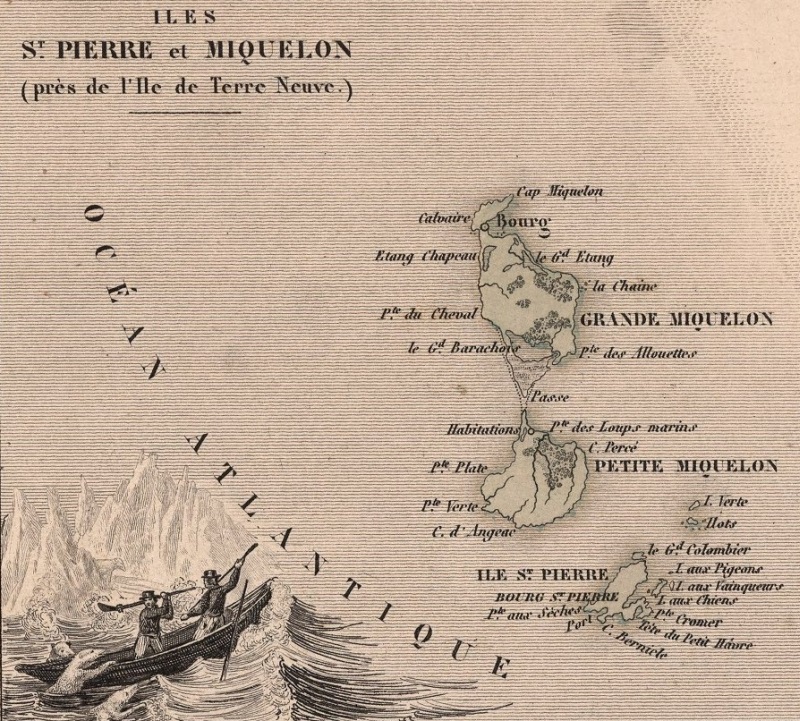
1869 map of Saint-Pierre and Miquelon. |
1870: Population: 4,750.
1870: The most trivial event being sometimes enough to pit one half of the population against the other, this is the case regarding the Clabordards and the Anti-Clabordards. Following the recent fires, clapboards (clabords) on houses were prohibited within a certain perimeter in the city centre. Some of the affected residents accepted this regulation, which provoked very strong protests from others. The Clabordards categorically refuse to comply, while the Anti-Clabordards approve the security measures of the administration. Incidents occur and arrests are made. The gendarmerie, aided by the naval forces stationed in the colony, has to intervene to forcibly remove the clapboards erected by the offenders. These events continue for some time, and the most turbulent days, during October and November 1870, are recorded in local history as the Journées des Clabords ("Clapboard Days").
1871: The first water pipes to individual homes are introduced.
Feb. 16, 1871: Prince Adalbert of Prussia, during discussions on the Franco-German peace treaty, requests the annexation of Saint-Pierre and Miquelon to Germany.
Nov. 22, 1871: A decree is issued establishing a Chamber of Commerce in Saint-Pierre.
May 13, 1872: A decree establishes municipal organization in the islands of Saint-Pierre and Miquelon.
Nov. 20, 1872: Victor Cordon is named the first mayor of Saint-Pierre.
Dec. 29, 1872: Victor Briand is named the first mayor of Miquelon.
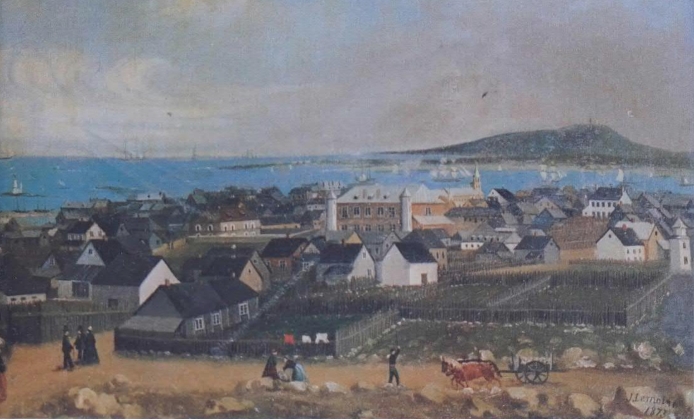
The town of Saint-Pierre in 1873 as seen by local painter Joseph Lemoine. |
Aug. 24, 1873: In the colony's greatest single disaster, 17 ships from Saint-Pierre and 2 from Miquelon are lost in a storm, with 216 lives.
May 21, 1874: The British sloop HMS Niobe shipwrecks near Cap Blanc in Miquelon. This prompts a reaction from the British Admiralty requesting the construction of a lighthouse. In 1881 France builds two iron lighthouses, one at Cap Blanc and the other on Pointe Plate, a small peninsula on the west coast of Langlade. They are put into operation on July 15, 1883.
1879: A road leading to Galantry is begun by the sailors of the state schooner Canadienne and completed by the administration.
Aug. 15-16, 1879: Another serious fire destroys 21 houses in Saint-Pierre.
1880: Population: 4,916.
Spring 1881: The colony's administration, aided by a few individuals, brings 25 pairs of rabbits from the neighbouring coast and releases them on the left bank of the Belle-Rivière on Langlade. The experiment is a complete success. The rabbits cross the isthmus and spread across the entire island in considerable numbers.
April 1882: Census population: 5,439 (Saint-Pierre 4,254; Île aux Chiens 549; Miquelon-Langlade 636).
March 13, 1884: The first election to the Superior Council of the Colonies (Conseil supérieur des colonies) is held. Louis Duluc, dit Louis Henrique, is elected.
April 2, 1885: A decree creates a General Council (Conseil général). Its 12 members are elected on July 19. On August 17 Paul Mazier is elected president.
Feb. 21, 1887: The Newfoundland legislature passes the Bait Bill, after an earlier one passed in 1886 did not receive assent; this one is sanctioned by the British government in 1888. Prohibiting the sale of bait to all foreign fishermen, this law in fact is primarily intended to deal a fatal blow to the French fisheries, because, under a special agreement between the governments of St. John's and Washington, it does not extend to U.S. fishermen. Aside from smuggling, the discovery of the whelk as a substitute bait allows the fishermen to avoid the disaster that could have awaited them.
Sept. 5, 1887: The title of governor is restored in place of commandant.
November 1887: Census population: 5,929 (Saint-Pierre 4,744; Île aux Chiens 611; Miquelon-Langlade 574).
May 14, 1888: Jacques Dupont is elected president of the General Council.
Aug. 24, 1889: Auguste Néel, sentenced to death for murder, is executed by guillotine. French law not only required this punishment, but also that the sentence be carried out in a public venue near the place where the crime was committed. A guillotine accordingly had to be shipped from Martinique. This remains the only guillotine execution in North America.
Feb. 24, 1890: Albert Calmette becomes head of the health service. While conducting studies on cod discoloration caused by a microbe, he discovers his calling: the study of microbiology. He later becomes famous as co-developer of the BCG tuberculosis vaccine.
Aug. 23, 1890: Delphino Moracchini is appointed governor but is not installed. The same goes on subsequent occasions for Alfred Martineau (Sept. 18, 1900), André Touzet (July 24, 1921), Auguste François Bonnecarrère (July 24, 1921), Auguste Eugène Ludovic Tholance (Oct. 30, 1930), Louis Bouge (Oct. 31, 1930), and Richard Brunot (Sept. 7, 1931).
November 1892: Census population: 6,247 (Saint-Pierre 5,020; Île aux Chiens 683; Miquelon-Langlade 544).
April 8, 1894: Elections are held to the General Council. On May 7 Paul Mazier is elected president.
Dec. 15 and 22, 1895: New elections are held to the General Council after a dissolution. On Jan. 6, 1896, François Le Buf is elected president.
1896: A waxed-clothing factory is established in Saint-Pierre. In 1897 a foundry begins operating; in 1898, a biscuit factory is set up to avoid duties levied on ship's biscuits imported from the United States and Canada; in 1899, a copper-paint factory (for painting ship hulls) is also established.
June 25, 1897: A decree abolishes the General Council, effective July 16, due to the small size of the colony.
November 1897: Census population: 6,352 (Saint-Pierre 5,329; Île aux Chiens 594; Miquelon-Langlade 519).
Feb. 20, 1898: Electric lighting is introduced in the town of Saint-Pierre.
June 3, 1898: A telephone cable is laid between Cap à l'Aigle and Anse à Tréhouart (Île aux Chiens).
Sept. 13, 1900: In a cyclone, 9 schooners are lost on the fishing banks, costing 120 lives.
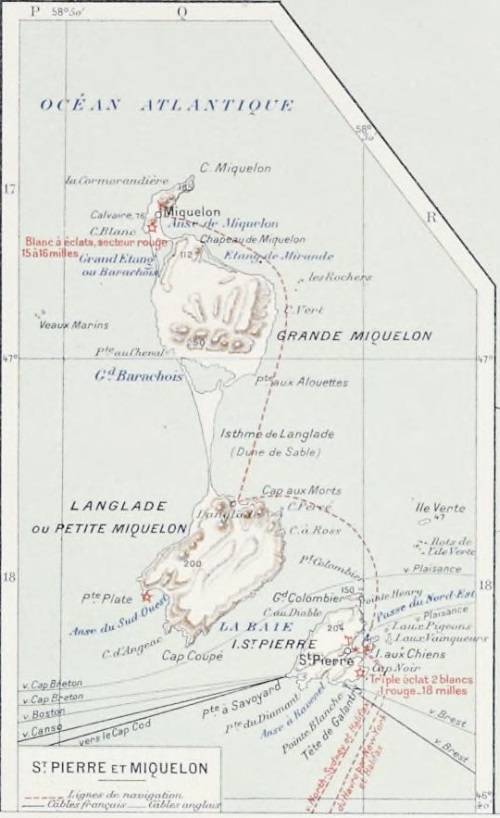
1902 map of Saint-Pierre and Miquelon. |
November 1902: Census population: 6,482 (Saint-Pierre 5,385; Île aux Chiens 543; Miquelon-Langlade 554).
Nov. 1, 1902: The wooden church in Saint-Pierre burns to the ground.
July 17, 1903: The boys' primary schools on Saint-Pierre and Île aux Chiens are secularized. The Brothers of Christian Instruction leave the islands, their departure provoking a mass demonstration at which 17 arrests are made.
October 1903: A radical weekly, Le Réveil Saint-Pierrais ("The Saint-Pierre Awakening"), is founded by Mazier, spearheading a challenge to the economic and political power of the Légasse family on Saint-Pierre. In response, Louis Légasse publishes a similar, if slightly less violent newspaper, La Vigie ("The Sentinel"). Elected by universal suffrage, Louis Légasse represents the islands on the Superior Council of the Colonies (1897-1924), while his brother Christophe Louis Légasse is apostolic prefect of the archipelago (1899-1915).
December 1903: In the election to the Superior Council of the Colonies, Légasse wins 60% of the vote, defeating Aristide Delmont, a black (Vigie posters played on the theme in showing the "cakewalk" and the Vigie election issue ran a grotesque slanderous song against Delmont). In the week before the election, Légasse was challenged to four duels over electoral insults, and he fought three of them.
April 8, 1904: France relinquishes the rights it has held over the French Shore since the Treaty of Utrecht. By this time the decline of the French fishing fleet has begun; the number of schooners equipped for the Grand Banks from Saint-Pierre falls from 207 in 1902 to 40 in 1909. The difficulty in obtaining sufficient bait, following the Bait Bill, is one of the determining causes, as well as the loss of numerous vessels due to a series of very strong gales. Added to this is the use of trawlers, whose methods are overturning the old fishing practices and delivering the final blow to the Saint-Pierre fishing fleet for offshore fishing, as shipowners in mainland France no longer need this supplementary production to ensure the supply of the French and foreign markets they control.
May 1, 1904: Municipal elections are held (contested on the question of a proposed loan to rebuild the church), leading to the election of the opposition's Gustave Daygrand as mayor of Saint-Pierre. On May 12 Dominique Borotra is elected mayor of Miquelon.
Dec. 8, 1904: Paul Cousturier arrives and takes office as governor.
March 22, 1905: The Légasse family founds La Morue Française ("French Cod"), a company that comes to control the cod-fishing industry, not only throughout the archipelago, but also in the major metropolitan naval ports. The company supports the church, while the French administration, in the period 1907-23, is opposed to Légasse and the administrators tend towards anti-clericalism.
April 2, 1905: The governor having dissolved the Municipal Council, new elections are held and a slate endorsed by the Légasse brothers is decisively elected. On April 8 Jean François Pompei is elected mayor of Saint-Pierre.
Jan. 13, 1906: Governor Gabriel Angoulvant receives a coded telegram ordering him to proceed with the secularization of the girls' primary schools on Saint-Pierre and Île aux Chiens. The contents of the telegram, although in code, are soon common knowledge, and demonstrators mass in front of the governor's residence. The crowd then moves to the house of Samuel Lagrosillière, the most resented anti-cleric on the island, break into his store and ransack it, and, after he escaped up onto his roof, throw snowballs at him until the suggestion is made that the house be burned down. This is narrowly prevented by the arrival of Mayor Pompei who sends for the police. However, Lagrosillière thereafter has to be guarded day and night by his friends until he clandestinely embarks for Bermuda on an English boat, never to return. Two days after the demonstration, the governor decrees the secularization of the nuns' schools, effective in September.
Dec. 30, 1906: Légasse wins a bitterly fought election for the seat on the Superior Council of the Colonies. After his victory, the houses of opposition leaders are stoned, demonstrators burn the Réveil editor in effigy, and the clergy and schoolchildren lead parades through the streets in celebration.
June 22, 1907: Louis Légasse is elected mayor of Miquelon. He is reelected in 1908 and 1912.
November 1907: Census population: 4,768 (Saint-Pierre 3,753; Île aux Chiens 510; Miquelon-Langlade 505), a major decrease due to emigration.
March 18, 1909: Pierre Poirier is elected mayor of Île aux Chiens.
March 1911: Census population: 4,209 (Saint-Pierre 3,403; Île aux Chiens 363; Miquelon-Langlade 493).
1915: The last schooner belonging to La Morue Française, named Périclès, is commissioned.
Feb. 3, 1915: The men of the archipelago leave for Europe on the transatlantic liner Chicago to fight in World War I. On February 26 the first Saint-Pierre native, Léon Leborgne, falls in Champagne. In total about 100 islanders die in the war.
December 1919: In municipal elections, the list headed by François Planté, representing civil servants and fishermen, defeats the joint slate of pro- and anti-Légasse businessmen.
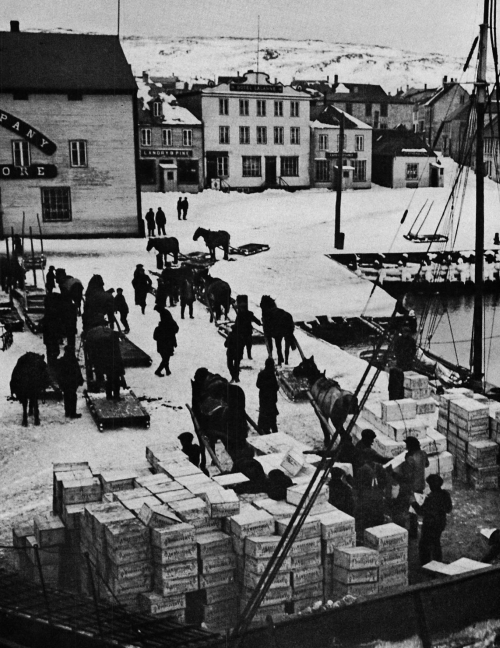
Cases of Scotch stack the quay at Saint-Pierre during the Prohibition era. Horse-drawn sledges haul the liquor to a complex of warehouses that sprang up as Saint-Pierre became one of the great transshipping depots for European distilleries. |
1920-33: Smuggling, known locally as fraude, experiences its most flourishing years when the Prohibition regime is in effect in the United States, creating a great though fleeting prosperity for the territory, remembered as "the time of whisky." Smugglers in speedy powerboats whisk the contraband to conspirators waiting on U.S. and Canadian beaches. On several occasions, notably in July 1927, an entire fleet of U.S. customs cutters come to patrol the immediate approaches to Saint-Pierre. Other than in this period, cod-fishing has been the sole livelihood of the colony.
1921: Census population: 3,918 (Saint-Pierre with Île aux Chiens 3,419; Miquelon-Langlade 499).
1923: For the first time in the century, the administration is able to balance its budget without aid from France.
Dec. 8, 1923: A wireless telephone service is inaugurated between Saint-Pierre and Île aux Chiens.
1924: A suggestion is made envisaging the transfer of part of the population to the Kerguelen Islands, where they would be employed in seal hunting.
1924: Légasse is finally defeated in elections for delegate to the Superior Council of the Colonies. Soon afterward his nephew, Jean Légasse, comes to take over the Saint-Pierre office of the company. He writes to his uncle recommending that the company cease its involvement in local politics.
1926: Census population: 4,030.
1928: Major harbour works are undertaken and entrusted to a Canadian firm, which completes them in 1933. Previously it often happened, during strong gales, that schooners, breaking their moorings, would collide with each other and eventually run aground at the bottom of the harbour.
Feb. 27, 1928: Adrien Juvanon arrives as governor.
Feb. 14, 1929: Governor Juvanon departs on convalescent leave (from which he does not return, being appointed to other posts) and Henri Sautot becomes interim governor.
June 10, 1930: Former mayor of Île aux Chiens (1909-20) Pierre Poirier dies.
May 2, 1931: The name of the Île aux Chiens ("Island of Dogs," probably referring to dogfish), with its negative connotation, is changed at the initiative of Father Yves Lavolé (the island's curé in 1915-28), though not to the name Île Notre-Dame des Marins as the priest wished but to the simple Île aux Marins ("Island of Sailors"). In 1920-21 the municipal council already proposed to rename the island Île de France, but the ministry rejected it as possibly confusing, this being also the name for the region around Paris besides being the former name of Mauritius.
July 1931: Census population: 4,321 (Saint-Pierre 3,464; Île aux Marins 279; Miquelon-Langlade 578).
Feb. 21, 1932: A radio station is inaugurated.
Dec. 10, 1932: A fishermen's union, the Syndicat des Petits Pêcheurs de Saint-Pierre et de l'Île aux Marins, is founded, headed until 1973 by Pierre Frioult.
Feb. 20, 1933: Georges Barrillot arrives as administrator, as the governor's title has been changed. To compensate for the drastic decline in customs revenue, he makes cuts in government expenditures during the spring, and even decreases the salaries of all civil servants.
Aug. 21, 1933: Four days after the presentation of the budget, about 200 demonstrators meet at the town hall and go to demonstrate in front of the administration building, several calling out threats to Barrillot to make certain officials leave or "we will make them leave by force, and you along with them." The next morning one of the named officials, the public prosecutor, imprisons four men who are out on parole and played an active part in the demonstrations. There are new demonstrations against these arrests, and some 250 persons make their way to the prison, batter down the doors, and free the prisoners. The administrator calls for reinforcements, and on August 24 the warship D'Entrecasteaux arrives. For fear of violence, the marines are not allowed off the ship. But when threatening protests again occur on August 26 the reinforcements are landed, the protesters cleared away, and on August 30 and 31 trials are held under guard of troops.
1934: An inspector from France, Louis Mérat, arrives to assess the situation. He finds that the island cannot support all its citizens (given the poor fishing seasons of recent years, compounded by unemployment resulting from the abrupt halt in alcohol traffic) and that certain persons are stirring up the population. Part of his solution is selective emigration. Some who have been prominent in anti-government actions are induced to emigrate to France and are offered free passage. Many of the 150 Newfoundlanders who came to the island to work at the height of the Prohibition prosperity are sent back. Altogether 100-200 people leave in one way or another. But there is no larger-scale emigration since Canada and the United States have tightened immigration requirements. There is talk of sending those who wish to settle in Morocco, but the project is abandoned.
1936: Exports in the year total 38,679,000 francs, imports 13,683,000, against 51,351,000 and 27,995,000 francs respectively in 1935. From 1925 to 1933, the lowest total volume of external trade was 237,004,943 francs (1925), the highest 680,196,637 (1930).
June 4, 1936: A complete administrative reorganization of the islands takes place for the purpose of economy, and the three municipalities of Saint-Pierre, Île aux Marins, and Miquelon-Langlade are dissolved. The colony receives the official name Territoire des Îles Saint-Pierre et Miquelon. A Conseil d'administration is appointed to serve alongside the administrator.
July 1936: Census population: 4,175 (Saint-Pierre 3,396; Île aux Marins 259; Miquelon-Langlade 520).
Early 1937: The new administrator, Gilbert de Bournat (who arrived January 27), requests labour in exchange for unemployment benefits. This way the road to Pointe Plate is built.
1938: Exports show a marked improvement, but in spite of efforts since 1935 to better the economic condition, through loans to shipping interests, there are still heavy annual deficits.
Night of June 18-19, 1939: A fire started accidentally at the Jacques-Cartier cinema spreads immediately, thanks to a strong northwest wind, to neighbouring buildings, 16 of which are destroyed near the port. Subsequently a regulation requires residents of the affected neighbourhood to apply bricks or cement plaster to the exterior of any wooden buildings they are about to rebuild and, once again, to refrain from using clapboards.
Nov. 29, 1939: A telephone line linking Saint-Pierre and Île aux Marins is inaugurated.
1940: Already in the vortex of economic depression, the islands are subjected to a Canadian semi-blockade similar to Martinique's.
Sept. 8, 1940: A Gaullist demonstration of 400-500 persons takes place.
October 1940: A group of veterans unsuccessfully attempts to organize a plebiscite so that the population could choose between Charles de Gaulle and Philippe Pétain.
Nov. 11, 1940: The Free French flag with the Cross of Lorraine is raised for the first time in the window of a building in Saint-Pierre.
January 1941: De Bournat declares support for Pétain's Vichy regime and sanctions the Gaullists.
Dec. 24, 1941: Vice-Adm. Émile Muselier, Free French national commissioner of marine and head of the Free French navy, lands from Free French naval vessels (the corvettes Mimosa, Alysse, and Aconit, as well as the submarine Surcouf) on the islands, acting on instructions from the Free French National Committee in London. He receives an enthusiastic welcome from the inhabitants and his first steps are to dismiss de Bournat (appointing Alain Savary in his place, effective December 27) and to close the wireless station, which formerly emitted meteorological reports likely to be of assistance to the enemy. On December 25 Admiral Muselier organizes a plebiscite among the 5,000 inhabitants of the islands, which results in an overwhelming majority - 783 to 15 (though with 242 abstentions or invalid votes; if these are considered, the affirmative percentage drops from 98, the figure widely reported, to 75) - in favour of Free France as opposed to "collaboration with the Axis powers." (The abstentions are explained by Vichyards who did not believe Pétain was collaborating with the Axis.) On December 26 the U.S. State Department issues a communiqué declaring the Free French action to be "contrary to the agreement between all parties interested" and "committed without the knowledge or consent of the U.S. government"; it is stated that the U.S. approached the Canadian government asking the latter what measures it proposed to take to establish the status quo in the islands. It is stated in Ottawa that the Canadian government had no knowledge of the intentions of the Free French forces prior to the occupation of the islands. No official comment is published in London, though surprise is expressed at the Free French action.
Dec. 29, 1941: The apostolic prefect, Alfonso Poisson, posts a notice on the door of the church saying that he does not recognize the new administration.
Jan. 12, 1942: All importation of arms and ammunition at Saint-Pierre and Miquelon is forbidden.
Feb. 8, 1942: Five men from Saint-Pierre die on the corvette Alysse, torpedoed by the Germans.
June 8-9, 1942: 17 more men from Saint-Pierre perish with Commander Roger Birot and his crew in the torpedoing of the Mimosa. When some Pétainist women make unpatriotic statements (e.g., "If the ships hadn't come to Saint-Pierre all of those young men wouldn't have died"), Gaullist indignation reaches a peak and mobs do 80,000 francs worth of damage to Pétainist stores and houses. Although a detailed hearing is held to
discover the identity of the culprits, no action is taken.
1943: An airfield is being constructed, the Free French administration having abandoned the road-building scheme that was tainted with de Bournat's unpopularity.
1943: A Council of Fisheries is established, replacing a former consultative commission set up in 1930.
Feb. 25, 1943: Pierre Garrouste is appointed administrator. He takes office May 14.
April 29, 1943: Prohibition of the export of postage stamps is ordered.
Dec. 2, 1943: Two Resistance fighters executed in France are Max Leban, from Saint-Pierre, and Léon Humbert, from a Saint-Pierre family.
Jan. 10, 1944: 119 conscripts depart on the Lady Rodney despite earlier protests against the general mobilization. Some join the 2nd Armoured Division of Gen. Philippe Leclerc which participates in the liberation of Paris. A total of 27 residents of the territory die in World War II.
May 1945: Census population: 4,354 (Saint-Pierre 3,804; Miquelon 550).
Nov. 4, 1945: In elections to the Constituent National Assembly, Henri Debidour wins 1,058 votes, Dominique Laurelli 641, and Henri Claireaux 466.
Nov. 13, 1945: The municipalities are reestablished, but Île aux Marins becomes part of Saint-Pierre.
Dec. 2, 1945: The Gaullist list of Georges Daguerre is elected in municipal elections. Daguerre is elected mayor of Saint-Pierre on December 20.
Dec. 25, 1945: A decree assigns the territory's currency the same relation with the French franc as the new CFA (Colonies françaises d'Afrique, from 1958 Communauté française d'Afrique, from 1962 Communauté financière africaine) franc (100 CFA francs = 170 [from 1948 200] French francs).
June 2, 1946: In elections to the Constituent National Assembly, Debidour wins with 1,064 votes, against 1,059 for Laurelli.
Sept. 25, 1946: The new administrator, René Marchand, arrives, taking office October 3.
Oct. 25, 1946: A decree provides for the reestablishment of the General Council.
Oct. 27, 1946: The islands become a French overseas territory.
Nov. 10, 1946: In National Assembly elections (the first under the Fourth Republic constitution), Laurelli wins 1,159 votes against 1,116 for Debidour.
Dec. 15 and 29, 1946: Elections are held to the General Council. A list organized by Henri Claireaux, consisting of moderate Gaullists and former Pétainists, wins a bare majority over the staunch Gaullist ticket. On Jan. 12, 1947, Henri Dagort is elected president.
1947: The islands continue an uneventful readjustment to postwar conditions and place chief emphasis upon the further development of the fishing industry and processing of fish products.
Jan. 12, 1947: Claireaux is elected (indirectly) to the Council of the Republic (11 of 11 votes).
Sept. 27, 1947: In National Assembly elections, Laurelli (who has Claireaux's support) wins 1,149 votes and former administrator Savary (running on the solicitation of the Gaullists, with whom he has retained an enthusiastic following) 1,127.
March 18, 1948: The new administrator, Jean Moisset, arrives, taking office March 21.
June 8, 1948: An airplane (a DC-3) lands for the first time in Saint-Pierre.
Dec. 19, 1948: Claireaux is reelected to the Council of the Republic (whose members are now called senators), winning 10 of 13 votes, against 3 for Joseph Amestoy.
1949: The cod fishing, the territory's only source of wealth, is poor this year (903 metric tons compared with 1,023 tons in 1948, which was already a bad year). The greater part of the catch is exported to the West Indies.
1950s: The port of Saint-Pierre experiences a resurgence of activity thanks to trawlers of various nationalities, primarily Spanish (working in pairs, called "les bœufs"), that call at the island.
1950: In spite of opposition by the small-boat owners, the territory purchases a trawler in experimental preparation for deep-sea fishing, which, with the inception of a cold-storage warehouse, is likely to revolutionize the local economy. From the time of the first trawl the development company unloads by the end of the year 320 metric tons of codfish worth 6,000,000 CFA francs.
Dec. 20, 1950: An electric generating station begins operating at Saint-Pierre.
Dec. 27, 1950: Former mayor of Miquelon (1904-07, 1920-24) Dominique Borotra (b. July 17, 1874, Miquelon) dies.
1951: A new local fishing company, Société de Pêche et de Congélation (SPEC), is established with state aid in Saint-Pierre. It owns several trawlers and a cold-storage facility, providing employment. The fishing industry has in fact declined in importance: 400 of the 5,000 inhabitants are fishermen, and there are 200 boats. Silver-fox breeding goes on, though the animals' food, which has to be imported from the mainland, is expensive; the annual output is 2,000 skins. It is suggested that the more lucrative mink could be acclimatized.
1951: A geological map is drawn up.
1951: Census population: 4,606.
June 17, 1951: In National Assembly elections, Savary (belonging to the Socialist Party, but supported by Claireaux of the Mouvement Républicain Populaire) wins 1,305 votes, Laurelli 932, and Pierre Merli 105.
1952: Progress is made on the fur farms. A seal-hunting company is founded.
1952: A specialist in lung surgery is put in charge of the campaign against tuberculosis.
1952: As a result of regular services by sea to and from Newfoundland, about 1,000 tourists are able to visit the islands.
Jan. 27 and Feb. 10, 1952: Elections are held to the General Council. On February 15 Alfred Léon Briand is elected president.
May 4, 1952: In municipal elections, the list of Mayor Georges Daguerre is reelected in its entirety.
May 18, 1952: Claireaux is reelected to the Council of the Republic (11 of 11 votes).
1953: Conscription is introduced into the territory.
Aug. 10, 1953: During the first year of its operation, the cold-storage plant has processed about 1,100 metric tons of frozen fish (filleted).
1954: The budget is balanced at 293,000,000 CFA francs, including a grant of 200,000,000 CFA francs from the French treasury. In addition, during the year France accords to the territory a subvention of 120,000,000 CFA francs to cover certain extraordinary expenditure. As the administrator proposes to increase local taxation, 7 general councillors and 13 municipal councillors resign in protest. All but three general councillors are reelected.
December 1954: The French National Assembly votes a special grant of 560,000,000 francs for the year 1955. There is some opposition to this, and one deputy points out that in fact France has to pay a yearly subvention of 130,000 francs to every inhabitant of the territory.
Dec. 13, 1954: Mayor Daguerre dies.
1955: The budget is balanced at 303,000,000 CFA francs (1 CFA franc = 2 metropolitan francs), including a grant of 190,000,000 CFA francs paid by the French government.
Jan. 13, 1955: Administrator Irénée Davier departs. His successor is Pierre Sicaud, who during the year decides that the islands' fishing fleet shall be increased by two trawlers.
Jan. 23, 1955: Joseph Lehuenen is elected mayor of Saint-Pierre for the first time.
October 1955: Sicaud pays an official visit to Newfoundland.
Jan. 2, 1956: In National Assembly elections Savary is reelected with 1,135 votes, against 1,126 for Laurelli.
Oct. 28 and Nov. 11, 1956: Elections are held to the General Council. On November 15 Claireaux is elected president.
1957: Restrictions on foreign imports cause difficulties for the local economy.
1957: Census population: 4,822.
Sept. 19, 1957: The archipelago is visited by Vincent Massey, the governor general of Canada, who sees the fishing installations of Saint-Pierre and the breeding of American mink at Miquelon. The visit is a display of friendship between France and Canada.
Dec. 6, 1957: There is a major strike by public-works employees. In the evening, a crowd estimated at over 600 people goes to Sicaud's residence, demanding his presence on the balcony and shouting hostile cries. The governor yields to the pressure of the crowd and grants the workers 75 francs an hour, whereas they only demanded 65 francs in the morning.
1958: The return of de Gaulle to power in France confuses the persisting wartime political alignments on the islands, for Gaullism now represents the doctrine of order, with none of the appeal it had for the down-and-out in 1941. Many old Pétainists now support de Gaulle while most of the workers oppose him.
June 8, 1958: Claireaux is reelected to the Council of the Republic (11 of 11 votes).
Sept. 28, 1958: Despite the opposition of Deputy Savary, the referendum on the new French constitution records 2,325 "yeses" (98.1%) against 46 "noes."
1959: A direct telephone line with France is opened.
March 8, 1959: At the municipal elections, the outgoing councillors are reelected at Saint-Pierre and the single list at Miquelon.
April 26, 1959: Claireaux is elected to the Senate (which has replaced the Council of the Republic under the Fifth Republic constitution).
May 10, 1959: Laurelli, Gaullist (Union pour la Nouvelle République), is elected to the National Assembly with 1,145 votes, against 968 for Claude Guy and 376 for Edgard Tupët-Thomé.
1960: The main local problems are those of full employment and population, which can be resolved only by greater development of maritime resources. The economy of the islands is largely dependent on the dollar zone for its trade.
February 1960: The General Council is dissolved by the French government after the resignation of 12 councillors on January 3 in protest against the $40,000 cut in the islands' subsidies effective January 1.
April 10 and 24, 1960: In elections to the General Council, the political group led by Claireaux wins 13 out of 14 seats. On April 25 he is reelected president.
1961: Some discontent develops in the territory when it is learned that plans for expanding the port at Saint-Pierre cannot be realized as the documents relating to the financing of this operation are not available. Furthermore, a plan to set up a transmitting station to advertise certain well-known French products on the American continent proves short-lived.
July 31, 1961: The French government decides to remove Saint-Pierre and Miquelon from the list of overseas territories exempted from military service in peacetime. On November 17 the General Council, Municipal Council, and Chamber of Commerce unanimously resign in protest.
1962: The European Economic Community (EEC) grants the territory a loan of NF17,500,000 to be used in modernization works at the port of Saint-Pierre.
1962: A summer school is established in Saint-Pierre by the University of Toronto for the French language.
Jan. 28, 1962: One of SPEC's trawlers, the Ravenel, with 15 sailors on board, is lost without a trace. (The wreck is finally found May 28, 2025.)
April 20, 1962: Census population: 5,025, a 4.1% increase over 1957. The population of Saint-Pierre is 4,287.
Oct. 28, 1962: In the referendum on electing the president of the republic by universal suffrage, 2,108 vote yes, 187 no.
Nov. 18, 1962: Albert Briand is elected to the National Assembly, winning 962 votes against 792 for Auguste Maufroy (Claireaux's candidate) and 627 for Laurelli.
1963: The primary school and post office on the Île aux Marins close as it has become nearly uninhabited.
September 1963: The Société des Batignolles of France begins work on the port expansion project, employing 100-150 Saint-Pierrais. It is completed in 1966.
1964: A modest airstrip is completed on Miquelon.
March 6, 1964: The airline Air Saint-Pierre is created by Briand.
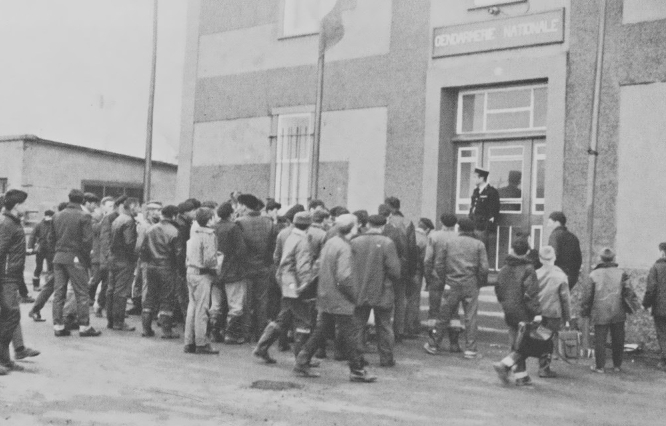
Saint-Pierrais seek the director of public works at the police station early on May 20, 1964. Many more come to find him there later. |
Early May 1964: Construction workers hold a demonstration in front of the government building with signs reading "Poverty Wage" and "Sixty cents, c'est une insulte." Another strike is held on May 19 with talk of making Charles Grad, the director of public works, leave Saint-Pierre. On May 20 the strikers sound the fire siren on the public school, immediately drawing out the bulk of the population. The workers start for the main square, then go looking for Grad - first to the government building, then to the police station, then to the church, then to Grad's house, and finally back to the police station, where they find him. Without allowing him to get his bags or say goodbye to his family, they walk him to the dock and send him off on a boat. (Like de Bournat in 1942, he receives a promotion on arrival in France.)
June 4, 1964: Deputy Briand resigns.
Aug. 30, 1964: Briand is reelected deputy with 1,246 votes, against 793 for Georges Blin and 248 for Francis Leroux. Briand thus demonstrates that the population does not support the General Council.
Aug. 31, 1964: Claireaux resigns as president of the General Council with 12 of his colleagues. Only one, Maufroy, remains, but only for a few days before Louis Jacquinot, minister for overseas départements and territories, dissolves the council.
Sept. 21, 1964: The opening of a high school allows students to continue their studies up to the baccalauréat.
Nov. 8 and 11, 1964: Elections are held to the General Council. On November 26 Briand is elected president.
Mid-1960s: As the local fishery is handicapped by dated technology and methods, aging processing facilities, and declining stocks, the French subvention to the islands covers half the budget, and contributes to the reputation of the Saint-Pierrais as the world's "most expensive Frenchman."
Jan. 29, 1965: The Île aux Marins becomes officially uninhabited, the last resident moving to adjacent Saint-Pierre. Some, however, maintain summer homes on the smaller island.
April 13, 1965: The members of the General Council (except Maufroy) resign again as a crisis erupts following a simmering dispute, ostensibly over minimum-wage levels, but actually involving a bitter power struggle between two brothers-in-law, Senator Claireaux and Deputy Briand, for political leadership of the territory. The situation appears so serious that, at the request of the frightened administrator (Jacques Herry), Paris rushes a force of 132 gardes mobiles, complete with jeeps, gas-masks, and automatic weapons, to Saint-Pierre on April 25. The population resents this invasion so deeply that they stage an impressive general strike on April 26-27 to back up their demand for the withdrawal of the troops and the recall of the administrator.
May 2, 1965: In municipal elections, the list of Mayor Lehuenen is reelected except for one candidate. Lehuenen obtains 1,534 votes, a figure rarely attained in municipal elections. He is reelected mayor on May 17.
Aug. 8, 1965: The members of the General Council are swept back into office with a firm popular mandate to purge the administration of expatriates who, like the administrator, are allegedly "unqualified." Fortunately for the administrator, his term of office expires shortly afterwards, enabling him to retire with some semblance of dignity. On October 31 Briand is reelected president of the council.
Feb. 24, 1966: Paul Lebailly is elected president of the General Council, replacing Briand (resigned).
May 29, 1966: Deputy Briand dies.
1967: Television arrives in the islands.
March 5 and 12, 1967: Jacques Philippe Vendroux is elected deputy, winning 1,170 votes in the first round against 741 for Albert Pen and 451 for Henri Le Besnerais, then receiving 1,328 votes in the second round as the only candidate. He is a nephew of the wife of French president Charles de Gaulle.
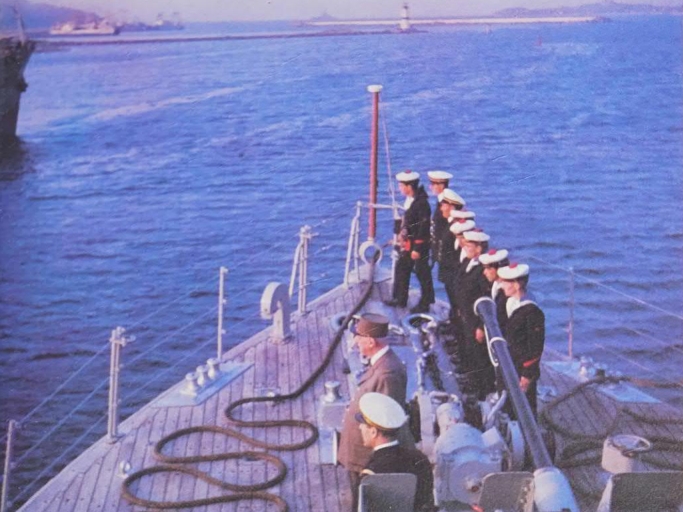
French president Charles de Gaulle aboard the Arcturus, visiting Saint-Pierre and Miquelon, July 20, 1967. |
July 20, 1967: French president Charles de Gaulle visits the islands.
June 23, 1968: Vendroux is reelected deputy unopposed.
Sept. 22, 1968: In senatorial elections, Albert Pen is elected with 12 votes against 7 for Paul Lebailly and 4 for Henri Claireaux.
Sept. 26, 1968: Albert Pen is elected president of the General Council, following the resignation of Lebailly (who dies December 18).
March 16, 1969: Richard Briand is elected to the General Council with 941 votes against 480 for Georges Lahiton.
June 1, 1969: In the French presidential elections, Saint-Pierre and Miquelon votes as follows: Georges Pompidou 1,585; Alain Poher 326; Alain Krivine 49; Jacques Duclos 39; Michel Rocard 25; Louis Ducatel 27; Gaston Defferre 23. In the second round on June 15 the vote is Pompidou 1,714 and Poher 362.
Aug. 30, 1970: Elections are held to the General Council. The list of Senator Pen wins against that of Deputy Vendroux. On October 20 Pen is reelected president.
Nov. 16, 1970: The Catholic prefecture apostolic of Saint-Pierre and Miquelon is elevated to a vicariate apostolic.
May 2, 1971: The list of Senator Pen wins municipal elections. On May 7 Pen is elected mayor of Saint-Pierre.
March 27, 1972: Canada and France delimit the maritime boundary between Newfoundland and Saint-Pierre and Miquelon, leaving open a dispute about the extent of the two countries' economic exclusion zones.
Jan. 1, 1973: The metropolitan franc is introduced again instead of the CFA franc.
Jan. 23, 1973: A cultural and sports centre opens in Saint-Pierre.
March 4, 1973: Frédéric Gabriel (apparenté Independent Republican) is elected deputy with 1,222 votes against 952 for former administrator Georges Poulet.
October 1973: Legislation to elevate the territory to the status of an overseas département is proposed by the French government.
May 19, 1974: In the presidential runoff, Valéry Giscard d'Estaing wins 1,972 votes, François Mitterrand 660.
Jan. 25, 1975: A crisis develops when the entire 14-member General Council resigns in support of demands for increased metropolitan aid for the islands and for the recall of Administrator Jean Cluchard. Civil servants in the islands went on strike on January 6, claiming that they had received no salary increase for four years, and subsequently political and trade union leaders threatened to call a general strike. The situation is exacerbated when, on February 2, a French warship arrives at the port of Saint-Pierre bringing a detachment of 65 mobile police from metropolitan France at the request of Cluchard to reinforce the local authorities in maintaining law and order. On February 6 some 2,000 of the islands' 5,000 inhabitants demonstrate against this move, and the withdrawal of the new force is added to the list of the islanders' demands. The secretary of state for overseas départements and territories, Olivier Stirn, responds by calling a conference of the islands' leaders in Paris to discuss the future of the territory. He also, on February 12, summons Cluchard to Paris for consultations, a move which is interpreted in Saint-Pierre as a "disguised recall." The conference opens in Paris on February 18, the principal participants being, in addition to Stirn and Cluchard, Senator Pen and Deputy Gabriel and Georges Poulet, the territory's representative on the national Economic and Social Council. After an initial deadlock, the conference concludes successfully on February 24 with the islanders accepting that Cluchard shall remain provided he takes a more moderate line and refrains from imparting his views to the population on radio and television. It is also agreed that, in return for the calling-off of the threatened general strike, the detachment of special police will be withdrawn. In addition, Stirn announces that the Saint-Pierre airport runway will be lengthened to accommodate jet aircraft and that a second quarantine yard for cattle in transit to the United States will be opened, which will double the territory's income from this source. On the basis of the agreements reached in Paris the General Council withdraws its resignation.
April 30, 1975: Jean Massendès is appointed as administrator.
Sept. 21 and Oct. 5, 1975: Elections are held to the General Council. The list of Senator-Mayor Pen wins 13 of 14 seats, defeating that of Georges Poulet. On October 17 Pen is reelected president.
Sept. 23, 1975: The mayor of Miquelon since 1962, Guy Cormier, resigns. On November 10 Yvon Detcheverry is elected mayor.
Oct. 21, 1975: Following consultations between the French government and the elected representatives of the the islands, Stirn announces on his arrival on a visit to the territory that the French government has decided to change the territory's status to that of an overseas département. This decision is confirmed on December 8 during talks in Paris between President Giscard d'Estaing and Gabriel, Pen, and Poulet.
March 7, 1976: The mayors of the two municipalities organize an unofficial popular consultation on the question of departmentalization. Three options are offered: "Yes," "Yes under duress," and "No." The ironical middle option (recommended by the Socialists) wins with 62.6%, while 28.9% vote "no" and 8.5% "yes." Turnout is 41% in Saint-Pierre and 45% in Miquelon. Gabriel opposed the referendum as "illegal" and favours the holding of a new referendum by the government. The Socialists wanted to make acceptance of full departmental status dependent on the fulfillment of certain conditions (including measures to halt rises in prices and improved facilities, e.g. a longer landing strip for aircraft, as originally promised by Stirn in February 1975). In addition, it was feared that departmental status would involve an automatic 20% surcharge on imports from any country, in particular Canada, outside the European Economic Community.
April 28, 1976: The French government approves bills granting the new status, with transitional provisions for the next two years, during which its existing General Council will gradually assume new duties and metropolitan legislation can be applied to the new département by ordinance, and under which the new département will continue to be represented in the French parliament by one senator and one deputy. The final details of the new status, as embodied in a text approved by a joint commission (composed of representatives of the territory's authorities and the French Secretariat of State), are, after approval by the National Assembly, finally adopted by the Senate on July 9.
July 19, 1976: The islands become an overseas département, on a presumed par with the départements of metropolitan France. The last administrator, Jean Massendès, becomes the first prefect on August 4. The departmentalization proves unpopular with many of the islanders, since it incorporates the territory's economy into that of the EEC, and is regarded as failing to take into account the islands' isolation and dependence on Canada for supplies and transport links.
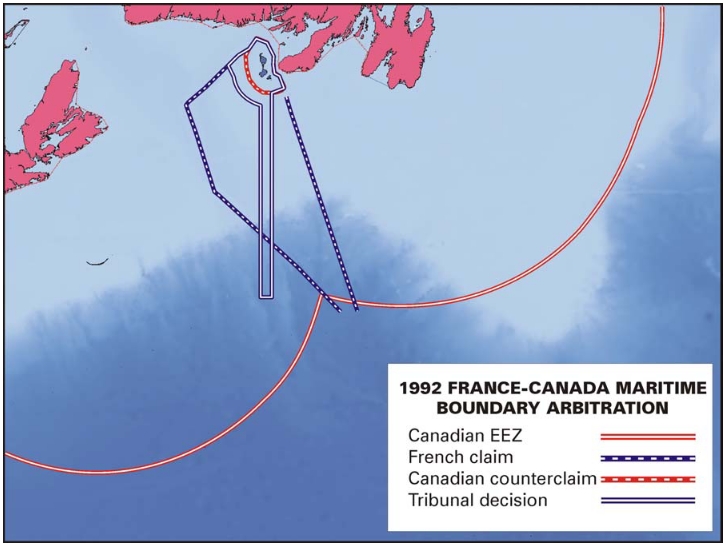
Nov. 1, 1976: Canada imposes an economic interest zone extending to 200 nautical miles (370 km) around its shores, effective Jan. 1, 1977. Fearing the loss of traditional fishing areas and thus the loss of the livelihood of the fishermen of Saint-Pierre, the French government (by a decree of Feb. 25, 1977) claims a similar zone around the islands. Hopes of discovering valuable reserves of petroleum and natural gas in the area heighten the tension between France and Canada. French boats from Saint-Pierre and Miquelon are being permitted by Canada to continue their traditional fishing operations until the two governments conclude a permanent agreement.
March 13, 1977: In municipal elections, the list of Senator-Mayor Pen is unopposed. He is reelected mayor on March 18.
May 21, 1977: Prefect Massendès departs. On June 3 the new prefect, Pierre Eydoux, arrives.
Sept. 25, 1977: Pen is reelected senator (30 of 32 votes).
March 12, 1978: In the first round of National Assembly elections, Marc Plantegenest wins 1,467 votes, Jean-Jacques Blanco-Carlotti 496, Paul Audouze 444, Hubert Germain 345, Andrée Olano 189, and Marcel Bossé 102. In the second round on March 19, Plantegenest is elected with 1,650 votes against 1,532 for Blanco-Carlotti.
June 13, 1978: A general strike is called to protest against economic hardship and neglect by the French government.
July 2, 1978: Mayor Detcheverry of Miquelon organizes a referendum about the eventual creation of a national park on the island. 307 vote in favour, 16 against.
Sept. 7, 1978: Former Miquelon mayor (1945-62) Clément Poirier dies.
Sept. 26, 1979: Prefect Eydoux departs. The new prefect, Clément Bouhin, arrives October 12.
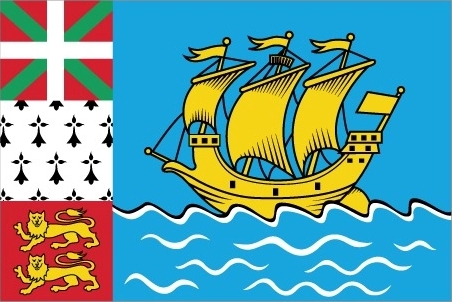
Early 1980s: An unofficial flag comes into use. It shows a yellow sailing ship, while on the hoist side a vertical band is divided into three parts, from top to bottom showing heraldic arms from the Basque Country, Brittany, and Normandy.
1980: An agreement between Canada and Saint-Pierre and Miquelon for delimitation of an exclusive economic zone is in the course of negotiation during the year.
March 12-22, 1980: A general strike paralyzes the islands, with gendarmes being flown in to aid the local police.
July 1980: On an official visit to Saint-Pierre, Paul Dijoud, French secretary of state for overseas départements and territories, emphasizes that the status of the archipelago as a département of France is irreversible but capable of modification.
July 1980: A proposed law prolongs by 18 months the term of office of the general councillors of the archipelago in order to bring the dates of renewal of the General Council into line with those in force in the National Assembly in Paris.
May 10, 1981: Saint-Pierre and Miquelon supports French president Giscard d'Estaing in his unsuccessful bid for reelection; he receives 2,039 votes against 896 for Mitterrand in the second round (turnout 78.4%).
June 14, 1981: In the first round of elections to the National Assembly (turnout 71.0%), Pen receives 1,025 votes, Blanco-Carlotti 830, Gérard Grignon 400, Victor Reux 199, Julien Lepers 181. In the second round on June 21 (turnout 78.6%), Pen is elected with 1,759 votes, against 1,151 for Blanco-Carlotti.
July 11, 1981: Prefect Bouhin departs. On August 31 the new prefect, Claude Guyon, arrives.
Sept. 20, 1981: Plantegenest is elected unopposed to succeed Pen as senator, the two having thus exchanged positions.
November 1981: There is a strike by civil servants.
March 2, 1982: A law of this date (Journal Officiel, March 3) provides for the departmental prefects' executive prerogatives to be transferred to the presidents of the General Council, effective after the next elections.
March 14, 1982: Socialist and other left-wing candidates, campaigning for a change in the islands' status, are elected unopposed to all 14 seats in the General Council. On March 24 Pen is reelected president unopposed. Thereafter Pen and his fellow councillors exert strong pressure on the metropolitan government in favour of a reversion to territorial status.
March 23, 1982: Prefect Guyon departs. The new prefect, Philippe Parant, arrives April 16. (On May 11 the title of prefect is changed in all départements to commissioner of the republic.)
April 21, 1982: Prime Minister Pierre Mauroy visits the territory, the first visit by a French prime minister under the Fifth Republic. Pen states publicly that the General Council is seeking, on the basis of the islands' specific character, "a supple territorial status." He says that such a status should "preserve for the representative of the state the role of arbiter as well as the function of local executive" but should also give to the General Council "full initiative in its deliberations together with enhanced control over their execution." In connection with the unresolved issue of the delimitation of economic zones in the Gulf of St. Lawrence, Pen urges Mauroy to show greater firmness in negotiations with the Canadian government to secure acceptance from the latter of the historic rights of French fishermen in the area; he also calls for a permanent French naval presence in Saint-Pierre and Miquelon. The prime minister responds by assuring the local representatives that the government intends to be firm in its contacts with Ottawa; at the same time he expresses his conviction that "our Canadian friends will show an imaginative approach in the search for joint solutions" to outstanding issues, possibly on the basis of a Franco-Canadian association to exploit the resources of the area jointly.
Late 1982: In bringing forward its decentralization legislation for the other four overseas départements, the French government responds to the pressure by accepting in principle the case for a change in the status of Saint-Pierre and Miquelon.
March 6, 1983: In municipal elections in Saint-Pierre, the list of Mayor Pen wins 23 seats, that of Victor Reux 3, and that of Georges Poulet 3.
May 9, 1983: Commissioner Parant departs. The new commissioner of the republic, Gérard Lefebvre, arrives June 25.
Oct. 4, 1984: Plantegenest is elected president of the General Council following the resignation of Pen.
Nov. 29, 1984: The National Assembly adopts (328-91) legislation giving the islands a new status, with a new name, collectivité territoriale, because the former departmental arrangement conflicted with the tariff structure of the EEC.
Jan. 27, 1985: In a local consultation about the status change, there are 1,578 votes in support and 972 against.
Feb. 27, 1985: The commissioner of the republic, Gérard Lefebvre, is expelled from Saint-Pierre by striking workers during the course of an industrial dispute. He is put on a boat bound for Newfoundland, but it changes course to Miquelon, where he disembarks.
March 26, 1985: Commissioner Lefebvre departs. The new commissioner, Bernard Leurquin, arrives April 1.
June 1985: Disagreements between members of the General Council lead to the temporary resignations of four council members.
June 11, 1985: The law changing the status is finally adopted (Journal Officiel, June 14). The new status of collectivité territoriale allows Saint-Pierre and Miquelon to receive the investment and development aid suitable for its position, while allaying Canada's fears of EEC exploitation of its offshore waters. Local representatives, however, remain apprehensive about the outcome of negotiations between the French and Canadian governments to settle the dispute over coastal limits. (France continues to claim a 200-mile fishing and economic zone around Saint-Pierre and Miquelon, while Canada wants the islands to have only a 12-mile zone.) The dispute is submitted to international arbitration.
March 16, 1986: At the first round of elections to the National Assembly, incumbent deputy Pen of the Socialist Party (PS) wins 1,526 votes, against 619 for Grignon, 612 for Reux, 206 for Blanco-Carlotti, and 163 for Serge Derible. In the second round on March 23, Pen defeats Grignon, 1,697-1,553.
Sept. 28, 1986: Deputy Pen, the sole candidate at the indirect election to choose the islands' representative in the Senate, wins 25 of 31 votes.
Nov. 30, 1986: A fresh election for a deputy to the National Assembly is held. Gérard Grignon, representing the centre-right Union for French Democracy (UDF), wins 1,184 votes, Plantegenest 1,084, Reux 519, and Pierre Miadonnet 166. In a second round on December 7, Grignon defeats Plantegenest, 1,893-1,410.
March 1987: Discussions on the coastal limits begin, and negotiations to determine quotas for France's catch of Atlantic cod over the period 1988-91 are to take place simultaneously. In the meantime, Canada and France agree on an interim fishing accord, which will allow France to increase its cod quota. The discussions collapse on October 9, however, and French trawlers are prohibited from fishing in Canadian waters.
April 3, 1987: Miquelon gets its own leisure centre.
May 29, 1987: French president François Mitterrand visits the islands after a visit to Canada.
June 30, 1987: A Saint-Pierre-Montreal air route is opened.
July 14, 1987: Commissioner Leurquin departs. He is succeeded by Jean-René Garnier.
Aug. 29, 1987: Prime Minister Jacques Chirac briefly visits the islands on his way to Ottawa.
1988: Pig-meat production is abandoned following an epidemic.
April 13, 1988: Pen and Grignon, Saint-Pierre's elected representatives to the French legislature, together with two members of the Saint-Pierre administration and 17 sailors aboard the Croix de Lorraine, are arrested for fishing in Canadian waters and held in jail in St. John's for 48 hours. Paris recalls its ambassador to Canada for consultations, and passport and customs officials delay Canadian visitors for hours at French airports. This episode, and the arrest of a Canadian trawler captain on May 5 for fishing in Saint-Pierre's waters, lead to an unsuccessful resumption of negotiations in September. In November Enrique Iglesias, the president of the Inter-American Development Bank, is appointed as mediator in the dispute.
May 8, 1988: In the second round of the French presidential elections, Jacques Chirac of the right-wing Rally for the Republic (RPR) receives 56.2% of the votes cast by the islanders, against 43.8% for the overall successful PS incumbent, François Mitterrand.
June 5, 1988: Grignon is reelected to the National Assembly, taking 90.3% of the vote against 9.6% for Pierre Paturel.
Sept. 25 and Oct. 2, 1988: The parties of the left win 13 of 19 seats at elections to an enlarged General Council. On October 7 Plantegenest is reelected president.
Dec. 20, 1988: Prefect Garnier (the old title was restored on March 3) departs.
Jan. 15, 1989: The French government unilaterally announces new fishing quotas for the seas around the islands, regardless of the quotas given to France by the Canadian government which disputes France's claim to a 200-mile fishing zone around the islands. The inhabitants, however, are angered by the quotas given to fishing companies based in France and by the appearance of two large French factory trawlers from Saint-Malo which they claim will deplete stocks and deprive the islanders of their share of the catch. The French government, anticipating unrest, sends a detachment of police reinforcements to the islands. On January 20 a Transall aircraft packed with gardes-mobiles lands at the Saint-Pierre airfield. The alarm is quickly raised and, despite a roadblock of gendarmes, the crowd surges forward with a considerable number of heavy vehicles and large trucks surrounding the plane, preventing the gendarmes inside from disembarking. In Miquelon, a second Transall, also packed with troops, is unable to land due to some 50 large vehicles blocking the runway. This aircraft is forced to divert to Newfoundland. In Saint-Pierre, the aircraft is grounded for over an hour. The crowd forces it to take off again without allowing anyone to disembark, its fuselage covered with numerous offensive inscriptions aimed at the metropolitan authorities. Bishop François Maurer and the two members of parliament, Pen and Grignon, condemn the attitude of the French government. After discussions with French prime minister Michel Rocard, it is agreed by the end of January that one of the factory ships will return to France.
Jan. 28, 1989: The new prefect, Jean-Pierre Marquié, arrives.
March 12, 1989: Municipal elections are held, leading to the reelection of Pen as mayor of Saint-Pierre. On March 24 Denis Detcheverry is elected mayor of Miquelon.
March 30, 1989: Iglesias successfully negotiates an agreement on fishing rights, whereby France's annual quotas for Atlantic cod and other species are determined for the period until the end of 1991. (Further quotas are subsequently stipulated for the first nine months of 1992.) Canadian ports are reopened to French vessels. The governments also agree upon the composition of an international arbitration tribunal which will delineate the disputed maritime boundaries and exclusive economic zones.
June 18, 1989: At elections to the European Parliament, the PS obtains 28.0% of the votes cast, marginally more than the centre-right alliance of the UDF and the RPR. Turnout is 25.8%.
March 15, 1990: Census population: 6,392 (Saint-Pierre, 5,683; Miquelon-Langlade, 709).
October 1990: The islanders again protest to the government concerning illegal fishing in their waters by a company based in Saint-Malo.
June 2, 1991: Prefect Marquié departs. His successor is Kamel Khrissate.
July 1991: The international arbitration tribunal begins its deliberations in New York City.
June 10, 1992: Yves Henry is appointed prefect.
June 10, 1992: The tribunal's ruling is issued, resolving the long-standing border dispute with Newfoundland, granting Saint-Pierre and Miquelon an economic zone of 3,607 square nautical miles (12,344 sq km). The zone is peculiarly shaped, consisting of a 24-mile extrusion west of Miquelon and a corridor southward from the islands, only 10.5 miles wide, but 200 miles long (subsequently called the "baguette"). The French authorities claim that the sea area granted will be insufficient to sustain the islands' fishing community. Talks on new fishing quotas for the area off Newfoundland fail, and, in the absence of a new agreement, industrial fishing in the area is effectively halted.
September 1992: 64.2% of voters approve ratification of the Treaty on European Union, although only a small percentage of the electorate participates in the referendum.
March 1, 1993: The mayor of Miquelon, Denis Detcheverry, and his entire municipal council resign to protest the inadequate funding allocated to the municipality.
March 21, 1993: Grignon is reelected to the National Assembly with 2,494 votes against 886 for Michel Massouty. Turnout is about 83%.
Dec. 31, 1993: René Maurice is appointed prefect. Prefect Henry departs Jan. 7, 1994. Maurice arrives January 16.
January 1994: Saint-Pierre and Miquelon protests at what it alleges was an unauthorized entry into the islands' waters by Canadian coastguards (who were attempting to intercept goods being smuggled from Saint-Pierre to Newfoundland).
March 20, 1994: In elections to the General Council, the list of Deputy Grignon wins 1,931 votes, that of Plantegenest 1,211 on Saint-Pierre, while on Miquelon the list of Michel Detcheverry wins 234 votes and that of Jean de Lizarraga 149. On April 1 Grignon is elected president.
Nov. 9, 1994: The governments of Canada and France sign an accord specifying new fishing quotas for a period of 10 years. In the following month deputies in the French National Assembly express concern that the terms of the agreement will be detrimental to Saint-Pierre and Miquelon's interests, although the government asserts that the accord recognizes the islanders' historic fishing rights in Canadian waters.
April 23, 1995: In the first round of presidential elections (turnout 57.4%), Chirac receives the greatest proportion of the votes cast in the islands (34.0%), followed by Édouard Balladur (23.5%) and Lionel Jospin (17.3%). In the second round on May 7 (turnout 66.8%) Chirac takes 60.9% of the island vote, against 39.1% for Jospin.
June 11, 1995: In municipal elections in Saint-Pierre, the list of Pen wins 1,659 votes (24 seats) and that of Briand 1,009 (5).
Sept. 24, 1995: At elections to the Senate, Pen is narrowly defeated (20-18) at a second round of voting by Victor Reux of the RPR, since 1994 the secretary of the islands' Economic and Social Council.
1996: Tourist arrivals in the year are estimated at 11,958.
Jan. 3, 1996: Jean-François Carenco is appointed prefect. He takes office January 27.
June 21, 1996: Grignon resigns as president of the General Council. He is succeeded in July by Bernard Le Soavec, co-founder of Archipel Demain (AD; "Archipelago Tomorrow").
June 1, 1997: Grignon is reelected to the National Assembly at a second round of voting, with 1,866 votes (52.3%) against 1,699 (47.7%) for Plantegenest.
Dec. 1, 1998: Mayor Pen resigns.
March 8, 1999: Census population: 6,316 (males 3,147, females 3,169).
August 1999: The completion of a new airport capable of accommodating larger aircraft further improves transport links.
March 19 and 26, 2000: In elections to the General Council, the list Défense des Intérêts de l'Archipel ("Defense of the Interests of the Archipelago") wins 11 seats in Saint-Pierre, Expérience et Innovation ("Experience and Innovation") 2, and Cap sur l'Avenir (CSA; "Heading for the Future") 2; in Miquelon Volonté Insulaire ("Insular Will") wins 3 seats and Miquelon 2000 1. On March 31 Plantegenest is elected president of the council.
May 2000: A number of government proposals regarding the socioeconomic and institutional development of the overseas départements, certain provisions of which are also to be applied to Saint-Pierre and Miquelon, are provisionally accepted by the National Assembly, and subsequently adopted by the Senate (following a number of modifications). The proposals are definitively approved by the National Assembly in November and are ratified by the Constitutional Council in December. Measures include provisions for improving and supporting the economic development of the islands, as well as the introduction of proportional representation in elections to the General Council.
Jan. 10, 2001: Jean-François Tallec is named prefect.
Nov. 15, 2001: Former mayor of Saint-Pierre (1955-71) Joseph Lehuenen dies at age 94.
Jan. 1, 2002: Euro notes and coins are introduced, and the euro becomes the sole legal tender from February 18, replacing the franc.
April 21, 2002: In the first round of the presidential elections, Chirac wins 30.8% of the island vote, followed by Lionel Jospin, with 13.7%, who is, however, eliminated nationally. In the runoff on May 5, Chirac overwhelmingly defeats Jean-Marie Le Pen of the National Front, with 90.0% of the vote.
June 9 and 16, 2002: Grignon, representing an alliance of the Union for the Presidential Majority and the UDF, is reelected to the National Assembly, with 69% of the vote in the second round.
Oct. 9, 2002: Claude Valleix replaces Tallec as prefect.
March 28, 2003: As part of a wider constitutional reform, the islands are given the status of an overseas collectivité (collectivité d'outre-mer).
Sept. 26, 2004: At elections to the Senate, the mayor of Miquelon, Denis Detcheverry, narrowly defeats the mayor of Saint-Pierre, Karine Claireaux, attracting 51.4% of the vote.
Dec. 15, 2004: Albert Dupuy is appointed to replace Valleix as prefect. He takes office Jan. 10, 2005.
May 29, 2005: A national referendum is held on ratification of the European Union constitutional treaty. 62.7% of the local electorate vote in favour of adopting the treaty; turnout is 39.1%. The treaty is rejected by a majority of voters in metropolitan France.
Dec. 27, 2005: Plantegenest resigns as president of the General Council. Paul Jaccachury becomes acting president.
Jan. 27, 2006: Charles Dodeman is elected president of the General Council to complete Plantegenest's term.
March 2006: Census population: 6,125 (Saint-Pierre 5,509; Miquelon-Langlade 616).
March 19, 2006: At elections to the General Council, AD wins 13 of Saint-Pierre's 15 seats with 66.8% of the vote; CSA takes the remaining two seats. Archipel Demain de Miquelon wins three of the four seats allocated to Miquelon with 60.9% of the vote; SPM Ensemble ("SPM Together") takes the remaining seat. On March 31 Stéphane Artano of AD is elected president of the General Council.
July 19, 2006: Yves Fauqueur is appointed to replace Albert Dupuy as prefect. Fauqueur arrives in Saint-Pierre on August 26; he is installed as prefect on August 28.
Feb. 21, 2007: Further provisions of the 2003 constitutional reform are effected, following the approval by the French Senate and National Assembly of an organic law that amended the statutes and institutions of French overseas possessions. The legislation redesignates the General Council as Territorial Council (Conseil territorial) and grants local government wider fiscal powers and greater control over the operation of the exclusive economic zone.
April 21, 2007: For the first time, presidential elections are held one day earlier than in mainland France due to the time-zone difference, so as not to be influenced by mainland results which previously were published long before polls in the Western Hemisphere closed. Ségolène Royal wins 26.6% of the local vote, Nicolas Sarkozy 24.9%, and François Bayrou 23.0%; turnout is 63.1%. In the runoff on May 5, Royal wins 60.9% and Sarkozy, who wins nationally, 39.1%; turnout is 74.8%.
June 9, 2007: In the first round of elections to the National Assembly, Grignon wins 35.3% of the vote, Annick Girardin, representing the Radical Party of the Left (PRG; later Radical Movement), Social Liberal, and CSA, 31.1%, Karine Claireaux (Socialist) 14.9%, and Marc Plantegenest 12.1%; turnout is 65.7%. In the second round on June 16, Girardin defeats Grignon, 51.3%-48.7%; turnout is 76.0%.
Jan. 18, 2008: Former commissioner of the republic (1987-88) Jean-René Garnier dies.
Feb. 19, 2008: Former administrator (1958-60) René Pont dies.
July 28, 2008: Jean-Pierre Berçot is named prefect.
Oct. 7, 2008: Former administrator (1965-67) Georges Poulet dies.
Oct. 29, 2009: Jean-Régis Borius is named prefect.
November 2009: Artano is convicted for misappropriation of public funds and fined €7,500 by the territory's Higher Court of Appeal, but remains president of the Territorial Council. Artano approved expense claims deemed excessive from his predecessor, Plantegenest. Plantegenest is fined €60,000 and given a four-month suspended prison sentence. Both men appeal the convictions, but in November 2010 the original decision is upheld.
Sept. 25, 2011: Claireaux, representing the PS, is elected to the French Senate, defeating Grignon, representing the UMP (now renamed Union for a Popular Movement), and replacing Detcheverry.
Nov. 16, 2011: Patrice Latron is named prefect. He takes office December 12.
March 18, 2012: At elections to the Territorial Council AD secures 52.6% of the vote (15 of the 19 seats) and Ensemble pour l'avenir ("Tomorrow for the future") 47.4% (4). At the end of the month Artano is reelected president of the Council.
April 22, 2012: In the first round of the French presidential election, François Hollande of the PS wins 33.8% of the votes cast on the islands, ahead of the incumbent, Nicolas Sarkozy of the UMP, who receives 18.6%. Hollande, who secures 65.3% of the islands' votes in the second round, on May 6, is elected president nationally.
June 9, 2012: Girardin is reelected to the National Assembly with 65.5% of the vote in the first round.
Mid-2012: A strategic action plan (2012-14), published under the auspices of the Office of the Prefect, establishes a new framework for French state support for the islands. The document identifies five strategic priorities that are to guide French central policy on the territory: economic diversification; sustainable development of the fisheries, ports, and agriculture; enhanced social cohesion; increased regional trade and integration (especially with regard to Canada); and greater efficiency in public services.
February 2013: The French overseas minister, Victorin Lurel, completes an official visit to the islands during which he reiterated the central government's support for efforts to diversify the economy of Saint-Pierre and Miquelon, in particular through the promotion of aquaculture and the development of port and tourism infrastructure.
June 2013: The governments of Canada and France reach agreement on an Enhanced Cooperation Agenda, aiming to boost bilateral trade and economic cooperation. As part of the initiative, regional cooperation between Saint-Pierre and Miquelon and Canada's Atlantic provinces is to be developed. However, in the context of growing international competition for control of the potentially enormous energy resources in the North Atlantic and Arctic regions, the long-standing Canadian-French dispute over coastal limits is rekindled in 2013. In July, during a meeting with Saint-Pierre and Miquelon's representatives to the French parliament, President Hollande pledges to "defend the interests of the archipelago" and confirms France's intention to submit a claim with the UN for the extension of the continental shelf of Saint-Pierre and Miquelon. In December Canada lodges a submission with the UN Commission on the Limits of the Continental Shelf (CLCS) providing information (albeit incomplete) in support of a substantial expansion of the limits of its Atlantic continental shelf, which, if accepted, would permit Canada to expand its territorial waters beyond 200 nautical miles. In response, in February 2014 the French National Assembly adopts a resolution, co-sponsored by Annick Girardin, affirming the legislature's support for the extension of the continental shelf of Saint-Pierre and Miquelon, precipitating Canadian formal objections.
Early 2014: President of the Council Artano calls for a debate on the possible institutional evolution of Saint-Pierre and Miquelon to a collectivité unique, in order to streamline administrative and political processes by replacing the existing structure (consisting of two municipalities and the Territorial Council) with a single administrative unit. This topic is discussed in March during a visit to the islands by the French minister-delegate for decentralization, Anne-Marie Escoffier.
March 23, 2014: At municipal elections, Karine Claireaux is reelected as mayor of Saint-Pierre; representatives of Claireaux's Ensemble pour Construire (EpC) electoral list, with 52.9% of the vote, become the largest group in the Saint-Pierre municipal council, with 22 members, ahead of the CSA list (7 members) led by Yannick Cambray (47.1%). In Miquelon-Langlade, 15 members are elected to the municipal council on a non-party basis; Jean de Lizarraga becomes mayor.
Early April 2014: Girardin becomes the first elected representative from Saint-Pierre and Miquelon to serve in the French government, as a secretary of state to the minister of foreign affairs and international development, with responsibility for development and the Francophonie. This necessitates her resignation (May 9) from the National Assembly; her substitute, Catherine Pen, automatically succeeds but within hours resigns, citing health reasons. On June 29 Girardin is reelected (59.9% of the vote, against 33.8% for François Zimmermann) with Stéphane Claireaux as substitute; on July 29 Girardin resigns again and Claireaux becomes deputy.
May 24, 2014: In European Parliament elections, local turnout is 17.2%. The coalition including the PS wins 29.7% of the vote, the UMP 29.3%, the National Rally 15.4%, and the Democrat Movement 13.8%.
Sept. 4, 2014: Jean-Christophe Bouvier takes office as prefect.
Sept. 17, 2014: Former commissioner of the republic (1982-83) Philippe Parant dies.
Nov. 24, 2014: Karine Claireaux is appointed president of the Office of the French National Council of the Sea and Coasts (serving until March 2021).
Dec. 23-24, 2014: President Hollande visits and becomes the first French head of state to set foot on the island of Miquelon.
2015: A report submitted to the minister of overseas territories recommends that the territory become a collectivité territoriale unique, to permit the streamlining of administrative and political processes.
2016: Representatives Karine Claireaux and Stéphane Claireaux propose that the territory should either adopt the proposed new status of collectivité territoriale unique or that its existing administrative structures be amended. Artano and AD representatives in the Territorial Council, however, oppose the proposed change in status.
Feb. 11, 2016: Girardin is promoted to the post of minister of civil service. She later serves as overseas minister (2017-20) and minister of the sea (2020-22).
Feb. 22, 2016: Former prefect (1981-82) Claude Guyon dies.
March 3, 2016: Henri Jean is named prefect.
March 24, 2016: Marine Le Pen visits the islands, weeks before announcing her candidacy for the 2017 presidential election.
March 19, 2017: In elections to the Territorial Council, AD wins 70.2% of the vote (17 of 19 seats) and CSA 29.8% (2). Turnout is 71.6%.
April 22, 2017: In the first round of the French presidential election, Jean-Luc Mélenchon of the far-left La France insoumise - who places fourth nationwide - wins 35.4% of the votes cast on the islands, ahead of Marine Le Pen of the National Front, with 18.2%; turnout is 54.9%. Emmanuel Macron of the centrist En Marche! (later La République en marche; REM) movement - third, with 18.0%, in the first round of voting on the islands - secures 63.3% of the vote in the second round, on May 6 (turnout 56.0%), defeating Le Pen (36.7%).
June 10 and 17, 2017: In elections to the National Assembly, Girardin is again elected as the territory's representative, representing REM and the CSA. Due to her government post, she resigns again on July 21 and Stéphane Claireaux becomes deputy.
Sept. 24, 2017: Artano is elected as the territory's representative in the Senate, necessitating his replacement as chairman of the Territorial Council; he is succeeded (October 24) by Stéphane Lenormand.
Nov. 7, 2017: The mayor of Miquelon, Jean de Lizarraga, resigns. The municipal council subsequently elects Danièle Gaspard as mayor.
Dec. 20, 2017: Thierry Devimeux is appointed prefect. He takes office Jan. 17, 2018.
March 1, 2018: The vicariate apostolic is suppressed and pastoral care of the territory's residents entrusted to the French diocese of La Rochelle and Saintes.
Late 2018: Groups of demonstrators known as gilets jaunes ("yellow vests") begin to stage demonstrations on numerous occasions in Saint-Pierre and Miquelon, principally to protest against increases in the cost of living and to oppose pensions reforms; continuing throughout 2019, these protests are considerably more subdued and smaller in scale than similar demonstrations in metropolitan France and in some other overseas territories. Supporters of the protests form a civil-society organization, Collectif 975 - Bien-vivre à Saint-Pierre-et-Miquelon (C975) in support of their demands; in July 2019 the organization publishes a list of 33 propositions intended for the consideration of locally elected officials.
May 25, 2019: In European Parliament elections, local turnout is 28.8%. The National Rally (formerly National Front) wins 24.0% of the vote, REM 18.3%, the Greens 14.5%, and La France insoumise 11.9%.
July 2019: Members of the territorial and national authorities sign a Convergence and Transformation Contract, which presents a model for the future economic development of the archipelago.
February 2020: AD (now led by Artano, who expresses support for the concerns of C975) announces that it will not participate in the municipal elections to be held in March. In the first round of voting held on March 15, a CSA-PRG opposition alliance led by Yannick Cambray obtains 24 of the 29 seats on Saint-Pierre (61.7% of the vote), the other 5 seats being won by the EpC list of outgoing mayor Karine Claireaux (38.3%). However, Claireaux's term is to be temporarily extended, owing to the pandemic of the novel coronavirus disease (COVID-19). Although no cases of the disease have been identified in the archipelago at this time, social and economic restrictions that apply across the French Republic enter into effect from March 17. No candidates participate in the concurrent municipal elections in Miquelon-Langlade on March 15 (consequently, the prefect is to designate a delegation to assume the responsibilities of the municipal council); a second round of voting in Saint-Pierre, initially scheduled for March 22, is postponed.
Late May 2020: Cambray succeeds Karine Claireaux as mayor of Saint-Pierre.
April-June 2020: The social and economic restrictions imposed in March are lifted in stages.
Sept. 18, 2020: The municipal council of Miquelon-Langlade elects Franck Detcheverry as mayor.
Sept. 29, 2020: Lenormand announces his resignation (effective at the end of October 12) as chairman of the Territorial Council. On October 13 Bernard Briand of AD is elected uncontested as his successor.
Jan. 6, 2021: Christian Pouget is appointed as prefect. He takes office January 30.
April 3, 2021: Briand proposes that Saint-Pierre and Miquelon be included within the "Atlantic bubble" travel area established by four Canadian provinces (New Brunswick, Newfoundland and Labrador, Nova Scotia, and Prince Edward Island) as a prophylactic measure during the pandemic in July-November 2020, and which is due again to enter into effect later in 2021. According to official data, 29 confirmed cases of COVID-19 have been reported in Saint-Pierre and Miquelon by April 4, with no fatalities; the limited prevalence of the disease on the archipelago reflects the strict limitations placed on travel to and from the territory. A programme of vaccination against the disease for the general public commenced in the territory on March 26 (healthcare workers and the particularly vulnerable having been vaccinated prior to that date).
Jan. 2, 2022: The prefect announces the imposition of a "health pass" (pass sanitaire), in effect in mainland France since summer 2021, requiring people to have been vaccinated, have recovered from COVID, or have a negative COVID test to access public places including bars, cafés, restaurants, museums, theatres, and long-distance trains. The move angers residents and, on January 9, protesters pelt Deputy Stéphane Claireaux with seaweed and stones outside his home. He announces the filing of criminal charges against those responsible. President Macron calls the incident "intolerable."
March 20, 2022: In elections to the Territorial Council, AD wins 45.9% of the vote, CSA 37.0%, and EpC 17.1%; turnout is 68.6%. The 19 seats are allocated in a second round on March 27, when AD wins 51.8% of the vote (15 seats), CSA 38.1% (4), and EpC 10.1% (0); turnout is 78.1%.
April 1, 2022: Bernard Briand is reelected (15 of 19 votes) as president of the Territorial Council.
April 9, 2022: In the first round of presidential elections, Mélenchon wins 40.9% of the island vote, Macron 19.8%, and Le Pen 17.0%; turnout is 55.0%. In the second round on April 23, Le Pen wins 50.7% and Macron (who is reelected nationally) 49.3%; turnout is 57.1%.
June 11 and 18, 2022: Stéphane Lenormand (AD) is elected deputy, defeating Olivier Gaston of the left-wing alliance New Ecological and Social People's Union (NUPES) by 50.4%-49.6% in the second round (turnout 56.0%).
July 13, 2023: Bruno André is appointed as prefect (effective August 21).
Sept. 24, 2023: In indirect senatorial elections, Girardin is elected with 20 of 39 votes, while Jacqueline Cormier André wins 17 and Patrick Lebailly 2.
June 8, 2024: In European Parliament elections, local turnout is 21.1%. The National Rally wins 25.6% of the vote, the coalition including the PS 20.8%, the coalition including Renaissance (formerly REM) 14.5%, and La France insoumise 10.9%.
June 29 and July 6, 2024: Lenormand is reelected deputy. In the first round (turnout 55.4%) he wins 43.1% of the vote, against 16.9% for Frédéric Beaumont, 14.9% for Marion Letournel, 14.6% for Patrick Lebailly, and 10.6% for Patricia Chagnon. In the second round (turnout also 55.4%) Lenormand defeats Beaumont, 61.7%-38.3%.
Sept. 13, 2024: Girardin loses her seat as senator and is declared ineligible for one year for not having opened a campaign account. She defended herself by emphasizing "the unique nature of the senatorial election in the archipelago" and argued that "she had incurred no expenses and received no income." On December 8 Jean-Marc Ruel is elected senator with 20 of 38 votes; Bernard Le Soavec receives 16 votes and Martin Detcheverry 2.
March 8, 2025: Former prefect (1991-92) Kamel Khrissate dies.
April 8, 2025: Laurent Wauquiez, a moderate right-wing presidential contender in France, suggests migrants under deportation orders known as obligations de quitter le territoire français (OQTF) should be given two options: either be detained in Saint-Pierre and Miquelon or return to their countries of origin. "The average temperature is 5° C throughout the year, with 146 days of rain and snow. I think quite quickly, it will make everyone reflect. You refuse to return to your country? Very well, you take a one-way ticket to Saint-Pierre and Miquelon, with no return flight to Europe," he says. Local authorities in response launch a humorous media campaign that reappropriates the OQTF acronym in various ways.
Sept. 14, 2025: In indirect senatorial elections, Girardin returns with 20 of 38 votes, while Le Soavec wins 16 and Detcheverry 2 (same division as in 2024).
Dec. 17, 2025: Marc Didio is appointed prefect. He takes office Jan. 12, 2026.
March 15, 2026: In municipal elections in Saint-Pierre, the list of Cambray (CSA) wins 71.7% of the vote (25 seats) and that of Martin Detcheverry (EpC) 28.3% (4); turnout is 57.8%. In Miquelon-Langlade, the list of Franck Detcheverry (L'action continue) is unopposed, taking all 15 seats; turnout is 66.8%.
May 6, 2026: Former deputy (1978-81), senator (1981-86), president of the General Council (1984-94, 2000-05), and mayor of Saint-Pierre (1998-2001) Marc Plantegenest dies.
Sept. 19, 2026: President Macron arrives in the territory for a three-day visit. On September 20 he is joined by Canadian prime minister Mark Carney, a symbolic gesture meant to reaffirm both countries' sovereignty in the face of U.S. president Donald Trump's expansionist ambitions.
-94, 2000-05), and mayor of Saint-Pierre (1998-2001) Marc Plantegenest dies.
Sept. 19, 2026: President Macron arrives in the territory for a three-day visit. On September 20 he is joined by Canadian prime minister Mark Carney, a symbolic gesture meant to reaffirm both countries' sovereignty in the face of U.S. president Donald Trump's expansionist ambitions.
pt>