Rulers: Saint-Barthélemy: History
Saint-Barthélemy
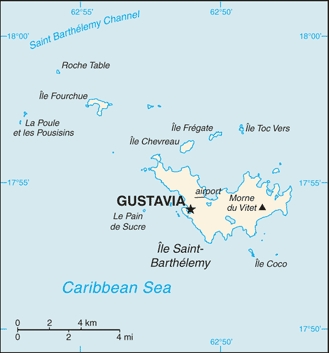 |
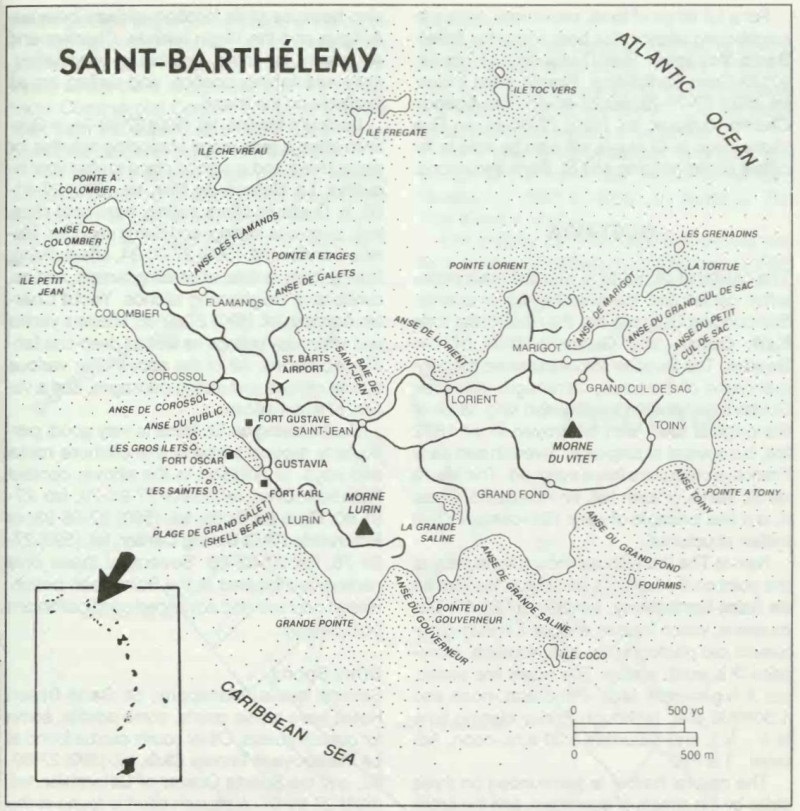
Saint-Barthélemy (in English colloquially now St. Barth, St. Barths, or St. Barts) is one of the Leeward Islands of the Lesser Antilles, in the Caribbean.
c. 2,500,000 years ago: During the Quaternary glaciations, the island, with St. Martin, Anguilla, and their peripheral islets, forms into a solitary landmass, the Anguilla Bank.
c. 500,000 years ago: Among the fauna of the Anguilla Bank is the blunt-toothed giant hutia (Amblyrhiza inundata), a rodent the size of a black bear, fossils of which have been found, besides Anguilla and St. Martin, on Île Coco, an islet off Saint-Barthélemy.
c. 1000 BCE: The island's first human inhabitants are the Stone Age Ciboney. Later the Arawak and (c. 1200 CE) Carib Indians appear in the region. Perhaps due to the lack of fresh water or the inhospitable topography, they never live permanently on the island, but they baptize it Ouanalao (pelican) and establish temporary encampments.
1493: Saint-Barthélemy is discovered with the other Antilles islands and presumably named after Bartolomé Colón, brother of the discoverer Cristóbal Colón (Christopher Columbus), although there is no clear reference to it in any document relating to the Columbian voyages. The island appears as San Bartoleme on a Spanish map of 1523. In face of the ferocity of the Caribs, the Spanish ultimately give up attempts to control the Lesser Antilles; this allows the English and French to make inroads.
1629: A Spanish attack on the English-French island of St. Christopher results in French privateer Pierre Belain d'Esnambuc agreeing to leave that island with all his people, numbering about 400. He leaves several of them on Saint-Barthélemy (and Saint-Martin and Anguilla), promising he will come back as soon as possible. He goes to Antigua to investigate the possibilities of a settlement there, but finds conditions unfavourable. The Spanish have meanwhile evacuated St. Christopher so he retrieves the colonists he left on the other islands and returns. This temporary visit marks the first time any settlement was established on Saint-Barthélemy.
1648: Saint-Barthélemy is first colonized by the French as Philippe de Longvilliers de Poincy, commander of the Order of Malta, captain-general of St. Christopher, sends about 50 people. These French settlers came from Normandy, Bordeaux, Brittany, or the south of France, seeking their fortune in the West Indies. The colonists' first life-sustaining plantings are probably manioc (cassava; used for pancakes), corn, millet, and potatoes (also used for animal feed). The principal export is tobacco.
1651: Saint-Barthélemy and the French section of Saint-Martin are purchased by the Order of Malta, de Poincy setting the condition that he remain as governor of these islands. This gives the islands greater security from Spain, which would not want to offend the powerful order.
1656: The arrival of Carmelite friars leads to quarrels with the Dominican order, which has coexisted on the island with Capuchin friars and Jesuits. Both sides demand to see the others' letters of religious authorization.
1656: The Caribs make a surprise raid at night, and the colonists are massacred almost totally, their heads impaled along the shore. The few terrorized survivors flee to St. Christopher.
1659: The Caribs having signed a peace treaty, Governor Poincy sends about 30 colonists again to Saint-Barthélemy. They multiply and become about 100 in 1664.
1665: The island (and the French portion of Saint-Martin) is purchased back from the Order of Malta by the Compagnie des Indes Occidentales (Company of the West Indies), the previous Compagnie des Îles de l'Amérique (Company of the American Islands) having been dissolved.
1674: Saint-Barthélemy becomes part of the royal domain and the colony of Guadeloupe. Jean-Baptiste Colbert, chief adviser of King Louis XIV, feared that St. Christopher might fall to the English (as it definitely does in 1713) and wanted to maintain a French base facing the English ones in the northern Antilles. For a long time, the island is a protected haven for the Caribs and privateers.
1687: Population: 501, including 355 whites and 141 slaves.
1688-97: During the War of the League of Augsburg, the inhabitants of Saint-Barthélemy (and Saint-Martin) are considered too weak to defend themselves and are evacuated to St. Christopher, while under French rule. But the English shortly capture St. Christopher and most of the French from Saint-Barthélemy go back to their island.
Oct. 25, 1700: A thorough report from François Roger Robert, administrator of the American islands for the secretary of naval affairs, Jérôme Pontchartrain, sharply criticizes the governmental methods customary in the Antilles:
The islands of Saint-Martin and Saint-Barthélemy are not regarded as very important. I, for one, look upon them as most useful to the other French colonies, in particular St. Christopher, and I strongly suggest that they should be kept and carefully protected, as well as the inhabitants who come back there and those who will come back, in order to support them and help them work at their own establishment in their land.
The little inhabitants find many sweet things in these islands. The air is wonderfully good there, serious diseases are unknown. They live a long life in good health. They derive their food from their cattle and fowl, they plant and grow all kinds of things and no crop ever fails. Several of them were producing indigo which sold quite well before the war. Most families have several children, which means that when the islands are well enough inhabited, we will be able to obtain from them quite a lot of cattle, fowl, and staples for St. Christopher and the other French isles.
This is why it is important to let these two little islands develop their population, and help them grow. The consumption of all kinds of staples necessary for life increases also, and to supply them these small islands are absolutely necessary. The example of what is happening on Sint Eustatius is quite useful in showing that the French should not neglect to foster population growth on the islands of Saint-Martin and Saint-Barthélemy, as well as on some even smaller islands whose ground is fertile, or poor but well cultivated. I feel I can draw a conclusion in this report and induce the French to reestablish with no problems and great care these two little islands which are their strongest colonies.
1701-14: During the War of the Spanish Succession, Raymond Balthazar Phélypeaux, governor-general of the French Antilles, writes to Versailles: "St. Christopher is still in the hands of the English, as is Antigua, and they are masters of the sea in the Caribbean. They also have Nevis and Montserrat. We do not believe we could retain Saint-Martin and Saint-Barthélemy against the slightest invasion." He advises that the two little islands "not have a garrison there, or militia, and not name a commander, nor install any battery."
1733: A royal ordinance orders settlers to plant prickly pear cacti in thick rows along the shores as defense. It is not fully implemented, however.
1744: During the War of the Austrian Succession (1743-48), the English pool their forces, attack Saint-Barthélemy, and win despite sharp resistance for several days, during which the commander of the island, Jacques Gréaux, is killed. The governor of Antigua led the attack, with the financial support of the New England merchants who were inconvenienced by the Saint-Barthélemy privateers. The English capture the French privateers and install their own buccaneers in the Carénage (the island's natural port), letting them ransack the inhabitants to the point where they end up stealing the very wood from their houses. The English also deport many families to St. Christopher. That island's governor, however, is opposed to the excessive violence by troops under his authority, so he gives the exiles the choice of staying in St. Christopher or returning to Saint-Barthélemy; all return to their island.
1764: The French reclaim the island after the Seven Years' War. To keep its profitable Caribbean sugar colonies, France abandoned its North American possessions.
1769: Victor Thérèse Charpentier, comte d'Ennery, governor-general of the Antilles, orders Auguste Descoudrelles, commander of Saint-Barthélemy and Saint-Martin, to undertake the rebuilding of the defenses of the island "so as, if such things are possible, to protect it from further catastrophes."
1772: A French report says about the island: "It is of great use at wartime as a port for our buccaneers when they go cruising the neighbouring English islands. The same reason for which it was originally occupied still exists, and our business would be too inconvenienced if that island belonged to the English."
1776: Census population: 523.
January 1779: The British occupy the island, but the French under Charles Henri Hector, comte d'Estaing, repossess it already in February.
July 1, 1784: Sweden signs a treaty with France by which Sweden acquires Saint-Barthélemy in exchange of trading privileges for the French in Göteborg. France considers the barren island of minor importance.
Dec. 4, 1784: The Swedish frigate Sprengtporten sails from Sweden to take possession of the island, arriving via Martinique on March 6, 1785; the island is officially handed over the following day. A document signed by Jean-Sébastien, chevalier de Durat, the last French commandant, describes the state of the island at this time, including this section on the inhabitants:
There are on the island only five or six families originating from Normandy who have much multiplied. They are not at all congenial and do not get along well with each other. Their poverty seems to be great. Right through the dense brushwood you arrive along curved paths at a dreary shack where a father and a mother are living responsible for 8 to 10 almost naked children, who in daytime work the soil like the Negroes and in the night go to sleep higgledy-piggledy on the ground. The marriages are frequent and very fertile. One marries always within the place, cousins with cousins, without dispensation, nor do they believe they are doing wrong. Their ignorance is crass, they hardly know how to speak. They run away and hide at the sight of a stranger. In short they are a kind of savages abandoned to the state of nature who prefer that before everything and in spite of their destitution are attached to Saint-Barthélemy. The air is very healthy there, one lives a long time. A Negro slave serves as a doctor on the island. One says he is quite knowing in regard to bloodletting and fractures.
An established European serves as secretary on the island and settles all matters of the colony. They seem to me to be in bad hands because he is a great drunkard.
The food shortage during the war has caused many whites and Negroes to perish.
A census is attached showing 458 whites, 281 Negroes, 10 free coloureds, 1 horse, 52 horned cattle, 1,327 sheep and goats, and 42 hogs.
April 16, 1785: In the first ordinance of the first Swedish governor, Salomon Mauritz friherre von Rajalin, Saint-Barthélemy is proclaimed a free port.
February 1787: The main town of Le Carénage, with a new town having been created around the old, is renamed Gustavia, after Swedish king Gustaf III.
June 1788: The population has more than doubled since 1785, now numbering 1,663, of which 656 live in Gustavia and 1,007 in la campagne. 829 are whites, 91 free coloureds, and 743 slaves.
Sept. 1, 1788: Governor Pehr Herman Rosén von Rosenstein requests more money from Stockholm to establish defenses on the island in view of the fact that Sweden and Russia are at war; he fears that a Russian fleet might take over the island.
February 1791: Governor Carl Fredrik Bagge af Söderby tells Stockholm that (following the French Revolution) revolutionary ideas have infected also the Swedish island inasmuch as the islanders refuse to maintain the roads built after the Swedes' arrival and the small garrison he has is unreliable because many soldiers would report sick in case of a serious crisis.
Aug. 1-2, 1792: A hurricane demolishes 51 and damages 10 houses and kills 26 and injures 6 people in
Gustavia. Other hurricanes wreak havoc on the island during the Swedish period in 1804, 1819, 1821, 1837, 1850, 1867, and 1876 (some mentioned below).
1793: Despite Sweden being neutral, the British begin to seize Swedish ships in the Antilles to enforce their naval blockade on France.
1795: Governor Bagge is recalled after widespread disapproval of his close association with Victor Hughes, commissioner of Guadeloupe for the French revolutionary National Convention. Under the new governor, Georg Henrik Johan af Trolle, Hughes becomes hostile toward Saint-Barthélemy, calling it "a nest of rebels and emigrants," and all commercial relationships between the two islands are ended.
1799: As trade flourishes, the exports of the island amount this year to 1,657,999 piastres gourdes compared to only 335,852 piastres gourdes for the imports.
1800: The population is about 6,000, with about 5,000 in Gustavia - a size only surpassed by six towns in Sweden proper.
March 20, 1801: A very strong British force invades the island during the Napoleonic wars. Governor Hans Henrik Anckarheim calls a War Council composed of officers and the leading citizens of the island, which decides that the island is in no position to defend itself; it is surrendered the following day. The British keep the island occupied with a small garrison. All Swedes in the colony are forced to take an oath of loyalty to the British king. A Colonel Wilson is named acting governor. He seizes all Swedish ships and puts them under the British flag, and confiscates all the shops and merchandise of the Swedish West India Company. He then starts building a fort overlooking the city. Wilson is soon replaced by a new governor, Cranstow.
July 10, 1802: The British end the occupation following the Treaty of Amiens (March 27). Former governor af Trolle, who was made a prisoner-of-war, says the British "behaved like pirates and brigands" and violated the conditions of surrender. Ultimately the British pay an indemnity of £9,000.
1803: The king of Sweden sets aside funds for the cleaning of the harbour, the repairing of wharves and cisterns, and for other urgent repairs arising from the British occupation. The appearance of quantities of counterfeit money adds to the difficulties.
Early 1804 to late 1819: A four-page weekly newspaper in English, The Report of St. Bartholomew, is published (with interruptions).
Nov. 12, 1807: The French, exasperated by raiders from Saint-Barthélemy's waters, carry out a surprise attack with little bloodshed, holding Gustavia and its immediate surroundings for less than 24 hours during which they seize ships and property belonging to alleged enemies of the French republic. The English were forewarned and fend off the attack.
Autumn 1810: Serious rioting breaks out, ascribed to general dissatisfaction with two Swedish officials and culminating on September 22 when August Nyman saves the town from being bombarded from the batteries of Fort Gustaf III by refusing to open fire on the crowds having assembled outside the government house.
1812: Population: 5,482, of which 3,881 live in Gustavia and 1,601 in the countryside. The slave population reaches a maximum of about 2,400.
Dec. 10, 1818: Governor Johan Samuel Rosensvärd dies in Nevis.
Sept. 20, 1819: An unusually violent hurricane hits the island, 56 ships of various sizes being lost and several others destroyed. King Carl XIV Johan donates 8,000 kronor from his personal funds to add to the state's funds to help the disaster victims.
1820: A "malignant fever" (probably yellow fever) kills many islanders, including no less than three of Governor Johan Norderling's children. This is followed by a drought, which causes suffering especially in the countryside.
September 1821: Another hurricane hits the island. The Lutheran church and many residences are destroyed; 11 American ships are lost, and other English and Spanish ships are sunk.
1822: Another drought destroys most of the crops.
December 1822: The U.S. Federal Gazette & Baltimore Daily Advertiser describes Saint-Barthélemy as being "a barren rock; producing nothing for the support of the human species, dependent entirely on the United States for everything. Although the island has ever been noted... as a rendezvous for freebooters, it was not until the administration of Mr. Norderling, the present governor, that these piracies were openly protected and the laws of nations and civilized society violated." The U.S. considers Saint-Barthélemy a serious thorn in their skin because of the many privateers using the uninhabited Five Peaks Island or Île Fourche, a normally uninhabited dependency of Saint-Barthélemy, as a base for attacks on trading vessels.
1823: The first serious economic depression is experienced when the British open up their Caribbean ports for U.S. vessels.
1827-30: A temporary trade conflict between Great Britain and the United States makes Gustavia once again an important transit harbour. Thereafter, however, the stagnant economy faces an almost uninterrupted downhill slope; there is virtually no immigration but instead waves of emigration, to North America and in the late 1830s also to Demerara (in modern Guyana) and from about 1850 to St. Thomas (Danish West Indies, modern U.S. Virgin Islands).
1828: Construction of a Catholic church is completed.
May 30, 1828: Former governor (1819-26) Johan Norderling, who was broadly esteemed, dies after being thrown off his horse which was startled by a cannon signalling the outbreak of a fire. He is buried on the island.
1830: Population: 4,394.
1835: Population: 3,548.
Aug. 2, 1837: Gustavia and the surrounding area are hit by the worst hurricane the island has experienced. It destroys 200 houses and damages 100 more, with 40 persons perishing in the rubble. Both the Catholic and Methodist churches are badly damaged. The government house is barely standing, and the governor and his family nearly perish while evacuating it.
1839-41: Intermittent "miasma fever" epidemics kill about 300 people, mostly in 1840.
1840: Population: 2,555.
1843 and 1867: Severe earthquakes break up buildings and roads.
1845: King Oscar I reinstates a request already made by Karl XIV in 1818 to relieve him of the personal ownership of Saint-Barthélemy as part of the "crown estates," given that it is a financial liability. The Diet agrees, making the island an integral part of Sweden.
1846-47: The Swedish state purchases the freedom of the last 523 slaves on Saint-Barthélemy. On Oct. 9, 1847, slavery is formally abolished. Many of the former slaves leave the island.
1850: There is a drought so severe that water cannot even be purchased.
1851: Guadeloupe gets its first Catholic bishop, and Saint-Barthélemy, which is three-fourths Catholic, becomes a part of that diocese. The bishop, Pierre Marie Gervais Lacarrière, visits the island this year and on later occasions, as does his successor, Théodore Augustin Forcade, five times in 1854-58, during which time the island's one parish is divided into the two parishes of Gustavia and Lorient.
March 2, 1852: A great fire provoked by gusty winds engulfs parts of western Gustavia, 135 houses being totally destroyed, affecting close to 500 people. Many merchants now leave the island for good.
Late 1852: Governor James Harlev Haasum issues a proclamation announcing a death within the Swedish royal family and a related text is translated into French in order to be read in the Catholic churches of Gustavia and Lorient but Abbé François Cuenat refuses to do so and even takes the mourning attire off a churchwarden. In early 1853 he also refuses to read a thanksgiving in regard to the birth of a Swedish prince. In sharp opposition to the governor's office the priest leaves the island at his own request in February 1853. This temporary rift between the Catholic church and the Swedish authorities is bridged over only with the arrival in Gustavia of Bishop Forcade in June 1854.
1853: Cultivation of cotton is replaced by that of the pineapple, with 95,429 dozens of pineapple fruits exported in the top year of 1858.
1857: The Swedish wooden church is finally demolished after many years of neglect and destruction from hurricanes and earthquakes. The few remaining Lutherans usually attend the Anglican church inaugurated in December 1855.
May 24, 1860: Governor Carl Ulrich writes in a letter that "since there are here no more than half a dozen or maybe eight people (the civil servants and my eldest daughter included) who speak or even understand one single word of Swedish inasmuch as the island never has been a Swedish colony in the strict sense of the word and any effort never has been made to make it such a colony by establishing Swedish schools and such like I cannot perceive that a return of the island to its first owner in such circumstances would in any way be contrary to the dignity of the country."
1862-65: During the U.S. Civil War the prize of cotton temporarily rises dramatically, causing the pineapple to be superseded again by cotton, but as soon as the war ends that cultivation too subsides in Saint-Barthélemy, dropping significantly after the hurricane of 1867.
Nov. 29, 1867: A hurricane annihilates all the crops and destroys 55 houses and damages 60 more.
Aug. 11, 1868: Governor Carl Ulrich dies.
1868-70: Negotiations about the island go on with the United States. Long before the Americans say no, Sweden also turns to Italy; however, when it is found out that Italy contemplates making a penal colony for its convicts - a kind of Devil's Island - out of Saint-Barthélemy, all further negotiations are quickly ended out of consideration for the islanders.
1872: Population: 2,390. Of these 2,032 are Catholics, 211 Anglicans, 133 Methodists, and 14 Lutherans.
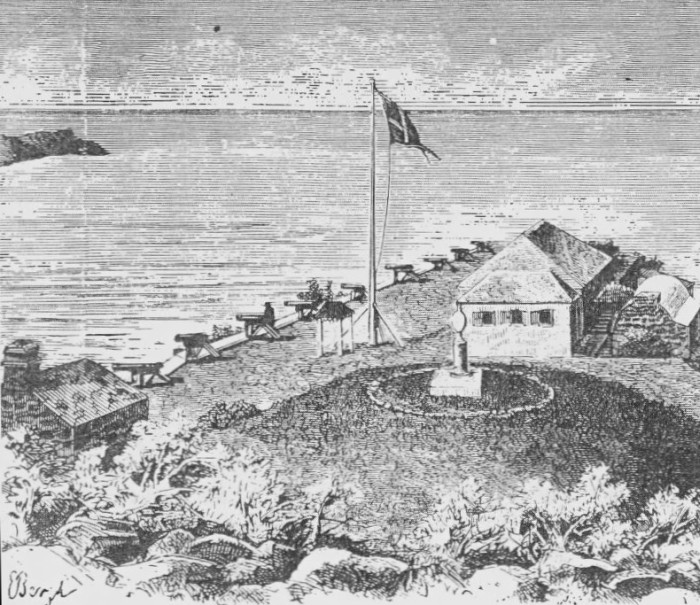
Fort Gustaf, 1878. |
1876: France is approached, eventually leading up to the treaty concluded in Paris on Aug. 10, 1877, by which the French government consents to take the island back as its territory if that is the wish of the islanders. The king writes to the last Swedish governor, Bror Ulrich:
In a humble petition, on May 6, 1864, parliament has asked us to consider the possibility of formally separating this colony from the state of Sweden, after having notified the population of Saint-Barthélemy and after their agreement to depend upon another nation. Since this island is so far away from Sweden and from its commercial sea routes, the care that the inhabitants expect from us is very precarious, so we have searched for a way to transfer this colony's interest to a power more able to take care of it.
Among all possible nations, France came first: it was the first parent state of this island and it is bound to its inhabitants through language and religion; and because of its other large colonies, France appears to have the best means of caring for the spiritual and material needs of the inhabitants.
Considering all these things, we had our ambassador in Paris open negotiations for the reconveyance of the said island to the aforementioned nation; the treaty, which was signed in Paris on the 10th of this month, determines that, after our approval, Sweden will transfer its rights over Saint-Barthélemy with the condition that the civil servants being employed in the island and belonging to the crown of Sweden will pay a sum of money to the king of Sweden, who will use it to establish a charitable foundation for the island's inhabitants.
Consequently to the terms of the parliament report, as the population should be consulted on the transfer of the island to another power, we ordered you, by this very letter, to set up a plebiscite as soon as possible. With a proclamation, you will inform the population of the reasons for our decision, to be published before the day of the vote. It is your authority to decide how the vote should be held, it being understood that any citizen over 21 has the right to vote. You will then inform me promptly of the result of the vote.
Ulrich delegates the task of arranging a plebiscite to the Catholic priest of Gustavia, Jean-Baptiste Gironis, who points out to the residents that the French flag assures the existence of a Catholic education and of no danger to their faith. Out of 352 votes all but one are cast for France. Only the tradesman and shipmaster Wellington Sicard votes for Sweden. The transfer was opposed by a few more intransigents, but they evidently boycotted the vote. The treaty is ratified in Stockholm on Nov. 9, 1877, and in Paris on March 4, 1878. France agrees to pay 320,000 francs to cover the costs of returning and retiring Swedish officials, and another 80,000 francs for the property of the Swedish state on the island. Sweden dedicates the 80,000 francs for the building of a new hospital on the island, but somehow the money disappears.
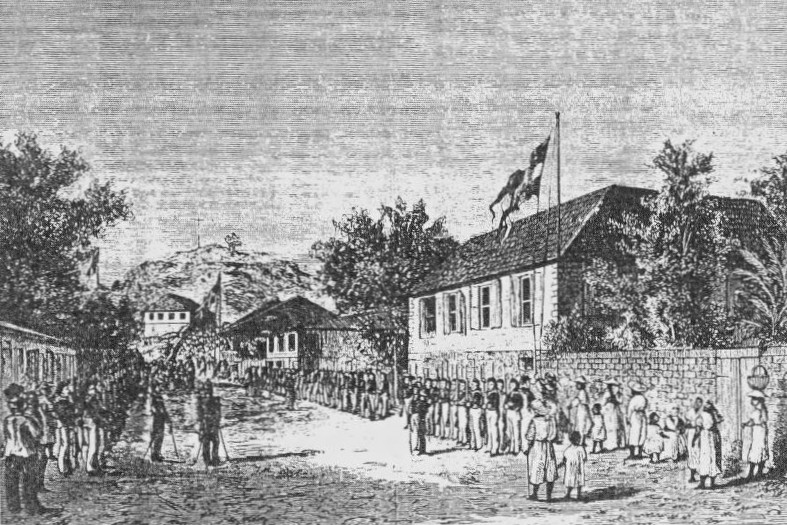
Sailors from the Vanadis lined up at the City Hall for the retrocession, 1878. |
March 16, 1878: The blue and yellow flag is hauled down from all official buildings. One Swedish and three French men-of-war lying at anchor at Gustavia fire their guns in a reverberating salute. The governor of Guadeloupe, Gabriel Couturier, takes possession as the island again becomes part of that colony. He tells the assembled population:
You have been separated from France for almost a century; your fathers bequeathed you their loyal attachment for the old Motherland, and you have kept its language, customs, and memories.
It is through the mutual agreement of two friendly powers who in turn owned your island, and after the freely expressed wish of the population, that the island of Saint-Barthélemy is today reunited with France.
Along with the flag that flies now over your shore, the French Republic brings you the benefit of its institutions and the protection of its laws. Every right, every guarantee assured to the French citizens are today also yours.
The law asserting your reunion with France places the island of Saint-Barthélemy under the government of Guadeloupe.
You can count on my most watchful concern. The administration in Guadeloupe will do everything in its power to better your situation and your well-being, to spread in this island the advantages derived from the peaceful reign of order, work, freedom, and progress. It cannot aspire to make you forget the paternal government it is replacing here, but it will at least try to act so that you will not miss it.
By drawing its inspiration from the generous and liberal views of the minister of marine and the colonies, the administration of Guadeloupe hopes to win the trust and affection of the honest and peaceful population, the interests of which are now in its hands, through its devotion to you.
People of Saint-Barthélemy:
You have always loved France, you belong to her today with your nationality. Let us join our feelings and wishes in the same impulse of love for our homeland.
This is followed by a Te Deum in the church of Gustavia, and the bishop of Guadeloupe, François Benjamin Joseph Blanger, praises the Swedish administration and its officers. A proclamation from King Oscar II is published thanking the people for their past faithfulness to the Swedish crown. During further events in the evening and on the following day, there are many speeches depicting a brilliant future for the island. Judge Jean Bertrand Auguste Cochet becomes temporary resident subject to the governor of Guadeloupe. Gustavia is confirmed as a free port. On March 20 the Vanadis, having witnessed the transfer of power, becomes the last Swedish military vessel to leave the island, with ex-governor Ulrich aboard.
July 27, 1878: A French decree declares Saint-Barthélemy an island dependency of Guadeloupe. A second decree, on August 31, gives it a Magistrate's Court.
Oct. 11, 1878: A post office is established. On the same day a 15-member commission is established to administer the island pending the election of a Municipal Council. Hippolyte Duchatellard, a powerful merchant, assumes the presidency of this commission with the temporary title of mayor; he takes office November 4, taking over the authority from Cochet.
Nov. 16, 1878: Duchatellard is elected mayor in municipal elections, with two deputy mayors to assist him. On the occasion of preparing the electoral roll a census was taken, showing 2,817 inhabitants (985 in Gustavia and 1,832 in the countryside).
1882: Jean-Baptiste Déravin is elected deputy mayor for Lorient and Burton Dinzey for Gustavia.
Jan. 19, 1882: A tax on dogs is introduced.
May 2, 1883: The first serious clash with the mainland government occurs as the minister of the interior claims some fields in the "50-step zone" - a government right-of-way along the coast for safety and customs purposes. The Municipal Council strongly opposes this demand, claiming that the 50-step rule does not apply to the island, and prevails.
Nov. 18, 1899: The governor of Guadeloupe protests against the reduction of the Gustavia wharf tax, which was unanimously voted by the Municipal Council. He demands that this action be repealed. Headed by the mayor, the municipality rejects this interference from the central administration into the affairs of the commune.
March 20, 1900: Jean-Bertrand Sourd is elected mayor after Duchatellard retired after 22 years in the post.
Dec. 15, 1900: The governor informs Saint-Barthélemy that because of a deficit in his budget, the commune will have to stop all financial support to religious establishments: churches, presbyteries, and the religious crafts factories in Lorient and Gustavia. The Council again indignantly protests against this meddling in its own business and maintains its original budget, "as it cannot reduce and even less eliminate these indispensable subsidies."
1912: Compulsory military service is nominally instituted, but not really implemented.
1913: Mayor Sourd unsuccessfully asks the Guadeloupe administration to transfer Isidore Lédée, master of the Gustavia boys' school, and Arthur Déravin, a judge, both political opponents of the mayor. In the municipal elections on October 26, held after an earlier election was annulled by Guadeloupe because of voting irregularities, the slate headed by Sourd is defeated. The new mayor is Louis Déravin, son of Arthur Déravin.
1915: In World War I the first convoy of troops from the island is drafted, the number of volunteers greatly exceeding the quotas assigned by the draft system.
End of November 1918: The schooner Inese II from Guadeloupe brings news of the armistice, touching off an enthusiastic uproar in Saint-Barthélemy. A few months later the island greets its returning veterans, about 60 of them. Five died in the war (Claude Aubin, Guillaume Falson, Joseph Magras, Antoine Querrard, Joseph Querrard).
Dec. 24, 1919: Théodore Lédée is elected mayor, Déravin having decided to retire in Guadeloupe.
May 1923: The public school in Colombier, planned since 1902, is finally opened.
Aug. 27-28, 1924: A hurricane causes extensive damage to roads and ditches and unroofs some buildings. The inter-island ship Verdun goes down at Nevis during the storm.
1925: The salt marsh of Saline is put into service and the salt begins to be harvested.
March 11, 1925: Adolphe Leroy is elected mayor. He takes office May 17.
1927: Mayor Leroy dies. His first deputy, Eugène Magras, becomes acting mayor and on April 13 is elected mayor.
1929: Mayor Magras retires in ill health. Ruben Déravin is elected in his place.
1931: Stephan Tara replaces Déravin as mayor. He is followed by Déravin again in 1933.
Feb. 18, 1934: A new hospital is opened (built without Swedish money; see 1876). It is for several decades under the management of the Sisters of Saint Paul de Chartres.
1940: The initial French defeat in World War II creates serious economic problems as the French Antilles are cut off from the motherland and mail is practically halted by a severe censorship.
1941: Mayor Déravin dies. He is succeeded by Clément Lédée.
1942: Jean Lédée succeeds his father as mayor. Clément Lédée resumes the office in 1943.
1943: Food supplies become a serious problem. However, the absolute essentials are rationed and can be obtained.
1943: Father Irénée de Bruyn, who was instrumental in getting the hospital built and was involved in many other improvements on the island, dies at 54.
1944: The governor of Guadeloupe names a delegation to take over the administration of the island, with Raynal Rosey at its head.
1945: Rémy de Haenen makes the first landing of a plane on the island, on the Saint-Jean "savanna." He subsequently spearheads the creation of a rudimentary runway.
1945: After the end of the war, Rosey is elected mayor.
March 19, 1946: Guadeloupe (including Saint-Barthélemy) becomes an overseas département.
1947: A desire for renewal and progress, after the war widened Saint-Barthélemy's horizons, is reflected in politics when Alexandre Magras is elected mayor. Under his administration, the improvement of the Gustavia port is started, roads are built, and restoration of various public buildings is begun.
1957: David Rockefeller, grandson of industrialist John D. Rockefeller, buys a large piece of land on the island for $32,500. He calls on architect Nelson W. Aldrich to design a villa, which is completed in the early 1960s. Meanwhile, prompted by Rockefeller, Edmond de Rothschild buys his own property, and, with a small exclusive hotel, Eden Rock, built by de Haenen in 1953, the island begins to be transformed into a jet-set sanctuary, visitors including Howard Hughes and Greta Garbo. Later the ballet dancers Rudolf Nureyev and Mikhail Baryshnikov have properties on the island.
1960s: The idea of a specific status for Saint-Barthélemy germinates as the beginnings of a promising development are felt.
1961: Gustavia Lighthouse is built.
1962: Magras retires as mayor, following a disagreement with Rémy de Haenen, a member of the Municipal Council. After new elections, de Haenen becomes mayor. During his mayorship, the first electricity and water plants are built.
Feb. 1, 1963: A decree (Journal Officiel, February 7) creates the arrondissement of Saint-Martin-Saint-Barthélemy (also called Îles du Nord) within the overseas département of Guadeloupe.
1967: Census population: 2,527. The principal quartiers are: Gustavia, 398; Corossol, 290; Flamands, 262; Lorient, 238.
1968: The number of Saint-Barthélemy people living in the U.S. Virgin Islands and in the United States is about 3,000, including those who have become U.S. citizens. In St. Thomas (Virgin Islands), "French town" is a miniature Saint-Barthélemy.
1969: The airstrip is lengthened to 800 m. The first regular airline service to the island is established.
Oct. 16, 1974: Census population: 2,491.
Early June 1975: Violent anti-government demonstrations against a new import tax and in support of a local hospital director and politician, Charles Querrard, erupt. (Querrard's contract was terminated and he was to be transferred to Basse-Terre, Guadeloupe, which was seen as a move by Mayor de Haenen to get a potential opponent off the island.) The airport is paralyzed and French riot police is sent to the island.
1977: Elections lead to Querrard becoming mayor.
1977: Saint-Barthélemy and the town of Piteå, Sweden, are twinned.
March 9, 1982: Census population: 3,059.
March 6, 1983: Daniel Blanchard is elected mayor.
Late 1984: The Gustaf III Airport is opened.
1985: The French authorities rule that income tax can be collected and there are further protests.
March 15, 1990: Census population: 5,038.
June 18, 1995: In municipal elections Bruno Magras is elected mayor, with a program clearly placing statutory developments at the forefront. Guadeloupe begins preparing for the devolution of Saint-Barthélemy.
Sept. 4-5, 1995: The passage of Hurricane Luis profoundly alters the island's landscape, stripping away vegetation, leaving the island looking as barren as if swept by wildfire. Just a few weeks later, however, it is reported to be green and blooming again.
Oct. 10, 1996: The Nature Reserve of Saint-Barthélemy (Réserve Naturelle de Saint-Barthélemy) is established, protecting over 1,200 ha of marine environment surrounding the island.
March 8, 1999: Census population: 6,852.
March 24, 2001: A twin-engined Air Caraïbes aircraft which left the nearby island of Sint Maarten crashes as it approaches the runway on Saint-Barthélemy, killing all 19 people on board and one on the ground.
Dec. 7, 2003: Saint-Barthélemy votes overwhelmingly (95.5%) to become a separate territory of the French Republic. Saint-Barthélemy is to be ruled by the president of the deliberating assembly (elected among its members for a five-year term).
Feb. 6, 2007: The reorganization is approved by the French Senate and the following day by the National Assembly. On February 21 the island is formally designated an overseas collectivity (collectivité d'outre-mer), as is Saint-Martin. Both come under a joint prefect (based in Saint-Martin; see Saint-Martin for appointments) delegated to the prefect of Guadeloupe, the latter being from July 9 also state representative in Saint-Barthélemy and Saint-Martin.
July 1, 2007: In elections to the new Territorial Council (Conseil territorial), the list of Bruno Magras, St. Barth First (Saint-Barth d'abord [SBDA], affiliated with the French Union pour un Mouvement Populaire [UMP]), wins 72.2% of the vote and 16 of 19 seats. Three others win one seat each: the Tous unis pour Saint-Barthélemy (All United for Saint-Barthélemy) list, led by Karine Miot-Richard, the Action Equilibre et Transparence (Action Balance and Transparency) list headed by Maxime Desouches - each with 9.9% of the vote - and Benoît Chauvin's Ensemble pour Saint-Barthélemy (Together for Saint-Barthélemy), with 7.9%. Turnout is 70.6%. Elected members:
| Bruno Magras, 56 | SBDA |
| Nicole Gréaux, 51 | SBDA |
| Yves Gréaux, 57 | SBDA |
| Marie-Thérèse Weber, 62 | SBDA |
| Michel Magras, 53 | SBDA |
| Rose-Marie Fauconnier, 51 | SBDA |
| Jean-Pierre Magras, 46 | SBDA |
| Cécile Tiberghien, 35 | SBDA |
| Patrick Kawamura, 54 | SBDA |
| Micheline Jacques, 36 | SBDA |
| Nils Dufau, 37 | SBDA |
| Jeanne-Marie Gréaux, 55 | SBDA |
| Andy Laplace, 32 | SBDA |
| Corinne Febrissy, 37 | SBDA |
| Ginette Gréaux, 40 | SBDA |
| Jules Brin, 47 | SBDA |
| Karine Miot-Richard, 43 | Tous unis pour Saint-Barthélemy |
| Maxime Desouches, 44 | Action Equilibre et Transparence |
| Benoît Chauvin, 35 | Ensemble pour Saint-Barthélemy |
On July 15 Magras is elected president of the Territorial Council, winning all 19 votes. An Executive Council is elected including Yves Gréaux, Nicole Gréaux, Michel Magras, and Marie-Thérèse Weber as vice presidents and Jean-Pierre Magras and Maxime Desouches as members. Pending the election of one member of the French Senate and one deputy (jointly with Saint-Martin) to the National Assembly, the territory is to continue to be represented by the Guadeloupean delegates.
Feb. 12, 2008: Patrick Kawamura is named (as the only candidate) a member of the Executive Council to replace Jean-Pierre Magras, who resigned on Dec. 17, 2007.
Night of July 30/31, 2008: Former mayor (1962-77) Rémy de Haenen dies at 92.
Sept. 21, 2008: Michel Magras (UMP) is elected senator (winning all 18 valid votes in the 20-member electoral college, with 2 invalid votes).
June 6, 2009: In European Parliament elections (conducted, like subsequent elections, one day earlier than in mainland France due to the time-zone difference, so as not to be influenced by mainland results), turnout in Saint-Barthélemy is 14.6%. The list of Marie-Luce Penchard wins 63.6% of the vote.
April 7, 2010: Kawamura resigns from the Executive Council.
Jan. 21, 2011: A new Executive Council is elected including Yves Gréaux, Nicole Gréaux, Michel Magras, and Marie-Thérèse Weber as vice presidents (as before) and Nils Dufau and Andy Laplace as members.
Jan. 1, 2012: Saint-Barthélemy becomes an overseas territory under European Union law, rather than an outermost region (unlike the other French Caribbean territories).
March 18, 2012: In elections to the Territorial Council, SBDA wins 73.8% of the vote (16 of 19 seats), Tous pour Saint-Barth 15.9% (2), and Saint-Barth en Mouvement 10.3% (1). Turnout is 71.5%. Elected members:
| Bruno Magras, 60 | SBDA |
| Nicole Gréaux, 55 | SBDA |
| Michel Magras, 58 | SBDA |
| Karine Miot-Richard, 47 | SBDA |
| Nils Dufau, 41 | SBDA |
| Cécile Tiberghien, 39 | SBDA |
| Andy Laplace, 36 | SBDA |
| Micheline Jacques, 40 | SBDA |
| Jean-Marie Danet, 46 | SBDA |
| Marie-Angèle Aubin, 47 | SBDA |
| Xavier Lédée, 31 | SBDA |
| Juliette Gréaux, 45 | SBDA |
| Alfred Brin, 30 | SBDA |
| Corinne Febrissy, 41 | SBDA |
| Donald Gumbs, 37 | SBDA |
| Elodie Laplace, 33 | SBDA |
| Benoît Chauvin, 40 | Tous pour Saint-Barth |
| Bettina Cointre, 30 | Tous pour Saint-Barth |
| Maxime Desouches, 48 | Saint-Barth en Mouvement |
Magras is subsequently reelected president of the Territorial Council, and an Executive Council is elected including Nicole Gréaux, Michel Magras, Karine Miot-Richard, and Nils Dufau as vice presidents and Micheline Jacques and Benoît Chauvin as members.
April 21, 2012: In the first round of the French presidential election, Nicolas Sarkozy (UMP) wins 62.4% of the votes in Saint-Barthélemy, compared with 11.4% for Marine Le Pen (National Front) and 10.1% for François Hollande (Socialist Party); turnout is 56.6%. A runoff election is held two weeks later, at which Sarkozy wins 82.7% of the vote, against only 17.3% for Hollande, the national winner; turnout is 64.2%.
June 9 and 16, 2012: In an election to the National Assembly the UMP's Daniel Gibbs (officially known as Gibbes, owing to an error in registration) is chosen to represent Saint-Barthélemy and Saint-Martin. In the first round, he wins 39.9% of the vote, Guillaume Arnell (diverse left) 25.6%, and Louis Mussington (Socialist Party) 16.7%; turnout is 30.1%. In the second round, Gibbs wins 52.3% and Arnell 47.7%; turnout is 35.9%.
November 2012: Legislation to impose price controls on a range of staple goods and encourage competition in Saint-Barthélemy and other French overseas possessions is approved by the National Assembly.
Jan. 28, 2013: The Territorial Council votes to establish the Territorial Environment Agency (Agence territoriale de l'environnement; ATE), effective May 1.
May 24, 2014: In European Parliament elections, turnout in Saint-Barthélemy is 14.9%. The UMP list wins 43.5% of the vote and the National Front list 31.7%.
Sept. 28, 2014: Senator Magras is reelected for a further term, winning 15 votes against 4 for Benoît Chauvin, with 2 invalid votes. (The electoral college consists of the members of the Territorial Council plus the sitting senator and deputy.)
May 2015: President François Hollande visits Saint-Barthélemy, the first visit by a French head of state since 1980. Hollande pledges to halve the amount of tax that the territory owes to the French state, a reform that is later approved by the National Assembly.
June 26, 2015: Gustaf III Airport is renamed Rémy de Haenen Airport (Aéroport Rémy de Haenen) after the pioneer aviator and mayor. On October 30 the name is amended to Aéroport de Saint-Barthélemy-Rémy de Haenen.
October 2015: Further legislation to monitor prices on the island is adopted.
November 2015: After attacks in Paris by militants connected to the Islamic State group and the declaration of a state of emergency in mainland France earlier in the month, this is expanded to cover the French Caribbean territories as a precautionary security measure. The local police are thus granted wide-ranging powers of arrest and the authority to prohibit public demonstrations.
Feb. 15, 2016: Former mayor (1947-62) Alexandre Magras dies at 98.
December 2016: Following protracted negotiations between French and Antiguan officials, agreement is reached on the delimitation of the maritime boundary between Saint-Barthélemy and Antigua and Barbuda. An accord formalizing the new boundary is signed in March 2017.
January 2017: Census population: 9,961.
February 2017: The National Assembly adopts the Loi Égalité Réelle Outre-mer (Real Overseas Equality Act) to address the high cost of living and the lack of socioeconomic development in the territories.
March 19, 2017: In elections to the Territorial Council, SBDA wins 53.7% of the vote (14 of 19 seats), Unis pour Saint-Barthélemy 20.6% (2), Saint-Barth autrement 18.1% (2), and Tous pour Saint-Barth 7.7% (1). Turnout is 67.3%. Elected members:
| Bruno Magras | SBDA |
| Nicole Gréaux | SBDA |
| Nils Dufau | SBDA |
| Micheline Jacques | SBDA |
| Andy Laplace | SBDA |
| Marie-Angèle Aubin | SBDA |
| Alfred Brin | SBDA |
| Juliette Gréaux | SBDA |
| Romaric Magras | SBDA |
| Séraphine Danet | SBDA |
| Francius Matignon | SBDA |
| Corinne Febrissy | SBDA |
| Ernest Magras | SBDA |
| Elodie Laplace | SBDA |
| Franciane Gréaux-Le Quellec | Unis pour Saint-Barthélemy |
| Xavier Lédée | Unis pour Saint-Barthélemy |
| Marie-Hélène Bernier | Saint-Barth autrement |
| Maxime Desouches | Saint-Barth autrement |
| Bettina Cointre | Tous pour Saint-Barth |
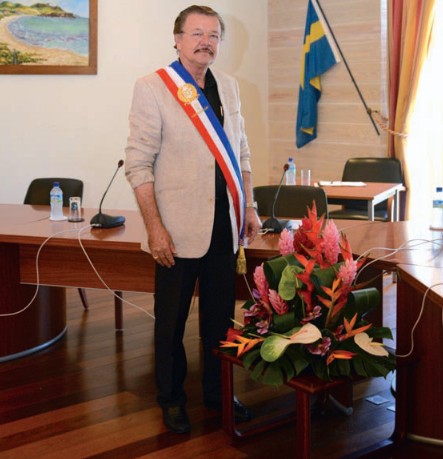
Bruno Magras takes office for another term as president of the Territorial Council, April 2, 2017. |
On April 2 Magras is reelected (16 votes against 3 blank votes). Six other members of the Executive Council are elected, all from SBDA: Nicole Gréaux, Nils Dufau, Micheline Jacques, Andy Laplace, Marie-Angèle Aubin, and Alfred Brin.
April 22, 2017: In the first round of presidential elections, François Fillon of Les Républicains, third-placed nationally, wins the most votes in Saint-Barthélemy, 40.7%, followed by Marine Le Pen of the National Front (22.5%), Emmanuel Macron of the En Marche! movement (16.2%), and Jean-Luc Mélenchon of La France insoumise (10.7%); turnout is 54.9%. In the runoff on May 6, Macron, who also wins nationally, wins 58.4% in Saint-Barthélemy against Le Pen's 41.6%; turnout is 52.2%.
June 10 and 17, 2017: Claire Guion-Firmin (also known by her maiden name, Claire Javois) of Les Républicains is elected to represent Saint-Barthélemy and Saint-Martin in the National Assembly. In the first round, she wins 26.0% of the vote, Ines Bouchaut-Choisy 21.8%, Jacques Hamlet 18.9%, and Marthe January 10.2%; turnout is 24.0%. In the second round, Guion-Firmin wins 54.7% of the vote and Bouchaut-Choisy 45.3%; turnout is 26.1%.
Sept. 6, 2017: Hurricane Irma, a category 5 storm, strikes the island. The French government declares a state of natural disaster and dispatches more than 2,000 security and medical personnel to the island (and to Saint-Martin) to aid in relief efforts. President Emmanuel Macron visits Saint-Barthélemy on September 12 and pledges further aid. Prime Minister Édouard Philippe reiterates the French government's commitment to the collectivity during a visit in November.
November 2017: The state of emergency is terminated following the adoption of new anti-terrorism legislation.
2017-18: The destruction of much of the island's housing in the hurricane and a large influx of reconstruction workers result in a housing crisis.
March 2018: The French government promises at least €370 million in aid for Saint-Barthélemy and Saint-Martin. It is estimated that reconstruction costs in the two territories will reach €3,000 million.
2019: The hurricane is assessed as having caused €835 million worth of damage to insured properties on the island; a Senate report in November estimates that 87% of reconstruction has been completed. An updated Natural Hazard Prevention Plan, designed to reduce the island's vulnerability to further natural disasters, is to be implemented by the Territorial Council.
May 25, 2019: In elections to the European Parliament, local turnout is 21.6%. The National Front list wins 26.1% of the vote, the La République en marche list 24.7%, and Europe écologie 18.8%.
March 17, 2020: Measures to prevent the spread of coronavirus disease (COVID-19), including the closure of non-essential businesses, are implemented. Further restrictions on movement are introduced a week later. Many restrictions are lifted in May, by which time Saint-Barthélemy has experienced more than a month without any new cases.
Sept. 27, 2020: Micheline Jacques is elected to the Senate (12 votes against 5 blank votes, 2 invalid votes, and 2 not voting).
Nov. 27, 2020: Marie-Angèle Aubin is elected president of the ATE, succeeding Micheline Jacques who held the post from May 2017 to September 2020.
Late November 2020: At the beginning of the tourist season, the number of tourist arrivals is reported to be similar to pre-pandemic levels. About the same time, the first virus-related death is reported. In early December a steering and monitoring committee is established to implement the island's recovery plan.
January 2021: A COVID-19 immunization programme commences; by August 17, 71.4% of the population has been vaccinated. COVID-19 infection rates were rising from January, however, and Saint-Barthélemy's borders were closed in February; they were reopened in June, albeit only to fully vaccinated travellers. Following further increases in cases, a nighttime curfew was introduced in May, and again in July, and in January 2022. By Sept. 6, 2022, according to World Health Organization figures, the number of cases of COVID-19 in Saint-Barthélemy has reached 5,263, with 6 deaths.
Feb. 10, 2022: Michel Magras announces his retirement from politics; his SBDA is subsequently led by his second cousin, Romaric Magras.
March 20, 2022: In the first round of elections to the Territorial Council, SBDA wins 46.2% of the vote, Saint-Barth Action-Equilibre 27.1%, and Unis pour Saint-Barthélemy 26.8%; turnout is 67.5%. The 19 seats are allocated in a second round on March 27, when Saint-Barth Union-Equilibre (a merger of Saint-Barth Action-Equilibre and Unis pour Saint-Barthélemy) wins 50.8% of the vote (13 seats) and SBDA 49.2% (6); turnout is 73.8%. Elected members:
| Xavier Lédée | Saint-Barth Union-Equilibre |
| Marie-Hélène Bernier | Saint-Barth Union-Equilibre |
| David Blanchard | Saint-Barth Union-Equilibre |
| Marie-Angèle Aubin | Saint-Barth Union-Equilibre |
| Maxime Desouches | Saint-Barth Union-Equilibre |
| Bettina Cointre | Saint-Barth Union-Equilibre |
| Olivier Gréaux | Saint-Barth Union-Equilibre |
| Mélissa Lake | Saint-Barth Union-Equilibre |
| Dimitri Lédée | Saint-Barth Union-Equilibre |
| Pascale Minaro | Saint-Barth Union-Equilibre |
| Fabrice Querrard | Saint-Barth Union-Equilibre |
| Caroline Maurel | Saint-Barth Union-Equilibre |
| Jonas Brin | Saint-Barth Union-Equilibre |
| Romaric Magras | SBDA |
| Micheline Jacques | SBDA |
| Nils Dufau1 | SBDA |
| Alexandra Questel | SBDA |
| Francius Matignon | SBDA |
| Sandra Lédée | SBDA |
1 Resigns March 29 to make way for the next on the list, Rudi Laplace.
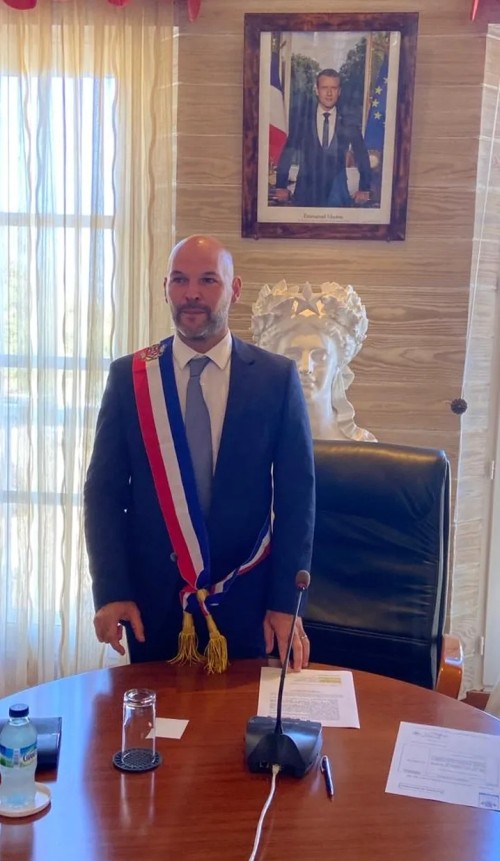
Xavier Lédée takes office as president of the Territorial Council, April 3, 2022. |
April 3, 2022: Xavier Lédée, the leader of Unis pour Saint-Barthélemy, is elected (with 13 votes against 6 blank votes) as president of the Territorial Council. Marie-Hélène Bernier is appointed first vice president, Bettina Cointre second vice president, Marie-Angèle Aubin third vice president, Maxime Desouches fourth vice president. To complete the Executive Council, two seats are reserved for the opposition; these go to Romaric Magras and Alexandra Questel.
April 9, 2022: In the first round of the presidential elections, Macron wins 23.8% of the Saint-Barthélemy vote, Le Pen 22.4%, Éric Zemmour (Reconquest) 17.8%, and Mélenchon 13.2%; turnout is 51.3%. In the second round on April 23, Le Pen, who loses nationally, wins 54.7% and Macron 45.3%; turnout is 56.6%.
June 11, 2022: In the first round of election for deputy of Saint-Barthélemy and Saint-Martin to the National Assembly, Frantz Gumbs of the Democrat Movement wins 47.1% of the vote and former deputy (2012-17) Daniel Gibbs 27.6%; turnout is only 21.2% (18.2% in Saint-Barthélemy). In the second round on June 18, Gumbs is elected with 67.2% of the vote, while Gibbs wins 32.8%; turnout is 24.6% (18.7% in Saint-Barthélemy).
2023: The island welcomes a record 292,835 visitors. A major factor behind this growth is a significant shift toward luxury tourism, as indicated by five-star hotels now making up 52% of the accommodations, compared to 27% in 2015. Tourism employs 35.3% of all salaried workers.
April 7, 2023: The estate built by Rockefeller (see 1957) is sold for $136 million to U.S. citizen Adam Sinn, said to be the highest real-estate transaction ever recorded on the island for a single residence.
Nov. 9, 2023: Senator Jacques is elected president of the Senate's overseas delegation (Délégation sénatoriale aux outre-mer).
Jan. 1, 2024: Population: 10,556.
April 2024: The 2022 alliance having broken down, the elected members of the Action-Équilibre group (led by Marie-Hélène Bernier) break from Lédée's group in the Territorial Council.
June 8, 2024: In elections to the European Parliament, local turnout is 21.8%. The National Front list wins 35.0% of the vote, the list Besoin d'Europe (presidential majority) 13.8%, and the list La France fière (supported by Éric Zemmour) 13.3%.
June 29 and July 6, 2024: Gumbs is reelected deputy. In the first round he wins 41.4% of the vote, Alexandra Questel (SBDA) 19.9%, and Philippe Philidor (Union for Democracy, of Saint-Martin) 16.9%; turnout is 28.7%. In the second round, Gumbs wins 56.0% and Questel 44.0%; turnout is 28.9%.
Jan. 9, 2025: A decree is published making Saint-Barthélemy and Saint-Martin into a full-fledged prefecture no longer dependent on Guadeloupe. This becomes effective on February 10 when Cyrille Le Vély takes office as prefect.
March 17, 2025: Lédée survives a no-confidence motion that sought to replace him with Bernier. The motion receives only 8 votes (10 needed).
Late March 2025: Romaric Magras resigns as head of the SBDA group, describing it as a "personal and family choice" also motivated by "the political situation and the playground atmosphere" that reigns within the Territorial Council. He hands over the leadership to Alexandra Questel.
June 3, 2025: As a result of the resignation of Magras (March 7) as member of the Executive Council, the entire council is elected anew. Marie-Hélène Bernier, the only candidate for the first vice presidency, is elected (10 votes in favour, 9 abstentions). Maxime Desouches tries unsuccessfully to win the second vice presidency from Francius Matignon. He receives only 8 votes to the SBDA candidate's 10. Marie-Angèle Aubin is elected third vice president (11 votes to 8 for Desouches) and Alexandra Questel fourth vice president (11 votes to 8 for Desouches). Desouches is finally elected as the only candidate for the seat of first Executive Council member, by a relative majority (9 votes) after three ballots. Finally, Bettina Cointre, the only candidate for the seat of second member, receives 18 votes out of 19.
Nov. 4, 2025: Romaric Magras announces his resignation as member of the Territorial Council. On December 29 Diana Bourel is installed in his place.