Rulers: Saba: History
Saba
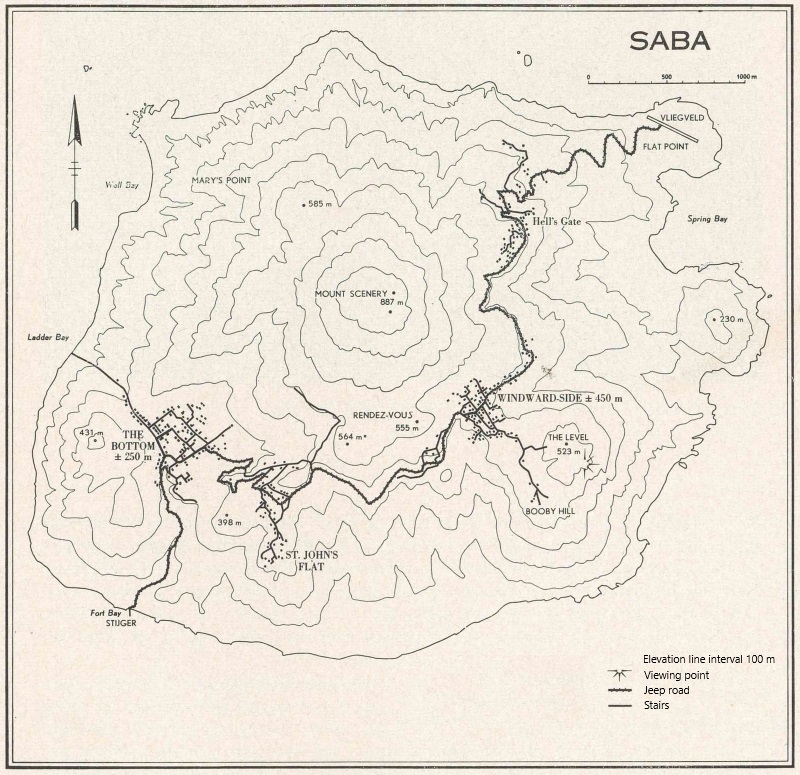
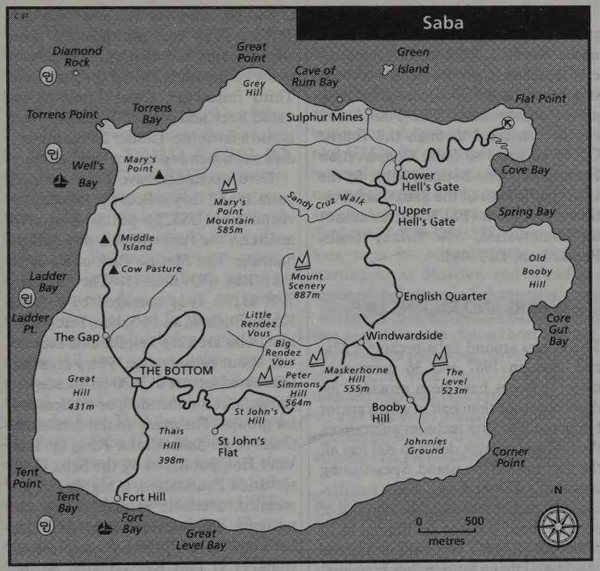
The small island of Saba (pronounced Say-ba) lies in the northeastern Caribbean Sea. With nearby Sint Eustatius and Sint Maarten, it comprises the Dutch Windward Islands, which however are part of the Leeward Islands group of the Lesser Antilles. (See introduction to Bonaire about the terminology.) The island is a dormant volcano (last major eruption over 5,000 years ago1); a few thermal springs still point to past volcanic activity. In pre-colonial times Saba was inhabited by Carib Indians (and possibly Arawaks before them), though this must have been a fluctuating population for lack of a permanent water supply. Research has brought to light Indian dwelling-places in The Bottom (close to the Anglican church) and on Spring Bay; a very remarkable adze almost 20 cm in length was found in the 1850s.
1 However, the youngest pyroclastic flow deposits in the island have been radiocarbon-dated to 1670 ± 60 years. The lack of a historical record of any eruption would seem to indicate that this was a minor one, and perhaps that it is more likely to be put in the pre-settlement part of that timeframe, i.e. 1610-40, if not for the puzzling fact that fragments of European pottery were found in the deposits.
Nov. 13 or 14, 1493: Christopher Columbus is the first European to sail past the island. Though the island lies within the Spanish domain, the Spaniards do not settle it any more than the other northern Lesser Antilles. The name Saba may have its origin in sound-imitation of an Indian word whose meaning is unknown; however, according to a French missionary, Father Raymond Breton, writing in 1665, the Carib name for the island (although the identification is not certain) was Amonhana (also of unknown meaning). An apocryphal story has Columbus promising his Spanish patrons at home and his crew at sea that they would reach the fabled land of Sheba (or Saba; in modern Yemen) and that the wealth thereof would repay all their labour; when he captured some Indians on Guadeloupe and Nevis and asked them the names of the small islands he had seen, they called one of them "Sobo" in their language and Columbus then told the crew that the Indians were merely mispronouncing Saba.
Nov. 5, 1595: The first mention of Saba, in the account of the travels of Sir Francis Drake and Sir John Hawkins, describes these seafarers as being near the island on this day.
1632: Some shipwrecked Englishmen succeed in reaching Saba in a small boat, becoming perhaps the first Europeans to set foot on the island. They find no people there, but some fruit trees.
November 1635: Pierre Belain d'Esnambuc, after taking possession of Martinique and Dominica, also takes possession of Saba for France. The French soon leave, however, and no more French claims are heard of.
1640: The Dutch take possession of Saba. In their search for fresh fish, which they found on the Saba Bank, Dutch colonists from Sint Eustatius (settled in 1636) presumably at an early stage went ashore on Saba, an island that was to prove admirably suited for vegetable-growing. The colonists, people from the Dutch province of Zeeland, discover a fertile valley, the bowl that comes to be called The Bottom - from the Zeeland word botte (bowl), subsequently altered by English travellers who do not know its derivation, supposing The Bottom to be the bottom of a crater. The first colonists create stairs partly cut into the rock that serve as the island's connecting roads (800 steps from Fort Bay to Windwardside) until the advent of the jeep in 1947. Without these rock-stairs settlement would have been out of the question. This also makes the island impregnable; at various points along the few narrow clefts or steps leading upward, the people pile stones on planks laid across poles, and if undesirable visitors try to ascend, the supports are pulled, causing a deluge of stones to crush the intruders.
1645: Guillaume Coppier, who may have visited the island in 1629, reports in his Histoire et Voyages des Indes Occidentales et de plusieurs autres régions maritimes & esloignées about Saba that "A group of savages live there, that are named Igniris, they go with their body completely naked and they have beards, which is different from all Indians, who pull out the hair as soon as it comes; they are idolatrous, their retreat is in the grotesque places of this island, living like wild animals." This could refer to a remnant of the Arawak subgroup named Igneri. In any case, if there was still such an indigenous population in 1629, it is not clear what happened to it subsequently, as no mention of it appears in any document. However, there are some legends about early settlers having to fight Indians to get at the water from the spring at Spring Bay.
c. 1650: A clergyman travelling in the area reports that the people of Saba support themselves by fishing.
1651: A landslide destroys the coastal settlement and people settle in The Bottom.
1659: The English have settled so soon and in such numbers that the services of a clergyman knowing English are required.
August 1665: Following the English capture of Sint Eustatius, Saba is also forced to surrender and suffers the same fate. The English, Irish, and Scots, numbering about 60, take the oath of allegiance, while the 87 Dutch people and 85 blacks and Indians are deported to Sint Maarten. Thomas Morgan is left behind as governor of both islands.
Oct. 7, 1667: John Simpson of Sint Maarten, having organized an expedition as soon as the English left Sint Maarten, recaptures Saba for the Dutch.
July 4, 1672: A few days after Col. William Stapleton took Sint Eustatius for the English, Capt. William Burt, on Stapleton's behalf, also occupies Saba, 40 soldiers being stationed there. The island is restored to the Dutch in 1682.
1683: Sint Eustatius and Saba come to be administered by the Dutch West India Company. Sint Maarten is added to the colony in 1703.
c. 1687: The people of Saba launch a movement to separate the island from Sint Eustatius, of which it has been a dependency. They say they are getting less than their due portion of the foodstuffs and powder and ball sent to the other island from Amsterdam. On July 11, 1689, the inhabitants abjure the commander of Sint Eustatius, Lucas Schorer, and proclaim Vice Commander Engel van Beverhoudt as commander of Saba. But the same year Sint Eustatius was conquered by the French, Schorer and some loyal followers escaping to Nevis. Saba manages to beat off the French with a shower of rocks, after which Schorer and his people take refuge on the island, where, though abjured shortly before, he is received as the Sabans' lawful commander, founds a kind of administration-in-exile, and in 1690 succeeds in raising an army of liberation 35 men strong. (In July 1690 this force makes an encampment in Sint Eustatius but withdraws when a stronger English force arrives, which takes the island; the English return it to the Dutch in 1696.)
1699: Population: 453, including 52 men, 53 women, 217 children, and 131 slaves.
18th century: The island maintains its insular isolation almost undisturbed. The people rarely receive visits from the administrators of Sint Eustatius and thus a kind of patriarchal society develops. One account from 1701 (by a French Dominican missionary, Father Jean-Baptiste Labat) describes almost everyone as a shoemaker. Around mid-century, some fishing and turtle-fishing are practiced, and there is some agriculture, so that the island is essentially economically self-sufficient.
1715: Population: 512, including 176 slaves.
Aug. 31, 1772: A hurricane causes severe damage to the church and 100 houses. While these can be rebuilt, this is not the case for the destroyed cotton, coffee, and indigo plantations. Cotton and coffee grown on Saba is no longer sufficient for domestic consumption and imports from St. Thomas begin.
1777: A virtually permanent lack of incumbents to the Saba parish of the Netherlands Reformed Church, in addition to the fact that the islanders almost exclusively speak English, brings the Anglican Church there.
Feb. 3, 1781: British admiral George Bridges Rodney seizes Sint Eustatius. He dispatches one of his officers, James Cockburn, to capture Saba, meeting no resistance. The British are driven off by the French in November of the same year, and in February 1784 the islands become Dutch again. Apparently these flag changes had no major consequences for Saba.
1790: Population: 1,301, including 730 whites, 564 slaves, and 7 free people of colour. Apart from the commander, the secretary, one of the council members, and a random citizen, none of the 730 whites can write.
1795: As the Dutch republic becomes a satellite of France, the islands come under French rule. The French exact initially fl. 50,000 a month, which given the small population (1,200 white inhabitants on Sint Maarten, 2,400 on Sint Eustatius, hundreds on Saba) cannot be scraped together and is gradually lowered.
19th century: Owing to its difficult terrain, Saba remains sparsely populated. By 1829 there is not a single shoemaker left. Instead, there is livestock farming, with some cattle and pigs being exported, and some agriculture, with the surplus being exchanged on St. Thomas for clothing and other goods. Some little profit is also made by shipbuilding (rowboats, canoes, schooners) and the weaving of straw hats. However, it is the islanders who leave the island that earn most; the people of Saba, being astonishingly good sailors, serve as helmsmen of U.S. sailing ships before their replacement by steam vessels. The island is divided into six divisions: Palmatapunt, de Vallei, Crispijn, St. Jan, de Hellepoort, and de Piek, each of these "villages" having its own elected chief, and the oldest of the elected council members being considered the head of the island and being appointed to the top position as vice-commander, etc.
April 21, 1801: The British take possession of Sint Eustatius and Saba. They return them to the Dutch pursuant to the Treaty of Amiens of March 27, 1802: Sint Eustatius in November 1802 and Saba in January 1803. The Dutch Windward Islands are divided into two colonies, Sint Maarten and Saba together, and Sint Eustatius. Each receives a governor, with Saba's vice-commander changed to a vice-governor.
July 2, 1806: The Dutch Council of the American Colonies sends a memorandum to King Lodewijk I Napoleon saying that on Saba 200 people live from agriculture, but "abundant sulfur, alum, and similar products could be extracted from that mountain, if access were not so difficult."
Feb. 22, 1810: The British again take over Saba.
1816: Population: 1,145, including 656 whites, 462 slaves, and 27 free people of colour.
Feb. 21, 1816: The island is finally confirmed as Dutch territory. The Dutch Windward Islands become a single colony again, under a governor based on Sint Eustatius; Sint Maarten and Saba together form a single subpart of the colony, governed by a commander. All regulations are translated into English, however, as there is no one on Saba who understands Dutch.
March 31-April 26, 1816: South American liberator Simón Bolívar's Republican Squadron anchors at Saba, where he recruits a number of men who go along with him to fight for the independence of Venezuela.
September 1819: A hurricane causes considerable damage, though less than on Sint Maarten.
Jan. 15, 1821: The combined commandership of Sint Maarten and Saba is abolished. Saba is placed directly under the governor's authority and thus rejoins Sint Eustatius.
1828: Johannes van den Bosch, commissioner-general for uniting the Dutch West Indian colonies, establishes a delegated court for Saba. This court continues to exist even after a regulation of May 1, 1834, stipulates that the Colonial Council and court for both islands is to be located on Sint Eustatius; Acting Administrator Theophilus George Groebe puts an end to this in 1836, creating a new vredegerecht (justices of the peace) for small cases on Saba. On Sept. 26, 1839, however, members of a new delegated court are appointed, and that court becomes a reality when a governor-general's resolution dated June 26, 1841, is promulgated on Saba on Feb. 17, 1842.
Aug. 1, 1828: The Dutch Caribbean islands (with Saba remaining subordinated to Sint Eustatius) and Dutch Guiana (Suriname) are united as Dutch West Indies, with a governor-general in Suriname.
Dec. 20, 1828: By decree of the governor-general, the vice-commander of Saba, Edward Beaks, Jr., is dismissed for supporting privateers, following a particular incident in which Beaks however had little power to do anything. Richard Johnson, the oldest council member, succeeds on Jan. 20, 1829.
Feb. 4, 1830: Henry Johnson Hassell acts in place of Johnson (who repeatedly requests resignation because of "my advanced age and consequent debility") until Thomas Dinzey Winfield becomes vice-commander on May 5.
Nov. 20, 1833: The title of vice-commander is changed to commander.
May 31, 1836: The apostolic prefect of Curaçao, Martinus Johannes Niewindt, accompanied by the priest Manuel Romero, visits Saba. At this time only seven Catholics live on the island. Niewindt notes: "The residents live... without the slightest religious service; the last Protestant teacher, whose moral conduct was very questionable, left this year; the church building which he used, and which is not in a very favourable condition, is the only religious institution." On June 1 presumably the first Holy Mass is celebrated on Saba, and another on June 2, but "because of our disastrous ignorance of the English language and... the limited time... we embarked on June 2."
June 10, 1836: Commander Thomas Dinzey Winfield dies. Beaks subsequently becomes commander.
Sept. 18, 1837: Saba's first prison facility is established. Although subsequent colonial reports almost consistently state that there are no prisoners, it is ultimately believed that a better prison is necessary (presumably connected to the slave emancipation), and this is achieved in 1863.
June 1843 and April 1844: J.F.A. Kistemaker, the pastor of Sint Eustatius, visits Saba. By 1850 there are 49 Catholics.
April 9, 1845: It is announced that the islands are to be separated from Suriname. This becomes effective July 16. The administrator of Curaçao becomes the ultimate authority for the other islands.
Dec. 31, 1845: Population: 1,500.
Jan. 27, 1848: Regulations are issued for the administration of the colony of Curaçao and Dependencies, comprising the Dutch Windward Islands and the three territories of the Dutch Leeward Islands - Aruba, Bonaire, and Curaçao. Under a governor based in Curaçao, each other island has its own administrator (gezaghebber, commonly translated as lieutenant governor).
June-December 1850: Kistemaker stays half a year on Saba, purchases a house in Windwardside, and converts it into a church.
1854: Saba is provided with a Roman Catholic pastor, Johannes G. Gast (celebrating Holy Mass for the first time on June 2). When the Anglicans see that he is successful, they react. Catholic children are denied school, Catholic poor are denied alms, churchgoers are harassed and stones are thrown, and libelous pamphlets are distributed. Gast describes life on the island as not idyllic; salt fish and sweet potatoes are usually the only meal. When he leaves in May 1858, there are 259 Catholics. By 1877 Hell's Gate is almost entirely Catholic, Windwardside half; The Bottom and St. John's are Anglican centres.
1854: The small island of Aves, an uninhabitable rock (because the water sometimes washes over it) over 200 km south of Saba (not to be confused with the Las Aves archipelago off the coast of Venezuela), which has always been visited from fishermen from Saba and Sint Eustatius who collected bird eggs and turtles, suddenly attracts attention because the captain of a U.S. ship found guano there, and some enterprising North Americans begin exploiting this product. Venezuela subsequently grants itself sovereignty over this island, although Venezuelans rarely visited it, and it is far from the coast. The Dutch government says it considers the island to belong to the northern group of Dutch islands. It is ultimately decided to end the dispute by submitting it to the arbitration of a friendly power, to be chosen by mutual agreement. Spain becomes the arbitrator, a remarkable choice, since Venezuela argues that Aves belonged to Spain during the Spanish period and Spain can therefore be considered more or less the judge in its own case. Queen Isabel II delivers her judgment on June 30, 1865, assigning the island to Venezuela, but with the Dutch to retain fishing rights or be compensated. This is accepted, and nothing changes for the fishermen.
1857: The most appalling hygienic conditions prevail at this time. There is hardly a family without leprosy or elephantiasis. Due to a lack of proper cisterns, many people obtain drinking water from the three wells on the coast, where everyone, including infectious persons, washes their clothes.
1860: The lands where sulfur has been found (on the north coast, not far from Hell's Gate) come into the hands of North Americans, and the McNick Sulphur Mining Company begins exploitation. Two miners from Sicily, where sulfur mines also exist, dig the shafts in 1875. However, the Americans find the results not sufficiently rewarding and cease exploitation in 1876. In 1903-05 further attempts are made to extract the sulfur, but these too are abandoned.
Oct. 18, 1862: The slave emancipation act is promulgated on Saba. The effective date is July 1, 1863. Little changes for the former slaves (numbering 708), who worked the land alongside whites under unusually humane conditions and are now given paid work.
May 7, 1863: Administrator Edward Beaks, Jr., at the head of Saba since 1836, dies. His son Edward James Beaks then acts in his stead but Mozes Leverock (son-in-law of the late Beaks) becomes the permanent successor (appointed June 22, taking office in July). This patriarchal Saban manages to make many improvements, having the streets of The Bottom paved, walls and fences built here and there, etc. The Bottomers are so pleased that on Dec. 25, 1868, they decide to rename the town Leverock, though the old name prevails.
1865: Population: 1,809, of which Saba-born 1,766, foreign-born 43; Saba-born by village: The Bottom 599, Windwardside 551, St. John's 244, Hell's Gate 140, Booby Hill 87, Mary's Point 75, Middle Island 70. The number of houses is 327.
Last quarter of 19th century: Gertrude Johnson of Saba introduces a special form of needlework called "Spanish Work" as she was taught this when at a Caracas boarding-school run by Spanish nuns. Especially after 1900 it becomes an export commodity, reaching a peak of fl. 22,690 in 1928 but petering out in the 1930s.
Aug. 1, 1875: Leverock dies. On October 15 Jan Jacob Beaujon Quast is appointed to succeed him.
Feb. 25, 1878: An Anglican church is consecrated. A permanent clergyman also arrives from England.
May 20, 1880: Administrator Quast dies.
March 25, 1883: Administrator Marius Lodewijk Statius van Eps dies. On June 15 Jacques Joseph Jonckheer is appointed to succeed him.
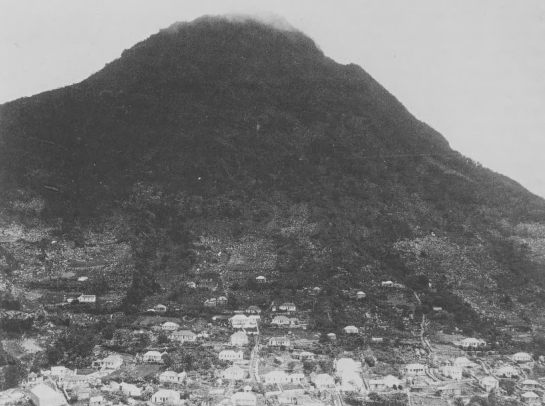
View of Windwardside and Mt. Scenery, 1890. |
September 1890: A hurricane hits the island, the worst Saba has experienced. 20 thatched houses and 1 wooden house are completely destroyed, and 32 thatched houses and 38 wooden houses severely damaged. Windwardside is hit the hardest.
1890-91: An administrator's residence is built.
1899-1902: During the Boer War, the British hire over 100 men from Saba to guard their prison camps in Bermuda. Sabans continue to find work on Bermuda until 1927.
1903: Dutch member of parliament Henri van Kol visits Saba and, though noting "relative prosperity," proposes to depopulate the island and transfer the population to Sint Eustatius, "where extensive government land awaits the hand of a developer." Seeing that his suggestion is not practicable, the same van Kol then works diligently for the foundation of a navigation school on Saba. This plan succeeds in 1909, when the school is founded in The Bottom. Run by Saban captain Frederick Augustus Simmons, it lasts until 1922.
1908: The construction of a jetty in Fort Bay having been approved, materials for the scaffolding are transported to Saba. However, getting the pillars into the ground does not succeed.
1912: Out of a total adult male population of 774, no less than 530 are listed as seamen in a census.
1913: Half the population is Catholic by this time. Part of this growth is explained by the initial objections of the Anglican church to marriage between people of different skin colours. Such couples often joined the Catholic church and had to promise, even if only one of the partners was Catholic, to have their children baptized and raised as Catholics.
1914-18: During World War I, cotton-growing (formerly an important industry, especially for the local manufacture of gloves) vanishes on Saba.
1915: Population reaches a peak of 2,488.
1917: With the United States entering World War I, Saban captains and navigators are employed on North American ships. After the war emigration to the U.S. increasingly occurs.
Aug. 3, 1920: Sint Maarten becomes the residence of the gezaghebber of the Windward Islands, represented on Sint Eustatius and on Saba by a deputy administrator (plaatsvervangend gezaghebber), from 1937 a subadministrator (ondergezaghebber).
1923: On the 25th anniversary of Queen Wilhelmina's accession to the throne, Saba receives the Queen Wilhelmina Library. In 1932 a branch is opened in Windwardside. Both branches languish and the Windwardside branch disappears at some point before being reopened in 1948 when a membership recruitment campaign increases the number of members in The Bottom from 2 to 25.
1925: Saba receives a small hospital, in The Bottom.
Sept. 12/13, 1928: A hurricane destroys 15 houses; many banana trees are swept away and livestock dies.
1930s: The rise of the oil industries on Aruba and Curaçao (where many Windward Islanders went for employment) results in a more liberal flow of government funds in the Antilles, which also benefits the Windward Islands.
Jan. 1, 1931: Census population: 1,457. Due to male emigration, the population shows a significant female surplus (males 551, females 906).
Nov. 2, 1931: A Saba-Sint Maarten telegraph service is opened.
Dec. 1, 1931: A regular two-week shipping service to the Windward Islands begins, following a route from Curaçao to St. Thomas, Sint Maarten, Saba, and Sint Eustatius, then St. Kitts, before returning to Curaçao again via Sint Eustatius, Saba, and Sint Maarten. Bonaire is added to the route in 1932.
Sept. 26, 1932: A hurricane causes considerable damage, several wooden houses being destroyed in Hell's Gate; 2 people die. The Catholic churches both in Hell's Gate and The Bottom are pushed from their foundations. They are subsequently moved back into place.
1933: A bridge is built over the gap created in 1819 that isolated Simpson's Bay for over a century.
Jan. 1, 1933: Dutch language lessons begin to be taught in all grades.
1934: The hamlet of Mary's Point, whose origin is shrouded in mystery (it has been mentioned as early as 1836), a 45 minutes' walk from The Bottom along a very difficult mountain path, disappears as the population of 32 is transferred to The Bottom. The residents married among themselves and had virtually no contact with the rest of the island's population. In 1902, 70 people lived there, 10 of whom were insane. In 1919 consideration was already given to transferring these people elsewhere on the island, but they were unwilling. Even in their new neighbourhood, called Promised Land, the Marypointers - as they continue to consider themselves - still form a closed community 30 years after the resettlement.
1934: The restoration of the Ladder (the steps up from Ladder Bay) and Fort Bay Road as well as the construction of a small jetty provides many jobs, even though it turns out that the jetty is of little value.
c. 1935: Saba receives a telephone network of 10 connections.
March 19, 1935: A new Catholic church is consecrated in The Bottom.
March 20, 1941: A U.S. motor yacht carrying representatives from the Virgin Islands Tourist Company visits Saba to investigate the possibility of taking tourists visiting the Virgin Islands on excursions to Saba. Indeed, motor vessels carrying ten or more tourists do visit Saba several times afterward.
1942: Journalist Martha Gellhorn, wife of writer Ernest Hemingway, visits Saba.
August 1942: As a result of German submarine action, the steamship connection between the Windward and Leeward Islands is discontinued. On October 24, rationing of flour and bread begins.
1943: A small hospital is built in Windwardside, as the one in The Bottom can be difficult to reach from the other villages.
Oct. 16, 1943: Fort Bay Road (1,150 m, with a maximum gradient of 20%) is completed.
May 5, 1945: A torchlight procession is held on the evening of Dutch liberation day.
Nov. 29, 1945: A radiotelephone connection with Sint Maarten is opened.
Nov. 23, 1946: A small seaplane lands in Fort Bay, the first aircraft to visit Saba (though air mail was dropped shortly before, on September 27 and October 5).
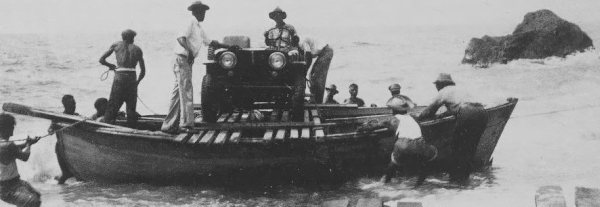
The first motor vehicle being landed on Saba, March 17, 1947. |
March 17, 1947: The first automobile appears, a jeep, lashed to two rowboats, which is floated to the pier and then lifted onto dry land by some 50 men. It initially has some defects but is finally (on March 18) made to run; it climbs the slope and drives to The Bottom in 6-7 minutes, which (for non-Sabans) is about an hour's climb. At first the jeep is unsuitable for any use other than going to Fort Bay, because all the other roads have steps; construction of roads is progressing slowly, but in 1951 St. John's becomes accessible, and Windwardside shortly thereafter. In 1952 there are 9 cars, and in 1964 46.
Sept. 20, 1948: Saba becomes part of the Netherlands Antilles federation.
March 17, 1949: The first elections to the Staten (Netherlands Antilles legislature) in which each of the three Windward Islands elects its own representative are held. On Saba two lists contest the election. Of 385 valid votes, 281 go to the list which bears the stamp of the National People's Party (NVP), with the most votes (179) going to the third candidate on the list, Charles Ernest Wilfred Voges, the subadministrator of Sint Eustatius.
c. 1950: The oil plants are mechanized, causing the dismissal of many Windward Islanders. A great number of them, however, remain on Aruba and Curaçao, having raised families there; others return.
Jan. 26, 1950: Prince Bernhard is the first member of the royal family to visit Saba.
1951: A cinema opens in The Bottom. Another one opens in Windwardside in 1954.
March 14, 1951: The administration of the Netherlands Antilles is reorganized, four autonomous island territories being created: Aruba, Bonaire, Curaçao, and the Windward Islands, with their own Island Councils. The title of ondergezaghebber in Saba is changed to administrateur. The Windward Island Council has 15 members, 5 from each island. Saba provides two of the six members (gedeputeerde, also called commissioners) of the Windward Islands Bestuurscollege (executive board).
June 4, 1951: The first Island Council elections take place (315 valid votes cast). Seats are won as follows:
| List I (K. Peterson et al. - NVP) | 3 |
| List II (J.L. Hassell et al. - a Roman Catholic group) | 2 |
| List III (R.A. Sorton et al. - a radical group) | 0 |
July 5, 1951: Mathew Levenstone and Ulric Hassell (both NVP) are elected as Saba's members of the Bestuurscollege, serving until 1955 (Levenstone switches to the Democratic Party [DP] after the Staten elections of 1954).
Feb. 14, 1952: A helicopter attempts to land in The Bottom; this proves impossible, but it lands at St. John's instead.
Dec. 15, 1954: A Charter (Statuut) gives the federation of six islands full autonomy in domestic affairs, and declares the Netherlands Antilles to be an integral part of the Kingdom of the Netherlands. Despite the Charter, there are demands for further self-government from within the federation for most of the latter half of the 20th century.
January 1955: A hurricane blocks the Fort Bay Road, and considerable damage is caused to the houses.
June 13, 1955: In Island Council elections, there are three lists. The DP list (D.L.N. Donker) receives 257 votes (3 seats), the NVP list (E.A. Johnson) 177 (2), and that of J.E. Vlaun, who wants to be independent, 8 (0).
July 2, 1955: Mathew Levenstone and Arthur Anslijn (both DP) are elected as members of the Bestuurscollege.
Oct. 24, 1955: Queen Juliana and Prince Bernhard visit Saba.
May 4, 1957: A commemorative plaque is hung at the entrance to The Bottom in memory of the 13 Sabans who fell in one way or another during World War II.
February 1958: Princess Beatrix visits Saba. To the great delight of the residents, she walks briskly and athletically up and down the stairs at a pace that is too much for many of her entourage.
1959: The Windwardside hospital burns down. It is then decided to build a centrally located hospital in St. John's, as road transport of patients has become possible. This, the Princess Irene Hospital, opens March 26, 1960.
Feb. 9, 1959: The first plane lands on Saba.
May 25, 1959: In Island Council elections, there are two lists. That of the DP (J.E.M. Levenstone) wins 324 votes and 4 seats, that of the NVP (Milton Johnson) 102 (1). On July 2 Levenstone and Anslijn are reelected members of the government, serving until 1963.
1960: A cooperative effort by the governments of the Netherlands and the Netherlands Antilles results in a welfare project equivalent to 12½ million Antilles guilders, of which 7½ million are grants to the Windward Islands for the execution of works which, though providing no direct profit in themselves, are necessary to promote private enterprise, among them the construction of airfields and of a harbour, and measures to ensure an adequate supply of electricity and water.
January 1961: The Saba Development Corporation is established.
Jan. 1, 1961: Census population: 980 (males 444, females 536), including 56 foreigners. The population of The Bottom is 344, of Windwardside 331, of Hell's Gate 188, and of St. John's 117.
Late 1961: It is estimated that approximately 20% of tourists staying on Sint Maarten for a few days also go on to Saba.
July 1962: Princesses Irene and Margriet visit Saba.
1963: The Saba People's Party (SPP) is founded by Cessie Granger.
May 31, 1963: In Island Council elections, there are three lists. That of the NVP-leaning SPP wins 208 votes and 2 seats, that of the DP 178 (2), and that of The True Democratic Party (TTDP) 73 (1).
July 2, 1963: Max Nicholson (TTDP) and Arthur Anslijn (DP) are elected as members of the government, serving until 1971.
Sept. 18, 1963: An airfield is officially opened, named Juancho Yrausquin Airport, after the former finance minister of the Netherlands Antilles who died in 1962. Regular air service between Sint Maarten and Saba already began on July 24, 1963.
Oct. 20, 1963: Electricity becomes available in The Bottom. Windwardside and St. John's follow on Jan. 23, 1964.
1964: Population: 1,022 (479 male, 543 female).
March 23, 1964: The road to the airport is opened in the presence of Dutch deputy prime minister Barend Biesheuvel and Netherlands Antilles prime minister Efraïn Jonckheer. It is named Drs. H.A. Korthals Road, after a former Dutch deputy prime minister and minister of Netherlands Antilles affairs.
March 2, 1967: As on the other Windward Islands, only a single list is submitted on Saba for the Island Council, so that no elections will take place. The first five on each list will therefore be declared elected. On the Saba list, submitted by the United Saba People's Party, these are M.W. Nicholson, E.A. Johnson, P.L. Granger, J.A. Anslijn, and J.G. Woods.
Aug. 24, 1968: The first newspaper, the Saba Herald, is established by Will Johnson. It lasts until 1993.
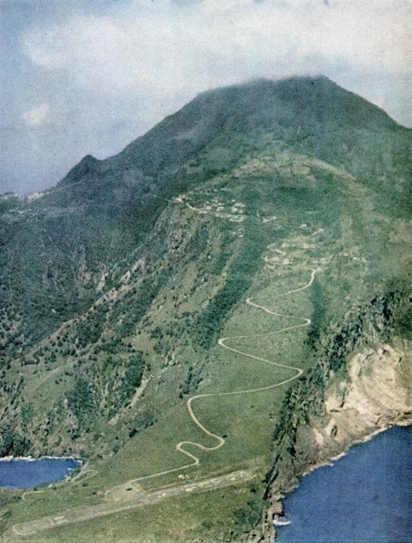
Saba's 400-m runway, the island's only flat surface, 1969. |
1970: A low point in population is reached: 907.
Nov. 24, 1970: The Windward Islands People's Movement (WIPM) forms a branch on Saba. Will Johnson is chairman.
May 7, 1971: The WIPM wins elections on Saba, ending 20 years of dominance by the DP, but remains in the minority in the Windward Island Council.
June 1971: John Woods and Calvin Holm are elected as Saba members of the Bestuurscollege, serving until 1975.
Sept. 28, 1971: A radio station, the Voice of Saba, goes on air.
Nov. 8, 1972: Capt. L.A.I. Chance Pier is opened. It allows not only fishing boats, but also sailboats and dive boats to moor, thus opening up the island to the possibility of tourism.
May 9, 1975: In Island Council elections, the WIPM wins 4 of 5 seats and the DP 1. But in the Windward Islands as a whole, the DP wins 9 of 15 seats and the WIPM 6.
Early July 1975: Will Johnson and Cessie Granger are elected as Saba members of the Bestuurscollege, serving until 1983.
Dec. 5, 1975: The first Saba Day is celebrated, subsequently held every first Friday in December.
1976: A new village called The Level comes into existence after completion of a road to that once isolated area.
1977, 1982: The WIPM boycotts the elections to the Staten, the parliament of the Netherlands Antilles, to reinforce its demands for a division of the Windward Islands.
April 27, 1979: The WIPM wins all 5 Saba seats in Island Council elections. The WIPM now also has a majority (8 of 15 seats) in the Windward Islands as a whole.
April 1, 1981: George R. Sleeswijk takes office as acting administrateur. In June Raphael A.M. Sorton is appointed administrateur, effective July 10.
December 1982: A solar-powered beacon at the rear of the secondary school in St. John's goes into operation. The central government commissioned the beacon in connection with the construction of the Sint Eustatius oil terminal, which has led to numerous tankers using this route.
February 1983: It is decided to make Saba its own eilandgebied (island territory) again, with its own gezaghebber. The last administrateur, Raphael A.M. Sorton, becomes acting gezaghebber on April 1.
May 6, 1983: In Island Council elections, the WIPM wins 77.4% of the vote (4 of 5 seats) and the DP 22.6% (1). Cessie Granger and Vernon Hassell subsequently become members of the Bestuurscollege.
Sept. 9, 1983: Acting administrator Sorton leaves office. From September 10 Cessie Granger is acting, until Wycliffe Smith takes office as administrator on November 1.
Nov. 21, 1983: Princess Juliana visits Saba.
Nov. 26, 1984: A bust of Simón Bolívar is unveiled in Windwardside as a remembrance of his 1816 visit.
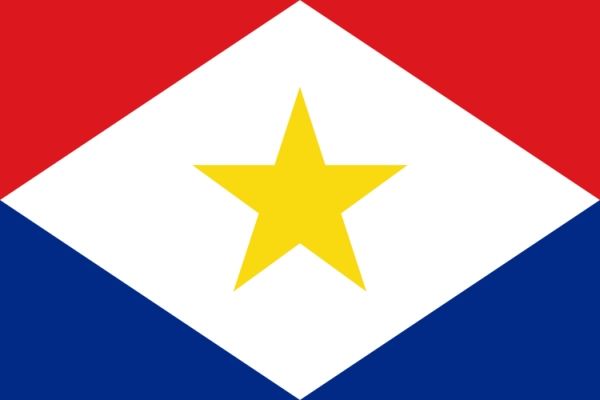
Dec. 6, 1985: An official anthem and a flag and coat of arms of Saba are adopted. The flag (designed by 18-year-old Edmond Daniel Johnson, a Saban student studying in the Netherlands, and chosen from among 130 entries in a competition) bears a white lozenge whose points touch the centre of each of the four edges of the flag. A five-pointed yellow star is emblazoned in the centre, representing Saba. The colour stands for the wealth of natural beauty found on the island and symbolizes hope for the future. The two triangles at the top of the flag are red and those at the bottom, royal blue. These colours symbolize historical and political ties with the Netherlands and the Netherlands Antilles. The anthem, written by Christina Maria Jeurissen (Sister Waltruda) of the order of Dominican nuns in 1960, is as follows:
Saba, you rise from the ocean,
With mountain and hillside so steep,
How can we reach you to greet you,
Isle of the sea, rough and deep.
Come, let us look at the rowers
with faces so placid and calm,
Guide us now safe through the breakers,
take us ashore without harm.
Chorus:
Saba, oh jewel most precious,
In the Caribbean sea.
Mem'ries will stay of thy beauty,
Though we may roam far from thee.
Saba, oh pearl of the ocean,
Friendly and lovely, though small,
Do not forget to be grateful,
To God the creator of all.
He in his goodness will guide you
and bless you in every part,
Making you always most precious
Saba, so dear to my heart.
May 1986: Saba signs a protocol with the Dutch government to implement English as the language of instruction throughout the school system, in place of Dutch.
May 22, 1987: The WIPM loses elections to Vernon Hassell's Saba Democratic Labour Movement (SDLM), which wins 51.0% of the vote and 3 seats (Cessie Granger, Ramon Hassell, Vernon Hassell). The WIPM wins 41.4% and 2 (Will Johnson, Elmer Linzey), and the Saba True Labour Party 7.6%. Cessie Granger and Vernon Hassell are subsequently confirmed as members of the government.
June 25, 1987: The Saba National Marine Park is established, circling the entire island from the high-water mark to a depth of 60 m, including the seabed and overlying waters.
Oct. 15, 1987: The Saba Conservation Foundation is established, with the main objective of preserving and managing Saba's natural and cultural heritage.
End of 1987: Population: 1,130 (553 men, 577 women).
August 1989: Sydney Sorton is appointed administrator, effective November 1.
April 12, 1991: In Island Council elections, the WIPM wins 72.0% of the vote (4 of 5 seats) and the SDLM 28.0% (1). Roy Smith and Steve Hassell subsequently become members of the government.
Oct. 14, 1994: Saba follows Curaçao's example and votes in a referendum (by 86.3%) to remain within the Netherlands Antilles federation, with 9.6% opting for separate status (like Aruba, which separated in 1986) and 3.6% for closer ties to the Netherlands. Turnout is 78.8%.
May 12, 1995: In Island Council elections, Steve Hassell's SDLM wins 54.4% of the vote (3 of 5 seats) and the WIPM 45.6% (2).
April 1999: Antoine J.M. Solagnier is appointed administrator, effective May 1.
May 7, 1999: In Island Council elections, the WIPM wins 70.7% of the vote and 4 of 5 seats (Lisa Hassell, Ray Hassell, Will Johnson, Eric Linzey), the Saba Labour Party (SLP) 22.3% and 1 (Ishmael Levenstone), and the Democratic Party of Saba 7.1%.
November 1999: Hurricane Lenny damages the airport tower, the main pier of the harbour, and other buildings.
August 2001: As a sign of the gradual disappearance of the artificial barriers that long existed between Caribbean territories with different colonial histories, Saba indicates its keen interest in joining the English-speaking Organization of Eastern Caribbean States.
May 23, 2003: In Island Council elections, the WIPM wins 47.3% of the vote and 3 of 5 seats (Lisa Hassell, Will Johnson, Rolando Wilson), the Saba United Democratic Party 36.8% and 2 (Steve Hassell, Lucia Woods), and the SLP 15.9%. Turnout is 89.1%. A government is subsequently formed including Will Johnson and Lisa Hassell.
Oct. 8, 2004: A commission established by the Dutch and Antillean governments recommends the dissolution of the Netherlands Antilles. The commission proposes that Bonaire, Sint Eustatius, and Saba (the "BES Islands") should be directly administered by the Dutch government as koninkrijkseilanden ("kingdom islands").
Nov. 5, 2004: In a referendum, voters choose direct links with the Netherlands with 86.0%; 13.2% support the status quo and 0.8% independence. Turnout is 77.8%.
Nov. 26, 2005: A preliminary agreement with the Dutch government is signed in Curaçao that the extant federation be dissolved by July 1, 2007. The status of koninkrijkseiland, equivalent to that of a Dutch province, is subsequently refined to that of a bijzondere gemeente ("special municipality") or officially an openbaar lichaam ("public body" or "public entity"), similar in most ways to metropolitan Dutch municipalities, but not being part of a province, and with separate social security and currency arrangements.
Oct. 11, 2006: An agreement confirming Saba's impending accession to special municipality status is signed in The Hague, Netherlands, and includes provisions for citizens to participate in Dutch national and local elections and in elections to the European Parliament.
March 2007: Saba says that it will not permit same-sex weddings, even though such ceremonies are recognized in the Netherlands.
April 20, 2007: In Island Council elections, the WIPM wins 73.8% of the vote and 4 of 5 seats (Carl Buncamper, Chris Johnson, Rolando Wilson, Bruce Zagers) and the SLP 26.2% and 1 (Akilah Levenstone).
July 2, 2007: Chris Johnson (son of Will Johnson) and Bruce Zagers are installed as members of the government.
July 2, 2008: Jonathan G.A. Johnson takes office as administrator.
Dec. 15, 2008: The Dutch prime minister, Jan Peter Balkenende, and the Antillean premier, Emily de Jongh-Elhage, sign an agreement for a phased dismantling of the federation to be completed by Jan. 1, 2010.
Sept. 30, 2009: It is decided that the federation will be dissolved on Oct. 10, 2010.
Oct. 10, 2010: Saba, like Bonaire and Sint Eustatius, becomes a special municipality of the Netherlands. The position of representative of the national government (rijksvertegenwoordiger, or kingdom representative) for the BES Islands (Caribisch Nederland) is instituted, based in Bonaire (see Bonaire for appointments etc.). The integration into the Netherlands means that Saba's Mount Scenery, at 887 m, now is the highest point in the Netherlands, far exceeding the Vaalserberg (322 m), the highest point in the European Netherlands. With the post of governor of the Netherlands Antilles gone, the gezaghebber comes to be called in English island governor, an even more dubious translation than lieutenant governor, given that the regular Dutch term for governor would be gouverneur and that municipal instead of sub-territorial status would, if anything, have justified a downgrade of the title.
Jan. 1, 2011: The U.S. dollar is formally adopted as Saba's currency, replacing the Netherlands Antilles guilder; the Island Council opposed the introduction of the euro, the currency of the Netherlands (Saba is not considered an integral part of the European Union but an overseas territory in association with it).
March 2, 2011: Elections to the Island Council are held. The WIPM wins 83.4% of the vote and 4 of the 5 seats (Carl Buncamper, Chris Johnson, Rolando Wilson, Bruce Zagers), while the SLP with 16.6% secures the remaining seat (Akilah Levenstone). Turnout is 86.9%. Chris Johnson and Bruce Zagers subsequently are confirmed as members of the government.
Dec. 25, 2011: Max Nicholson, prominent businessman and politician, owner of the island's lone radio station and at times acting gezaghebber, dies.
March 9, 2012: Former member of the Island Council (1963-91) and government (1975-91) Cessie Granger, 94, dies.
Sept. 12, 2012: Saba residents' first opportunity to vote in Dutch polls comes when elections to the Second Chamber (lower house) are conducted. The Democrats 66 win with 54.8% of the vote, ahead of the Labour Party with 19.9%. Turnout is 28.4%.
Oct. 10, 2012: Dutch legislation to legalize same-sex marriage in the special municipalities takes effect. The first same-sex marriage on Saba takes place on December 4.
Nov. 14, 2013: King Willem-Alexander and Queen Máxima visit Saba.
May 22, 2014: In elections to the European Parliament on Saba, the Democrats 66 win 47.8% of the vote, the Socialist Party 23.0%, the Christian Democratic Appeal 9.7%, and the Labour Party 6.2%. Turnout is 14.2%.
December 2014: Figures released by Statistics Netherlands show that 93% of the population of Saba indicate that English is their first language; hardly anyone speaks Dutch as first language.
March 18, 2015: In elections to the Island Council, the WIPM wins 57.2% of the vote and 3 of 5 seats (Chris Johnson, Rolando Wilson, Bruce Zagers) and the SLP with 42.8% increases its representation to 2 seats (Ishmael Levenstone, Monique Wilson). On March 26 Chris Johnson and Bruce Zagers are reappointed members of the government.
Oct. 12, 2015: A committee, chaired by Liesbeth Spies, to evaluate the success of the new administrative arrangements in Bonaire, Saba, and Sint Eustatius since October 2010 presents its findings. The committee concludes that, in spite of positive results, as in health care and education, much is still disappointing: economic development has been limited, poverty has increased, and islanders feel that they have not been involved in the changes enough, and that insufficient account has often been taken of the special circumstances on the islands. Differences in language, scale, and culture are making the collaboration between the three islands and the central government more difficult. The Saba authorities endorse the committee's findings.
May 12, 2016: The Dutch government, in response to the evaluation committee report, announces proposals to counter poverty and to encourage investment, employment, and development in Bonaire, Saba, and Sint Eustatius. Island administrations will also be given more support. The Saba authorities generally regard the proposals as unfocused, limited, and ineffective. On June 28 the First Chamber (the upper house of the Dutch parliament) approves a motion on the establishment of a minimum standard of living in the three islands. The Second Chamber adopts a similar motion on October 25.
May 27, 2016: Rolando Wilson is inaugurated as member of the government, replacing Chris Johnson, who is appointed as head of the representation of the Netherlands in Sint Maarten. Replacing Wilson as Island Council member is Vito Charles.
March 15, 2017: In elections to the Dutch Second Chamber on Saba, the Democrats 66 win 30.0% of the vote, the Socialist Party 26.1%, GreenLeft 16.2%, the Christian Democratic Appeal 10.4%, and the Labour Party 6.5%. Turnout is 43.3%.
September 2017: The passage of Hurricanes Irma and (two weeks later) Maria results in substantial damage to Saba's housing stock and infrastructure (particularly the harbour). The mainland authorities pledge to provide the island with some €27 million of reconstruction funding. The construction of a new harbour is due to be completed in 2023.
Oct. 31, 2017: The Dutch parliament approves a constitutional amendment that formalizes the status of Bonaire, Saba, and Sint Eustatius as public bodies; previously their constitutional basis was only secured in the Kingdom Charter, not the Dutch constitution. In addition, an Electoral College (Kiescollege) will ensure that residents with Dutch nationality can indirectly vote for the First Chamber. The influence is very limited, however, as the three islands together represent less than the amount of votes needed for one actual seat in the chamber.
2018: The GDP contracts by 2.5% as a result of a decline in tourism following the hurricanes. Inbound tourism by sea and air drops by nearly 16% in the year.
June 29, 2018: The Dutch government announces measures to reduce poverty and improve employment in Bonaire, Saba, and Sint Eustatius. On July 13 the mainland authorities announce a €30 million poverty alleviation and economic development fund, the investments to be made contingent on good governance and sound financial management.
2019: A project to expand the island's airport is completed. Air passenger arrivals rise to 8,900 in the year, the majority from the Netherlands (including the Dutch Caribbean). Overall tourist arrivals increase by 10%. Tourism is the largest contributor to the economy. Saba records a budget deficit of $621,000, owing to a lack of structural funds.
March 20, 2019: In elections to the Island Council, the WIPM wins 79.0% of the vote and all 5 seats (Carl Buncamper, Vito Charles, Eviton Heyliger, Rolando Wilson, Bruce Zagers). The SLP wins 12.7% and "List 3" (a non-party "blank list," led by Dave Levenstone) 8.2%. Turnout is 92.1%. In the first elections to the Electoral College for the Dutch First Chamber, the WIPM wins 83.3% of the vote (4 of 5 seats) and the SLP 16.7% (1); turnout is 73.4%. On March 28 Bruce Zagers and Rolando Wilson are sworn in again as members of the government, being replaced on the Island Council by Esmeralda Johnson and Hemmie van Xanten. In the Electoral College's vote on May 27, the Saba electors give 2 votes each to the Democrats 66 and GreenLeft, with one blank vote.
May 23, 2019: In elections to the European Parliament on Saba, the Democrats 66 win 57.5% of the vote, the Labour Party 14.2%, and GreenLeft 10.6%. Turnout is 12.4%.
June 27, 2019: The Dutch government sets the "social minimum" for Saba at $1,077 per month. To this end, the Netherlands announces further measures to increase local incomes, including a rise in the minimum wage. Saba and the Netherlands conclude a cooperation agreement ("Saba Package") in the field of social and economic development, good governance, and public policy and security, to run until 2022.
Oct. 24, 2019: Former Island Council member Ishmael Levenstone (b. July 23, 1940) dies.
2020: A budget surplus of $962,000 is achieved.
April 11, 2020: The first confirmed case of the new coronavirus disease (COVID-19) in Saba is announced. Authorities temporarily seal the territory's borders to foreign travellers, order the closure of schools and non-essential businesses, introduce a nighttime curfew, and impose an island-wide lockdown. The apparent success of these policies in containing the spread of the disease prompts the territorial administration to end the lockdown in May, and a phased reopening of borders commences in early July. However, some restrictions are reintroduced in late July owing to concerns about rising case numbers on neighbouring islands. Meanwhile in April the Dutch government announces emergency support for businesses and workers in Saba, Sint Eustatius, and Bonaire estimated to cost €13 million. However, government representatives from the three islands request more comprehensive measures to offset the economic downturn.
November 2020: Some non-essential travel begins to be permitted to the island, and there is a further relaxation of the rules from May 1, 2021. With support from the Netherlands, Saba begins its COVID-19 vaccination programme in February 2021; by August more than 90% of the adult population has been fully vaccinated. No COVID deaths have been reported by the end of 2021. Tourism arrivals fell to 2,900 in 2020 as the pandemic closed borders.
2020-21: The Saban government announces a series of additional financial relief measures. The Netherlands also agrees to provide further emergency financial assistance, and Dutch medical and humanitarian aid is dispatched to the island.
Nov. 6, 2020: The Netherlands grants Saba the right to implement the special allowance (bijzondere onderstand, for people with low incomes who have unexpected large expenses) and an exemption from the work permit requirement for teachers.
Jan. 1, 2021: Population: 1,918.
March 17, 2021: In elections to the Dutch Second Chamber on Saba, the Christian Democratic Appeal wins 43.0% of the vote, BIJ1 (bijeen - "together") 25.3%, the Democrats 66 9.4%, and the People's Party for Freedom and Democracy 6.3%. Turnout is 49.6%.
October 2021: The European Union approves a new association agreement, which provides for EU development funding for Saba and the other Dutch Caribbean territories during 2021-27.
December 2021-January 2022: A spike in the infection rate forces the government to tighten its public health protocols. Nevertheless, owing to the island's high vaccination rate, travel restrictions are eased in February-March, and in May all remaining visitor entry requirements are withdrawn. By September 5, according to the World Health Organization, there have been 723 confirmed COVID-19 cases and two fatalities.
2022: Tourism increases from 4,000 in 2021 to 4,900, still considerably lower than before COVID in 2019, when 8,800 tourists visited the island.
May 2022: In response to high rates of poverty in Saba, the Dutch government increases various social benefits on the island and announces the introduction of an unemployment benefit. Additional financial resources are also to be allocated to the island administration. On June 13 the Saban and Dutch governments sign a socioeconomic development agreement ("Saba Package 2.0") to support the island further.
June 1, 2022: Hemmie van Xanten becomes an independent after resigning from the WIPM.
Dec. 8, 2022: To reinvigorate the sector, a five-year tourism master plan is presented.
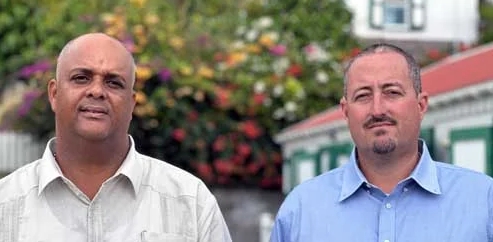
Government members Eviton Heyliger (left) and Bruce Zagers, 2023. |
March 15, 2023: In elections to the Island Council, the WIPM wins 59.3% of the vote and 3 of 5 seats (Eviton Heyliger, Rolando Wilson, Bruce Zagers), the Party for Progress, Equality and Prosperity 31.2% and 2 (Saskia Matthew, Hemmie van Xanten), "List 4" 9.1%, and the Saba Caring People Party 0.4%. Turnout is 83.6%. In elections to the Electoral College, the WIPM is unopposed. On March 29 a government is formed including Eviton Heyliger and Bruce Zagers, who are replaced on the Island Council by Vito Charles and Elsa Peterson. In the Electoral College's vote on May 30, the Saba electors give all 5 votes to the Labour Party.
Nov. 22, 2023: In elections to the Dutch Second Chamber, 54.8% of voters on Saba choose the Democrats 66, followed by GreenLeft/Labour Party with 15.2% and the People's Party for Freedom and Democracy 7.0%. Turnout is 26.3%.
June 6, 2024: In elections to the European Parliament, turnout on Saba is 17.0%. The leading parties are the Democrats 66 (47.1%; most of these votes being for the state secretary for kingdom relations, Alexandra van Huffelen) and GreenLeft/Labour Party (20.6%).
Oct. 8, 2024: Saba and Ballast Nedam International Projects sign the construction contract for the new Black Rocks harbour.
Nov. 15, 2024: Princess (former queen) Beatrix visits Saba.
Nov. 25, 2024: Former administrator (1999-2006) Antoine J.M. Solagnier dies.
Jan. 1, 2025: Population: 2,158, an increase of 5% over a year.
July 1, 2025: Saba's longest-serving administrator, Jonathan Johnson, announces that he will not seek reappointment when his third six-year term concludes in 2026.
Aug. 29, 2025: The Dutch government approves a bill to increase the number of members of BES Island Councils and governments, in Saba's case from 5 to 7 and from 2 to 3 respectively, to take account of population growth. The expansion takes effect with the next elections in 2027.
Sept. 12, 2025: A local fireman, Sheldon Johnson, 32, is killed in a shooting at Hell's Gate. Saba's previous homicide, a case of strangling, occurred in 2015, while the last fatal shooting took place in 1989.
Oct. 29, 2025: In elections to the Dutch Second Chamber on Saba, the Democrats 66 win 39.8% of the vote, GreenLeft/Labour Party 26.3%, the Party for Freedom 9.7%, and New Social Contract 8.1%. Turnout is 26.6%.
May 29, 2026: Jocelyn Levenstone is appointed as administrator, effective July 1. He is sworn in on July 9.