|
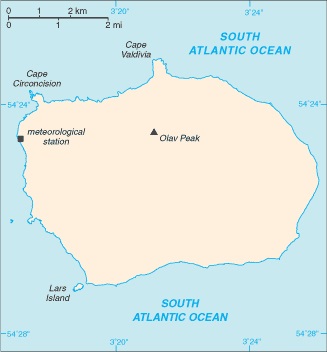 |
Jan. 1, 1739: The island is discovered by French navigator Jean Baptiste Charles Bouvet de Lozier, of the Aigle.
1755: Captain James Cook searches unsuccessfully for the island.
Oct. 6, 1808: Captain Lindsay of the British whaler Swan finds land in the area and names it Lindsay Island.
Dec. 6, 1822: U.S. whaler Benjamin Morrell of the Wasp arrives at the island, which he names after Bouvet.
Dec. 16, 1825: A British sealer, George Norris, lands on the island, not realizing it is Bouvet, and names it Liverpool Island and takes possession of it in the name of King George IV. He finds another island not far to the northeast which he calls Thompson. The claim is not followed up by the British government.
Nov. 25, 1898: The island is rediscovered by the German Valdivia deep-sea expedition (Captain Adalbert Krech), establishing its position and finding no other island in the area.
1920s-30s: Regular landings on the island occur as part of Norwegian Antarctic expeditions.
Dec. 1, 1927: Bouvet Island is claimed for Norway as a potential whaling station, the Norwegian flag being first hoisted over the island by people from the Norvegia. Two huts are erected.
Jan. 18, 1928: An article appears in the press to the effect that a Norwegian sealing company has been granted exclusive rights by the British Colonial Office to use Bouvet and (the phantom) Thompson islands as sealing bases. Norway then (January 19) notifies Britain of its occupation and, by royal decree of January 23, confirms that the island is under Norwegian sovereignty. On February 15 Britain formally reserves its rights to the island based on the 1825 landing. An exchange of notes follows, Norway arguing that even if Britain had acquired a title in 1825, this would have been invalidated by British inactivity for a century.
Nov. 19, 1928: The British government waives its claim in favour of Norway.
Feb. 27, 1930: The island is declared a Norwegian dependency.
Dec. 17, 1971: A royal decree declares the entire island and its adjoining territorial waters to be a nature reserve.
February 1977: An automated weather station is established.
December 1978-March 1979: A Norwegian expedition operates a manned station at the island.
February 1983: A South African-designed automatic weather station is erected as a backup for the Norwegian station.
January 2014: The Norwegian Polar Institute sets up a new research station on the island (following the apparent collapse and disappearance of the previous station, which was erected in 1996). The new, more robust station is designed to accommodate six people for periods of two to four months.
 |
Jan. 21 (Jan. 9, O.S.), 1821: The island is discovered by the Russian explorer Adm. Faddey Bellinsgauzen (Fabian Gottlieb von Bellingshausen) and named after former emperor Pyotr (Peter) I.
Jan. 17, 1927: The Norwegian Odd I expedition sights the island. It circumnavigates it but is unable to land.
Feb. 2, 1929: The first recorded landing on the island is made by the Norvegia expedition, which then claims the island for Norway.
May 1, 1931: A royal proclamation places Peter I Island under Norwegian sovereignty.
January 1933: The Norwegian government introduces a bill to declare Peter I Island a Norwegian dependency. The bill also provides that the laws which now apply to Bouvet Island will also apply to Peter I Island. It takes effect March 24.
July 13, 1933: By royal decree the Ministry of Trade is given the task of administering the island, with the same powers as a county governor.
Feb. 8-13, 1948: The Brategg expedition visits the island.
Summer 1959-60: The Soviet Union's attempt to establish a meteorological station on the island proves unsuccessful.
June 23, 1961: The island becomes subject to the Antarctic Treaty.
March 3, 1971: The Argentine Antarctic Institute installs the Teniente (Lt.) Luis Ventimiglia hut on the island.
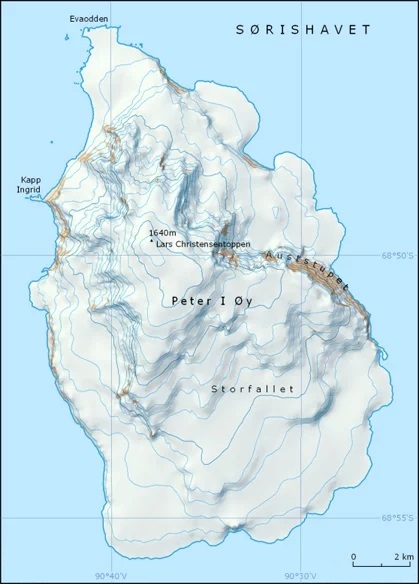
January-February 1987: Few landings having been made since 1929, the Norwegian Polar Institute conducts a relatively long survey and establishes an automated weather station on the island. The Ventimiglia hut is no longer to be found, having probably been buried in the snow and ultimately collapsed into the sea together with ice as a result of glacier displacement. A map to the scale of 1:50,000 is made after the visit.
1895: Norwegian whalers make their first landing on the Antarctic continent.
Dec. 14, 1911: Roald Amundsen's expedition plants the Norwegian flag at the South Pole.
1929: The first Norwegian territorial claims in Antarctica are made, following many years of Norwegian involvement in the exploration and survey of the continent.
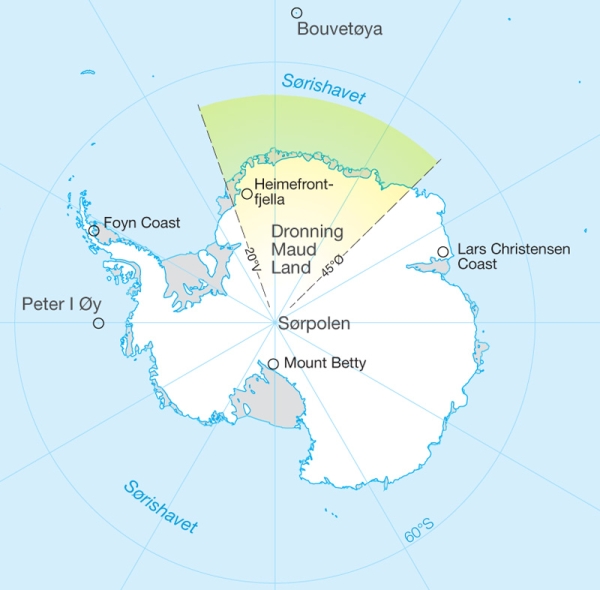
1929-30: Hjalmar Riiser-Larsen leads the first expedition to use aircraft for research purposes, conducting several successful reconnaissance trips over Queen Maud Land, so named in January 1930 for the wife of King Haakon VII. The first flyover of the South Pole is executed by another Norwegian air pioneer, Bernt Balchen, on Nov. 28-29, 1929.
1931 and 1936-37: Further claims are made.
Jan. 14, 1939: The claims are formalized by the Norwegian authorities, and the land placed under their sovereignty. The territory then receives its western and eastern limits, between the British and Australian claims. Although since the early 1900s it has been an important part of Norwegian polar policy to reject the "sector principle," on which a number of states based claims in both the northern and southern polar regions, the wording of the claim does not imply any great difference in practice. The annexation is made known to most of the other countries with which Norway has relations, most of whom receive the notification without comment. The United Kingdom answers (September 1) that it recognizes Norwegian sovereignty in the area, but some countries (including the United States and Soviet Union) express reservations and Germany rejects the claim. In August, Germany announces the formation of a German Antarctic sector between 4°59´ E and 16°30´ E, called Neuschwabenland, lying completely within the area that Norway already annexed; this claim never receives international approval and is not raised again after World War II.
1950-51: The Norwegian-British-Swedish Maudheim expedition explores the area. The first wintering takes place at the Maudheim base, at about 71°03´ S, 10°56´ W.
1956-60: The Norwegian Antarctic Expedition has its base at Norway Station (about 70°30´ S, 2°30´ W). This station is afterwards taken over by South Africa, which closes it in 1962 and erects in the neighbourhood a new station, SANAE (South African National Antarctic Expedition).
June 21, 1957: Queen Maud Land is given the status of a Norwegian dependency.
Dec. 1, 1959: Norway is an original signatory of the Antarctic Treaty (effective June 23, 1961). Norway upholds its claim to sovereignty but supports the pattern of international cooperation.
1967: Norway's role in the Antarctic whaling industry ends. Due to overexploitation of whale stocks in the Southern Ocean, from the 1950s Norway worked actively to limit the catch.
1976-77 and 1978-79: Two Norwegian expeditions carry out very advanced research in the ice-filled waters off Queen Maud Land.
February 1990: The Troll research station is opened.
1992: The Tor research station is opened.
Feb. 12, 2005: The Troll research station, previously suitable only for summer use, reopens as an all-year station; an airstrip to serve the facility is also opened. In addition to the two Norwegian stations, there are several other active research stations operated by a number of other countries.
June 12, 2015: A report of the Norwegian Foreign Ministry to the Storting notes that Norwegian authorities "have not opposed" any interpretation of the Norwegian claim as extending all the way to the South Pole. Previously the southern extent of the territory was often depicted as undefined, ending in a diffuse curly line a short distance from the pole or with a colouring "fading out" toward the south.