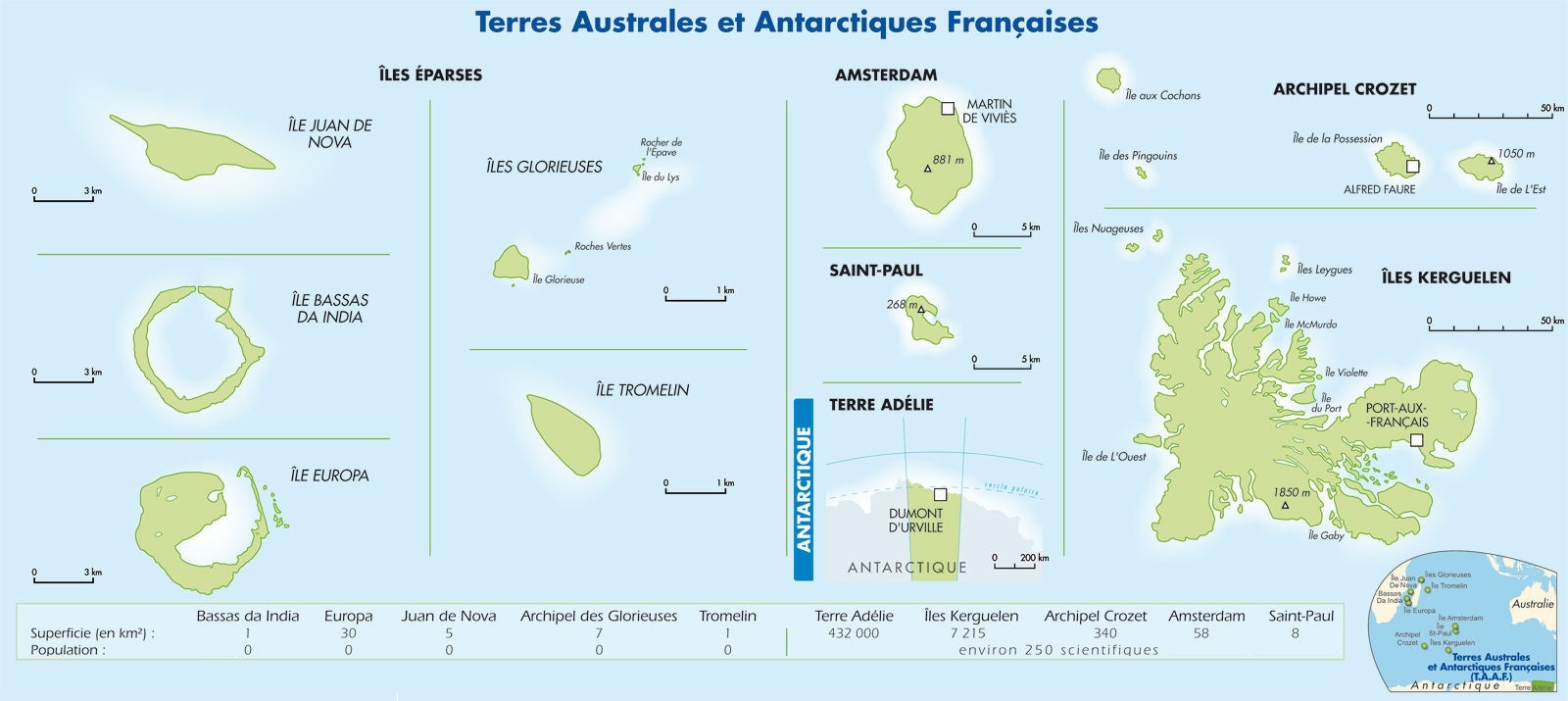
|
1501: Juan de Nova discovers the island that comes to be named after him.
1506: The Portuguese ship São Cristóvão, nicknamed A Judia ("The Jewess"), wrecks on the atoll that gets the name Baixos da Judia ("Banks of the Jewess"), which from errors in map-copying becomes Bassas da India.
1522: Saint-Paul and Nouvelle-Amsterdam islands are sighted by the crew of Fernão de Magalhães (Ferdinand Magellan).
1633: Saint-Paul and Nouvelle-Amsterdam islands are first visited by a Dutch navigator, Anthony van Diemen.
1722: Tromelin is discovered by the La Diane and called Île de Sable.
July 31, 1761: The French transport L'Utile wrecks on the Île de Sable with 80 black slaves left on it. All die except seven women, who live chiefly on shellfish and brackish water for 15 years until they (and an eight-month-old child) are taken off Nov. 29, 1776, by Captain Jacques Boudin de Tromelin, for whom the name Tromelin is thereafter applied to the island, on which the French flag is planted.
January 1772: Captain Marion Dufresne and his mate, Julien Crozet, discover a group of islands that become known as the Crozet archipelago and take possession for France.
Feb. 12, 1772: Yves Joseph de Kerguelen, in command of the flûte (storeship) La Fortune, sights another archipelago, later named after him, and claims it for France (one of his officers landing near Cap Bourbon). On his return to France, Kerguelen declares that he has discovered a southern continent, and in 1773 he is sent to "verify and complete his discoveries." In January 1774 he again takes formal possession, in the Baie de l'Oiseau in the north. His explorations are not extensive, but sufficient to dispel his belief that he found a new continent.
Dec. 24, 1774: Europa Island is discovered by the ship Europa. For some time thereafter it is often confused with Bassas da India, their names being interchanged or both taken for the same island.
December 1776: Captain James Cook visits the Kerguelen Islands with the ships Resolution and Discovery. He enters the Baie de l'Oiseau on Christmas Day, whence comes its new name of Christmas Harbour. Subsequent examinations of the eastern and southern parts of Kerguelen lead him to write that "from its sterility, I should, with great propriety, call [it] the Island of Desolation, but that I would not rob M. de Kerguelen of the honour of its bearing his name."
1799: Robert Rhodes, commanding the Hillsborough, a vessel fitted out for seal and elephant-seal hunting, spends several months at the Kerguelen Islands and explores a significant part of the coast.
1810: Tromelin comes under the jurisdiction of Île de France (later Mauritius), and in 1814 (when Mauritius is confirmed as British) that of Île Bourbon (later Réunion).
1840: Jules Dumont d'Urville, the first French explorer to set foot on Antarctica, lands on Adélie Land and takes possession in the name of King Louis-Philippe I.
May 12, 1840: Captain Sir James Clark Ross, commanding the British ships Erebus and Terror and charged with leading the Antarctic magnetic expedition, anchors in Kerguelen's Christmas Harbour and remains there for 68 days, exploring the deep bays of the surrounding area.
July 1, 1843: The governor of Île Bourbon orders that possession be taken of Saint-Paul and Nouvelle-Amsterdam islands in the name of France for a fishing establishment. The mainland government, however, does not approve of an annexation and extends only a French protectorate over the islands.
1853: Saint-Paul and Nouvelle-Amsterdam are abandoned because of prohibitive customs duties imposed on goods entering Réunion. These duties practically prevented the sale of fish originating from Saint-Paul and Nouvelle-Amsterdam, sacrificed in favour of a large quota of cod from Saint-Pierre and Miquelon imposed by mainland France on Réunion consumers.
1868: A British firm asks permission to open a coaling station on Kerguelen, but the proposal is shelved during the Franco-German War and not revived.
1871: An attempt at cattle farming on Nouvelle-Amsterdam is made by a farmer from Réunion named Heurtin. He gives up after eight months, demoralized by the isolation.
Jan. 6, 1874: HMS Challenger (Captain George S. Nares) arrives at the Kerguelen Islands during its voyage of exploration. It stays until early February, exploring the eastern side.
Oct. 26, 1874: The Gazelle (Captain Georg Freiherr von Schleinitz), of the German Transit of Venus Expedition, arrives at Kerguelen and stays (with interruptions) until Feb. 5, 1875.
1877: A British company proposes to begin to mine coal deposits in Breakwater Bay, Kerguelen, but the scheme comes to nothing.
1878: Hippolyte Caltaux encounters a group of unknown islands he names Îles Glorieuses (in remembrance of the French revolution of 1830). He plants the French flag there on March 2, 1880, and settles on the island, encountering in subsequent years difficulties with the commanders of British ships that pass near the islands.
Aug. 23, 1892: France takes possession of the Îles Glorieuses. They are administratively attached to Mayotte in 1895. Caltaux remains there until 1907; although he tried to sell his rights to the islands, a decree of forfeiture is issued against him and they are granted as a concession to the Société des Îles Malgaches (Malagasy Islands Company).
1893: The Eure takes possession of Saint-Paul and Nouvelle-Amsterdam for France, after the La Bourdonnais was hindered by the weather from doing so in 1892. It also hoists the French flag at Kerguelen in Christmas Harbour and Gazelle Basin, and places a depot of provisions and clothing for shipwrecked sailors in the latter.
Oct. 31, 1897: Bassas da India, Juan de Nova, and Europa become French possessions.
1900 and 1913: The Rallier du Baty brothers (Raymond and Henri) visit the Kerguelen Islands for geographic and hydrographic surveys.
1901: During the German South Pole expedition, a German meteorological station is set up in Observatory Bay, Royal Sound, Kerguelen, under Josef Enzensperger, who dies there on Feb. 2, 1903.
1912: The Îles Glorieuses are administratively attached to Madagascar.
Nov. 21, 1924: France annexes Adélie Land to the government-general of Madagascar.
1928: A spiny lobster cannery is established on Saint-Paul. When the company goes bankrupt in 1931, seven workers are abandoned. Only two survive until 1934 when rescue finally arrives.
April 1, 1938: France formally claims sovereignty over Adélie Land, defined as the sector of Antarctica between 136° and 142° E.
May 16, 1939: A U.S. note to the French government expresses a policy according to which the U.S. does not recognize French sovereignty in Adélie Land.
January 1950: A permanent French base, Camp Heurtin, is established by Paul de Martin de Viviès on Nouvelle-Amsterdam, followed by a second at Port-aux-Français, on the Courbet Peninsula of Kerguelen Island.
Feb. 3, 1950: The first permanent French base on the Antarctic mainland is built at Port-Martin. Destroyed by fire on Jan. 24, 1952, it is replaced in 1956 by a new permanent base on Petrel Island on the coast of Adélie Land, called Dumont d'Urville.
Aug. 6, 1955: Under the terms of legislation approved by the French government, the Crozet, Kerguelen, Saint-Paul, and Nouvelle-Amsterdam islands are detached from the administration of Madagascar and the TAAF established as an overseas territory, under the authority of an administrator-superior, responsible to the government member for the overseas possessions. The administrator-superior is assisted by a Consultative Council, which meets at least twice annually. The Council is composed of seven members who are appointed for five years by the government member for the overseas possessions (from among members of the Office of Scientific Research and from those who have participated in scientific missions in the sub-Antarctic islands and Adélie Land).
1957: An oilworks is set up at Kerguelen Island to process sea elephants.
Jan. 29, 1957: At Adélie Land another station is completed in connection with the International Geophysical Year: Charcot, at the magnetic pole, 320 km from the sea. Three men winter over at this isolated station, which is at an altitude of 2,000 m.
January 1958: The third French expedition to Adélie Land arrives, relieving men at the bases of Dumont d'Urville and Charcot. The second base is to be abandoned and the first maintained on a permanent footing.
Dec. 1, 1959: France is an original signatory of the Antarctic Treaty (effective June 23, 1961).
1960: A team comprising 30 men takes up residence on Nouvelle-Amsterdam, and another group of about 60 begins permanent residence at the town of Port-aux-Français in the Kerguelen group. They include scientists and employees of a company engaged in the hunting of sea elephants. In Adélie Land, 14 scientists set up a station on the highest part of Petrel Island. The station is under the direction of the Expéditions Polaires Françaises, headed by Paul Émile Victor.
April 1, 1960: The Îles Éparses are detached from Madagascar shortly before the latter's independence (June 26) and attached to the French Overseas Ministry.
1961: The temporary installations at Nouvelle-Amsterdam are replaced by permanent buildings. Camp Heurtin is renamed La Roche Godon.
1961: Studies are made of the upper atmosphere at Port-aux-Français, in cooperation with the U.S. observatory at Minneapolis and the Soviet observatory at Arkhangelsk.
October 1961: In Adélie Land an expedition sets off from Dumont d'Urville station to the old Charcot base.
November 1961: A project for hunting sea elephants is initiated at Kerguelen Island, using a pilot factory. The only other economic activity is fishing for crayfish at Saint-Paul and Nouvelle-Amsterdam by a French firm which has its office at Réunion.
1964: Another base is opened at Alfred Faure on Île de la Possession, in the Crozet Archipelago.
1966: Nouvelle-Amsterdam is renamed Amsterdam.
1972: Following the death (Dec. 17, 1971) of its founder, La Roche Godon is renamed after him Martin de Viviès.
1973: Madagascar claims sovereignty over the Îles Éparses.
April 2, 1976: Mauritius formally claims sovereignty over Tromelin. The French government officially rejects the claim on December 17.
Jan. 18, 1980: The president of the Comoros, Ahmed Abdallah, expresses claims to the Îles Glorieuses during a visit to Paris. He cites their proximity to the Geyser Bank and declares: "As soon as we have recovered Mayotte, we will officially claim the Glorieuses."
January 1986: France becomes the fourth member of the Indian Ocean Commission (Madagascar, Mauritius, Seychelles). A few days later, Madagascar includes the Îles Éparses in its "exclusive maritime zone" by extending it to 200 miles. No French reaction to the decision is registered.
1987: Certain categories of vessels are allowed to register under the flag of the Kerguelen Archipelago, provided that 25% of their crew (including the captain and at least two officers) are French. These specifications are amended to 35% of the crew and at least four officers in April 1990.
Early January 1989: Work on the construction of a 1,100-m airstrip in Adélie Land (which, the authorities asserted, would improve access to research facilities) is suspended, following clashes between construction workers and members of the international environmental protection group Greenpeace, who occupied the site to protest against the project, which, they claimed, would involve the destruction of large penguin breeding colonies. The French authorities subsequently agree to allow Greenpeace to conduct an independent assessment of the environmental impact of the airstrip, and work on the project resumes shortly afterwards. In February 1991 the French government invites five environmental groups to visit the construction site. Four of these groups subsequently publish a report detailing their findings and recommendations concerning the future use of the runway. The project is subsequently abandoned, however, following severe storm damage in 1994.
1992: The French government creates a public interest group, the Institut Français pour la Recherche et la Technologie Polaires (IFRTP; renamed the Institut Polaire Français Paul Émile Victor [IPEV] in 2002), to assume responsibility for the organization of scientific and research programmes in the TAAF.
1993: Under an agreement between the IFRTP and Italy's Programma Nazionale di Ricerche in Antartide, work begins on a joint project, Concordia, with a permanent base to be established at Dome C.
1994: Limited numbers of tourists begin to be permitted to visit Crozet, Kerguelen, and Amsterdam. About 60 tourists travel to the territories each year aboard the supply and oceanographic vessel Marion Dufresne II.
1997: A decree is promulgated, under which administration of the TAAF is formally transferred from Paris to Saint-Pierre, Réunion, in April 2000.
January 1997: Population: 128.
March 25, 1998: Brigitte Girardin is named as administrator-superior.
May 24, 2000: François Garde is named as administrator-superior.
June 4, 2002: Former administrator-superior (1982-87) Claude Pieri dies.
Nov. 14, 2002: Former administrator-superior (1973-79) Roger Barberot dies.
March 28, 2003: The category of "overseas territory" is removed in a French constitutional revision. The TAAF are left as a sui generis territory.
February 2004: A new satellite surveillance system against illegal fishing is implemented. Incursions are believed to have been reduced by some 90% by November 2005.
Dec. 20, 2004: Michel Champon is appointed to replace Garde as administrator-superior. He takes office Jan. 21, 2005.
2005: Concordia is officially opened for winter operation.
Jan. 3, 2005: Administrative control of the Îles Éparses is transferred from the prefect of Réunion to the administrator-superior of the TAAF.
May 2005: New legislation is enacted under which the "Kerguelen Register" is replaced with a new French International Register, whereby, inter alia, the captain, one officer, and at least 25% of the crew will be required to be nationals of a European Union (EU) member state, or of a country in the European Economic Area. In 2020 21 vessels are registered to the TAAF.
Oct. 3, 2006: Crozet, Kerguelen, Amsterdam, and Saint-Paul are designated as a nature and marine reserve (Réserve naturelle nationale des Terres australes françaises).
Jan. 8, 2007: An agreement to increase cooperation between France and Australia in combating illegal fishing in the southern Antarctic is signed. It is ratified by Australia in January 2011 (it having previously been ratified by the French government).
Feb. 21, 2007: An organic law is promulgated making the Îles Éparses an integral part of the TAAF.
March 7, 2007: Éric Pilloton is appointed administrator-superior.
Sept. 3, 2008: Rollon Mouchel-Blaisot is appointed administrator-superior. He takes office October 16.
June 7, 2010: A bilateral co-management agreement relating to Tromelin and its surrounding maritime areas is signed by France and Mauritius. It is not ratified by the French parliament, however.
Oct. 6, 2010: Christian Gaudin is named administrator-superior. He takes office November 4.
Feb. 29, 2012: Pascal Bolot is named administrator-superior. He takes office April 10.
Sept. 17, 2014: Cécile Pozzo di Borgo is named administrator-superior. She takes office October 13.
2015: Fishing for so-called icefish in the TAAF - which was banned around Kerguelen since the early 1990s owing to stock depletion - recommences under strict controls. No vessels apply for the 3,081-metric-ton catch quota in 2018.
Dec. 12, 2016: The marine reserves are extended by some 550,000 sq km, to 672,969 sq km (which includes areas outside territorial waters but within a limit of 200 nautical miles). New enhanced marine protection zones are established by the same decree, encompassing some 120,000 sq km of maritime areas where extractive industries, including fishing, are prohibited. In March 2017 "protected perimeters" are set up round the zones, establishing a protected region totalling 1,662,766 sq km.
February 2018: France lodges a request for United Nations Educational, Scientific and Cultural Organization (UNESCO) World Heritage status to be accorded to Crozet, Kerguelen, Saint-Paul, and Amsterdam. This is accorded on July 5, 2019.
Oct. 30, 2018: Evelyne Decorps is appointed as administrator-superior. She takes office November 19.
2019: The TAAF authorities authorize vessels to make 46 trips, involving 6,126 visitors, mainly to the Antarctic Peninsula.
Oct. 16-17, 2019: The territories are represented at the Oceans Conference of the Association of the Overseas Countries and Territories of the EU, at which a joint declaration project is signed on the sustainability of the oceans.
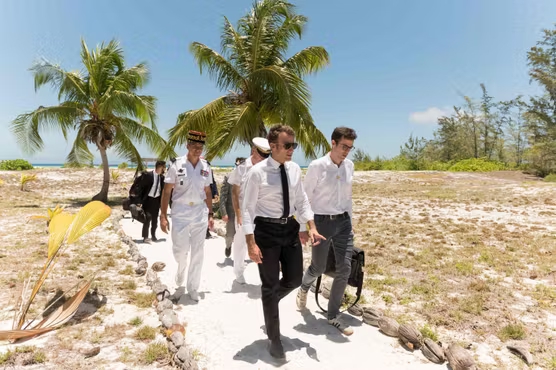 French president Emmanuel Macron on Grande Glorieuse, Oct. 23, 2019. |