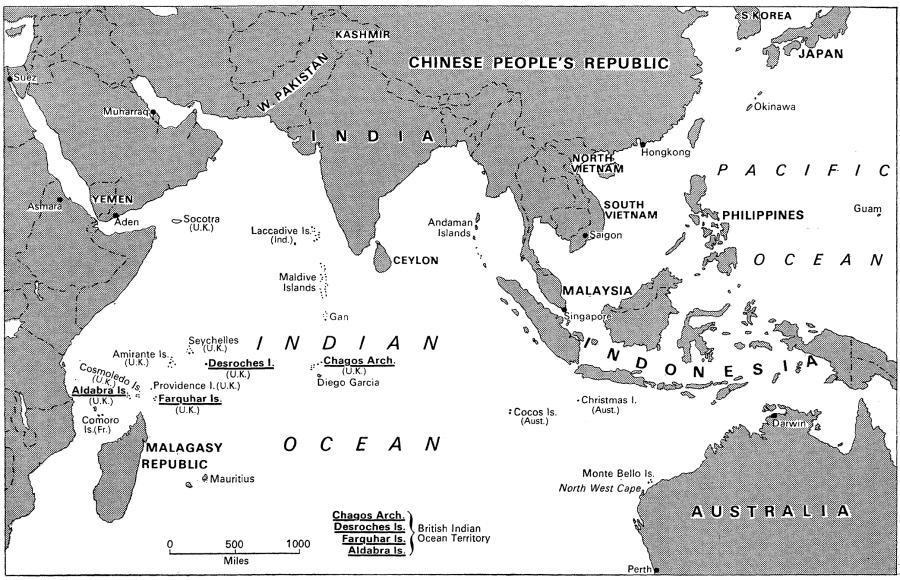
16th century: The Chagos Islands are discovered by the Portuguese and named Baixos das Chagas ("Shoals of the Wounds [of Christ]"). Over time "Chagas" evolves into "Chagos." Diego Garcia is named after the Portuguese navigator who discovered it in 1532. The Portuguese remain indifferent to the islands, however, using them only as markers on their trade routes to the Indies.
1743: French navigator Lazare Picault of the Elizabeth explores the islands. There are at that time no human inhabitants.
1780s: The first settlers, probably French, begin coconut (copra) plantations, which are to be the basis of the islands' economy for the future.
1814: The islands pass from French to British rule as part of Mauritius.
1824: The first British government agent in Diego Garcia, Le Camus, is appointed.
Beginning of 20th century: There is a floating population of some 426 families of African, Malagasy, and Indian origin, although most regard themselves as permanent residents. The copra production company provides living quarters but the people generally prefer to build their own thatched cottages. There is no electricity, sanitation, or other infrastructure. The men and women who work on the plantations receive a monetary wage but the chief payment is barter. Copra workers also fish and most families have small kitchen gardens and rear chickens and ducks. During the decades which follow there is movement of workers between the islands and Mauritius and the Seychelles under contract to the plantation company, while there are other inhabitants who were born on the islands and whose families go back several generations.
Early 1960s: The islands' population is in decline, due to low wages, monotonous work, the lack of facilities, and the great distance from Mauritius and the Seychelles, while the plantations are suffering from a lack of investment. In 1962, when the Chagos Agalega Company Ltd. acquires the plantations, the settlement population is a very small community of less than a thousand, settled on the three main islands. No one has lived on the outer islands for years.
|
The U.K. secretary of state for the colonies, Anthony Greenwood, announced in a parliamentary written answer on November 10 that the British government had decided to set up the new colony to provide certain defense facilities for the British and U.S. governments in the Indian Ocean. The first commissioner of the British Indian Ocean Territory would be Julian Edward George Asquith, Earl of Oxford and Asquith, who would hold that position concurrently with his present post of governor of the Seychelles.
Greenwood explained that the new arrangements had been made by order-in-council in agreement with the Mauritius and Seychelles governments and that "appropriate compensation" would be paid to these governments. Details of the compensation were not made public, but it was stated in British newspapers that about £3,000,000 would be paid to Mauritius for the Chagos Archipelago.
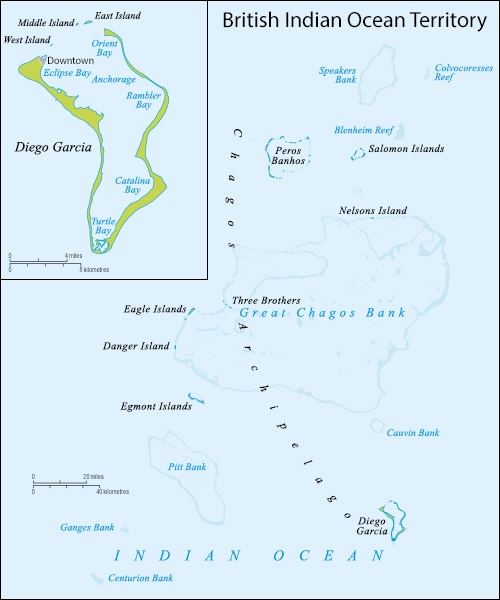
Diego Garcia is a coral atoll with a population of some 500 itinerant workers employed in the export of copra, salt fish, and tortoise-shell. 21 km long and 6 km wide, with a spacious lagoon enclosed by a coral reef, it has a good harbour and a site for a large airfield, and was of some strategic importance in World War II as a naval port of call. It was pointed out in the press that it was almost exactly halfway between the widely separated U.S. communications centres in the Philippines and at Asmara, on the Red Sea coast of Ethiopia (later independent Eritrea). Moreover, with the airfield of Gan in the Maldives, it was on the direct British staging-route to Australia and the Far East via the Red Sea.
In Mauritius, all three ministers of the Parti Mauricien - the second-largest party in the island - tendered their resignations on November 12 after reports that Diego Garcia and other islands were to be sold to Britain for £3,000,000 for Anglo-American defense purposes. In a statement in London on November 7, during the Mauritius constitutional conference, Gaëtan Duval, one of the three ministers, had said that the Parti Mauricien would not accept an Anglo-American base on Diego Garcia or the other islands unless Britain and America agreed "to buy all our sugar at a preferential price and accept Mauritian immigrants."
The Indian deputy minister of state for external affairs, Dinesh Singh, told the Council of State in New Delhi on November 18 that the government of India's policy towards bases in the Indian Ocean was one of "strong opposition" and that India would do everything possible to resist the establishment of an Anglo-American base in the Chagos Islands.
Despite the opposition of the Organization of African Unity (OAU) the colony is created to allow the establishment of defense and communications facilities by the governments of Britain and the United States. To that end, the operation of the copra plantations is ended in 1967 and the existing population of plantation workers is expelled: some 1,200 persons are relocated, mainly in Mauritius, during 1967-73.
April 1, 1967: An agreement between Britain and the U.S. regulating the joint use of BIOT for defense purposes is published in London. Under the agreement (formulated in an exchange of letters between the British foreign secretary and the U.S. ambassador in London on Dec. 30, 1966) each country will have the use of any facility built by the other, and each will pay for its own site preparations, while shared financing will apply to any jointly constructed facilities. The agreement runs for 50 years with an option to renew for a further 20 years. Agreement is also reached with the U.S. on the use of the island of Mahé, in the Seychelles, for tracking and telemetry facilities.
April 6, 1967: The Indian external affairs minister, Mahomedali Currim Chagla, states in the Lok Sabha that a protest has been made to Britain against her proposal to purchase the islands comprising BIOT for the provision of transit, refuelling, and communications facilities for British and U.S. military aircraft. India, he says, is opposed to the establishment of bases in the Indian Ocean area, and in any case feels that the purchase of the islands violates the UN resolution which states that no administering power can dismember any portion of a country which has yet to become independent.
November 1967: The British government announces that it does not intend to proceed with plans for a staging-post and airstrip on the island of Aldabra, to be manned by British and U.S. personnel. The proposal aroused strong opposition from scientists, naturalists, and wildlife conservationists in many countries. Lying outside the world's shipping lanes, Aldabra is 32 km long and about 11 km across at its widest point, and is remarkable for the richness and uniqueness of its fauna and flora, much of which is found nowhere else in the world. Aldabra is the home of such rare amphibians and avifauna as the giant tortoise (the only other known colony is in the Galápagos Islands), the flightless rail, the frigate bird, and the pink-footed booby, and is one of the few remaining breeding grounds of the green turtle.
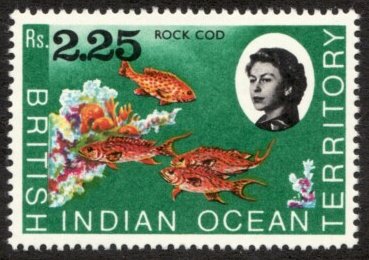 One of the first set of original BIOT stamps, 1968. |
On Jan. 21, 1974, Defense Department officials in Washington were reported as confirming plans for the expansion of the naval station into a base which could support naval operations, as increased Soviet naval activity was expected in the Indian Ocean once the Suez Canal was reopened. Julian Amery, U.K. minister of state at the Foreign and Commonwealth Office (FCO), stated in the House of Commons on Feb. 5, 1974, that "in response to a U.S. proposal and in accordance with the 1966 Anglo-American Agreement" the U.K. government had agreed in principle to the expansion of the facilities at Diego Garcia (involving improvements to the anchorage, the airfield, and shore facilities). This announcement was immediately followed by strong objections voiced by representatives of governments intent upon making the Indian Ocean a zone of peace.
"Total opposition" to the above agreement was expressed in New Delhi on February 6 by Swaran Singh, the Indian minister of external affairs, who said that India had told the United States that "the bringing-in of naval units, including aircraft carriers, into the region without any ostensible objective" had "caused concern to all littoral states." Indira Gandhi, the Indian prime minister, reiterated on February 7 that the Indian Ocean should be a zone of peace and added that India faced "increasing external dangers," inter alia from "activities of some powers who are planning to set up a nuclear base in the Indian Ocean." Sirimavo Bandaranaike, the prime minister of Sri Lanka, on February 8 sent personal messages of protest to U.S. president Richard Nixon and British prime minister Edward Heath, asking them to reconsider the decision in the interest of peace in the Indian Ocean.
Sen. Donald Willesee, the Australian foreign minister, said in Canberra on February 7 that the Anglo-American decision did not contribute to the achievement of Australia's long-term objectives in the region. Australia, he stressed, had given its firm support to the UN ad hoc committee on the Indian Ocean zone of peace and had endorsed proposals for neutrality in the region of the Association of Southeast Asian Nations (ASEAN). Norman E. Kirk, the New Zealand prime minister, similarly expressed support, on February 8, for the concept of the Indian Ocean as "a zone of peace, free from great-power rivalry, tensions, and military escalation," adding that New Zealand did "not welcome the buildup of any nation's military or naval presence in the area." The Malagasy government denounced the Anglo-American agreement on the same day.
Sir Alec Douglas-Home, U.K. foreign and Commonwealth secretary, said in Nairobi (during a visit to East Africa) on February 7 that those who protested against the buildup of Western naval strength in the Indian Ocean were applying "double standards," seeing that there had "not been a squeak" about the fact that the Russians had been "building up their fleet in the Indian Ocean for years."
In Washington, Defense Department officials disclosed before the Senate Armed Services Committee on March 12 that under the new plans for Diego Garcia aircraft carriers as well as KC-135 tanker planes (used to refuel B-52 strategic bombers) could be accommodated. Adm. Elmo R. Zumwalt, the U.S. chief of naval operations, stated before a House of Representatives' Foreign Affairs subcommittee on March 20 that the U.S. needed a naval support base on Diego Garcia "to be able to project military power into the region," which might produce "major shifts in the global power balance over the next decade." He denied that expansion of the Diego Garcia facility would set off a "naval race" in the Indian Ocean, as the Soviet Union already possessed a support system in the region "substantially more extensive than that of the United States," with access to harbours or airstrips in Somalia, Iraq, and Yemen (Aden).
Maj.Gen. George Loving, director of plans of the U.S. Air Force, said at a Senate subcommittee hearing on April 1 that, though the Diego Garcia base could be used by B-52 bombers "only in extreme emergency," half a squadron of F-111 swing-wing tactical aircraft capable of carrying nuclear weapons could be placed on the base. The Senate Armed Services Committee unanimously decided on April 3 to defer "without prejudice" the approval of funds of $29,000,000 requested by the U.S. administration for the Diego Garcia project, whereas the House of Representatives approved the expenditure on April 4 by 255 votes to 94.
While Japan and Pakistan gave official support to the U.S. plan, further opposition to it was expressed by other littoral states. In Japan, Masayoshi Ohira, the foreign minister, said on March 20 that Japan expected "a balanced peace" in the Indian Ocean. In Pakistan, it was reported on April 26 that Prime Minister Zulfikar Ali Bhutto had stated that his country would not object to the establishment of a U.S. base on Diego Garcia, adding that small countries could not dictate to great powers.
President Suharto of Indonesia, however, declared early in March that his government decidedly rejected an arms race in the Indian Ocean, where a zone of peace should be set up urgently. Muhammad Saleh Muti, the foreign minister of Yemen (Aden), criticized the U.S. naval presence in the Indian Ocean in New Delhi on March 13, when he denied that his country had offered the Soviet Union military facilities. "Full support" for the concept of the Indian Ocean as a zone of peace was expressed in a joint communiqué issued in New Delhi on March 14 at the end of a visit by Ahmed Zaki, the prime minister of the Maldives (where the RAF has facilities on the island of Gan). Pres. Julius Nyerere of Tanzania said during a visit to Canberra in mid-March that he and Gough Whitlam, the Australian prime minister, held similar views on the proposed base. The Australian government, in notes delivered on March 23, called on both the U.S. and the Soviet Union to restrain their rivalry in the Indian Ocean.
The high commissioner of Mauritius in New Delhi, Rabindrah Ghurburrun, said on April 7 that, if the United States were allowed a base on Diego Garcia, Britain would be violating an undertaking given in 1967. The British Foreign Office denied the claim.
In a joint communiqué issued on April 26 at the end of a visit to New Delhi by Ne Win, the prime minister of Burma, the two sides expressed concern at recent developments in the Indian Ocean and called upon all those involved to refrain from any action that would "militate against the objective of keeping this region a zone of peace."
Following a discussion in Washington on April 15 between David Ennals, minister of state at the Foreign Office in the new U.K. Labour government, and State Department officials, as well as subsequent talks between U.S. defense experts and British ministers in London, it was reported on May 11 that Britain had decided to allow the U.S. project to go ahead.
Dec. 3, 1974: U.K. defence secretary Roy Mason announces in the House of Commons that the British government has agreed to the U.S. proposal for a "relatively modest" expansion of the existing U.S. defense base facilities on Diego Garcia in view of the Soviet naval presence in the Indian Ocean. The Indian government thereupon, on December 6, expresses its "deep concern" at this British decision and declares that India is "totally opposed" to the establishment of any foreign bases in the Indian Ocean, as this would encourage competition between navies in the area. Officials of the U.K. FCO are subsequently reported to have expressed Britain's readiness to hold discussions with Australia, India, Malaysia, Sri Lanka, and other countries interested in making realistic progress towards arms limitation in the Indian Ocean.
Dec. 17, 1974: The U.S. Senate, when it approves by 85 votes to none a military construction appropriations bill providing for total expenditure of $2,900 million, vetoes all funds for the development of Diego Garcia. Expenditure of $18,100,000 for the proposed base (i.e. $14,800,000 for a naval construction programme and $3,300,000 for extension of the Air Force runway) was provisionally approved by the House of Representatives, against a total of $29,000,000 asked for by the Defense Department, provided that the president certified it to be necessary in the national interest. A compromise decision is reached on December 18, when both the House and the Senate authorize the Defense Department to approach Congress again after it reconvenes on Jan. 14, 1975.
February 1975: Michel Ventacassen, a Chagossian, brings a case to the High Court in London concerning the expulsions.
Feb. 7, 1975: Indira Gandhi, the Indian prime minister, informs both the United States and Britain of her "profound preoccupation" with the two countries' agreement on the development of Diego Garcia.
March 1975: At a conference in London, the Seychelles (which has been promised independence in 1976) demands the return of the Aldabra, Desroches, and Farquhar islands.
May 1975: U.S. president Gerald Ford declares in a brief note to the Senate: "I have evaluated all the military and foreign-policy implications regarding the need for U.S. facilities on Diego Garcia... and certified that the construction of such facilities is essential to the national interest of the United States."
June 10, 1975: James R. Schlesinger, the U.S. secretary of defense, testifying before the Senate armed services committee, asks for approval of expenditure of $13,800,000 for the Diego Garcia project during the 1976 fiscal year (towards a total estimated cost of $108,000,000 for developing the facilities) and emphasizes the need for counterbalancing the growing Soviet naval presence in the area. He supports his request by producing normally secret aerial reconnaissance photographs taken in April 1975 by a high-altitude reconnaissance aircraft flying over international waters, showing "the construction of fuel tanks, a long runway, a communications station, and a missile handling facility" at the Somali Red Sea port of Berbera, which in his view are Soviet installations.
In support of his plea Schlesinger pointed out that a quarter of U.S. petroleum and petroleum-product imports, as well as 65% of Western Europe's petroleum and over 70% of its petroleum-product imports, came from the Persian Gulf area. The Soviet Union's naval presence in the Indian Ocean, he said, currently averaged "approximately 19 ships on a regular basis"; in addition to the facilities at Berbera, he continued, the U.S.S.R. had provided Yemen (Aden) with assistance in managing the port of Aden and was assisting Iraq in the development of the port of Umm Qasr, on the Persian Gulf. The reopening of the Suez Canal, he added, would "certainly increase Soviet flexibility in supporting or reinforcing its units in the Indian Ocean." As it appeared that the Soviet Union intended to undertake a naval buildup in the region, the U.S. should have logistics facilities which would permit it to "maintain a credible presence" to guarantee "regional security and stability in this area." With fuel storage on Diego Garcia, he pointed out, a carrier task force would be able to operate for 30 days independently of other sources, which were 4,000 miles (6,000 km) away in the Philippines.
Schlesinger's statement on the existence of Soviet facilities was strongly denied in Somalia and in the Soviet Union. At the invitation of the Somali government Berbera was subsequently visited by an international group of journalists and two delegations led by U.S. members of Congress. The journalists were taken from Mogadishu to Berbera by Mohamed Siad Samantar, the Somali ambassador in Paris, who, after the visitors had on June 28 been refused access to two areas which were said to contain secret Somali military installations, said to them: "You have seen Berbera and can see that there is no Soviet military base."
Sen. Dewey Bartlett (Republican), who visited Somalia on July 4-5 at the head of a U.S. delegation, said after his return to Washington on July 6 that there was no proper missile base at Berbera but that there were "installations allowing the maintenance, storage, and supply of missiles"; that the installations which he had seen were "of Soviet design with Soviet construction techniques, material, and equipment being used"; and that there were a substantial number of Russians in the area. He added that the Russians had access to "a significant missile handling facility" and would "soon have access to a major airport."
Samuel S. Stratton (Democrat), who, with seven other members of the House of Representatives, had visited Berbera, said in Washington on July 8 that he was convinced that the Soviet Union had established at that port "the most extensive Soviet naval and air support facility for the Soviet forces that exists outside the Soviet Union," though he added that he had not seen any missiles, the delegation not having been allowed to enter a missile installation building or to board a Soviet vessel present in the harbour; but he had seen signboards in Russian and also Soviet personnel.
Following Schlesinger's statement, the U.S. Senate armed services committee authorizes the requested expenditure of $13,800,000 by 10 votes to 6 on June 17.
July 28, 1975: The proposed expansion of U.S. naval facilities on Diego Garcia is finally approved by the U.S. Congress, when the Senate rejects by 53 votes to 43 a resolution introduced by Sen. Mike Mansfield (the Democratic leader in the Senate) opposing the administration's plans.
Senator Mansfield, when introducing his resolution, argued that the establishment of a U.S. naval base on Diego Garcia would represent an expansion of U.S. commitments, promote a "superpower confrontation" in the Indian Ocean which, the nations in the area had declared, should be a "zone of peace," and provide "an entering wedge" for a three-ocean U.S. Navy operating in the Indian as well as in the Atlantic and Pacific oceans.
Sen. John C. Stennis (Democrat), the chairman of the Senate armed services committee, on the other hand, opposed Senator Mansfield's resolution by saying that the base was "an absolute necessity" if the U.S. was to have the ability to keep open the sea lanes to the Persian Gulf.
In the House of Representatives a move to block part of the funds provided for Diego Garcia in a separate appropriations bill failed in a voice vote on July 28.
These decisions meant that the U.S. Navy was free to proceed with the construction on Diego Garcia of a harbour, a 12,000-ft (3,700-m) runway, and refuelling facilities for a carrier task force - these measures necessitating an increase of U.S. military personnel on the island from the present 430 to about 600 men.
Feb. 25, 1976: Another U.K.-U.S. exchange of notes, replacing the 1972 supplementary agreement, provides for an expansion of the facilities.
June 28/29, 1976: The islands separated from the Seychelles are returned to the newly independent Republic of Seychelles. After this date the colony comprises only the islands of the Chagos Archipelago, including Diego Garcia, with a total land area of 60 sq km covering some 54,000 sq km of ocean. Administrative headquarters, which were at Victoria, Seychelles, during 1965-76, are thereafter at the FCO in London. The commissioner, a post hitherto combined with that of governor of Seychelles, is now separately appointed.
1977: The future of Diego Garcia hangs in the balance throughout the year as the result of suggestions put forward by U.S. president Jimmy Carter to the Soviets for creating a demilitarized zone in the Indian Ocean as a sweetener for the SALT II negotiations. Discussions between Paul Warnke and Lev Mendelevich for the Soviet Union take place in Geneva, Moscow, Washington, and Bern. The president's proposals seem originally to involve the abandonment of Diego Garcia (of which Mauritius would then claim restitution) in return for a Soviet withdrawal from the base at Berbera in Somalia. But in the course of the year the Soviet Union's support for the Mengistu Haile Mariam regime in Ethiopia forces its withdrawal from Berbera, which leaves it without a bargaining card. Indeed, the Soviets then make overtures to the Maldives to take over Gan island, relinquished by the Royal Air Force as an Indian Ocean pied-à-terre, but this is refused. By the end of the year the discussions turn on a limitation of the number of warship visits to the Indian Ocean and a mutual ban on the deployment of "multiship task forces." However, the work on Diego Garcia is rushed forward day and night. Though smaller than Berbera or Aden, used by the Soviet fleets, it is planned to have a naval dock, a deep anchorage for the largest ships, a lengthened runway, a jet fuel farm and storage. Though it will not be finished until 1979-80 it becomes a substantial bargaining counter for Indian Ocean disarmament.
1978: Indian Ocean security remains a preoccupation of the islands as well as the littoral states in a year that sees the introduction of 200-mile fishing zones and the withering away of the negotiations between the Soviet Union and the United States on force levels, which seemed to make progress in 1977. The Seychelles conference of Indian Ocean island Communist parties and opposition groups demands that the superpowers dismantle all naval bases. The United States indicates that the arming of Diego Garcia will not go beyond the level envisaged in 1975, while Soviet naval forces are scaled down after the Americans sent in a large task force including the carrier Enterprise.
April 1978: The sum paid to Mauritius in 1973 is distributed, with interest, by the Mauritius authorities after discussions on how best to use the money, the islanders having rejected a proposal to be resettled on the Agalega Islands (a dependency of Mauritius about 1,000 km north of the main island) in favour of a cash distribution to about 600 families.
1979: The Americans develop the Diego Garcia base at top speed with British approval.
1980: Mauritian prime minister Sir Seewoosagur Ramgoolam (Labour Party), who hitherto called the U.S. naval base in Diego Garcia a bastion of freedom, launches an agitation for its early cession to Mauritius, thus forestalling the Mouvement Militant Mauricien (MMM). He obtains a resolution of support from the OAU summit and promises to "rally world opinion." In June he talks with British prime minister Margaret Thatcher, who reiterates Britain's position that the Chagos Islands were never at any period under Mauritian sovereignty, only British; they were administered from Mauritius for administrative convenience only. Under the terms for Mauritius' independence, negotiated by Ramgoolam himself, Britain undertook not to cede the islands to any other power and eventually to cede them to Mauritius when, in Britain's judgment, no longer needed for defense, meanwhile passing fishing rights to Mauritius - such arrangements, however, providing no grounds for any earlier claims against British sovereignty. The Anglo-American agreement for U.S. use of Diego Garcia, however, has become an increasing irritant to African left-wing leaderships, and they fasten upon the failure of the American authorities to get advance British clearance for the placement in June of six large floating warehouses at Diego Garcia, claiming it to be a breach of the Anglo-American agreement. The placement was part of a stepped-up development of the naval and air base consequent upon the naval buildup in the Indian Ocean following the Iran crisis. The dispute over the status of Diego Garcia is heightened by the continued slow negotiation to set up a trust fund for the "removees" from the Chagos Islands, whose living conditions in Mauritius are deplorable. Britain offers a further £1,250,000 provided the removees confirm their undertaking not to return to the islands. But they are put under left-wing pressure in Mauritius not to agree to those terms.
June 29, 1981: Talks open in London between the British government and an all-party delegation from Mauritius. The discussions focus on additional compensation for the former inhabitants of the Chagos archipelago resettled in Mauritius. The FCO announces that a further £300,000 will be added to the £1,250,000 offered as a final settlement of Britain's obligation to the evacuees. This is rejected as inadequate by the Mauritian delegation, which seeks an additional £8 million. When the negotiations adjourn without agreement on July 2 it is understood that a solution will be pursued through diplomatic channels.
Aug. 13, 1981: The British government discloses its previous agreement to U.S. plans to expand the island's military facilities in order to accommodate B-52 bombers on a regular basis. This heightened military profile ensures that the Chagos archipelago will remain the focus of the littoral states' attention in their increasingly polarized debate over the superpower naval presence and the possible transformation of the Indian Ocean into a "zone of peace."
March 1982: After five days of negotiations between British and Mauritian delegations in Port Louis (the capital of Mauritius), the controversy over the level of compensation for the displaced people (known as the Ilois) and the whole issue of the status of the Chagos archipelago appears to have been resolved. The £4 million compensation agreed between the British government and the Mauritian government of Ramgoolam is accepted, although it represents only half the amount sought by the Ilois and the all-party Mauritian delegation.
June 11, 1982: The MMM wins elections, leading to new uncertainty. When the British government indicates a willingness to talk to Mauritius about the strategically sensitive issue of the U.K.-U.S. defense facility, it points out that this does not imply a commitment to negotiate about the sovereignty of Diego Garcia.
July 7, 1982: The new Mauritian government accepts the compensation agreement negotiated by its predecessor, but reserves its position on the sovereignty of Diego Garcia and indicates that it regards an offer to the Ilois of resettlement elsewhere in BIOT as an unacceptable compromise. A trust will be established to administer the compensation fund for the Ilois. In addition, the Mauritian government is to make available land worth £1 million for the Ilois housing programme. The ex gratia payment of £4 million is made to the Ilois Trust Fund on October 28 and between 1982 and 1984 payment is made to 1,344 Chagossians in Mauritius of £2,976 each.
August 1982: The publication of the London-based Minority Rights Group report Diego Garcia: A Contrast to the Falklands, calling for an inquiry into the fate of the Ilois, rekindles British and international interest in the Chagos archipelago. Attention focuses on the U.S. air and naval base, which, with its extensive port and storage facilities, and its extended runway accommodating B-52 bombers, remains the hub of Washington's Indian Ocean strategy. Suggestions that nuclear weapons are also stored on the atoll heighten regional anxiety to hasten implementation of the UN resolution declaring the Indian Ocean a zone of peace.
1983: The United States continues to consolidate its base and communications facilities on Diego Garcia. It is estimated to have invested about $1,000 million in extending runways to handle B-52 bombers, improving deep-water port facilities, and building storage facilities for equipment in readiness for use by a Rapid Deployment Force. A fully-equipped RDF unit is reported to be stationed at the base.
February 1983: During his two-day official visit to India, the prime minister of Mauritius declares his intention to make the U.S. base on Diego Garcia and the Mauritian claim to the island a major issue at the forthcoming New Delhi summit of the Nonaligned Movement. Anerood Jugnauth insists that the Mauritian ban on warships of the U.S. and Soviet navies will continue despite the resulting loss of much-needed foreign exchange.
July 1983: 36 Mauritian coconut-fibre pickers land illegally on Peros Banhos, 200 km north of Diego Garcia. The British government denies there are any plans to involve a naval vessel in the incident, and the expulsion of the merchants is left to the British military commander on Diego Garcia acting in his civilian capacity as deputy commissioner. The Mauritians leave in August and no political significance is attached to the incident.
1984: The controversial U.S. secret strategic base on Diego Garcia is less conspicuous as an international issue this year. The government of Mauritius plays down its claim to the island, though officially upholding it, and the earlier campaign for the closure of the military base is dropped, along with the proposed appeals to major international forums such as the UN and the International Court of Justice, advantage being taken instead of opportunities to supply labour and goods to the base. However, U.S. military activities in the Indian Ocean become a focus of attention in Moscow where it is alleged that the upgrading of facilities on Diego Garcia include launching-sites for intercontinental and medium-range nuclear missiles.
February 1984: It is reported that people who were displaced from Diego Garcia are seeking U.S.$6 million from the U.S. government to finance their resettlement in Mauritius. The U.S. administration declines to accept any financial responsibility for the population.
July 1984: During discussions with Jugnauth in London, Thatcher rejects his demand that the islands be returned to Mauritius.
September 1984: An unprecedented eyewitness report in the London Sunday Times confirms the intensity and sensitivity of the military activity in and around the isolated Diego Garcia base. The report also cites evidence suggesting possible plans by the British government to build further installations on a neighbouring island to augment the facilities for the U.S. Rapid Deployment Force.
July 1986: During a visit to Mauritius, Indian prime minister Rajiv Gandhi, currently chairman of the Nonaligned Movement, calls for the dismantling of the U.S. base on Diego Garcia, for the sovereignty of the Chagos archipelago to be returned to Mauritius, and for an international conference on the Indian Ocean.
August 1987: The U.S. Navy begins to use Diego Garcia as a facility for minesweeping helicopters taking part in operations in the Persian Gulf.
January 1988: Mauritius renews its campaign to regain sovereignty over the Chagos Archipelago, and reiterates its support for a "zone of peace" in the Indian Ocean.
November 1989: Following an incident in which a military aircraft belonging to the U.S. Air Force accidentally bombed a U.S. naval vessel near Diego Garcia, a demonstration is held outside the U.S. embassy in Mauritius, demanding the withdrawal of foreign military forces from the area. The Mauritius government announces that it will draw the attention of the UN Security Council to the dangers that it perceives in the execution of U.S. military air exercises. However, the U.S. assistant secretary of state for African affairs reiterates during an official visit to Mauritius, in the same month, that the U.S. will maintain its military presence in the Indian Ocean.
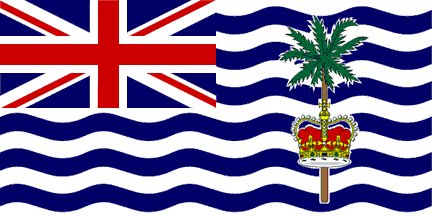 |
Documents read out in the High Court showed the lengths to which Britain went in 1967-73, in the words of Whitehall officials, "to maintain the pretense that there were no permanent inhabitants" of the Chagos Islands so that the U.S. base could be set up. Britain had to convince the UN that there were no indigenous people. It said they were there as transient contract workers. During the case it also transpired that the British government had received a subsidy of U.S.$11 million on the purchase of Polaris submarines in the 1960s from the U.S., in return for the lease of Diego Garcia for the U.S. military.
The islanders, in bringing their case, claimed that they were "dumped" on the dockside in Mauritius. Their counsel, Sir Sydney Kentridge, Q.C., called it "a very sad and by no means creditable episode in British history." He said the ultimate decision to deny the islanders their rights was taken by two prime ministers, Harold Wilson and Edward Heath. The islanders said the 1971 ordinance breached Article 29 of the Magna Carta which forbids the banishment of citizens of the realm. They now wanted to resettle on Peros Banhos and Salomon Atoll, 200 km from Diego Garcia. Before the case, three islanders were taken to Peros Banhos (June 9-13) to inspect conditions there.
A report commissioned from independent consultants by the FCO supported the case for the Diego Garcia islanders to return home to Salomons and Peros Banhos. It said "resettlement of one or both of the atolls is physically possible." The 123-page document was quietly placed in the House of Commons Library at the end of July, just before the parliamentary recess. The islanders' lawyer said that of 3,800 people given a questionnaire about a possible return only one did not want to go back. The five consultants visited the islands (May 9-14) to find out if a settled population could be supported there. The British government had expressed doubts.
Nov. 3, 2000: Judges in the High Court in London overturn the 1971 Immigration Ordinance. Lord Justice Sir John Laws describes the ordinance as an "abject legal failure" in its neglect of the interests and rights of the Ilois, who were British subjects. Referring to the "high political reasons" for the ordinance he quotes the Roman historian Tacitus: "They make a desert and call it peace." U.K. foreign and Commonwealth secretary Robin Cook says later that the government will not be appealing against the judgment, although it has been widely reported that the U.K. has been under pressure from the U.S. government to block the islanders' right to return. The U.S. built up Diego Garcia as a communications centre, a naval anchorage, and a military airfield, and fears for the security of the base if other islands in the Chagos archipelago were re-inhabited. Situated midway between Africa and Asia, Diego Garcia is regarded by the U.S. as of unique strategic importance. It is reported on November 13 that the U.K. FCO has issued a new ordinance allowing the 3,500 Ilois to return to any of the 52 Chagos islands except Diego Garcia. According to the Financial Times officials indicated that the U.K. would meet only its minimum obligations under the UN charter to assist the resettlement of the islanders.
Dec. 10, 2000: When U.S. secretary of state Madeleine Albright meets Prime Minister Jugnauth of Mauritius he says his country demands the restoration of sovereignty. Meanwhile the islanders prepare to launch a $6 billion compensation claim against the U.S. which has refused to allow them back on Diego Garcia, denying them the use of the island's airstrip.
October 2001: As it was in 1991, Diego Garcia once again becomes a strategically important military base as the main U.S. naval and air backup base in the war in Afghanistan.
Nov. 7, 2001: It is reported that 200 Chagos islanders are staging an indefinite protest outside the British high commission in Port Louis until they are allowed to return to their homes in the Chagos Islands. They claim that the U.K. government is still preventing them even from visiting the islands.
Dec. 20, 2001: The islanders' case against the U.S., in which they allege genocide, torture, and forced relocation, is filed.
May 21, 2002: The British Overseas Territories Act comes into effect. It does, after all, allow Chagossians to apply for British citizenship, but only those born between 1969 and 1982. An initial 19 Chagossians land at Gatwick airport this year and the Chagossian population in Britain subsequently grows steadily to several thousand, most of them settling in the town of Crawley, West Sussex.
June 30, 2002: It is reported that the exiled Ilois islanders have refused an offer by the U.K. government to take them back to the islands "to visit their ancestors' graves" because the U.S. government denied them permission to visit Diego Garcia. It is reported that the invitation was also declined because the U.K. authorities were attempting to dictate who should go on the trip, which had been planned for October.
Mid-2002: The Chagos islanders initiate legal action against the recruitment consultancy that supplies civilian employees for the U.S. naval base on Diego Garcia, alleging that the company discriminated against them when appointing staff to the base; the consultancy is the first of 12 entities that the islanders intend to sue in the U.S.
October 2002: Diego Garcia is preparing for another war against Iraq. Approximately 1,900 troops are stationed on the island, as well as material for two brigades (of ground troops and marines) and 10 B-2 stealth bombers. (The war begins in March 2003.)
Oct. 31, 2002: U.K. lawyers representing 5,023 Chagos Islanders launch a claim in a London court for compensation for their eviction. The U.K. government, given its previous payments in 1973 and 1982, regards the new claim as "legally unsound." The Foreign Office meanwhile commissioned a new report that said it would be too expensive to rebuild the infrastructure to allow resettlement. An alternative report done for the lawyers says the idea that resettlement could not take place is "fatuous."
Oct. 9, 2003: The High Court in London rules that there is no legal basis for a compensation claim against the U.K. government on behalf of the Ilois. Although Justice Duncan Ousely recognizes that U.K. governments ill-treated the Chagossians (who "alone were made to pay a personal price for the defense establishment on Diego Garcia") and in addition acted illegally, he also rules that the said governments did not know at the time that their actions were unlawful. Ousely also notes that the islanders were already compensated in 1978 and 1982.
Dec. 13, 2003: An article in The Independent quotes reports in the Washington Post and Time magazine asserting that the recently built Camp Justice in Diego Garcia is an interrogation centre for terrorist suspects held by U.S. forces. The U.K. government denies such reports.
March 2004: Paul Bérenger, the recently installed prime minister of Mauritius, renews the campaign to reclaim sovereignty after specialists in international law advised him that the decree by which the United Kingdom separated the Chagos Archipelago from Mauritius was illegal.
June 10, 2004: The U.K. government effects a change in the law (through orders-in-council, thus avoiding the scrutiny of the parliamentary process) to nullify the High Court judgment of November 2000. The BIOT (Constitution) Order 2004 declares that "no person has the right of abode in the territory or has unrestricted access to any part of it." The BIOT (Immigration) Order 2004 repeals the 2000 ordinance and prohibits anyone from entering the territory without a permit from the immigration officer.
June 17, 2004: A group of exiled islanders begin a legal appeal against the 2003 High Court ruling that they are not entitled to compensation from the U.K. government for the privations that they suffered as a consequence of their eviction.
July 7, 2004: It is reported that the government of Mauritius intends to leave the Commonwealth in order to circumvent a rule barring member states from taking the U.K. to the International Court of Justice. Mauritius seeks to pursue its claim for the return of the Chagos Islands. However, it is reported on July 8 that U.K. Foreign Office minister Bill Rammell has announced a further extension of the Commonwealth rule to cover even former members of the organization. Mauritian prime minister Bérenger, visiting London on July 9, is denied an opportunity to meet either Prime Minister Tony Blair or Foreign and Commonwealth Secretary Jack Straw. The normally conciliatory Commonwealth secretary-general Don McKinnon makes pointed criticisms on July 9 of the U.K. government's lack of cooperation.
October 2004: The continuing negotiations over the future of the Chagos Archipelago focuses on economic matters when British foreign secretary Jack Straw meets Mauritian foreign minister Jaya Krishna Cuttaree in London. The meeting foreshadows the possibility that British prime minister Blair might help Mauritian prime minister Bérenger in his dispute with the United States over sovereignty in the archipelago. Britain maintains its position that the archipelago will be returned to Mauritius when it is no longer necessary for Europe's security.
Dec. 26, 2004: The archipelago is not seriously damaged by the devastating Indian Ocean tsunami.
Dec. 6, 2005: A legal action is begun in the High Court, London, by Bancoult and other Chagos Islanders seeking to overturn the 2004 U.K. government orders-in-council. Hearings are expected to last for five days, with the ruling on a judicial review to be delivered at a later date.
March 30, 2006: By permission of the U.K. government, 102 Chagos Islanders set out on a sea voyage from Mauritius to visit parts of their homeland for the first time in over 30 years since their removal. During a 12-day visit, the islanders land on several islands, including Diego Garcia, to tend graves, hold religious services, and revisit the ruins of their former homes, but no overnight stays are allowed.
April 21, 2006: The U.S. Court of Appeals for the District of Columbia rules that it has no authority to order compensation to those evicted in order to make way for the establishment of a U.S. military base on Diego Garcia.
May 11, 2006: The High Court in London rules that orders-in-council made by the U.K. government under the royal prerogative in 2004 abolishing the right of abode of the exiled Chagos islanders in their former homes were irrational and unlawful because they were not concerned with "the interests of the territory" or of its former inhabitants. Lord Justice Sir Anthony Hooper and Justice Sir Peter Cresswell say that the U.K. government's policy of exiling U.K. citizens from their homes, whilst at the same time claiming that this was done for the "peace, order, and good government" of the territory, was "repugnant." The FCO, which is given 28 days to appeal, says it is disappointed at the judgment. The action was brought in the name of Bancoult, leader of the Chagos Refugee Group. The U.S. is said to regard Diego Garcia as one of its most important bases; it was used to mount long-range bombing sorties during both the invasion of Afghanistan in 2001 and that of Iraq in 2003.
July 23, 2006: Camp Justice is renamed Thunder Cove.
Feb. 5, 2007: The U.K. government begins an appeal against the high court ruling of May 11, 2006. The counsel for Foreign and Commonwealth Secretary Margaret Beckett argues that the judges "erred in law" and "misdirected themselves" because they asserted a jurisdiction over the monarch's right to legislate.
March 7, 2007: President Sir Anerood Jugnauth of Mauritius says in an interview with BBC radio that he is prepared to take Mauritius out of the Commonwealth in order to take the U.K. to the International Court of Justice, on behalf of the exiled population of the Chagos Islands.
May 23, 2007: The court of appeal in London rejects an appeal by the U.K. government against a high court judgment in May 2006 that the government had acted unlawfully in abolishing in 2004 the right of abode of the exiled Chagos Islanders in their former home islands. The three judges order the government to pay the islanders' legal costs and describe its treatment of them as a "repugnant abuse of power." The exiles, who are living in Mauritius, the Seychelles, and the U.K., mostly in conditions of poverty, number some 4,000, including about 500 of those originally expelled. The judges, headed by Master of the Rolls Sir Anthony Clarke, refuse a stay on the effect of the judgment, allowing the islanders the right to return home immediately, although in practice to do so they need help from the U.K. government. The FCO says that it will consider an appeal to the House of Lords, the U.K.'s highest court of appeal.
Feb. 21, 2008: The British government admits that, contrary to previous statements, a number of so-called rendition flights (the transfer of detainees by the U.S. Central Intelligence Agency to third countries where it is possible that they are subjected to torture during interrogation) have used facilities at Diego Garcia.
Oct. 22, 2008: The House of Lords, in its role as the U.K.'s highest court, upholds a U.K. government appeal against previous rulings granting the right of return to the Chagos Islanders. The U.S. military base on Diego Garcia is considered of strategic importance and the U.K. authorities argued that allowing the islanders to return to neighbouring islands constituted a risk to security. The Lords' decision, citing as its main reason the fact that the U.K. would have been obliged to meet the costs of economic, social, and educational advancement of the residents, marks the end of a lengthy legal battle between the islanders and the U.K. authorities launched in the name of Bancoult, who expresses disappointment at the Lords' ruling, but insists that the islanders will continue to fight for the right to return. An all-party parliamentary group is established to keep the matter before the U.K. Parliament, and the right of the islanders to return is subject of a case introduced in 2004 at the European Court of Human Rights (ECHR) in Strasbourg.
March 9, 2009: A plan is presented at the Royal Society, the U.K.'s most prestigious scientific body, to turn the Chagos Islands into a legally protected marine reserve. The plan is launched in a booklet entitled The Chagos Archipelago: Its nature and the future by the Chagos Conservation Trust, which is supported by the Royal Society for the Protection of Birds, the Linnaean Society of London, the Zoological Society of London, and the U.S. Pew Environment Group. The proposal (which would require the approval of both the U.K. and U.S. governments) describes the islands as "probably the most pristine tropical marine environment on Earth." Support groups for the Chagossians object that the conservation plan was hatched without any consultation with the exiled islanders. They protest that the reserve would be more effective if they were permitted to return as "custodians of the environment."
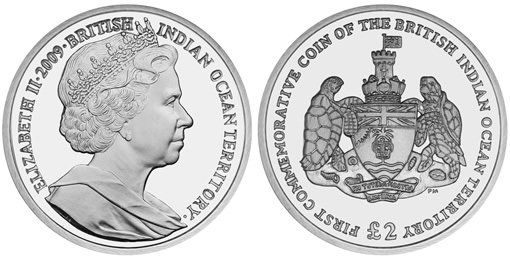 The first BIOT commemorative coin, 2009 - commemorating itself. |
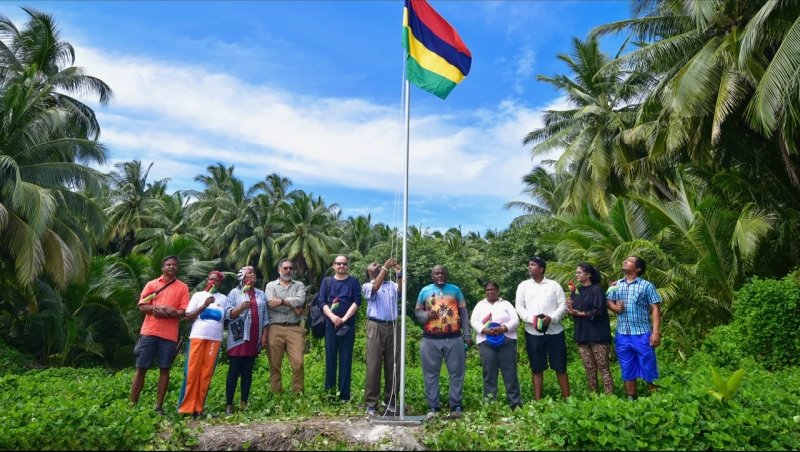 Officials raise the Mauritian flag on Peros Banhos, Feb. 14, 2022. |
 |