Rulers: Pitcairn Island: History
Pitcairn Island
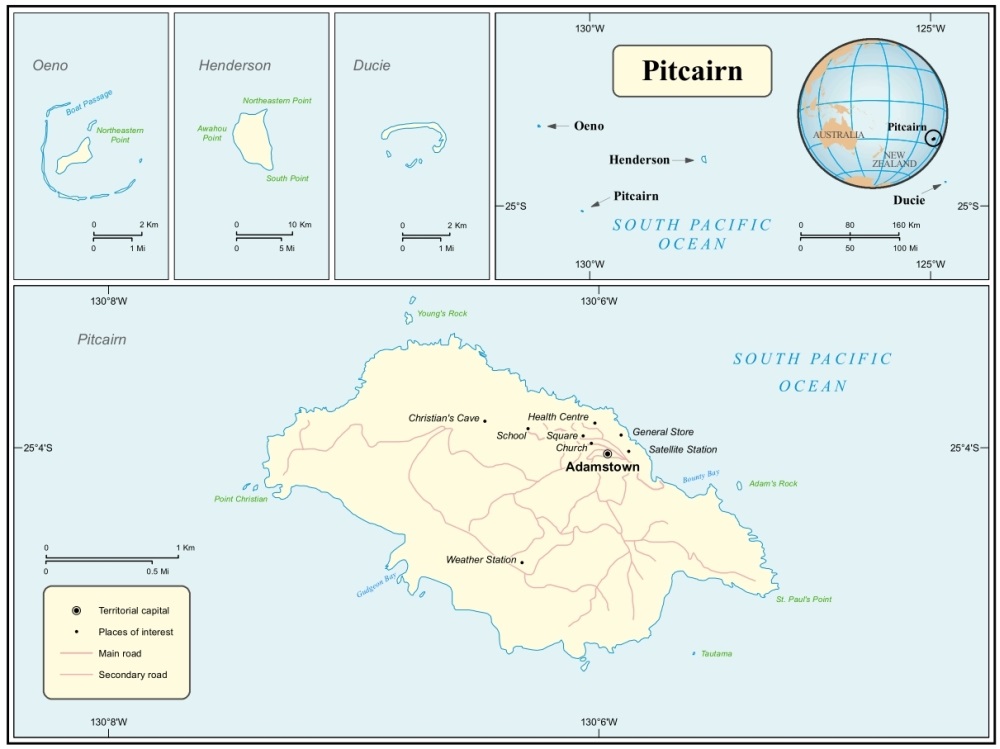
One of the world's remotest places, Pitcairn Island lies in the South Pacific (at 25°04´ S, 130°06´ W), almost midway between New Zealand and Peru. The territory includes uninhabited Henderson, Ducie, and Oeno islands, and as such is also called in the plural Pitcairn Islands. It appears that Pitcairn and Henderson were first colonized by Polynesians from Mangareva Island (now part of French Polynesia), 400 km away, by 1000 CE. In time, deforestation took its toll; with no trees suitable for building boats, communication and commerce ceased among the islands about 1450. Mangareva's inhabitants survived despite savage wars and cannibalism, but the inhabitants of Henderson (about 50) and Pitcairn (a few hundred) died out after 150 years of isolation. The deleterious effects of inbreeding, or the lack of breeding if the incest taboo was maintained, may have played a role; and so may murder and cannibalism in the face of dwindling food supply caused by climate fluctuations.
Jan. 26 and 29, 1606: Pedro Fernández de Quirós discovers what are probably Ducie and Henderson islands. He calls them Encarnación and San Juan Bautista, respectively.
July 2, 1767: Discovered by a British naval officer, Philip Carteret of the HMS Swallow, Pitcairn is named for the sailor who first sighted it, Robert Pitcairn.
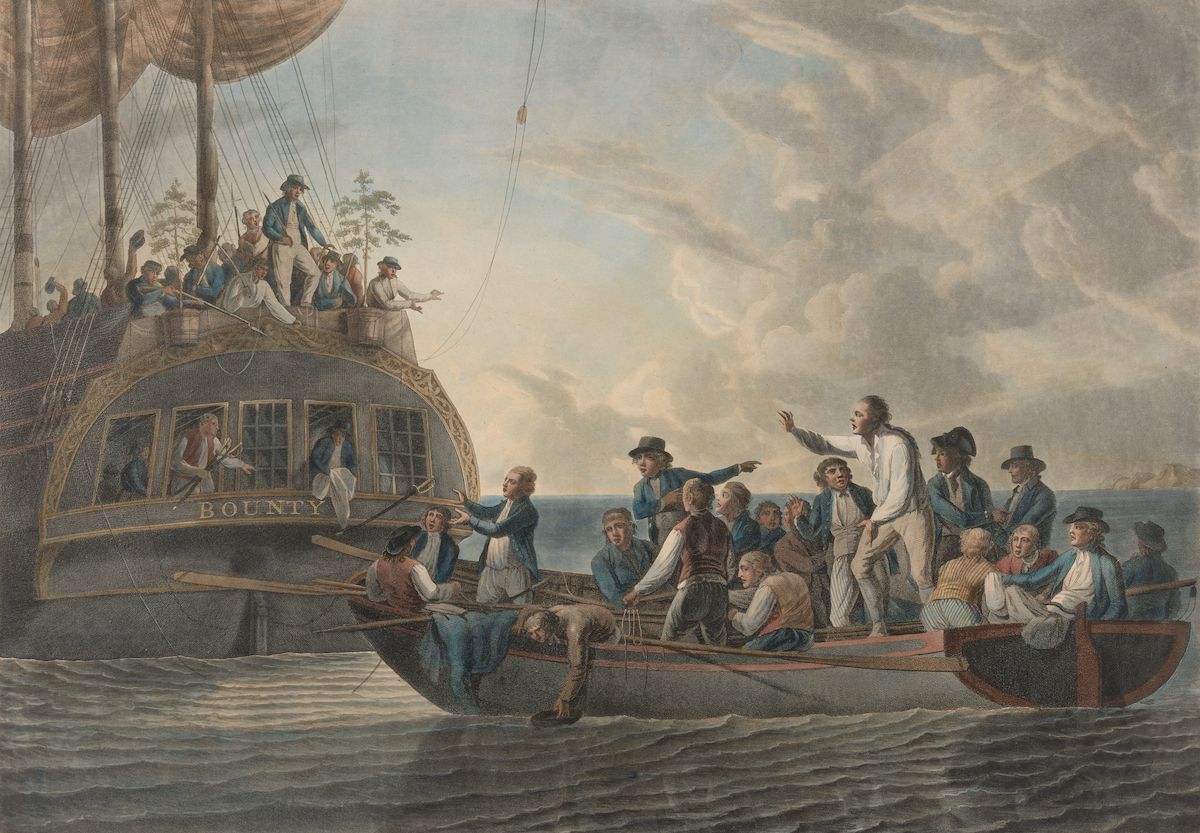
The Mutineers turning Lieutenant Bligh and part of the Officers and Crew adrift from His Majesty's Ship the Bounty by Robert Dodd, 1790. |
April 28, 1789: On a voyage from Otaheite (later known as Tahiti, in modern French Polynesia) to the West Indies with a cargo of breadfruit saplings, and being in the vicinity of Tonga, the crew of the British ship HMS Bounty, led by the first mate, Fletcher Christian, mutiny and set their captain, William Bligh, and a number of loyal sailors adrift (who succeed in reaching Timor, from where they return to England) and set course for the Austral Islands. Most of the crew wanted to return to Otaheite, but Christian knew that in time a British naval ship would come in search for them and Otaheite would be the most likely place to start looking.
Late May 1789: The mutineers arrive off Tubuai. Although the natives are unfriendly and there is a lack of livestock, the Bounty after three days sails to Otaheite, returning to Tubuai on June 23 with livestock and some Polynesians to help them establish a community there.
August 1789: Continuing conflict causes Christian to abandon the settlement and again return to Otaheite, arriving September 22. While 16 of the crew vote to stay in Otaheite, 8 decide to remain with Christian and continue the search for an uninhabited island, hidden from the outside world.
Jan. 15, 1790: The 9 mutineers and their 19 Polynesian companions (12 women, an infant girl, and 6 men) reach uninhabited Pitcairn, which exceeds their highest hopes; on January 23 they burn the ship and go about settling their new island home. A factor in the decision is that the island has been misplaced on Admiralty maps and would thus be hard to find.
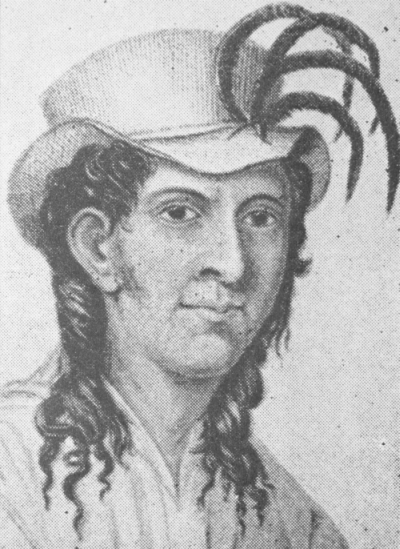
Fletcher Christian's celebrated first son, Thursday October Christian, in the hat with cock feathers he wore to greet the first visitors from the outside world. |
October 1790: The first child is born on Pitcairn, a son of Fletcher Christian and the Polynesian woman Mauatua ("Isabella"), and named Thursday October Christian, presumably after his birthday.
December 1790: In a conflict with the mutineers over women, two Polynesian men, Tararo and Oha, are killed.
March 16, 1791: Captain Edward Edwards of HMS Pandora, when in search of the mutineers, rediscovers and names Ducie Island, after Francis Reynolds-Moreton, Baron Ducie. Pitcairn is not sighted, but at Otaheite 14 Bounty men are captured and imprisoned in a dark cage, known as Pandora's Box. Later the Pandora strikes the Great Barrier Reef and four of the Bounty men drown.
Sept. 20, 1793: Five of the mutineers - John Williams, Fletcher Christian, John Mills, Isaac Martin, and William Brown - are killed by the four remaining Polynesian men due to their ill treatment (they had not been allotted any land, which Christian had divided into 9 equal parts for the mutineers; and they shared one woman, Mareva). On October 3 the four Polynesian men are themselves killed in the fight over the women, many of whom take the side of the Europeans. Leadership of the community passes to Edward Young, the other remaining mutineers being Matthew Quintal, William McCoy, and John Adams (also known as Alexander Smith), who was shot but survived.
April 20, 1798: Drunk on a locally distilled brew, McCoy throws himself off a cliff and is killed.
Early 1799: Young and Adams, believing their lives are in danger from the man, kill Quintal.
Dec. 25, 1800: Young dies of asthma. Leadership passes to Adams, the last mutineer alive on Pitcairn. He becomes a strict disciplinarian and extremely religious and instructs the many children born on the island according to his understanding of Christian concepts.
Feb. 6, 1808: The community, having so far survived in obscurity, is discovered by the American whaler Topaz (Captain Mayhew Folger); Folger finds Adams as well as 10 Polynesian women and 24 children. Some of the events described above are necessarily based on Adams's testimony and there is some uncertainty to them, particularly about the death of Fletcher Christian; no gravesite exists and some gossip of him being seen in England suggest a possibility, though on the whole improbable, of him having somehow left the island. The date of the killing of the five mutineers (though it goes down in Pitcairn history as Massacre Day) may be an approximation.
Sept. 17, 1814: Two Royal Navy men-o'-war, HMS Briton and HMS Tagus, are the first British visitors to reach Pitcairn since 1790. Favourably impressed by Adams, they agree it would be "an act of cruelty and inhumanity" to arrest him. Captains of the ships correct a calendar error caused by Fletcher Christian's omission to change the date as the Bounty, going east, had crossed the date line (not yet internationally defined, but by default the 180° meridian); the ship was already east of the meridian at the time of the mutiny, but on Bligh's intended course he would soon have crossed the line again going westward. In this connection there are inconsistent stories regarding Thursday October Christian's first name, mainly (1) that it was originally Friday and later corrected to Thursday, or (2) that it was originally Thursday, later corrected in the wrong direction to Friday, when it should have been Wednesday, and, on realizing this, rather than adopting a third variant, he went back to the original Thursday.
1817: Teehuteatuaonoa ("Jenny"), a Polynesian woman brought to Pitcairn by the Bounty, leaves the island on the ship Sultan of Boston.
January 1819: Oeno Island is discovered and Henderson Island rediscovered by Captain James Henderson in the Hercules. In February the latter island is sighted by Captain Henry King in the English whaler Elizabeth who names it after his ship. Ultimately the name Henderson Island prevails, however.
Dec. 20, 1820: A boat's crew of the wrecked U.S. whaler Essex lands on Henderson Island, from which they are rescued on April 8, 1821. They found eight mysterious skeletons in a cave there.
December 1823: The U.S. whaler Oeno (Captain George B. Worth) sights and gives its name to Oeno Island, supposing it a new discovery.
Dec. 10, 1823: The British whaler Cyrus arrives at Pitcairn. John Buffett, a shipwright from Bristol, England, takes pity on Adams and requests permission from Captain John Hall to remain on the island. Buffett is given permission to stay; however, his friend, John Evans, is not. Evans jumps ship and hides until Cyrus departs. Both men are accepted into the community and extend the island's genetic pool through being the first non-Bounty, non-Polynesian settlers. Buffett becomes schoolmaster and also initiates the Pitcairn Island Register book, mainly for noting births, marriages, deaths, and ship arrivals but also other events, the main events since 1790 being included retrospectively.
December 1825: Captain Frederick William Beechey of HMS Blossom visits Pitcairn for 16 days. He provides a detailed account of the island, more accurate than most preceding narratives.
November 1828: The well-educated George Hunn Nobbs arrives at the island. He is a strong character and soon ousts Buffett from the role of schoolteacher and pastor. He is initially accompanied by an American shipmate, Noah Bunker, who is ill and commits suicide in early 1829.
March 5, 1829: Adams (for whom the single settlement is named Adamstown) dies, aged 65. Nobbs is not accepted as his successor, and the community cannot agree on a new head.
March 6, 1831: The islanders, facing a threat of water shortage at their increased numbers, depart Pitcairn on the Lucy Anne to be resettled on Tahiti, where they (87, including one born on the voyage) arrive on March 21. Queen Pomare IV and her people treat the Pitcairn Islanders with great generosity and kindness, but disease strikes quickly, and 12 Pitcairners die, beginning with Fletcher's eldest son, Thursday October Christian (April 21). Many grow dissatisfied and decide to return to Pitcairn, the last 65 departing on August 14 on the U.S. ship Charles Doggett and reaching Pitcairn on September 3. Thereafter, the island becomes a port of call for whalers and passenger ships steaming between the United States and Australia.
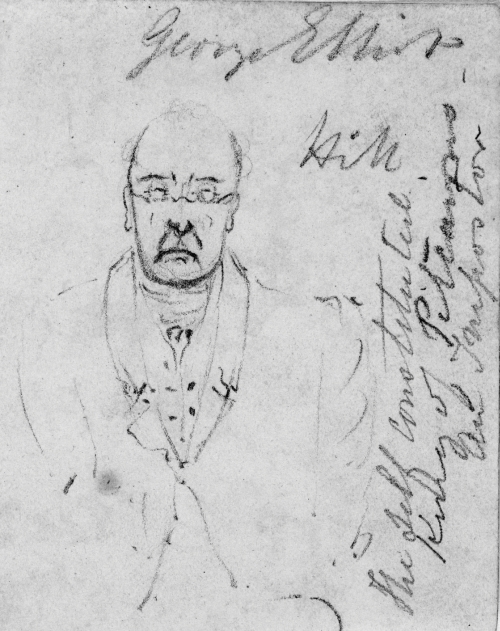
The only known likeness of Joshua Hill is this sketch by sailor George Elliot with the inscription "Hill. The self-constituted King of Pitcairn - An Impostor." |
October 1832: Joshua Hill, a puritanical busybody, lands on the island, claiming to have been sent by the British government, and establishes himself as president of a Commonwealth of Pitcairn. He abolishes the distilling of liquor and introduces arbitrary imprisonment and other severe punishments for the smallest misdeeds.
March 1834: Hill secures the expulsion of the "foreigners" Nobbs, Buffett, and Evans. This, however, causes a reaction and his power declines. Buffett returns from his Tahiti exile on September 16 and Nobbs and Evans from Mangareva (in the Gambier Islands, also in modern French Polynesia) on October 13.
December 1837: Hill is expelled by HMS Imogene and carried off to Valparaíso, Chile, after his false pretense and duplicity was discovered in January 1837 by the commander of HMS Actaeon.
Nov. 29, 1838: A British naval captain, Russell Elliott, visits the island in HMS Fly and supplies the islanders with a Union Jack, which is hoisted in token of their submission to British sovereignty. He institutes regulations (signed on board his ship on November 30) which are in effect a constitution, forming the basis for subsequent Pitcairn law. It provides for universal adult suffrage (making Pitcairn likely the first place in the world to grant suffrage to women) and mandating education for all Pitcairn children from ages 6 to 16. Elliott supervises the election of Edward Quintal, chief elder under the Hill regime, as the first chief magistrate, future elections for the chief magistrate (who must be native-born) to be held at the beginning of each year by all natives over 18 years of age and residents of 5 years' duration. The magistrate is assisted by one elected councilman and one appointed by the magistrate. These officials are answerable to the commanding officers
of visiting British men-of-war, for whom difficult questions are reserved.
Nov. 9, 1839: HMS Sparrowhawk visits the island, having on board Gen. Ramón Freire, ex-president of Chile. James Lowry, a lieutenant in the vessel, supplies the following description of Pitcairn and its people: "At the time of our visit they had increased in number to 102 (51 males, and 51 females) - a great part of them children, and as fine a race as ever I saw. Some of the girls, and young women, were very pretty, and would be considered beauties in Old England; all were very good looking... The island is a beautiful little spot... and is supposed capable of maintaining 1,000 inhabitants... there is abundance, and will be for some generations to come, as but a small portion of the land is cultivated. A great part of the produce the inhabitants supply to whalers, in barter for clothes, or any necessary articles they want - money there being of no value... Before every meal, they offer up thanks... On their first rising, they assemble, and sing the morning hymn; and, before resting, they again meet, and sing the evening hymn... Generally, the girls marry at 14 or 15, and the men under 20... There has been only one old maid on the island; she is now nearly 50; is as cross and crabbed as any old maid need be; and she rails against the early marriages most heartily... They have no springs; but have plenty of water from the rain, as there are now several reservoirs... [The experience of the temporary migration to Tahiti in 1831] has done them this good, that they will not again be anxious to leave their own sweet isle; and they seem quite aware that they are far better off, and happier, than the generality of mankind."
May 2, 1840: A serious altercation takes place between Edward Quintal, Sr., and John Evans, Sr., with Quintal, a powerful man, finally lifting Evans, who is small, and throwing him violently into a pigsty, causing various injuries.
August 1841: A severe attack of influenza does not leave a sufficient number of able persons to dig the yams and the island register records that almost every house has the appearance of a hospital, but the visitation is relieved by the services of Dr. W. Gunn, surgeon of HMS Curacoa, which comes from Callao on August 18. The increasing number of ships touching at Pitcairn (19 in 1841, 31 in 1842, 29 in 1843, 49 in 1846) may explain new maladies assailing the island this decade; in 1849 there is so much sickness that the public school has to be closed.
Sept. 19, 1841: "Isabella," widow of Fletcher Christian, dies at an unknown age.
March 4, 1843: The first recorded visit of Pitcairners to Henderson Island takes place.
April 15, 1845: The worst storm in the island's history destroys many coconut palms, bananas, yams, and boats and causes landslides leading to fish deserting the coastal waters.
1846: Population: 134.
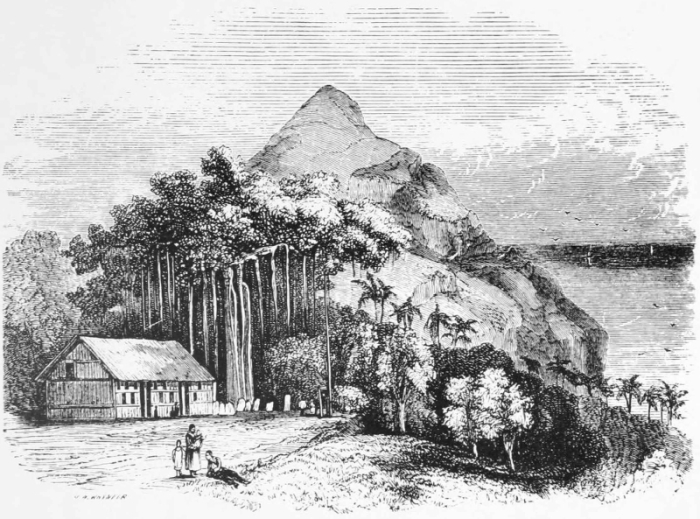
The church and schoolhouse, drawing by Conway Shipley, 1848. |
June 12, 1846: A new church and schoolhouse is completed.
1849: A Frenchman of military air, who arrived with some other voyagers by the brig Fanny, seems to offer to place the island under French protection. When informed that the islanders are loyal subjects of Queen Victoria, he remarks that he did not know that Pitcairn was a British colony.
1850: Population: 156.
Jan. 23, 1850: On the 60th anniversary of the burning of the Bounty, the islanders observe the first "Bounty Day," which becomes an annual tradition.
July 10, 1850: Teraura ("Susannah"), a Tahiti native and last survivor of the original settlers, dies.
Jan. 26, 1853: Magistrate Matthew McCoy meets with a fatal accident when the first visiting steamship, HMS Virago, is about to leave and a salute from the Bounty's ancient gun is to be fired and goes off prematurely.
July 27, 1853: The islanders, in a memorial to the queen of this date, while acknowledging "the visits of your Majesty's ships... with pride and gratitude... humbly trust we may be allowed to consider ourselves your Majesty's subjects, and Pitcairn's Island a British colony... in the fullest sense of the word... And if your Majesty's Government would grant us a document, declaring us an integral part of your Majesty's dominions, we should be freed from all fears (perhaps groundless) on that head..."
Aug. 17, 1855: HMS Juno (Captain Stephen Grenville Freemantle) arrives and the formal proposal is made for a removal of the islanders to the larger Norfolk Island, which was formerly used as a penal colony and thus has a ready infrastructure but now no other inhabitants. "All felt the necessity of some change," according to Freemantle, "for another subdivision of land would reduce the portions to mere insignificant patches." With some misgivings, 153 out of a population of 187 determine to accept the proposal.
May 3, 1856: Given the absence of any assurance as to the position of those who might remain at Pitcairn, all 194 islanders embark on the Morayshire taking them to Norfolk Island, where they (plus a baby born during the voyage) arrive on June 8.
Jan. 17, 1859: 16 of the Pitcairners (two families of the Youngs, including children of Margaret Young from her former husband, with the surname McCoy), dissatisfied with the new home, are brought back to the island in the Mary Ann.
1864: The 1838 constitution is restored on Pitcairn.
Early February 1864: A further 24 people (Youngs, Christians, Buffetts, and an American, Samuel Warren, who married the daughter of Thursday October Christian II) return from Norfolk Island on the St. Kilda. The new population thus shares only five surnames.
1868: Some of the Norfolk Island settlers, including old John Buffett, visit Pitcairn and urge their relatives to rejoin their now wealthier community, but this does not happen, and the mutineers' descendants remain divided between the two places, though occasional visits between them continue.
Sept. 25, 1875: The Liverpool ship Khandeish is wrecked on Oeno. The crew reaches Pitcairn on September 28 and stays for 51 days during which time they are regarded by the inhabitants as part of themselves, until they embark on the Ennerdale for San Francisco. One of them, Peter Butler, an American, remains on the island. As a result of the returned sailors' lavish praise of their treatment, the citizens of San Francisco send the Pitcairners a stream of gifts.
September 1878: Population: 90 (41 males, 49 females), including one survivor of the generation immediately following the mutiny: Elizabeth Young, 88, daughter of John Mills.
1880-86: A peculiar visitation of temporary insanity, lasting up to two years, affects 11 or 12 young members of the community.
Early 1881: Two Pitcairn youths travel to England, where one of them is secured for exhibition in the Westminster Aquarium. Rescue is effected by a friend of the Pitcairners, Rev. A.W. Drew, and the two youths eventually return to Pitcairn.
June 5, 1881: The Acadia shipwrecks on Ducie Island. Its crew reaches Pitcairn, and when in February 1882 the Edward O'Brien arrives to pick them up, three choose to remain. Two of them, Albert J. Volk and Phillip Coffin, marry island girls, but when the third, Albert Knight, finds favour over a homegrown rival, protests raised by the girl's family result in his removal and in an interdiction of further settlement by strangers. Volk eventually returns to his native Wales with his wife.
Oct. 18, 1886: A Seventh-Day Adventist missionary, John Tay, arrives and, by unanimous vote, is allowed to stay and argue his cause. After learning the tenets of the faith, in March 1887 most of the Pitcairn people embrace it, setting aside the forms and prayers of the Church of England from earlier times. This means that Saturday becomes the day of rest instead of Sunday (something the community inadvertently practiced before, due to the calendar error).
Sept. 16, 1887: Pitcairn officially becomes a British settlement under the British Settlements Act.
1890: A Seventh-Day Adventist missionary ship sails for Pitcairn. The missionaries relieve the ageing Simon Young in the school and, energetically, introduce history, grammar, cooking, and nursing. They begin a newspaper and a kindergarten and open a public park.
Oct. 3, 1892: HMS Champion arrives. The islanders ask Captain Eustace Rooke to reorganize their system of government.
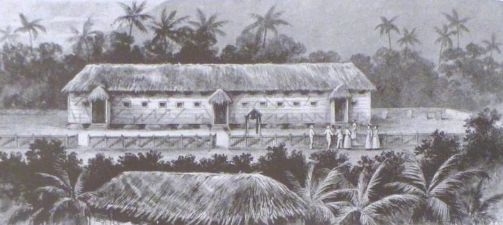
The Pitcairn parliament house, 1897. |
Jan. 1, 1893: A parliamentary form of government is adopted. A 7-member parliament is elected, from which the members elect a president, vice president, two judges, and a secretary.
April 1893: The shipwrecked crew of the Bowdon, stranded on Oeno reef, comes to Pitcairn Island. One crew member brings a spreading infection of enteric fever (typhus) to Pitcairn which claims the lives of 12 Pitcairners (including 6 children) between August and October.
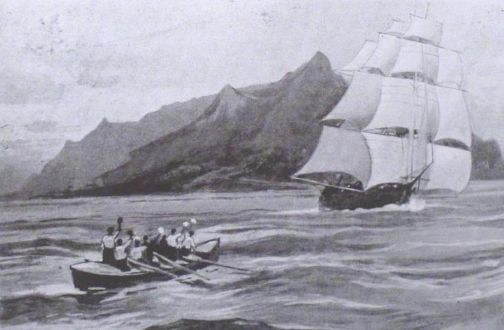
The Royalist off Pitcairn, 1898. | 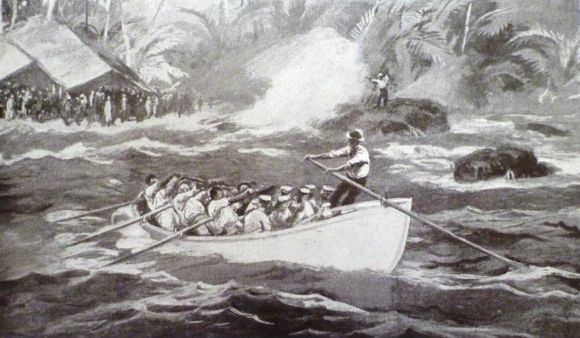
The court officials coming ashore for the trial of Harry Christian, 1898. One of the islanders on the big rock is signalling the rowers "time" in between the breakers, and the islanders are waiting on the beach - the way visitors from ships have come ashore ever since 1808. |
June 19, 1897: Two murders are committed on Pitcairn. Since Pitcairn is outside the limit of the Pacific Order-in-Council, 1893, the suspected murderer cannot be brought to the nearest British post in Fiji. Pitcairn is the only British possession beyond 149°30´ W longitude, the boundary of the order-in-council. Accordingly, on June 22, 1898, the settlement is included under the jurisdiction of said order-in-council and thus under the Fiji-based high commissioner for the Western Pacific. In August 1898 the Royalist arrives at Pitcairn with Fijian police magistrate Hamilton Hunter on board to try Harry Christian for murder. Harry Albert Christian, 24, great-grandson of mutineer Fletcher Christian, had a one-year-old illegitimate daughter by his first cousin Clara Warren, 21, but it was said that he had his eyes on another island girl, so he killed Clara and the baby, allegedly throwing them in the water at a place known as Isaac. Their bodies were never found, only traces of blood. Islanders living close to the northern edge of town claimed they had heard cries at the time Clara had disappeared, but none had actually seen him do it. He is sentenced to death on August 30, and executed in Fiji on October 8.
July 6 and 10, 1902: Henderson and Oeno islands respectively are claimed by symbolic act and made dependencies of Pitcairn. Ducie Island is annexed in May 1903, when the British consul in Tahiti hoists the British flag.
1904: The 1893 constitution is found to be too cumbersome. R.T. Simons, the British consul in Tahiti, reestablishes the post of chief magistrate, "who must not be a church officer," and forms two committees to take charge of internal and external affairs. A council comprises the chief magistrate, two assessors, and the chairmen of the two committees. Adultery and rape are excluded from local jurisdiction; "such matters must be referred to the High Commissioner's Court for the Western Pacific." An annual license fee of six pence for the possession of firearms is introduced; there are otherwise no taxes.
July 21, 1906: Captain E.E.S. Gaunt of HMS Cambrian makes provisions for an island prison.
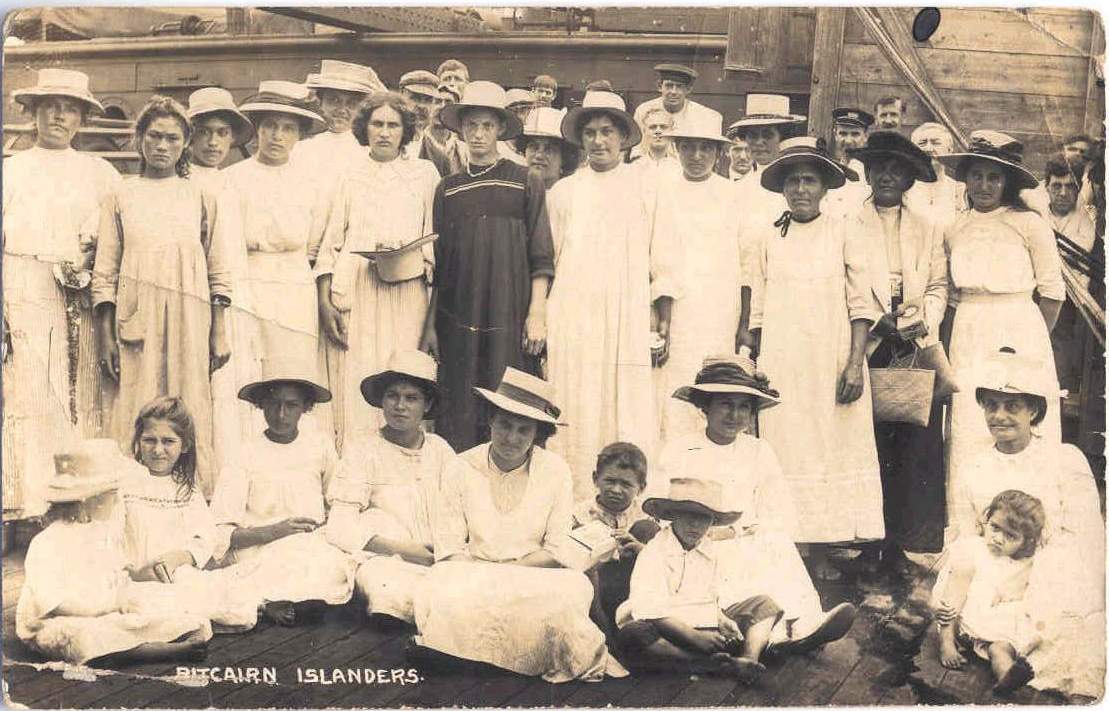
A 1910 photograph of Pitcairn Islanders. |
1911: The External Committee is abolished as having insufficient work to justify its continued existence and because of conflicts which had arisen between it and the Internal Committee as to the exercise of their respective functions. The functions of the Internal Committee are expanded to include those of the former External Committee.
1914: Pitcairn becomes a stopping point on the direct Panama to New Zealand shipping route when the Panama Canal opens. The island's isolation is over with frequent liners carrying hundreds of passengers anxious to have mementoes. More and more islanders develop an urge to see the world, and Pitcairner communities grow up in Wellington and Auckland, from where some move on to Australia.
1926: New Zealand postage stamps begin to be used, after previously letters from Pitcairn franked "Posted on Pitcairn Island: no stamps available" were delivered free of charge in New Zealand and elsewhere.
Dec. 6, 1931: Two boats containing 29 men and youths leave Pitcairn on a trip to Oeno Island to collect bêche-de-mer. Limited supplies of food are carried and they intend to be home by Christmas. Six of the remaining men and boys decide to take a third boat to Oeno for a pleasure trip, leaving on December 13. When the third boat arrives, the others have already almost run out of food. Bad weather delays their return and they finally make it back more than three weeks later than planned and in a state of near-starvation, but all recover.
Nov. 3, 1933: The Bounty's rudder is found by Parkin Christian.
1934: Bêche-de-mer fishing rights on Oeno are granted by the high commissioner for the Western Pacific to a private individual in New Zealand, but the concession is withdrawn in 1941.
December 1934-January 1935: Dr. Harry Shapiro, a U.S. anthropologist, spends 10 days on Pitcairn to prepare a study of the islanders. Among his findings is an estimation that "practically 25% of births at present are illegitimate and a considerable number of the permanent unions are not legitimatized, even though they have produced large broods of children."
1937: The island's population peaks at 233.
Aug. 21, 1937: The three islands near Pitcairn Island are visited by HMS Leander, who sends a landing-party ashore to confirm Great Britain's claim to ownership by fixing up notice boards and hoisting flags on the islands. Henderson Island, to the northeast of Pitcairn Island, and the two coral reefs Ducie and Oeno, northeast and northwest of Pitcairn Island respectively, have smooth lagoons suitable for landing grounds for seaplanes. Though uninhabited, they show signs of previous occupation.
1938: Two American philanthropists give the Pitcairn Islanders their first radio transmitting and receiving station. It is superseded during World War II when much improved facilities are introduced and a small team of New Zealand radio operators is stationed on the island.
1940: H.E. Maude, representing the British high commission in Fiji, consolidates and expands Simons' laws of 1904. The chief magistrate is henceforth called island magistrate.
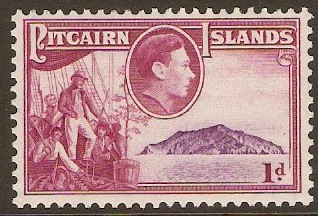
Pitcairn Islands 1940 stamp. |
Oct. 15, 1940: The first Pitcairn Island postage stamps are issued. They subsequently become a major source of public revenue.
1941: A small post office is built in the Square of Adamstown. The amount of mail increases significantly.
1944: Radio communications are improved when Pitcairn becomes a meteorological station.
1948: The government formally assumes responsibility for education, using a surplus of £40,000 amassed by the 140 islanders, principally from the sale of postage stamps. A.W. Moverley is appointed as education officer (teacher) in 1949 (on loan from the New Zealand Department of Education). A year later a school is completed at an area known as Pulau. Moverley is relieved in 1951 by Roy Sanders, and successors continue to be supplied by New Zealand and serve typically two or three years.
1952: Administrative responsibility is transferred to the governor of the British crown colony of Fiji when that post is separated from that of high commissioner for the Western Pacific.
1954: Population: 136.
1957: U.S. eccentric Robert Tomarchin spends three weeks on Henderson Island with his chimpanzee, Moko.
1957: Correspondence courses in post-primary education are introduced.
January 1957: The remains of the Bounty are discovered by Luis Marden, an undersea photographer on the staff of the National Geographic Magazine. The wreck was located in Bounty Bay at a depth of about 10 m by Marden and two young Pitcairners after several weeks of aqualung diving. Part of the ship's hull was embedded in coral, the finds including hull fittings, an oarlock, and fragments of copper with which the Bounty had been sheathed. The ship's anchor is discovered in February.
1958: Six more skeletons are discovered on Henderson Island.
1959: An influenza epidemic affects all but a few islanders, but there is only one death.
April 1959: The teacher and the pastor begin publication of the monthly Pitcairn Miscellany. The two earlier efforts to publish a newspaper on Pitcairn (the Monthly Pitcairnian begun in December 1892 and the Pitcairn Pilhi of July 1956-December 1957) proved to be short-lived.
1960: Population: 144. About this time the population begins to decline markedly due to emigration, mainly to New Zealand.
1962: The complete rebuilding of the radio station is begun with financial assistance from the British government.
1963: A reafforestation scheme is begun, concentrating on the planting of miro trees, which provide a rosewood suitable for handicrafts.
Nov. 8, 1964: The Local Government Ordinance constitutes a locally elected Island Council, presided over by the island magistrate (who is elected triennially) and comprising 10 members, of whom four are elected, five nominated (three by the elected members and two by the governor), and one is an ex officio member (the island secretary).
Nov. 8, 1964: An ordinance provides for the establishment of an official Souvenir Agency.
1965: With the aid of a grant from the U.K. Colonial Development and Welfare Fund, two tractors are introduced and earth roads are constructed between Adamstown and the most frequented parts of the island. Vehicles are then introduced to the island. The wheel as an aid to transport previously appeared only on the traditional wheelbarrow, which has been developed to cope with the steep terrain.
1966: Population: 98.
1966: France begins nuclear tests on Mururoa Atoll, about 850 km to the northwest of Pitcairn. Magistrate John Christian decides not to issue a formal protest, assuming it would be ignored.
1967: A General Store is established as a cooperative society, providing for the household needs of the community.
1968: Population: 75.
1968: Motor-vehicle licenses are introduced.
1968: Millie Christian is the first woman to run in Island Council elections. She tries again in 1969 but loses both times.
Mid-1968: Passenger ships cease to call regularly at Pitcairn Island. Sea communications are then maintained by cargo vessels running between New Zealand and Panama which make scheduled calls every few months. The change means that islanders have less opportunity to supplement their incomes by selling handicrafts and curios.
June 16, 1968: The following declaration is unanimously made by the Island Council: "Having noted the discussions which had taken place from time to time in the United Nations Committee on Colonialism about the future status of the remaining smaller colonial territories; and having also noted that the British colony of the Pitcairn Islands is one of the territories considered by the committee, the Pitcairn Island Council declares that it has no present wish to seek to change the nature of the relationship between the government and people of Pitcairn and the government of the United Kingdom but if, at any time, change should be desirable, the Council has full confidence that this can and will be negotiated satisfactorily by free agreements between those whose sole concern it is. The Council further declares that independent statehood would be administratively and economically impracticable for the small isolated island community of Pitcairn."
Nov. 4, 1969: A coat of arms is granted.
Oct. 10, 1970: When Fiji becomes independent, the Pitcairn Order 1970 comes into operation, by which the British high commissioner in New Zealand assumes administrative control as governor of Pitcairn, carrying out his duties through the Island Council. Liaison between the governor and the Island Council is conducted by a commissioner, usually based in the office of the British consulate-general in Auckland, New Zealand.
February 1971: Prince Philip visits on the royal yacht Britannia.
Dec. 31, 1971: Population: 85.
July 19, 1973: The surname McCoy dies out on Pitcairn with the death of Violet McCoy.
September 1973: Population: 76. Aside from 5 "foreigners," the remaining 71 share only five family names - Brown, Christian, Clark, Warren, and Young.
Dec. 25, 1973: Thelma Brown and Carol Christian are elected unopposed as the first women on the Island Council.
1974: By now there are 34 light motorcycles and three Mini Moke cars in use.
Dec. 31, 1974: Population: 63.
1975: One of the islanders, Tom Christian, appeals to Pitcairners abroad to come back and "repopulate a dying land." But he warns that some young people still want to leave, that the ocean swells are heavy for those who man the island's longboat, that shipping and mail services are extremely poor, and that earning a living can be difficult. On the other hand, he says Pitcairn is still free of crime, vice, and drugs. Later in the year, six young Pitcairners return from New Zealand where five of them were receiving medical treatment.
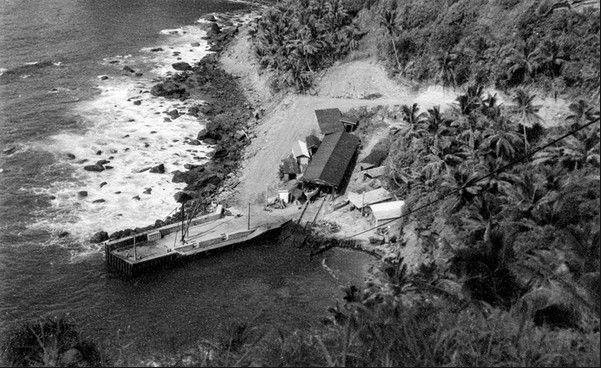
Newly-built jetty in 1977. |
1977: A jetty is constructed by a team of Royal Engineers.
1979: Population: 65.
1981: An unofficial referendum of the adult population produces a vote of 26-3 (with 4 undecided) in favour of an airstrip. The British are not persuaded to act, however.
1982: A minimum wage rate of NZ$1 per hour is established.
1982: The Pitcairn administration asks for a surveyor to visit the island to help clear up confusion over land boundaries.
1982: Pitcairners ask the governor, during a visit to the island, to try to arrange more shipping services, possibly through French Polynesia, to make the island a more attractive place to live.
1983: Population: 59.
1983: The British government turns down an offer by U.S. millionaire Arthur M. "Smiley" Ratliff to buy Henderson Island and build an airstrip on it.
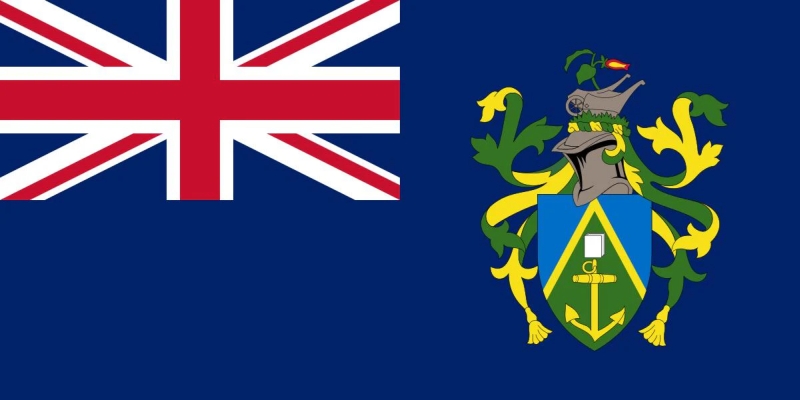
April 2, 1984: A flag (suggested by the Island Council in December 1980) is authorized, consisting of the Blue Ensign with the Pitcairn coat of arms. It is flown for the first time in May during a visit by Governor Sir Richard Stratton.
1985: Pitcairn's first radio-telephone link is established.
1985: A cadastral survey of Adamstown and surrounding areas is undertaken by a surveyor from the U.K.
1987: The British high commissioner in Fiji, acting on behalf of Pitcairn, joins representatives of the U.S., France, New Zealand, and six South Pacific island states in signing the South Pacific Regional Environment Protection Convention, the main aim of which is to prevent the dumping of nuclear waste in the region.
1987: The governor signs a one-year fishing agreement with Japan, whereby the Japan Tuna Fisheries Co-operative Association is granted a license to operate vessels within Pitcairn's exclusive economic zone. The agreement is subsequently renewed, but lapses in 1990.
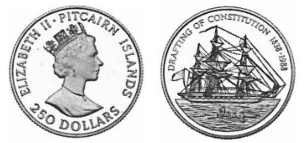
$250 Pitcairn coin commemorating the 150th anniversary of the first constitution, 1988. |
1988: Pitcairn commemorative coins are first issued. The Pitcairn dollar is at par with the New Zealand dollar. New Zealand currency is in everyday use.
Mid-1988: The local population of 48 consists of 25 Christians, 13 Warrens, 7 Youngs, and 3 Browns.
Jan. 1, 1989: Uninhabited Henderson Island is included on the UNESCO World Heritage List, the first British dependent territory to be so designated. The island, 168 km east-northeast of Pitcairn, is to be preserved as a bird sanctuary. There are five species of bird unique to the island: the flightless rail or Henderson chicken, the green Henderson fruit dove, the Henderson crake, the Henderson warbler, and the Henderson (or Stephen's) lorikeet. Conservationists hope the UNESCO move will keep away developers.
Dec. 31, 1989: Population: 49.
1990: Vehicles in use include 6 conventional motorcycles, 24 three-wheelers, 8 four-wheeled motorcycles, one motor car, and three tractors. A bulldozer was parachuted onto the island in 1983.
January 1990: Celebrations marking the bicentennial of the settlement of Pitcairn are held.
September 1990: David Moss takes office as governor.
Dec. 31, 1990: Population: 52.
Dec. 31, 1991: Population: 66.
1992: An exclusive economic zone (EEZ), designated in 1980 and extending 370 km (200 nautical miles) off shore, is officially declared.
1992: A modern telecommunications unit is installed.
Early 1992: It is reported that significant mineral deposits, formed by underwater volcanoes, have been discovered within the islands' EEZ. The minerals, which are believed to include manganese, iron, copper, zinc, silver, and gold, could (if exploited) dramatically affect the territory's economy.
Dec. 31, 1992: Population: 54.
1993: The jetty derrick is refitted with a hydraulic system.
April 1993: During an official visit to Pitcairn, the governor is presented with a document expressing dissatisfaction with British policy towards the islands, and raising the question of a transfer of sovereignty. Improved relations with France provoke speculation that an arrangement might be established with the French government concerning the future administration of the territory.
July 1993: It is reported that Governor Moss stated that the U.K. would not abandon its responsibilities to Pitcairn because of the costs involved in administering the island. He suggested that Pitcairn would remain a British territory indefinitely as independence was not a viable option and no other state was interested in taking over the territory's administration.
Dec. 31, 1993: Population: 55.
1994: Scientists studying Henderson Island express concern that its unique flora and fauna is threatened by the accidental introduction of foreign plant species by visitors and by an increase in the rat population.
August 1994: Robert John Alston takes office as governor.
September 1995: The islanders announce their intention (with the aid of the international environmental pressure group Greenpeace) to initiate legal proceedings against the British government for its failure to oppose the latest series of nuclear tests in French Polynesia. As the closest inhabited land to Mururoa Atoll (the site of the experiments), Pitcairn islanders would be more vulnerable than French Polynesians or other islanders in the region to any harmful consequences from the tests, and the British government's tolerance of France's decision is therefore perceived to be negligent and possibly illegal under the Euratom treaty.
October 1995: It is reported that a variety of donors have contributed about £80,000 to improve a much-rutted road used to reach the boat landing, from which islanders meet passing ships and do their boat and rock fishing. Among the donors are King Hussein of Jordan, former French president François Mitterrand, and actor Robert Redford.
Dec. 31, 1995: Population: 55.
1996: A Medical Centre is built, with British finance, replacing the old dispensary at the Square.
1997: Pitkern joins English as an official language by declaration of the Island Council. It is a mixture of English and Tahitian with the former predominating.
1997: British travel writer Dea Birkett's book Serpent in Paradise enrages Pitcairners. In it she describes her voyage to Pitcairn as a disillusioning experience.
1997: The British government sets up a £30,000-a-year "Pitcairn Island Good Government Fund" to pay for a British community-style policeman to spend six to eight weeks a year there. The move follows an inquiry by a team of five into an allegation of rape. Two police sent from London to join the team - the first British police to set foot on Pitcairn - reported that the allegation was unfounded, but that there were serious concerns about the lack of policing on the island, which has only 38 inhabitants. The island has no recent history of crime. The magistrate's court has not sat for 20 years and the three-cell jail built in 1990 has never been used.
1997: The rats on Ducie Island are eradicated, providing a safer environment for birds.
1999: Attempts begin to increase revenue from the island's agricultural output by producing dried fruits (notably bananas, mangoes, and pineapples). Diversification of this sector to include production of jam, dried fish, and coffee is subsequently under consideration.
Jan. 8, 1999: What could be the last of the few cannons that were aboard the Bounty is raised from the Bounty Bay wreck site. It is initially sent to the Museum of Tropical Queensland for conservation.
Early 1999: The Pitcairn Island police and customs office requests that no honey or beeswax be sent to the territory in order to protect from disease the island's growing honey industry, which is being developed as a source of foreign exchange. Pitcairn honey, which is pronounced to be "exceptionally pure" by the New Zealand Ministry of Agriculture, begins to be exported, largely through Internet sales, in late 1999. A new stamp is issued to commemorate the launch of the industry.
November 1999: Two complaints about sexual abuse are reported to a British policewoman, Gail Cox, who is on Pitcairn training an islander in community policing.
Dec. 7, 1999: Steve Christian is elected as Pitcairn's first-ever mayor, replacing the position of island magistrate. Jay Warren, who held the latter post, becomes chairman of the Internal Committee, which oversees public work that is required of all able-bodied adult men on the island. Warren is also to perform the judicial role of a magistrate if such is ever required in the future.
2000: A move by Britain to cut the £3,000 subsidy it pays to each cargo ship that makes a detour to the islands to deliver vital supplies angers the islanders who say they might have to be evacuated because of lack of funds. Mayor Christian says their only income is selling stamps to collectors. He threatens they might seek an alliance with the French.
2000: Legislation is enacted intended to ensure that every Pitcairn Islander is entitled to an allocation of house, garden, orchard, and forestry land "sufficient to meet their needs" for as long as they live on Pitcairn. An annual land tax payable on all land held by non-residents of the territory, or on land held by residents "in excess of his or her reasonable needs," is aimed at ensuring that sufficient land is available for reallocation through the Land Court, upon application. (By the late 1970s, owing mainly to emigration, most of Pitcairn was owned by Pitcairn Islanders who no longer lived on the island.)
2000: 10 cruise ships visit the island in the year, compared with just two or three annually in previous years.
Jan. 16, 2000: A 15-year-old girl makes a formal statement to Cox that she was raped at age 10.
April 2000: Another Pitcairn woman makes a statement alleging a number of incidents of rape and other sexual assaults from the time she was aged 8-9. She suggests that such offending has been widespread on the island.
April 2000: Simon John Eisdell Moore, New Zealand crown solicitor, is appointed Pitcairn's first public prosecutor.
July 2000: British detectives begin investigating sexual abuse on the island ("Operation Unique"). Officers from Kent police travel the globe conducting interviews.
Oct. 19, 2000: It is reported that Pitcairn Island has followed the example of Tuvalu by concluding a profitable deal to license its Internet suffix, having so far sold NZ$200,000 worth of domain name addresses. The suffix ".pn" is popular as an international abbreviation of telephone. The commissioner of Pitcairn, New Zealand-based U.K. civil servant Leon Salt, says that the Internet deal, supplementing Pitcairn's traditional income from postage stamps, could make the island economically self-sufficient. The approximately 50 inhabitants of Pitcairn do not themselves have access to the Internet.
March 2001: The 42 people of the island vote in a referendum to let a New Zealand building consortium, Wellesley Pacific, turn it into a tourist destination, with two airports, its own airline, and four-star hotel. The vote is 22 for and 6 against. Mayor Christian says change is essential - "Pitcairn is on its last legs." Environmentalists warn that unique plant and animal life could be devastated. The international airport would be on Oeno Island, one of the world's last undisturbed coral atolls. The company would give the islanders 10% of the profits and there would be no more than 30 visitors at a time. The British deputy governor visits the colony for talks. The company claims that if the islands achieve self-sufficiency through the proposals within five years then Pitcairn could become an independent state within the Commonwealth.
March 2001: British detectives join forces with New Zealand police to continue inquiries into alleged rape on the island. It is reported that they are now looking at 15 sexual assaults.
September 2001: In a letter to Governor Richard Fell, Mayor Christian asks for a "truth and reconciliation commission" for the accused Pitcairners: "Legal procedures appear frightening to us all and we cannot see how a court sitting or prison term can assist alleged perpetrators to understand the implications of what they may have done or assist the victims to feel good about themselves."
May 2002: Wellesley Pacific's director reportedly announces that the development will begin within the next 12 months, describing plans for a lodge on Pitcairn and for a floating hotel off Oeno Island. The British high commission in Wellington, however, says that approval for any such development has yet to be given, but that the company is welcome to submit proposals. Ultimately nothing comes of it.
May 21, 2002: The British Overseas Territories Act takes effect, granting citizenship rights in the United Kingdom to residents of the overseas territories, including Pitcairn. The legislation also entitles Pitcairners to hold British passports and to work in the U.K. and elsewhere in the European Union.
July 23, 2002: It is reported that investigations into allegations of sexual abuse in Pitcairn threaten the future of the tiny island community. The investigation has led to evidence of widespread sexual abuse of teenage and younger girls. It is reported that the U.K. and New Zealand police are prepared to charge up to 20 present and former male inhabitants of the island, but that no charges have actually been brought because of the difficulty of finding a suitable location where the trials could be held under U.K. law.
Nov. 26, 2002: A parliamentary committee in New Zealand approves legislation, the Pitcairn Trials Bill, to allow an undisclosed number of Pitcairn Islanders to stand trial in New Zealand for the rape and indecent assault of underage girls. Although Pitcairn is a British territory, the U.K. government proposed conducting the trial in New Zealand because of the logistical difficulties of holding the trial on the island, with its population of only 44. Dissenting from the committee's majority decision are MPs from the Green and New Zealand First parties who believe that siting the trial in New Zealand is against the wishes of the islanders. The law is passed on December 17.
December 2002: Steve Christian is reelected mayor.
April 7, 2003: In the first court proceedings on the island in more than 100 years, a judicial delegation from New Zealand charges nine men (a fifth of the island's population of 45) with 64 offenses, including 21 of rape, 41 of indecent assault involving teenage girls, and two of gross indecency with a child under 14. In June four more men are charged with 32 offenses including 10 charges of rape. It has been widely reported that opinion in Pitcairn is against the trial, and is particularly opposed to a trial in New Zealand, with many taking the view that the legal process could effectively destroy the community. There are suggestions that Governor Fell could have avoided a trial by establishing a form of truth and reconciliation commission. Fell is criticized for ignoring a petition by the islanders to allow his deputy Salt to accompany the legal team to the island.
Sept. 14, 2003: Emily Rose Christian is the first child born on the island in 17 years, boosting the population to 48.
Sept. 19, 2003: It is reported that Governor Fell has dismissed Commissioner Salt, because of his alleged obstruction of prosecutions for child abuse against a total of 13 Pitcairn men (including 6 living overseas). It is reported on September 26 that Salt has filed a legal action against the U.K. government for wrongful dismissal, saying that he was removed from office because he put the interests of Pitcairn before those of the U.K. The decision angers many Pitcairners. "Leon's refusal... to enter into a new contract unless we agreed to unacceptable preconditions together with his uncooperative attitude towards this office and officials visiting Pitcairn have let me with no option," Fell writes to complainants. Leslie Jaques becomes new commissioner.
Feb. 16, 2004: Former governor (1976-80) Sir Harold Smedley dies.
April 2004: Free Internet access is introduced.
April 19, 2004: The Pitcairn Supreme Court, sitting for only the second time in its history, in Auckland, New Zealand, rules that the trial of seven men from Pitcairn for a range of serious sexual offenses against children will be held under U.K. law in New Zealand. Lawyers for 7 out of a total of 13 men charged argued that because the accused were all descendants of mutineers on HMS Bounty in 1789 who had thereby escaped British rule, the U.K. had no sovereignty over Pitcairn and the men should be tried by their peers on the island.
May 18-20, 2004: A representative of the mayor participates in the Pacific regional seminar of the UN special committee on colonial countries and peoples, held in Madang, Papua New Guinea.
June 30, 2004: The Supreme Court rules that the trial of seven men accused of 96 sexual offenses against children will after all be held on the island itself, overruling objections by Pitcairn's U.K. administrators concerning the logistical obstacles to holding a trial there. The court will have to travel 5,000 km to reach Pitcairn, which has no airport or harbour.
August 2004: The British government announces the provision of U.S.$6.5 million in emergency assistance for the territory in order to avert a financial crisis. The aid programme includes a grant (partly financed by the European Union) to fund improvements to the road between Bounty Bay and Adamstown and to investigate the potential for ecotourism as a possible source of future revenue.
Aug. 11, 2004: It is reported that amid fears of violence ahead of the trial the 45 residents are asked to hand in their 20 guns to the island's two policemen. A spokesman for the governor also cites a more general safety risk, because the island's population is set to swell by about 25 during the trial. The British government plans to ship in police, a jail, and court officials for the proceedings. "There is the possibility of them wandering into shot when somebody is hunting. The island is not all that big and it is covered in vegetation, and the potential for an accident is very real."
Sept. 29, 2004: The trial of seven men for 55 sex attacks on women and girls, stretching back 40 years, opens on Pitcairn before a newly-constituted Pitcairn Supreme Court. The three New Zealand judges appointed to the court to try the cases (who, along with four prosecutors, three defense lawyers, two court officials, and two Defence Ministry officials, had to make a six-day air and sea journey that ended in longboats) hear evidence from witnesses via videolink from Auckland. The defendants are all named publicly for the first time, but the names of the complainants are not released. Defense lawyers state that they intend to challenge the legitimacy of the trials and of the U.K.'s jurisdiction in the matter. The victims say they were treated as "sex things" as girls and raped at will.
Oct. 25, 2004: Six of the men are found guilty of raping and indecently assaulting girls. Among them is Mayor Steve Christian, 53, convicted of five rapes of girls, one of them 12 years old. He was described as the "leader of the pack" who believed he had a right to have sex with young girls. His son Randy is convicted of four rapes and five indecent assaults. Len Brown, 78, is convicted of two rapes and his son Dave of nine indecent assaults. Dennis Christian is convicted of one indecent assault and two sexual assaults he pleaded guilty to at trial. Terry Young is convicted of one rape and six indecent assaults. Jay Warren is cleared of indecent assault. Whilst the defense maintained that consensual underage sex was regarded as normal on Pitcairn, a view supported by some Pitcairn women, the prosecution, backed by testimony from eight victims who were former residents, said that the attacks resulted from a coercive, male-dominated culture in the tiny, isolated, secretive community. On October 28 Steve Christian is sentenced to three years in prison and Randy to six years. Len Brown is sentenced to two years confinement, and Dave Brown and Dennis Christian to a total of 700 hours of community work. All defendants remain free on bail pending further litigation in the case involving British jurisdiction in Pitcairn. Chief Justice Charles Blackie tells Steve Christian that the sentences - light compared to those commonly given for rape convictions in the U.K. and the U.S. - are "tailored to Pitcairn," taking into account "factors unique to the island, such as its isolation, its permanent population of less than 50 people, and its dependence on the manpower of its able-bodied citizens." Defense attorneys had argued that jail terms for the men would strip Pitcairn of its tiny population of able-bodied men and hamper vital services, such as ferrying passengers and cargo to and from the island's only dock. The men will not be jailed until 2005 at the earliest because of legal wrangling over whether Britain still has jurisdiction over the island. Six further defendants, former residents of the island, are due to go on trial on similar charges in New Zealand in 2005. On October 30 Mayor Christian is dismissed by the governor. On November 8 the Island Council chooses Brenda Christian (Steve's sister and Pitcairn's only police officer since 1999) as mayor to fill the post until a formal election is held in December.
Dec. 15, 2004: Jay Warren, the only islander acquitted at the recent trial, is elected mayor, defeating Brenda Christian. Mike Warren is elected chairman of the Island Council. The four new councillors are all women: Meralda Warren, Olive Christian, Carol Warren, and Lea Brown. Most members are supporters of the convicted men.
2005: Major improvements to the jetty and slipway at Bounty Bay and to the Hill of Difficulty road, which leads to the landing area, are carried out.
2005: A museum is constructed on the island to house some of Pitcairn's historical artefacts, including the Bounty cannon (it returns from Australia in 2009).
May 24, 2005: The six convicted men lose an appeal as the Pitcairn Supreme Court, sitting in Auckland, rejects the defendants' challenges, which were based on a claim that the trial was invalid because the defendants had been unaware that English law applied on the island. However, the prosecution produced plentiful evidence to show that the islanders had traditionally resorted to the U.K. for aid in resolving legal problems, although there was also evidence that Pitcairn had suffered from administrative neglect. It is reported that the six will make a final appeal to the Privy Council in the U.K. Their prison and community-service sentences are suspended until the question of jurisdiction is resolved.
Feb. 8, 2006: George Fergusson is appointed governor, to take office in April.
March 2006: The population increases with the birth of only the second baby in some 20 years. The child's father is Randy Christian, one of the six convicted men.
June 2006: Two further Pitcairn men, living in New Zealand, are brought before the Pitcairn Magistrates Court sitting in Auckland to face sexual-abuse charges.
July 10, 2006: An appeal by the six convicted Pitcairners to Britain's Privy Council is cut short when, on day one of the hearing, the judges dismiss any suggestion that the island is not subject to British law. The men argued the island was settled by renegade pirates and was a self-governing state; Judge Lennie Hoffmann, Baron Hoffmann, said he had seldom heard such an unrealistic argument. The hearing, which was expected to take two weeks, ends abruptly the following day when the judges say they have heard enough argument.
July 11, 2006: Former governor (1984-87) Terence Daniel O'Leary dies.
Oct. 30, 2006: The Privy Council rejects final appeals by the six convicted men. Subsequently the U.K. government announces that it will send jailers to Pitcairn to establish a prison, Her Majesty's Prison Pitcairn. The convicted men themselves assist in the construction of the prison. Seven New Zealand prison officers are dispatched to staff the new facility.
Dec. 24, 2006: Elections are held to four seats on the 10-member Island Council. Four members of the Council are directly elected; two serve in an ex-officio capacity (the mayor and the chairman of the Island Council, both offices being directly elected); one is co-opted by the chairman and the four elected members; two are appointed by the governor, including the island secretary; and one is reserved for the non-resident commissioner to liaise between the Council and the governor. The mayor serves a three-year term, the island secretary an indefinite term; the terms of all other councillors are one year. There are no political parties on the island.
Feb. 1, 2007: A retired British police sergeant, Malcolm Gilbert from the Orkney Islands, recruited by the Foreign and Commonwealth Office on a 12-month contract to police the island, arrives.
July 18, 2007: During a workshop on human rights, the islanders vote to accept the European Convention on Human Rights (14 votes), while the option of additionally adopting Pitcairn's own Human Rights Charter receives 7 votes, and the options only to have Pitcairn's charter or to make no change receive no votes.
December 2007: Mike Warren is elected mayor. Incumbent Jay Warren is runner-up in a three-way contest. The island's 38-strong electorate also elects new members of the Island Council.
August 2008: A new constitution is accepted by the Island Council, on the urging of Commissioner Jaques.
October 2008: Victims of child sexual abuse succeed in winning agreement from the U.K. government that they are entitled to financial compensation for physical and psychological injuries.
Dec. 31, 2008: Census population: 66.
March 17, 2009: The governor signs an ordinance ending an alcohol prohibition dating from the 1830s, after a majority of islanders voted for the change. The consumption of an alcoholic beverage manufactured from the ti plant, an evergreen flowering plant in the family Liliaceae, on Pitcairn by two of the Bounty sailors shortly after they arrived at Pitcairn in 1789 had been credited with contributing to both suicide and murder on the island over a period of several years, leading to the ban. The ordinance still prohibits the consumption of liquor by Pitcairners while they are on Henderson, Ducie, and Oeno, the other islands of the Pitcairn group, and prohibits boat crews drinking alcohol for at least 12 hours before they go out to meet visiting ships.
April 1, 2009: The new governance structure provided for in the constitution (which otherwise has not yet been promulgated) comes into operation, establishing for the first time public service positions to head up four divisions - Community Development, Operations, Natural Resources, and Finance and Economic.
April 22, 2009: It is reported that Brian Young, the last of the 10 men convicted and jailed for rape and assault of women and underage girls, has been released from the now-empty prison.
September 2009: Governor Fergusson presents the Island Council with a draft revised constitution. The presentation of the draft document begins a consultation period for Pitcairners, which closes on October 31 and involves virtually all members of the small island community. Advice on human rights and other constitutional matters is provided by the Commonwealth Foundation. Video-conference facilities are used during the consultation process, enabling the islanders to discuss the proceedings with officials in the United Kingdom and New Zealand. The revisions will incorporate the Island Council, define the role of the governor, appoint an attorney general, and bring the island's court system into the constitution. Fergusson is quoted as saying that the most significant change in the new draft is that it explicitly states people's rights. Previous constitutions for Pitcairn were enacted in 1838, 1893, and 1904.
September 2009: The government begins to operate the MV Claymore II as the island's only dedicated passenger/cargo vessel, providing tourists with adventure tourism holidays to Pitcairn.
Sept. 10, 2009: Vicki Treadell is appointed governor, to take office in May 2010.
Dec. 11, 2009: Simon Young is elected deputy mayor. Brenda Christian, Jay Warren, Dave Brown, and Lea Brown are elected councillors. Paul Kelvin ("Pawl") Warren is the governor's appointee.
2010: Following the British government's provision of funding for a beekeeping expert to assist islanders with the expansion of their honey industry, the number of beehives has increased to 150, total output is estimated at around 1,000 jars annually, and the product is being supplied to New Zealand and exclusive food retailers in the U.K.
March 4, 2010: Governor Fergusson, on his annual visit to Pitcairn, proclaims a new constitution, replacing the Pitcairn Order of 1970. It provides for an ombudsman (who is to be responsible for investigating any complaints of government maladministration), creates the role and assures the independence of the attorney general, establishes a permanent Supreme Court, and includes an obligation for the Island Council to be consulted on all draft legislation. Elections to the Island Council will be held every two years rather than every year. The position of commissioner for Pitcairn comes to an end in March; holders of this post were Thomson Reid Cowell (1958-65), Kenneth Bain (1965-70), Ted Dymond (1970-73), Reginald Hicks (1973), Fred Warner (1973-74), Garth Harraway (1974-96), Leon Salt (1996-2003), and Leslie Jaques (2003-10).
June 3, 2010: Vicki Treadell is sworn in as governor by Chief Justice Charles Blackie. This is the first time a Pitcairn governor has sworn an oath before taking up office, a requirement introduced under Pitcairn's new constitution.
August 2010: With the number of rats on Henderson Island estimated to have reached 30,000, UNESCO emphasizes the need for urgent action to address the rodent problem (the rats are reported to be killing 95% of chicks of the endangered Henderson petrel each year) and warns of the possibility of the removal of the island's World Heritage status.
December 2010: The government establishes a Tourism Department. Since the investigation of the child abuse and the subsequent trials the U.K. has spent nearly £20 million improving the infrastructure of Pitcairn.
Dec. 4, 2010: It is reported that Mayor Mike Warren was arrested in May by the New Zealand police officer seconded to the island, charged with 20 representative counts of possessing indecent photographs of children and five counts of possessing pornographic images and videos of children on his computers. Warren was not among the men charged in the previous sex scandal on Pitcairn, but was a strong supporter of the men involved. Later in December, Warren is reelected as mayor with 15 votes compared with 11 received by each of his two nearest rivals.
2011: The U.K.'s Royal Society for the Protection of Birds (RSPB) conducts an operation to eliminate the rats on Henderson Island. However, the operation proves unsuccessful since although more than 99% of the rats were killed, the small number that survived multiplied rapidly thereafter. In 2015 two RSPB teams confirm that the rat population has recovered to pre-2011 levels.
December 2011: At a hearing held at New Zealand's Papakura District Court, at which Warren appears via satellite videolink, the mayor's lawyers challenge the jurisdiction of New Zealand's courts to hear cases pertaining to Pitcairn, arguing that his case should be dealt with in Pitcairn. The hearing is adjourned, and again in February 2012, due to continual failure of the videolink. His application is finally rejected in a hearing in May.
Dec. 12, 2011: In the annual elections, Simon Young is reelected as deputy mayor for a two-year term. Also for a two-year term the following are elected as councillors: Jay Warren, Brenda Christian, Michele Christian, Jacqui Christian, and Kerry Young. This is the first time the governor's office has not appointed a councillor as its representative so there are now five elected positions. With the office of mayor being three years, and councillors now being elected for two years instead of one, 2012 is set to be the first year in a long time with no need for elections.
2012: A deal is agreed providing for the supply of Pitcairn coffee, which is produced in very limited amount, to a U.K.-based coffee retailer.
February 2012: Population: 54.
February 2012: Kevin Lynch is appointed deputy governor (and British consul-general in Auckland).
April 8, 2013: It is reported that a U.K. government programme for wind turbines in Pitcairn has been abandoned due to a lack of response from an Australian energy company.
July 7, 2013: Tom Christian, a former magistrate, and for many years the governor's representative on the Island Council and Pitcairn's radio operator, dies, aged 77. A great-great-great-grandson of Pitcairn founder Fletcher Christian, Tom Christian was appointed MBE in 1983 and was regarded as an elder statesman of the community. However, he is said to have been ostracized by some for his support for the 2004 trials of several men for sexual abuse of underage girls.
Aug. 19, 2013: It is reported that the U.K. government plans to conduct a survey amongst Pitcairn Islanders living in New Zealand, Norfolk Island, the U.K., and the U.S. to discover what might attract them to resettle on Pitcairn and develop the economy, which is currently partly dependent on aid. The U.K. government wishes to increase the population from its current level of about 50 to 80 by 2016. This diaspora survey is conducted in October-November (33 respondents) revealing little interest among former residents and descendants of Pitcairn Islanders in resettling on the island. It identifies three primary barriers to returning: issues arising from the history of child sexual abuse; concerns regarding the acceptance of outsiders and new ideas; and inaccessibility.
Nov. 12, 2013: Shawn (a son of Steve) Christian is elected mayor (defeating Simon Young 20-19 in a third round of voting) and Brenda Christian deputy mayor, with Charlene Warren, Darralyn Griffiths, David Brown, Michele Christian, and Leslie Jaques (the former non-resident commissioner for Pitcairn, who has since become a resident) as councillors. It is the first council with a majority of voting members being women.
Aug. 9, 2014: It is disclosed that two reports prepared for the U.K. government on the population and economy of Pitcairn, the U.K.'s last Pacific territory, reveal that the island is approaching a social crisis that would bring into question the sustainability of the dwindling community in the near future. The reports make it clear that the scandal over the commonplace sexual abuse of underage girls has deterred former islanders from returning. Children of outside professionals working on Pitcairn are barred from living on the island. Of the 49 remaining residents, few are children because none have been born there for nearly four years.
Aug. 15, 2014: Jonathan Sinclair is sworn in as governor.
November 2014: The post of administrator is created to replace that of governor's representative, and filled by Alan Richmond.
April 2015-April 2016: In this fiscal year U.K. budgetary aid to Pitcairn is £2.91 million. Revenues from the sale of stamps and registration fees from the Internet domain name have recently fallen, while expenditures have increased considerably, particularly in regard to shipping, telecommunications, and medical services (in part because of the aging population), so that domestic revenue represents only 5% of Pitcairn's finances.
May 15, 2015: A new law allowing same-sex marriage comes into effect, though the island reportedly has no gay couples wanting to wed.
July 2015: A project by the EU-funded Pacific Territories Initiative for Regional Management of the Environment (INTEGRE) to prevent erosion at St. Paul's Point (on the far eastern tip of the island) and Ailihau (on the southern coast) is concluded, with assistance from several workers from French Polynesia.
October 2015: The Island Council approves the 2015-19 Sustainable Tourism Development Master Plan. The objective is to "capitalize on the Pitcairn Islands unique points of difference, its Bounty heritage, its endemic flora and fauna, its endemic birds, its pristine marine environment, its prehistoric history, and its natural beauty."
November 2015: A review by the Island Council on the question of repopulation is completed. A key part of this is a redesigned and more user-friendly website, including a new promotional film, which is intended to allow those interested in migrating to Pitcairn to begin the application process more easily and in a more informed way. In addition, new procedures are approved for immigrants applying for council land. After the changes are made, a small number of applications are received.
November 2015: Robin Shackell is appointed as deputy governor and Nicola Hebb as administrator to replace Alan Richmond in 2016 (he leaves in May, she takes office in August, Shackell acting in the interim before departing for New Zealand to take up the post as deputy governor).
Nov. 9, 2015: Lea Brown is elected as new councillor (replacing David Brown) and Charlene Warren-Peu as deputy mayor.
Dec. 14, 2015: A public meeting is held to discuss future funding proposals to be supported by the EU. Upcoming projects under the 10th European Development Fund (EDF) are discussed, primarily focused around upgrading infrastructure to enhance the tourist experience. Included in the EDF-10 proposal is a purpose-built vessel, designed to deliver passengers from ship to shore and back; the surfacing of several key roads; the installation of new road signs; and the construction of a new community centre, museum, and general store.
March 2016: Mike Warren is convicted and sentenced to 20 months in jail by the Pitcairn Supreme Court in Auckland for the image possession charges and a charge of engaging in an online sex chat with a person purporting to be a 15-year-old girl. In July he loses an appeal in the Pitcairn Court of Appeal. His imprisonment begins on September 4.
May 2016: The Island Council agrees to work with the Internet Watch Foundation in a scheme funded by the U.K. Foreign and Commonwealth Office. On June 1 the foundation launches reporting portals for child-abuse imagery for 12 British overseas territories including Pitcairn.
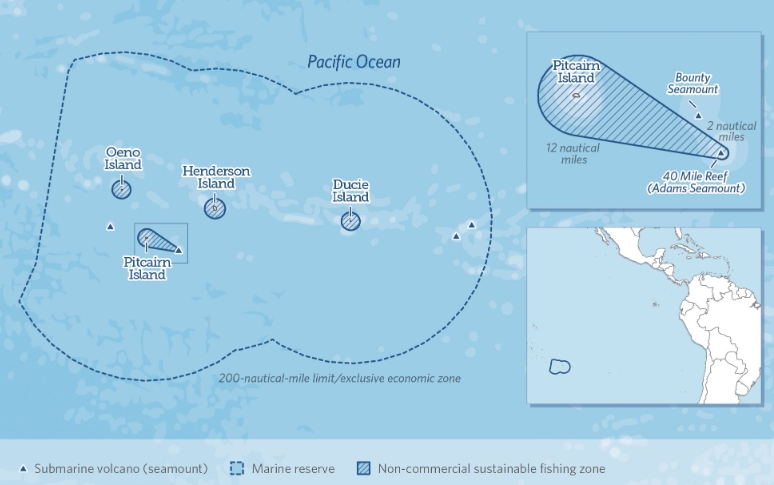
The Pitcairn Islands Marine Reserve. |
Sept. 15, 2016: As announced in the U.K. budget of March 2015, the U.K. establishes a marine reserve around Pitcairn, spanning about 830,000 sq km (99% of Pitcairn's exclusive economic zone).
Nov. 9, 2016: Shawn Christian is reelected as mayor, defeating Simon Young.
December 2016: Census population: 41.
2017: Construction work on an alternative landing facility, at Tedside on the west coast of Pitcairn, is completed; there are plans to build a paved road to connect the new facility with Adamstown.
March 2017: A document of the U.K. Department for International Development says that Pitcairn "continues to face a very uncertain future" and the government "wants to engage with the islanders in a concerted, meaningful, and frank discussion of the viability of the island."
March 29, 2017: The Island Council notes that Pitcairn has been requested by French Polynesia to stop smuggling of alcohol and cigarettes on Claymore II and reminded that the use of the port at Mangareva was "a privilege and not a right."
May 15, 2017: Henderson Island is identified in a study published in Proceedings of the National Academy of Sciences as having the world's highest density of plastic rubbish. The uninhabited island has accumulated an estimated 37.7 million items of debris, weighing 17.6 tonnes, from the 5,000 billion plastic items calculated to be circulating on the world's oceans.
July 2017: Councillor Leslie Jaques gives evidence to the U.K. House of Lords Select Committee on the European Union on the likely impacts of Britain's withdrawal from the EU. He notes that the EU provides "a significant amount" of funding - accounting for about 30% of Pitcairn's overall budget - and explains the importance of being part of a regional envelope of funding, which helps to facilitate cooperation with French Polynesia, Wallis and Futuna, and New Caledonia. Pitcairn gains benefits in other respects too; the EU is one of Pitcairn's largest markets for its honey exports, and the free movement of Pitcairners to French Polynesia, and particularly Tahiti, for medical treatment is crucial.
Sept. 13, 2017: Laura Clarke is appointed governor, to take office in January 2018.
Nov. 8, 2017: In Island Council elections, Michele Christian, Darralyn Griffiths, Leslie Jaques, Sue O'Keefe, and Kevin Young are elected. The position of deputy mayor is uncontested and thus retained by Charlene Warren-Peu.
December 2017: Census population: 54 (49 permanent residents and 5 expatriates).
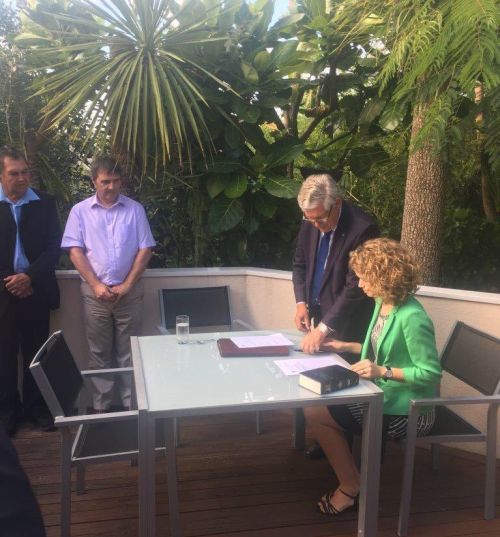
Laura Clarke is sworn in as governor of Pitcairn by Pitcairn chief justice Charles Blackie in Auckland, N.Z., Jan. 25, 2018. |
Jan. 25, 2018: Laura Clarke is sworn in as governor.
Feb. 20-23, 2018: At an EU Overseas Countries and Territories Ministerial Conference held in Brussels, an EDF-11 Focal Sector agreement is signed, worth €2.35 million, to upgrade the island's medical centre and to support several tourism-related activities, including "improving accessibility to Pitcairn, specifically by developing the Bounty Bay and Tedside landings and improving on-shore facilities" and "constructing a shelter and information centre for tourists and other visitors."
August 2018: Nick Kennedy becomes administrator.
Nov. 30, 2018: A Child Safeguarding Memorial is unveiled with the ambiguous inscription: "To say we're sorry does not seek punishment or blame, it doesn't say they were right and we were wrong, just that we have learnt and understand the error of our ways."
March 2019: The MV Silver Supporter becomes Pitcairn's passenger/cargo vessel, promising a boost to tourism, as the new schedule will see 21 passenger sailings to the island per year, up from 12, together with increased opportunities for special-interest cruises and charters. However, in May it becomes clear that France does not allow the new ship to pick up or drop off freight at Mangareva.
March 24, 2019: Population: 37.
Early April 2019: Pitcairn and its neighbouring islands are recognized as an International Dark Sky Sanctuary (an area with no nightly light pollution of the atmosphere), named Mata ki te Rangi, or "Eyes to the Skies" (one of the possible old Mangarevan names for the island from the time of Polynesian settlement prior to European rediscovery). It is hoped that the sanctuary status will increase the number of "astro-tourists."
May 11, 2019: An article in Britain's Telegraph does not help the island's cause. Entitled "Secrets of Pitcairn, the tropical island that covered up a child-sex scandal," it begins by reporting the experiences of a photographer, stating that "the locals were hostile and a culture of silence culminated in the worst experience of her life." The article says that "Many islanders believe Britain is looking for an excuse to wash its hands of this remote and costly anachronism."
June 2019: A team of international scientists, environmentalists, and a photographer visits Henderson Island, funded by the U.K. government and the Pew Trusts. The expedition investigates the quantity of plastics, the rate of accumulation, and the impact on the marine and land environments.
Nov. 6, 2019: Charlene Warren-Peu is elected as Pitcairn's first female mayor. Kevin Young is elected deputy mayor and the new Council, taking office Jan. 1, 2020, includes Ariel Harding, Michele Christian, Leslie Jaques, Shawn Christian, and Lea Brown.
Nov. 30, 2019: Former governor (1987-90) Robin Byatt dies.
Dec. 18, 2019: The administrator circulates a memo on the consideration of whether the U.S. Air Force should establish a satellite-monitoring station on Pitcairn. On Jan. 22, 2020, the governor, according to the Island Council minutes, "stated that she can absolutely reassure the community that there are no plans for a U.S. base to be established on Pitcairn." Nevertheless it is subsequently decided that a delegation from the U.S. Air Force should be invited for initial discussions.
February 2020: The U.K. government blocks an attempt by TRON, a blockchain-based decentralized operating system, to establish a cryptocurrency in Pitcairn. In November the administrator is forced to remind the mayor and councillors that they "are not permitted to receive gifts from [TRON] as they have been offered in an attempt to influence."
Feb. 23, 2020: Population: 37.
March 2020: The Island Council approves measures aimed at preventing an outbreak on Pitcairn of coronavirus disease (COVID-19). Until further notice cruise ships, tour vessels, and yachts are not permitted to land passengers at Pitcairn Island (although they can land at Henderson, Oeno, and Ducie). Visits by tourists via the MV Silver Supporter are also forbidden, and before boarding the vessel in New Zealand, Pitcairn residents returning to the island are required to go into quarantine for 14 days and to take a test during this period to identify that they are free of the virus; the period of quarantine is reduced to 10 days in February 2021.
Late April 2020: Mayor Warren-Peu is drawn into controversy after a falling-out among several councillors, a division manager, the administrator, and a member of the community. One trigger was an attempt by the mayor to "silence" a member of the Island Council who had asked about the condition of the longboats. This then opened up a much broader discussion about the nature of decision-making on Pitcairn, including how Island Council business is undertaken, whether the role of the administrator should be reviewed, and the degree to which information is shared within the council and the wider community.
October 2020: Fresh charges are laid against former mayor Mike Warren, who is accused of having roamed the island in the nude, once in January and twice in June.
January 2021: Alasdair Hamilton becomes deputy governor and Mark Tomlinson administrator.
Feb. 16, 2022: Iona Thomas is appointed governor, to take office in August.
April 2022: Colin Leeman becomes administrator.
Early July 2022: Stephen Thwaites becomes administrator.
July 2022: Pitcairn registers its first COVID-19 case after two years of almost complete isolation (March 2020-March 2022).
Late July 2022: Tim Moody becomes administrator.
Aug. 9, 2022: Iona Thomas is sworn in as governor.
October-November 2022: Simon Bull is administrator.
Nov. 9, 2022: Simon Young is elected mayor (19-16), to take office Jan. 1, 2023. Born in England (no relation to the Bounty Youngs), he is the first non-Pitcairner in the post.
December 2022: Steve Townsend and Fiona Kilpatrick take office as joint administrators. The married couple previously fulfilled a similar role on Tristan da Cunha.
September 2023: The government opens a Marine Science Base, one of the most remote research centres in the world.
April 2024: Lindsy Thompson becomes administrator.
July 2025: Rachael Midlen succeeds Thompson as administrator.
October 2025: Alasdair Hamilton leaves office as deputy governor. His successor is Paul Greenhalgh.
Nov. 5, 2025: Shawn Christian is elected mayor, Charlene Warren deputy mayor, and Torika Christian, Melva Evans, Michele Christian, Simon Young, and Shirley Young as councillors.
Aug. 14, 2026: Louise Cantillon is appointed governor, succeeding Iona Thomas who left the post in April. She is sworn in on September 15.