Rulers: Christmas Island: History
Christmas Island
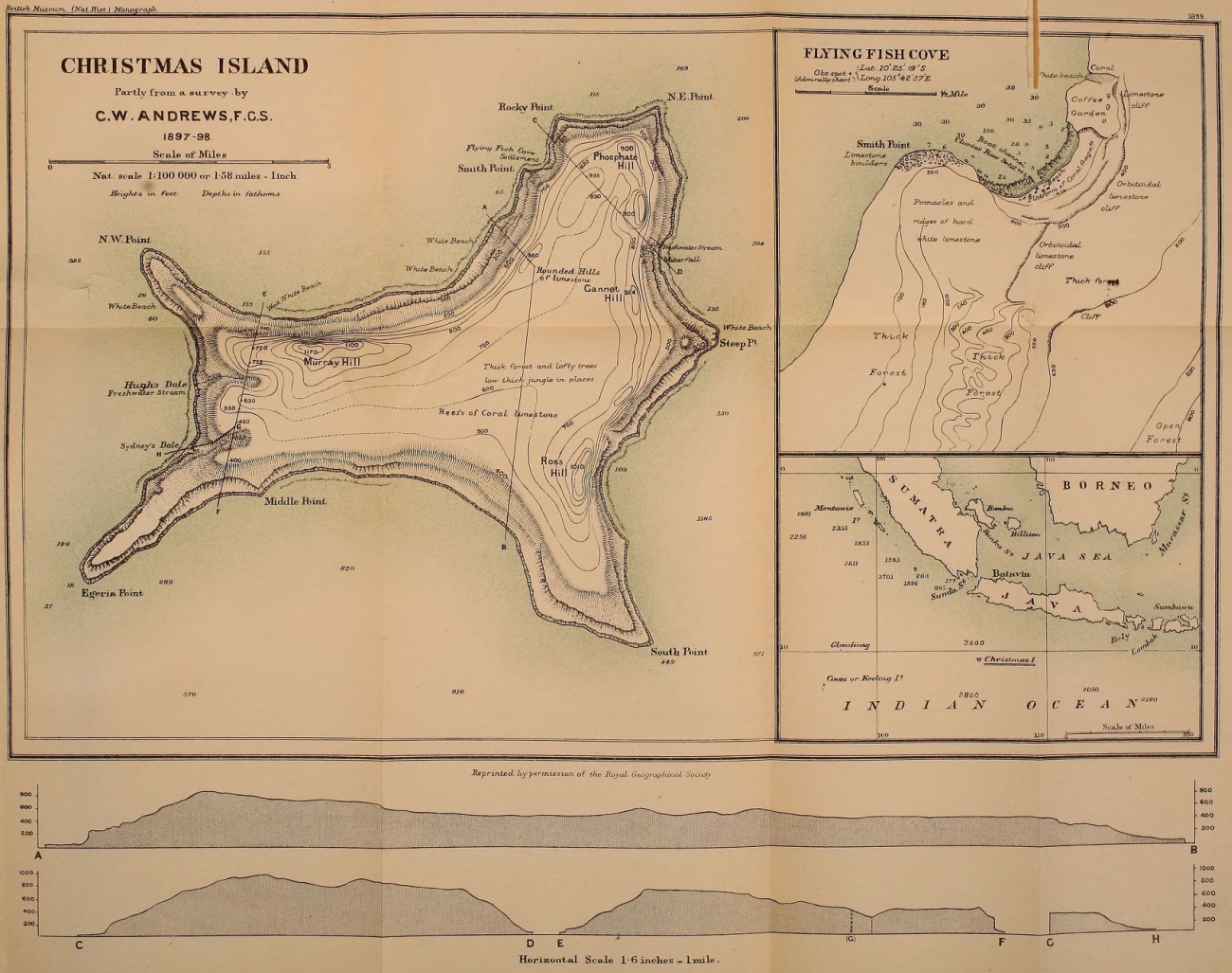
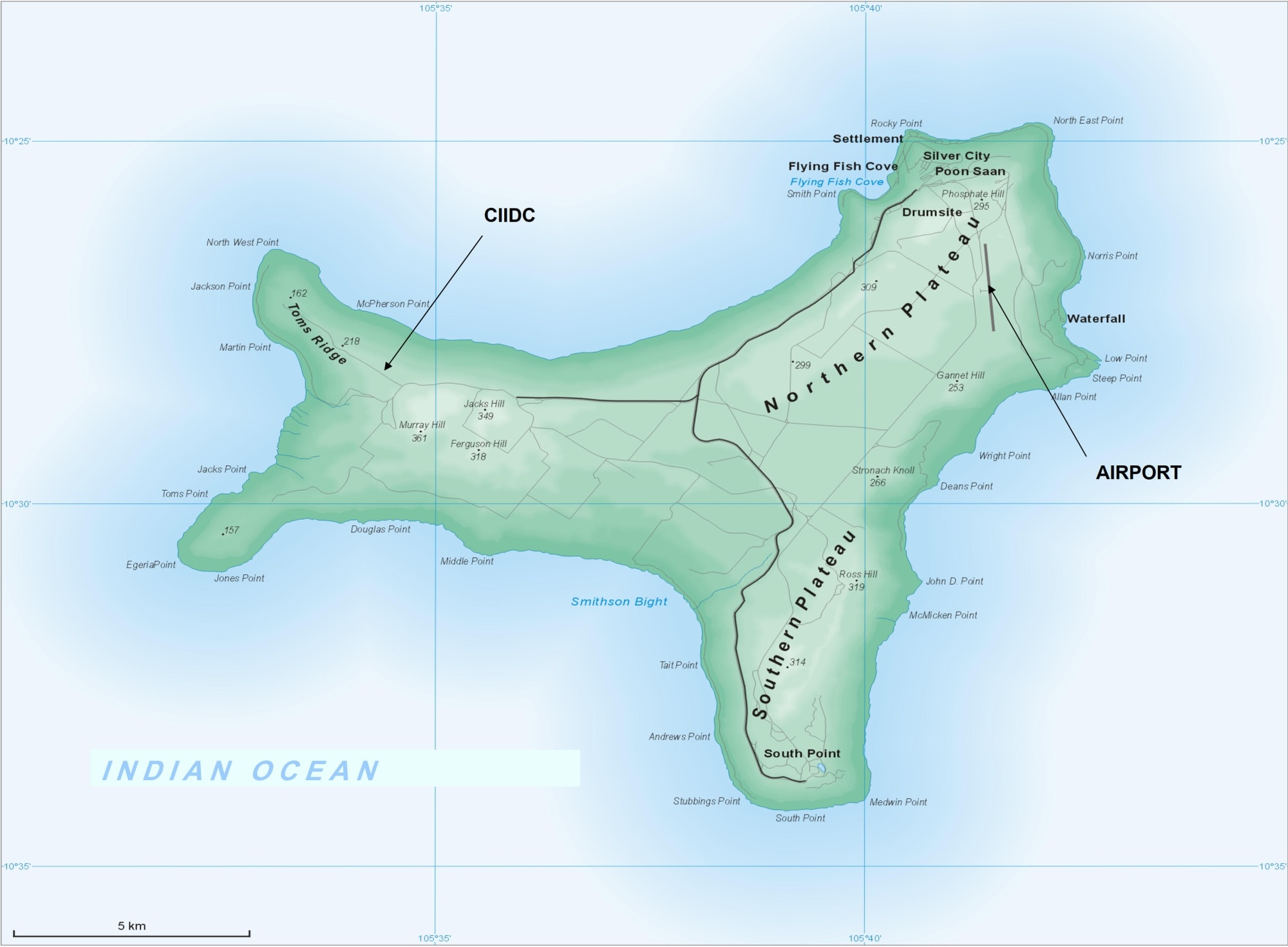
Christmas Island lies in the Indian Ocean, 350 km south of the Indonesian island of Java and 1,400 km northwest of the North West Cape - the nearest point on the Australian coast. It is not to be confused with another Christmas Island (Kiritimati), in the Pacific and part of Kiribati.
1615: The island is first sighted by Richard Rowe, master of the Thomas.
Dec. 25, 1643: Captain William Mynors of the British East India Company arrives on Christmas Day at the island, which he names Christmas Island.
1666: The island appears on a Dutch map by Pieter Goos, in which it is called Moni.
March 1688: English navigator William Dampier on the Cygnet makes the earliest recorded landing on the island. He finds it uninhabited:
...we fell in with a small woody island in lat. 10°20´ S. It was deep-water about the island, and there was no anchoring; but we sent two canoes ashore, one of them with the carpenters to cut a tree to make another pump; the other canoe went to search for fresh water, and found a small brook near the southwest point of the island, but there the sea fell on the shore so high that they could not get it off. At noon both the canoes returned on board, and the carpenters brought on board a good tree; the other canoe brought aboard as many boobies and man-of-war birds as sufficed all the ship's company when they were boiled.
They also got a sort of land animal, somewhat resembling a large crawfish without its great claws. The island is a good height, with steep cliffs against the south and southwest, and a sandy bay on the north side, but with very deep water steep to the shore.
1718: Captain Daniel Beekman provides an account of the island, remarking that "the island looks exceeding pleasant, being covered with lofty trees, and may be known by the following directions: Coming from the northwestward, it appears pretty high, with a saddle in the middle; the westernmost land is the highest, trenching away to the northward to a low, flat point; the easternmost point is low, but bluff. I sounded within eight miles of the low point, but had no bottom with the 100-fathom line out. The island is about seven leagues from east to west." Both the heights and the length of the island in his account are much exaggerated.
1771: The Pigot, East Indiaman, attempts to find an anchorage, but fails. The crews of this and other passing vessels report the occurrence of wild pigs, coconut palms, and lime trees, none of which really exist.
1857: The first attempt at an exploration of the island is made by the frigate Amethyst, from which a boat's crew is landed with the object of attempting to reach the summit, but the inland cliffs prove an insuperable obstacle, and the ascent is abandoned.
1872-76: During his expedition to the East Indies, British naturalist Dr. John Murray carries out extensive surveys, and predicts that phosphate will be found on the island.
1886: The surveying vessel Flying Fish (Captain John Maclear) is ordered to make an examination of the island. The coast is found to consist of limestone cliffs, and it is only after sailing nearly all round the island that an anchorage is found in a bay with a white shingle beach on the north coast. To this the name Flying Fish Cove is given. Another white beach is seen towards the northwest point, but no anchorage is found near it. A number of men are landed, and collections of the plants and animals are obtained, but, since the island seems of little value, no serious attempt at exploration is made.
September-October 1887: Specimens of soil and rock are collected by the men of HMS Egeria (Captain Pelham Aldrich), who cut a way to the top of the island. J.J. Lister, who accompanies the expedition as naturalist, makes extensive collections both of the fauna and flora, but does not have time to penetrate to the middle of the island. No indication is found that the island has ever been inhabited, though a few ships, probably whalers, seem to have touched at Flying Fish Cove, for some of the large trees have letters cut on them. Towards the end of the year the collected rocks are submitted to Murray for examination, who finds that some are nearly pure phosphate of lime.
June 6, 1888: Captain W.H. May of HMS Imperieuse lands at Flying Fish Cove and declares the island part of the British dominions, this annexation coming at the urging of Murray.
November 1888: The first settlement is established at Flying Fish Cove (and comes to be known by that same name, or alternatively just as The Settlement) by George Clunies Ross of the Cocos Islands, some 1,000 km to the southwest. His brother Andrew Clunies Ross, with his family and a few Cocos Malays, subsequently reside there and build houses, dig wells, and make small clearings for planting coffee, coconut-palms, bananas, and other plants in the neighbourhood of Flying Fish Cove.
Jan. 8, 1889: Christmas Island is incorporated in the British crown colony of the Straits Settlements with its capital at Singapore.
1890: HMS Redpole calls at the island for a few hours, and H.N. Ridley, of the Singapore Botanical Gardens, who is on board, collects a number of plants not previously recorded.
February 1891: A 99-year lease is granted to George Clunies Ross and Sir John Murray to mine phosphate and cut timber.
1895-96: Sydney Clunies Ross makes explorations in the higher part of the island, resulting in the discovery of large deposits of phosphate of lime.
1897: The lease is transferred to the Christmas Island Phosphate Company, Ltd. (CIPCO), which is largely owned by the former lessees. Labour is imported, mostly from China.
May 23, 1900: By proclamation of this date, Christmas Island is incorporated in the settlement of Singapore, within the Straits Settlements. Singapore maintains a district officer on the island with a few police attached to his staff for the maintenance of law and order.
1905: Christmas Island exports of phosphate have reached 97,942 tons. The island's annual report this year shows that there are 1,061 inhabitants comprising 10 Europeans, 6 Eurasians, 952 Chinese, 42 Malays, 38 Sikhs, 8 Japanese, and 5 others.
1914-18: Australian interest in Christmas Island is sparked during World War I by the likely disruption of phosphate supplies from Nauru (hitherto a German protectorate) to Australia and New Zealand.
1926: As demand for superphosphate is increasing and is predicted to outstrip the capacity of Nauru and Ocean Island, a committee of Australian phosphate manufacturers suggests that it might be advisable to purchase Christmas Island phosphate rights from CIPCO, and for the British Phosphate Commission (BPC) to work it in conjunction with Nauru and Ocean Island. The BPC is made up of Australian, British, and New Zealand representatives. During the Imperial Conference in London in November, Sir Alwin Dickinson, the British commissioner of the BPC, submits a proposal in favour of purchase at about £1,600,000.
September 1927: The Australian and New Zealand governments agree to Dickinson's proposed course of action, but the British government decides not to join them in the proposed purchase of rights. After considerable delay, negotiations are conducted in 1929 but are aborted because CIPCO is not willing to sell for less than £4,000,000.
December 1940: Nauru is attacked by German raiders during World War II, and the BPC subsequently arranges phosphate supplies from Christmas Island, from which 94,000 tons is obtained up to early 1942.
March 31, 1942: Christmas Island is occupied by Japanese troops; many of its inhabitants are captured and sent to prison camps in Indonesia. Japan abandons attempts to export phosphate after one of its ships was torpedoed by Allied submarines.
Oct. 18, 1945: Following the end of the war, HMS Rother lands an armed party to retake control, to an enthusiastic welcome from the locals. CIPCO thereafter resumes operations.
April 1, 1946: The Straits Settlements are dissolved, Singapore (including Christmas Island) becoming a separate colony.
June 1947: Prime Ministers Joseph Benedict Chifley of Australia and Peter Fraser of New Zealand agree to propose to the British government that, on expiry of CIPCO's lease in 1990, the lease not be renewed, but that rights to mine the phosphates should then be granted to the BPC on behalf of the three governments. Late in 1947, the United Kingdom rejects the proposal on the grounds that "it would be impossible to bind whatever government might be in power here some time forty years hence not to renew the company's concession on its expiry." The British government suggests instead the resumption of negotiations for Australia and New Zealand to purchase the rights. It also flags that it will be necessary to inform the governor of Singapore before any final arrangement is made with the company.
May 1948: The Australian and New Zealand governments reopen negotiations to purchase CIPCO's assets and rights for the unexpired period of the mining concession for a lump sum. On July 16, a price of £2.75 million is settled with CIPCO. The British-administered Singapore government requires the continuation of royalty payments under the lease, the continuing application of Singapore labour laws, and the continuing provision by the company or its successors of essential services for government officers stationed on Christmas Island. The sale is publicly announced on October 1 and concluded on December 31.
Nov. 26, 1949: An agreement between Australia and New Zealand is concluded establishing the Christmas Island Phosphate Commission to carry out mining and shipping operations on behalf of both governments. One commissioner is to be appointed by the Australian government, one by the New Zealand government, and one by the two governments jointly. The British Phosphate Commissioners are to be appointed as managing agents of the Christmas Island undertaking. Rent and royalty payments will continue to be paid to the government of Singapore.
July 1950: The United Kingdom's commissioner-general for Southeast Asia asks the Australian prime minister for assistance in obtaining the use of Christmas Island as a place of confinement for political detainees from Malaya, noting the difficulties that their retention in Malaya is causing for the Malayan authorities. The Australian and New Zealand governments both consult the BPC, which expresses grave concern that the effect of establishing a settlement of upwards of 7,000 political detainees would probably cause their staff of 1,700, of all races, to leave the island. They also point out the inadequacy of domestic and other facilities. The two governments share these concerns and reject the proposal.
March 1952: There is press speculation about the use of Christmas Island as an observation post for the United Kingdom's atomic weapons tests at Woomera, South Australia. (Incidentally, later British nuclear tests take place at the other Christmas Island, in the Pacific.)
September 1954: Australian government representatives meet to review the outlook for demand and supply of phosphates in Australia. By this stage, supply to Australia and New Zealand has been rationalized to minimize shipping costs. Australia is now taking the whole output from Christmas Island, and New Zealand is drawing a larger tonnage from Nauru and Ocean Island, which are nearer to it, to compensate. The interdepartmental committee notes that Australia has two particular interests in Christmas Island: as a source of phosphate, and as a strategically located island. The committee records its concern about the potential for Singapore to force up the price of phosphate by imposing export taxes and taking other action to get more and more revenue from the island. It also notes constitutional changes, expected in 1955, affecting the government of Singapore. The cabinet decides on November 24 that it is in Australia's interests to have sovereignty over Christmas Island transferred to it, and authorizes Prime Minister Robert Menzies to open the question by informal discussions in London.
October 1955: The Australian minister for external affairs, Richard Gardiner Casey, raises the transfer question with the governor of Singapore in London. The governor comments that there would be strong opposition in Singapore to the transfer of Christmas Island to Australia because of loss of revenue and natural dislike of losing territory, and that the Malayan Communist Party would relate this to Australian troops in Malaya and the transfer of Cocos Islands currently underway. Casey agrees to let the matter "lie fallow for a year before raising it again."
March 1956: Menzies raises the proposal of detaching the island from Singapore and retaining it under British control at the Commonwealth Prime Ministers' Conference in London, and in April receives an interim reply from British prime minister Sir Anthony Eden saying that it is not a simple matter and it will take some time to reach conclusions. On October 22 a substantive reply comes from the foreign secretary, saying the U.K. is agreeable in principle to the detachment, but that it would not be possible to deprive Singapore of the phosphate-royalty revenue, or for any expense to fall on the U.K. Discussions ensue over the next months about how best to make the financial arrangements with Singapore.
June 6, 1957: The U.K. colonial secretary, Alan Tindal Lennox-Boyd, announces that arrangements are being made to transfer the administration of Christmas Island from the British to the Australian government. A similar announcement is made in Canberra by Australian foreign minister Casey.
Lennox-Boyd explained that in the light of the new constitutional arrangements for Singapore, H.M. government did not consider that they could ask the Singapore government to continue to administer Christmas Island (which lies some 1,300 km to the south of Singapore) on their behalf. Australia, he pointed out, drew about one-third of her phosphate requirements from the island and was the government most closely concerned with its administration. Moreover, the Australian government had given assurances that British subjects ordinarily resident on the island at the time of transfer, and those born thereafter, would enjoy the same rights of citizenship and immigration as had been extended to the inhabitants of the Cocos Islands when the latter island group was transferred to Australia in 1955.
The decision to transfer the administration of Christmas Island from Singapore to Australia was strongly criticized by the leaders of two opposition parties in the Singapore Assembly - Lee Kuan Yew, leader of the People's Action Party, and Lim Choon Mong, of the moderate Liberal-Socialist group. In reply to these criticisms, the acting chief minister pointed out that Christmas Island had never belonged to Singapore, which had only been "asked to administer it and nothing more."
On August 1 in the House of Commons, John Profumo, secretary of state for the colonies, was asked to what extent the inhabitants of Christmas Island had been consulted on the transfer. Profumo replied that there was no indigenous population; that the inhabitants' citizenship rights would remain unaffected; that they would be free to continue to return to their own territories; and that those remaining on the island would be eligible to acquire Australian citizenship. For those reasons, the government had not considered it necessary to consult before deciding on transfer.
Dec. 13, 1957: Australian legislation - the Christmas Island (Request and Consent) Act 1957 - is enacted requesting the transfer of Christmas Island and providing for parliamentary consent to the steps constitutionally needed to bring it about (considered necessary under the Statute of Westminster).
Jan. 1, 1958: Under an order-in-council of Dec. 13, 1957, Christmas Island is detached from Singapore and administered as a separate dependency of the U.K. pending its transfer to Australia, to take place later in 1958. An ex gratia payment of 20,000,000 Malayan dollars (nearly £2,500,000) is made (by the U.K., which is to be reimbursed by the Australian and New Zealand governments) to the Singapore government to compensate it for the loss of revenues from the island's phosphate deposits, which are worked jointly by Australia and New Zealand.
April 17, 1958: The Christmas Island Act is introduced in the British House of Lords, to enable the British government to transfer the administration of the island to Australia. It is enacted May 14.
Sept. 2, 1958: Legislation (the Christmas Island Act 1958) authorizing Australian acceptance of the island, passed by both houses of the Australian parliament in late August, receives assent.
Oct. 1, 1958: Under a British order-in-council of September 11 and a proclamation of the Australian governor-general of September 18, the island becomes an Australian territory. (The event comes to be commemorated in the observance of Territory Day on every first Monday of October.) The Australian flag is raised in the morning (the Union Jack was lowered at the close of business on September 30) and Donald Evan Nickels is sworn in as official representative, appointed by the Australian government. Later in the month a new agreement between the Australian and New Zealand governments is concluded governing their mutual rights and interests in Christmas Island. The agreement preserves New Zealand's position as an equal partner with Australia in the Christmas Island Phosphate Commission.
Oct. 1, 1960: John William Stokes becomes official representative.
June 13, 1966: Charles Ivens Buffett becomes official representative.
May 1, 1968: An administrator (Brig. Leslie Dudley King), appointed by the governor-general, replaces the official representative.
1970: Ordinances are made to modify those Singapore laws that were continued at acquisition.
Early 1975: The status of the island is discussed with Indonesia and Singapore.
1979: An Australian arbitration officer, James Taylor, is forcibly prevented from leaving after he inserted layoff clauses in employees' agreements with the British Phosphate Commission. The islanders demand that both he and the island's administrator be replaced so that better terms could be obtained for the commission's Malaysian workers.
1980: An Advisory Council is established for the administrator to consult.
1981: All residents of the island become eligible to acquire Australian citizenship.
1984: The Australian government announces a decision to move towards a "normalization" policy and the extension of mainland laws to Christmas Island. Social security, health, and education benefits are extended to the island, and Australian citizens resident on the island are enfranchised there.
Oct. 26, 1984: The Services Corporation Ordinance 1984 creates the Christmas Island Services Corporation with power to provide many local and community services on the island.
September 1985: The first Christmas Island Assembly is elected by residents. Nine members are elected for one-year terms. The Christmas Island Services Corporation is placed under the direction of the Assembly.
Early 1986: The Christmas Island Assembly holds a design competition for an island flag. However, the winning design (announced April 14) is not formally adopted as the official flag.
November 1987: The Assembly is dissolved, and the administrator empowered to perform its functions.
Late 1980s: Full income tax liability is introduced.
Dec. 10, 1990: A new Christmas Island Assembly is elected under the Christmas Island Assembly (Amendment) Ordinance 1990.
1991: Both the commonwealth government and the Christmas Island Assembly endorse a "proposed package of changes extending to the residents of Christmas Island rights, opportunities, and obligations equivalent to those of their fellow Australians in comparable communities."
July 1, 1992: The Christmas Island Shire Council, created as a result of the law reform process whereby Australia decided to apply the laws of Western Australia as territory laws, begins operating. In Western Australia a shire is a type of local government area. The Christmas Island Shire Council replaces the Christmas Island Assembly and Christmas Island Services Corporation. By 1998 the term "Shire of Christmas Island" replaces "Christmas Island Shire Council."
Dec. 18, 1993: The Christmas Island Casino and Resort is officially opened. Backed by Tommy Suharto, son of the Indonesian president, it attracts mainly wealthy Indonesians. However, it is only profitable during the first year of operations, and closes in April 1998, causing an estimated drop in the number of international visitors of 65%.
May 7, 1994: An unofficial referendum on secession, sponsored by the Union of Christmas Island Workers, is held concurrently with local-government elections. While the result is negative, the poll serves to point out widespread frustration over a number of issues, including a housing shortage, high freight charges, and the Australian government's plans to abolish the island's duty-free status (which has become a considerable source of revenue). Some 85% of voters favour a greater degree of autonomy, while rejecting the possibility of total secession from Australia.
Aug. 6, 1996: Census population: 1,906.
Oct. 1, 1997: Ron Harvey takes office as administrator of both Christmas Island and Cocos Islands ("Australian Indian Ocean Territories"), which from here on are under a common administrator, based at Christmas Island. He is assisted by two official secretaries, one in each territory, but in the early 2000s that position is also unified and based on Christmas Island.
Nov. 1, 1998: Graham Nicholls is appointed acting administrator.
Feb. 4, 1999: Bill Taylor is appointed as administrator.
Nov. 6, 1999: A referendum returns a 62% vote favouring self-government.
May 23, 2001: The Australian and Russian governments sign a bilateral space activities agreement that will enable Russian rockets to be used for launching satellites from Christmas Island. It is hoped the spaceport on the island will be ready by 2005.
Aug. 7, 2001: Census population: 1,446.
Late August 2001: The Norwegian cargo ship MV Tampa, having picked up a boatload of migrants in distress, is refused permission by Australia to disembark them on Christmas Island, prompting international condemnation and a serious diplomatic dispute between Australia and Norway. Hundreds of Christmas Island residents attend a rally urging the Australian government to reconsider its stance. In September an Australian military ship transports the 433 mostly Afghan refugees to Nauru and New Zealand, which accepted them temporarily. The same month the Senate in Canberra approves new legislation, which excises Christmas Island and other outlying territories from Australia's official migration zone, and imposes stricter criteria for the processing of asylum seekers and the removal of their right to recourse to the Australian court system. However, increasing numbers of asylum seekers continue to attempt to reach Christmas Island via Indonesia and by mid-November several hundred have been placed in a detention centre on the island, the Phosphate Hill Alternative Place of Detention (APOD).
Dec. 18, 2001: Australian and Russian space agencies sign another key agreement to begin construction of a joint space centre on Christmas Island in February 2002. The two countries expect to launch satellites from the planned base from 2004 using Russia's Aurora booster rockets.
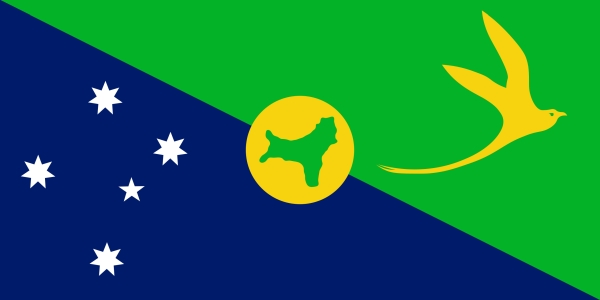 |
Jan. 26, 2002: The Christmas Island flag, as chosen in 1986, is officially adopted by Administrator Taylor. The blue and green triangles represent the sea surrounding the island and the vegetation of the island. The Southern Cross in the blue triangle is the representation appearing in the Australian national flag. The image in the green triangle is the golden bosun bird (Phaethon lepturus fulvus), which is unique to the island. The gold disk in the centre of the flag represents the island's phosphate mining history and was originally included to provide a background for the green map of Christmas Island.
March 11, 2002: The Australian government, which expresses increasing concern over the threat of international terrorism, decides to build an additional detention centre for illegal immigrants on Christmas Island, at a projected cost of more than A$150 million, in order to accommodate an anticipated total of 18,000 asylum seekers who are expected to arrive at Christmas Island during 2002-06.
April 2002: It is reported that Russia might withdraw from the spaceport project because they cannot guarantee security and safety with a large-scale detention centre nearby. Negotiations indeed come to an impasse during the year, also because Russia wants to limit Australia's access to its rocket technology and classified information.
February 2003: Plans to scale down the detention centre project are announced.
July 2003: A boat carrying 53 asylum seekers from Vietnam is intercepted in Australian waters (the first such vessel to be found in the region since 2001), and its passengers are transferred to Christmas Island.
Nov. 1, 2003: Evan Williams takes office as administrator.
2004: Christmas Island continues to be used as a detention centre for illegal migrants seeking to enter Australia. In the Australian election campaign, Prime Minister John Howard praises Christmas Island's major role as part of the successful "Pacific solution" to stop boat people who are attempting to reach the Australian mainland.
February 2005: Work begins on the construction of an 800-bed "immigration reception and processing centre" (some 100 construction workers being engaged on the project) despite concerns that the structure is not needed and warnings by Shire president Gordon Thomson that there are no psychiatric services on the island should asylum seekers require them. The facility, which is being paid for by the Australian government, is intended to replace the old detention centre which is closed in July. It is reported in November, however, that the shuttered facility, to the annoyance of many Christmas Island inhabitants, will be temporarily reopened to house a group of seven Indonesian detainees. Speculation among some observers that the Australian government intends to use the new centre as a military base for U.S. forces is dismissed by official sources. However, the islanders become increasingly suspicious of the government's intentions, particularly when unofficial information begins to circulate that the building specifications of the project are similar to those implemented in high-security military facilities.
May 7, 2005: Turnout at Shire elections is about 48%.
Dec. 15, 2005: Neil Lucas is appointed administrator, to take office Jan. 30, 2006.
January 2006: A group of 43 asylum seekers from Papua (Indonesia) found on Queensland's Cape York is transferred to Christmas Island to be interviewed by Australian immigration officials. The Papuans are flown to the island as part of the Australian government's long-standing policy to process unauthorized arrivals offshore. They are granted temporary visas in March, while awaiting transfer to the Australian city of Melbourne.
May 29, 2006: The Australian government says the spaceport proposal is not necessarily dead, but that government support offered to the particular project headed up by businessman David Kwon has lapsed as he failed to meet milestones.
Aug. 4, 2006: The budget for the detention centre is increased to A$396 million.
Aug. 8, 2006: Census population: 1,349.
February 2007: More than 80 Sri Lankan refugees, en route from Indonesia, are intercepted by a ship of the Australian navy and detained on Christmas Island, prior to being transferred to Nauru.
Oct. 25, 2007: Gordon Thomson, president of the Shire since 2003, and Foo Kee Heng, deputy president from 2002, are reelected to their positions.
2008: The Australian government uses the increased capacity of another detention centre on Christmas Island, the Construction Camp APOD (adjacent to Phosphate Hill APOD), to process asylum seekers. The island is for the moment Australia's last remaining offshore detention site in the country's Pacific Solution for unauthorized boat arrivals (though not for long, as others, in Nauru and Papua New Guinea, are reopened in subsequent years).
Dec. 20, 2008: The purpose-built North West Point (NWP) Immigration Detention Centre, forming the core of the Christmas Island Immigration Detention Centre (CIIDC), is opened. It was completed in April but the new Australian government, which had been opposed to its construction, hesitated to put it to use until further boat arrivals caused the Phosphate Hill and Construction Camp facilities to reach maximum capacity. Representatives of the human rights organization Amnesty International were permitted to visit the detention centre in August and said: "It is an extremely harsh and stark environment to detain people seeking asylum while their applications for protection are determined... The damage that has been done to people's mental and physical health by detaining them in remote high-security detention centres such as this has been documented repeatedly."
January 2009: 28 refugees from Afghanistan and Iran, who were intercepted off Western Australia in the latter part of 2008 and detained on Christmas Island, are granted permanent residency in Australia. The members of this group, which includes 10 children, are thus the first beneficiaries of the Labor government's "more humane" approach to the issue.
April 2009: There is a sharp increase in the arrival of asylum seekers (particularly from Afghanistan and Sri Lanka) on boats sailing into Australian waters, causing the NWP to soon reach capacity and Australian immigration minister Chris Evans to double the size of the detention facilities to house 2,300 people, including the addition of two further temporary APODs, Lilac and Aqua (becoming operational in January and May 2010, respectively).
Sept. 17, 2009: Brian James Lacy is appointed administrator, to take office October 5.
November 2009: The Australian government transfers some asylum seekers to mainland Australia for processing. Evans rejects claims by the new Australian opposition leader, Tony Abbott, that the government has abandoned offshore processing of asylum seekers and reiterates that the government is committed to mandatory detention of unauthorized boat arrivals. Later this month (November 21) the first significant disturbance, involving some 150 detainees from different ethnic backgrounds fighting against each other using broken pool cues, tree branches, and broom handles, takes place on the island, more than 40 detainees and five security staff being injured.
December 2009: Amnesty International describes the Australian government's holding policy as "unviable and inhumane."
December 2009: Christmas Island hosts its first cruise ship (the P&O Pacific Sun), after upgrades to its port and mooring facilities.
2010: Australian officials report that some 130 boats filled with asylum seekers were intercepted off Christmas Island during the year. The influx of nearly 6,400 asylum seekers leaves detention centres on the island overcrowded as the Australian government struggles to process the backlog of refugees.
April 18, 2010: Former administrator (1982-83) William Yates dies.
June 2010: In an attempt to ease the overcrowding, the authorities commence the transfer of dozens of asylum seekers from Christmas Island to a disused mining camp at Leonora, Western Australia. Meanwhile, asylum seekers on the island continue to be processed and resettled in mainland Australia.
Nov. 11, 2010: In a unanimous ruling that is expected to have extensive implications for government policy, the Australian High Court finds in favour of two unsuccessful Sri Lankan asylum seekers. The two Tamil migrants had been detained on Christmas Island and argued that legislation that prevented them from appealing against the rejection of their asylum claims was unfair. The dispute centred on the official distinction made between asylum seekers who arrived by sea and those who had travelled by air: the latter category was not subject to automatic detention and had the right of appeal in the event of the rejection of a claim for asylum.
Nov. 19, 2010: Ten asylum seekers sew their lips together in protest against their detention.
Dec. 10, 2010: The Territories Law Reform Act 2010, including provision for the comprehensive application of the laws of Western Australia to Christmas Island, receives assent.
Dec. 15, 2010: A wooden boat carrying some 90 men, women, and children, referred to as SIEV (Suspected Irregular Entry Vessel) 221, founders on rocks at Flying Fish Cove and sinks, killing about 50 Iraqi, Iranian, and Kurdish asylum seekers.
March 11-18, 2011: Rioting breaks out among asylum seekers held in the detention centre. At least 170 detainees escape from the centre, where more than 2,500 people are housed. Further disturbances occur on April 20-30, June 9, and July 19-21. Meanwhile, an investigation begins into the tragic December 2010 shipwreck off Christmas Island; charges of people-smuggling and reckless conduct are brought against an Iranian-born Australian, Ali Khorram Heydarkhani. A parliamentary inquiry concludes in June that the response of the authorities was as effective as possible under the prevailing weather conditions. Some 70 vessels carrying more than 4,500 asylum seekers from such places as Afghanistan, Pakistan, and Iran are intercepted off Christmas Island during 2011, with another major disaster when a ship founders off Java on December 17, killing about 200 of 250 on board.
Aug. 9, 2011: Census population: 2,072.
Oct. 18, 2011: Foo Kee Heng is elected as Shire president (Thomson not standing again) and Azmi Yon as deputy.
Feb. 23, 2012: An inquest into the 2010 shipwreck undertaken by the Western Australia state coroner finds that the situation had been "generally foreseeable" and yet the federal government failed to provide rescue vessels or an adequate surveillance system on Christmas Island.
June 21 and 27, 2012: About 100 further lives are lost when two boats carrying asylum seekers from Indonesia to Christmas Island sink en route. Those rescued are transferred to Christmas Island.
August 2012: Three Indonesian crew members of SIEV 221 are found guilty of people-smuggling in a Perth court, and sentenced in September to prison terms of more than five years. In October Heydarkhani is sentenced to 14 years.
July 2013: The detainee population peaks at 3,233. The regular operating capacity is only 1,094. The numbers subsequently go down as the Australian government signs agreements with Papua New Guinea and Nauru that provide for the assessment of asylum seekers there and permanent offshore resettlement of those with valid applications who intended to find asylum in Australia. Further, the government of Tony Abbott, which comes to power in September, initiates the stringent "Operation Sovereign Borders" approach, under which migrants are intercepted at sea by the military and denied permission to land on Australian territory. Consequently, no new migrant arrivals on Christmas Island are reported in 2014-19.
Oct. 19, 2013: In elections to the Shire, Gordon Thomson, Hafiz Masli, Cheng Siew Vincent Saw, Foo Kee Heng, and Philip Woo are elected for terms ending October 2017 and Rosnah Pal for a term ending October 2015. Thomson is subsequently elected Shire president.
August 2014: The Aqua and Lilac APODs are closed.
September 2014: The outgoing administrator, Jon Stanhope, makes an official apology to each resident of Christmas Island and the Cocos Islands, saying the federal government holds the islanders in "contempt." He includes the names and contact details of six senior bureaucrats in the Department of Infrastructure and Regional Development in Canberra he says have ignored the islanders' concerns for more than 12 months. The department defends its conduct, saying it holds regular community forums on the islands.
Oct. 6, 2014: Barry Haase takes office as administrator.
November 2014: An inquiry by the Australian Human Rights Commission into the situation of children confined in immigration holding centres presents its report to the government; the findings are publicized in February 2015. The commission notes that most of the 315 children held on Christmas Island during an inspection of the detention facilities there in October 2012 had been held for an average of 6-8 months and had been offered on average two weeks of education. Furthermore, one-third of children detained on Christmas Island and the mainland are reported to be suffering from mental health disorders requiring psychiatric support. The children were also found to be vulnerable to sexual assault and other violence. Ending the detention of children is strongly recommended.
December 2014: All asylum seeker family groups on Christmas Island (totalling 194 people, including 94 children) are transferred to a detention centre in Darwin.
2015: The Christmas Island detention facilities receive an influx of male foreign nationals with criminal convictions whose Australian visas were revoked owing to December 2014 amendments to the Migration Act that imposed more stringent standards with respect to the "character requirements" demanded of visa holders; these men, who are held alongside the asylum-seeker population, are referred to as "Section 501s" (after the relevant section of the Migration Act).
May 2015: The Australian government announces plans for the closure of the Construction Camp and Phosphate Hill APODs and the transition of the main NWP immigration centre into a "contingency" site for migrant reception and processing.
Nov. 8, 2015: Police use tear gas and allegedly force to quell violent disturbances that erupted at the detention complex following the escape and apparently accidental death of an Iranian Kurd inmate. Later in that month a boat carrying asylum seekers is intercepted within 200 m of Flying Fish Cove; the boat is towed away from Christmas Island by a navy vessel and the passengers are returned to Timor Timur, Indonesia.
Aug. 9, 2016: Census population: 1,843 (including 240 detainees).
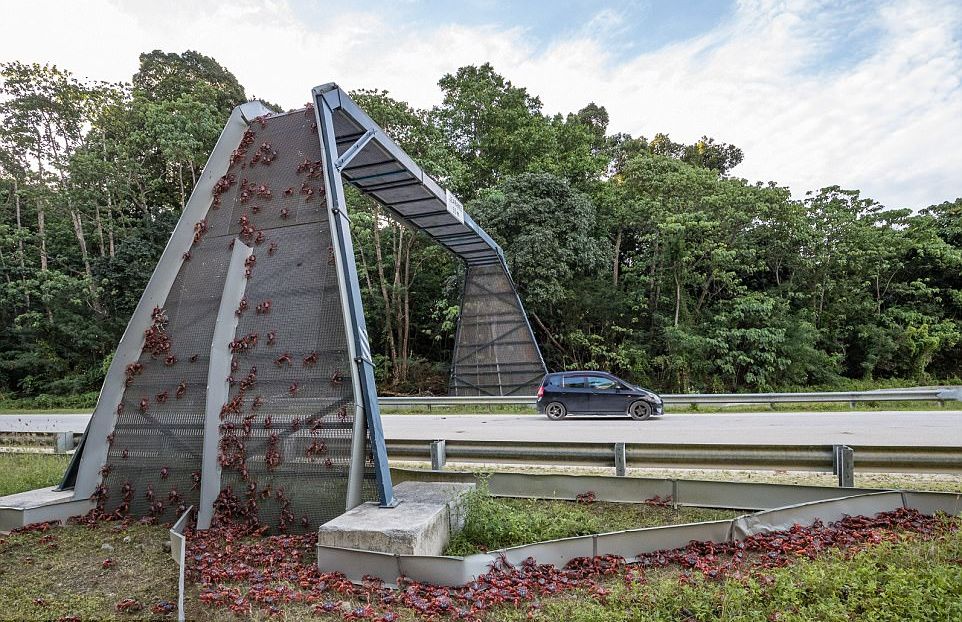
Red crabs (Gecarcoidea natalis) on their annual migration from the forest to the ocean cross a specially constructed road bridge, 2017. |
Sept. 4, 2017: Natasha Griggs is appointed administrator, to take office October 5.
Sept. 13, 2017: The New South Wales Supreme Court rules in favour of the federal government in response to a class action brought by survivors and relatives of the deceased in relation to the SIEV 221 disaster; the court finds that the federal authorities neither sent the vessel to sea, thereby exposing its occupants to harm, nor had control over its primitive nature. The ruling is upheld in January 2019.
October 2018: The Australian government confirms that the last 35 detainees have been transferred from Christmas Island to facilities on the mainland.
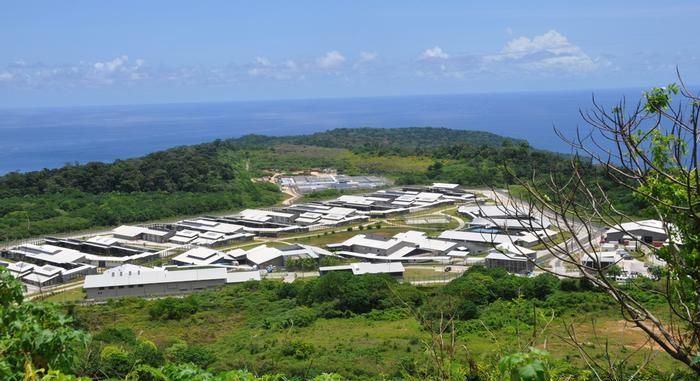
The Christmas Island detention centre. |
February 2019: The Australian House of Representatives and Senate approve legislation facilitating the transfer of sick asylum seekers held in external processing centres to Australia for treatment, and it is announced that the Christmas Island facility will be reopened to accommodate them, following its closure just a few months earlier. The new medical evacuation laws come into effect in March, and contractors and medical staff are sent to the Christmas Island facility. However, none of the asylum seekers brought to Australia under the Medevac legislation are transferred to Christmas Island. The legislation is repealed in December, and the NWP detention centre is returned to "contingency mode."
Late August 2019: Four Tamil asylum seekers (including two young children born in Australia) are transported from Australia to be detained on Christmas Island (although not at NWP) after an attempt to deport them to Sri Lanka was halted by a court injunction. In June 2021 the family is moved to "community detention" in Perth, and after a new Labor government takes office, it is allowed to return to its Queensland home in June 2022.
Oct. 19, 2019: In elections to the Shire, Kelvin Kok Bin Lee, Azmi Yon, Morgan Soh, and Farzian Zainal are elected for terms ending October 2023.
February 2020: The Australian government quarantines more than 200 Australian citizens at the NWP detention facility for two weeks. They were evacuated from China's Hubei province owing to the outbreak of novel coronavirus disease (COVID-19), which is declared a pandemic by the World Health Organization in March.
March 18, 2020: Administrator Natasha Griggs declares a state of emergency on Christmas Island and the Cocos Islands, in order to protect the territories from the COVID-19 pandemic. A travel ban is imposed and residents returning to the island have to self-isolate for 14 days after arrival.
Aug. 4, 2020: The Australian Border Force confirms that the detention facility on Christmas Island will be reopened to house some 250 "Section 501s" convicted of serious criminal offenses who are currently in immigration detention on the Australian mainland, to relieve pressure during the COVID-19 crisis. As of Jan. 31, 2021, 229 men (comprising 167 "Section 501s," 13 "illegal maritime arrivals," and 49 others) are held at the NWP.
Oct. 5, 2020: Natasha Griggs is reappointed as administrator for two more years.
Oct. 20, 2020: The Shire adopts a resolution establishing a Christmas Islanders Governance Forum with the aim of identifying islanders' preferences for their governance. The council notes that Christmas Island remains a "colonial possession" of Australia and that under the current "undemocratic regime" islanders do not elect the people who make the laws that govern their daily lives.
April 25, 2021: Former administrator (1977-80) Frank Boyle dies.
May 11, 2021: Australia announces the creation of two marine parks around Christmas Island and the Cocos Islands, together covering 740,000 sq km, an area bigger than France.
Aug. 10, 2021: Census population: 1,692.
Oct. 16, 2021: In elections to the Shire, Gordon Thomson, Kee Heng Foo, Hafiz Masli, Vincent Saw, and Philip Woo are elected for terms ending October 2025.
March 6, 2022: The first COVID-19 case on Christmas Island is recorded. No deaths are ascribed to the virus.
Oct. 4, 2022: Sarah Vandenbroek becomes acting administrator.
May 11, 2023: Farzian Zainal is appointed administrator. She is sworn in May 26, for a 3-year term beginning June 19.
Oct. 3, 2023: The detention centre is reported to be empty, with all remaining detainees brought to the Australian mainland.
Oct. 21, 2023: In elections to the Shire, Kelvin Kok Bin Lee, Azmi Yon, Swee (Mel) Tung, and Steven Pereira are elected for terms ending October 2027.
Oct. 18, 2025: In elections to the Shire (reduced from 9 to 7 members based on population estimates), 3 nonpartisan members (Tracey Krepp, Stephanie Lai, Gordon Thomson) are elected for terms ending October 2029. On October 20 Steven Pereira is elected (unopposed) and sworn in as Shire president.
Nov. 17, 2025: Google announces plans to build a data hub on Christmas Island, as well as a subsea cable system connecting the island to the Maldives and Oman.