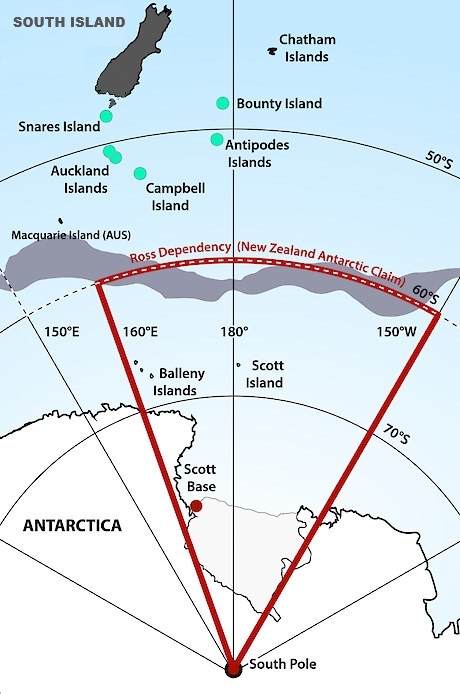
Map of Ross Dependency. The gray shading depicts the Antarctic Convergence (approximate boundary for the Southern Ocean). The dashed line is the northern border of the CCAMLR convention area. The green dots are sub-Antarctic islands of New Zealand.
Map of Ross Dependency. The gray shading depicts the Antarctic Convergence (approximate boundary for the Southern Ocean). The dashed line is the northern border of the CCAMLR convention area. The green dots are sub-Antarctic islands of New Zealand. |
July 30, 1923: A British order-in-council brings the area under New Zealand jurisdiction. In 1917 Britain had used the sector principle (which allowed a nation to claim an area of the Arctic or Antarctic from its existing territory to the pole) to extend its claim over areas of the Antarctic coastline as far as the pole, and after World War I it sent a secret dispatch to New Zealand's government, proposing that Australia and New Zealand should do likewise, suggesting that the whole of the Antarctic should eventually be part of the British Empire. In May 1923 New Zealand agreed, despite limited interest in Antarctica.
Jan. 11, 1957: The first Ross Dependency stamps are issued.
Jan. 20, 1957: Scott Base is established on Ross Island by Sir Edmund Hillary.
Jan. 31, 1957: Hallett Station, a joint New Zealand-United States operation, opens at Cape Adare.
Jan. 4, 1958: Sir Edmund Hillary and his party become the first to reach the South Pole overland since Robert Falcon Scott in 1912.
March 1958: The Ross Dependency Research Committee is formed to supervise New Zealand activity in the territory.
Dec. 1, 1959: New Zealand is an original signatory of the Antarctic Treaty (effective June 23, 1961).
October 1966: Harrison Laboratory is established at Cape Bird, Ross Island.
Jan. 9, 1969: A new scientific station is opened at Lake Vanda, about 130 km west of Scott Base.
1973: Hallett Station closes.
Nov. 28, 1979: Air New Zealand flight TE901 crashes into Mt. Erebus (on Ross Island), killing all 257 on board.
1986: Traces of petroleum are discovered in the territory, more than 600 m below the seabed.
1988: In an effort to stop illegal fishing in the Ross Sea, patrols begin to be undertaken periodically by air force planes and navy vessels, in coordination with similar surveillance by Australian planes and ships.
Dec. 6, 1994: The Antarctica (Environmental Protection) Act 1994 is assented to, consolidating measures aimed at conserving the region's flora and fauna (which includes 18 species of penguin, 6 species of seal, and several rare species of whale) included in the Antarctic Treaty, and reinforcing the Convention for the Conservation of Antarctic Marine Living Resources (CCAMLR; in force since April 7, 1982).
January 1995: The Vanda station is removed due to concerns over rising lake levels.
July 1, 1996: The Ross Dependency Research Committee is disbanded, its activities being incorporated in the New Zealand Antarctic Research Institute.
1997: New Zealand begins to conduct exploratory fishing for toothfish in the Ross Sea.
2002: A Statement of Strategic Interest in Antarctica stresses New Zealand's environmental stewardship in the region.
November 2010: A Defence White Paper echoes warnings by conservationists in calling attention to the vulnerability of the Antarctic landmass and seas to unscrupulous resource exploitation.
October 2016: The 25 members of CCAMLR unanimously agree to establish a Marine Protected Area in the Ross Sea region, covering some 1.55 million sq km, effective Dec. 1, 2017.