Rulers: Guernsey: History
Guernsey
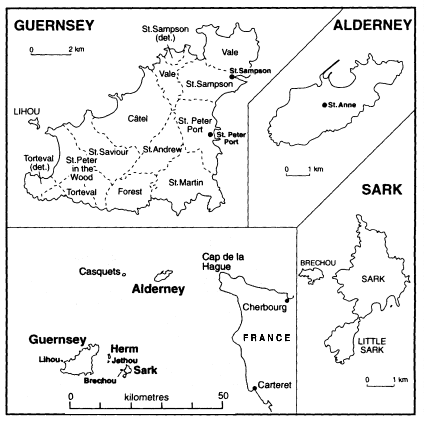
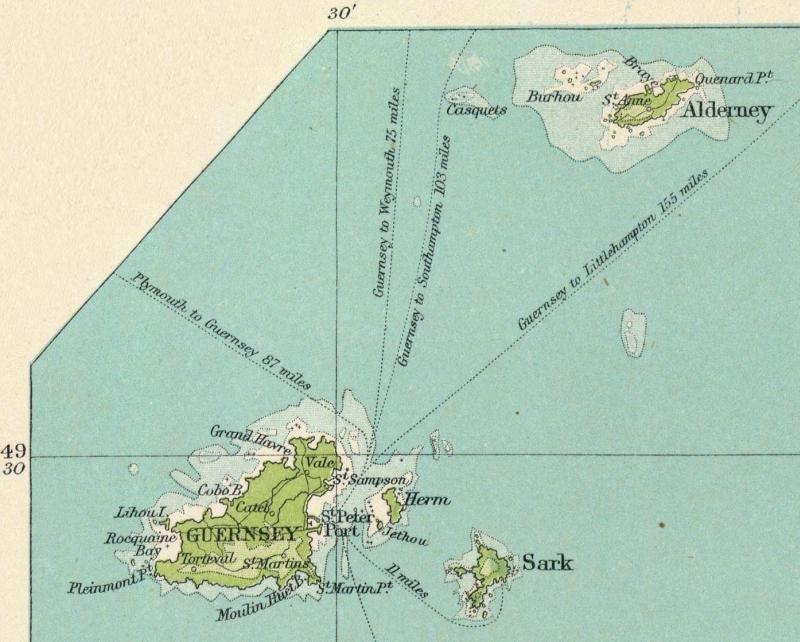
The Bailiwick of Guernsey is one of two British crown possessions (the other being the Bailiwick of Jersey) making up the Channel Islands, in the English Channel between England and France (but closer to France). It comprises the main island of Guernsey (with nearby Lihou) and the smaller Alderney, Sark (with nearby Brechou [or Brecqhou]), and Herm (with nearby Jethou), besides other small islands that are essentially uninhabited. Only Guernsey, Alderney, and Sark (in French Guernesey, Aurigny, Sercq) have a regular population; Brechou, Herm, and Jethou have individual tenants. Governmental and judicial proceedings on Guernsey are conducted in English, even though many of the island's inhabitants speak Norman French as their first language.
Neolithic structures such as dolmens (megalithic tombs) and menhirs (detached upright stones) indicate that Guernsey was inhabited as early as about 5000 BCE. These remains were long associated with Celtic people, who however only appeared in the 1st millennium BCE. Guernsey was known as Sarnia to the Romans and Alderney as Riduna (based on the common interpretation of the "Antonine Itinerary," though the identities are not definite). While the islands became part of Roman Gaul sometime after 56 BCE, the Roman impact was meagre judging by physical evidence.
c. 550: Christianity is brought to Guernsey by Sampson (later St. Sampson), bishop of Dol, in Brittany.
565: Magloire (later St. Magloire), successor of Sampson as bishop of Dol, lands in Sark to found a monastery, according to legend. One of his brethren, St. Vignalis, is recognized for introducing Christianity to Alderney c. 575.
March 709: A violent earthquake with tidal waves affects the west of Guernsey. Some later argue that this event caused the separation of the island from the mainland, but according to modern geology this must have happened about 10,000 years earlier.
838 or 856: According to the 12th-century chronicler Wace (Roman de Rou), the Danish chieftain Hastein lands on, and pillages, all the main Channel Islands: "En Auremen [Alderney], en Guernesi [Guernsey], en Sairc [Sark], en Erm [Herm], en Gersi [Jersey]."
Oct. 22-29, 842: The islands are visited by another violent earthquake, according to the chronicler of the Abbey of Fontenelle.
933: The Channel Islands become part of the Duchy of Normandy when French king Raoul (or Rudolf) surrenders the Cotentin Peninsula and the islands to William "Longsword," son of Rollo, founder of the duchy.
11th century: Early documents show that the chief landowners are the lords of Saint-Sauveur (hereditary vicomtes of the Cotentin), the vicomtes of the Bessin, the abbey of Le Mont-Saint-Michel, and the duke of Normandy. Guernsey is never dominated by any one great landowning family, and the early growth of commerce in St. Peter Port, with later smuggling and privateering and 19th-century industrial development, weakens what remains of the feudal landlords' power.
1066: By the Norman Conquest of England, the islands come under a common ruler with England. On the death of William "the Conqueror" in 1087, however, the domains are split again.
1106: Guernsey permanently becomes a possession of the English crown when the latter comes into personal union with the Duchy of Normandy.
1111: According to the Dédicace des Églises (a dubious manuscript), the parish church of St. Sampson is consecrated this year, followed by those of St. Michael (1117), St. Philip of Torteval (1130), St. Saviour (1154), St. Margaret (1163), St. Peter-in-the-Wood (1167), St. Martin (1199), Câtel (1203), St. Andrew (1284), and St. Peter Port (1312). The parochial divisions existed long before, however, and six churches were already mentioned in a charter of about 1055 (which also provides the first mention of St. Peter Port).
1177: Guernsey and Jersey, previously administered together by the seneschal of Normandy, who appointed a deputy to represent his power in the islands, are now administered separately under two deputies.
1204: The Channel Islands are separated from Normandy as King John loses continental Normandy but retains the islands which, after an initial period of confusion, are brought securely under the king's control by 1207. The islanders choose to remain with the English crown, perhaps because it is more distant, allowing for more local autonomy. Indeed the islands are never made part of England (or later Great Britain or the United Kingdom). They are put in charge of a warden (Latin custos) and sometimes granted for life to a "Lord of the Isles."
1212: The defenses and garrisons of the islands are first tested when Eustace the Monk (a lapsed Benedictine) sails to attack them. He is repulsed from Jersey and Guernsey, but manages to seize Sark, where he leaves a force of his freebooting followers. In 1214 the warden Philippe d'Aubigny attacks the fortress island and sends Eustace's men as prisoners to Winchester. Subsequently Eustace again sails to the islands and seizes them for the French cause, but d'Aubigny catches up with him at the naval battle of Sandwich (Aug. 24, 1217) and Eustace is beheaded on his own quarter-deck.
1275: Otto de Grandison becomes warden, then in 1277 Lord of the Isles. The grant of this office is regarded by both king and recipient as a means of providing this royal favourite with an income, and Otto seeks to ensure this by an oppressive regime. However, he only visits the islands once (1323) and in his perpetual absence sub-wardens carry out the executive functions for him. As the sub-warden cannot conduct sessions of the king's courts regularly on all four of the main Channel Islands, his judicial responsibilities fall to two bailiffs, for Guernsey and Jersey. In Guernsey the bailiff comes to preside over the Royal Court, in which judgment is given and the law declared by 12 jurats (or permanent jurors). The Royal Court survives substantially in this medieval form, administering the law of Guernsey founded on the custom of Normandy and local usage, into the 21st century. From the bailiffs' practice of referring difficult points of law to local notables, Guernsey's deliberative and legislative assembly, the States of Deliberation, ultimately emerges (15th century).
1294: A savage French raid kills a quarter of the population and despoils Guernsey's churches.
1304: Two slightly dissimilar seals are issued by the king for the two bailiffs, thus formalizing the two bailiwicks, with Sark and Alderney included in Guernsey, after a previous experiment with a separate "bailiff of Sark and Alderney" was unsuccessful.
1328: Otto de Grandison, the detested lord of the islands since 1277 (apart from the period 1294-98 when Edward I took the islands into his own hands because of the war with France over Gascony), dies. The islanders are slightly conciliated by the honest government of the new warden, John de Roches.
1336: David Bruce, a Scottish refugee in France, leads a raid on the islands, the main damage apparently being to Sark and Alderney. The islanders subsequently give up one of their cherished privileges, that of not being forced to do any military service. They comply with the order of the warden Thomas de Ferrers that all men capable of bearing arms should be levied. This is the foundation of the island militias which have a continuous history of 600 years. Following the outbreak of the Hundred Years' War (1337-1453), the bailiwick is occupied by the French in 1338-39; they retain Castle Cornet, which was built in the 13th century on a small island just off the coast of St. Peter Port.
1345: Castle Cornet is retaken from the French.
1347: The French are driven from Sark.
1356: The French again take Castle Cornet. It is regained in 1357.
1360: With the signing of the Treaty of Brétigny, by which the French recognize Edward III's claim to Aquitaine and give up all claims to the islands, the English in return recognizing the rights in the islands of the bishop of Coutances, the war temporarily dies down.
1363: The Le Marchant family of Guernsey acquires Brechou.
1372: Guernsey is invaded by Yvain de Galles (Owen of Wales), son of a Welsh prince put to death by Edward III. A pitched battle takes place and the islanders suffer heavy casualties, more than 400 dead according to one authority. Eventually Yvain withdraws after unsuccessfully trying to take Castle Cornet. The invasion becomes the subject of the ballad "La descente des Aragousais," either referring to an Aragonese contingent among the invaders or perhaps due to the fact that the Hundred Years' War has provided ample opportunities for Spanish pirates and "Aragonese" might have come to be a generic term for such attackers.
1373: Sark is abandoned after devastation by Bertrand de Guesclin. For almost 200 years, the island becomes a haunt for pirates and smugglers.
1380: In another raid the French take control of the islands, which are granted to Adm. Jean de Vienne as a personal possession. But the warden Sir Hugh Calverley manages to raise a relieving force and expel Vienne.
1415: In the first mention of a Guernsey ship, the Mary helps to ferry Henry V's armies to France.
1468: Guernseymen help to expel the French from Jersey, earning another charter confirming the island's liberties.
1478: Sir John Dichefield becomes the first "captain" of Guernsey, subordinate to Sir Richard Harliston, since 1473 captain-in-chief of the entire archipelago.
1486: Guernsey (with Alderney and Sark) is put under a captain (Edmund Weston) directly under the crown, ending Harliston's position. On Dec. 3, 1487, the title Lord of the Isles also ends when the last holder, Anne Beauchamp, Countess of Warwick, relinquishes it, leaving no common Channel Islands authority. The title of captain later becomes governor.
1534: An ordinance requires hedges to be cut back to avoid impeding roads.
July 1549: The French occupy Sark. They are expelled by Flemish corsair Adrian Crole on Sept. 7, 1553.
1550-1649: Of 100 accused witches during this period, 18 are burnt, 27 hanged, strangled, and then burnt, 32 banished, and two whipped and banished.
1565: On reports of anti-Huguenot riots, the jurats are summoned to the Privy Council and seven are dismissed.
Aug. 6, 1565: Helier de Carteret of Jersey receives letters-patent from Elizabeth I to colonize Sark.
1569: An order-in-council regulates relations between governor and bailiff.
1578: The bailiff and jurats flee to Castle Cornet due to popular disturbances.
1579: The Chief Pleas of Sark are instituted (first meeting November 5), with all the associated officials, in an attempt to make Sark essentially into a bailiwick of its own.
1581: An ordinance of the Royal Court says: "All adulterers shall be imprisoned three weeks, and on each Saturday during the three weeks shall be put in the cage, from 9 o'clock AM, until dark, and on the last Saturday shall receive, in the carrefours of the town, 24 lashes, until blood be drawn; and those convicted of fornication shall receive the same punishment, excepting that they shall have only 12 lashes before the cage."
October 1581: The seigneur of Sark, Helier de Carteret, dies and is succeeded by his son Philippe de Carteret.
May 28, 1582: The Guernsey procureur lays a formal complaint against the seigneur of Sark, Philippe de Carteret, for setting up a court of justice without authority in the Bailiwick of Guernsey. The bailiff of Guernsey, with four jurats, is sent to Sark to investigate. He impounds the records of the Sark court and arrests the Sark bailiff and two Sark jurats, taking them back to Guernsey. The two jurats are later allowed to return to Sark, but only on condition of abstaining from any judicial function; whilst the Sark bailiff (Édouard de Carteret) is imprisoned in Castle Cornet and, although released two months afterwards, is never allowed to go back to Sark, having to stay in Guernsey until his death in 1601. Meanwhile Philippe de Carteret appeals to the Privy Council, whose decision in 1583 instructs the Guernsey court to set up a new Sark court consisting of five jurats (elected by popular vote of the inhabitants), the senior one acting as judge, but this court's competence is to be limited to civil cases, all criminal cases having to be referred to the Royal Court of Guernsey, thus clearly establishing Sark's subordination to Guernsey.
1584: John Chamberlain, son and brother of former governors of Guernsey, is granted Alderney in fief by the crown, on the same terms as Helier de Carteret was granted Sark. However, Alderney already has a settled population of 700.
1591: Chamberlain sells his Alderney rights to Robert Devereux, Earl of Essex. When the earl is executed for high treason in England in 1601, his property on Alderney is ordered to be seized. By 1607, whether in right of the old grant or a new one, William Chamberlain is the occupant.
1594: The seigneur of Sark, Sir Philippe de Carteret, dies, leaving an heir (also Philippe) of 10 years of age. Accordingly the boy's uncle, Amice de Carteret, acts as seigneur during his nephew's minority. Amice immediately arranges for the formal installation of the new court which was ordained 11 years previously. Five jurats are elected and sworn in, with Robert Slowley (who received most votes) being appointed as juge.
17th century: The knitting industry reaches a zenith. Ultimately, the island gives its name to the "guernsey" sweater; though the term only begins to appear in print in the 19th century, the garment itself was in local use long before that.
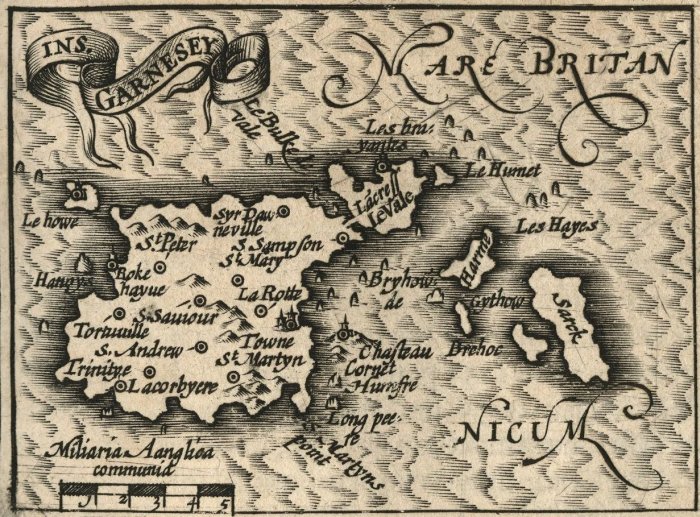
1607 map of Guernsey. |
1608: An order-in-council restricts the governor's powers, obliging him to consult the Royal Court.
1620: The Earl of Essex makes over Alderney to Sir William Essex (no relation).
1627: Rachel Alexandre of Sark is burnt as a sorceress.
1642: On the death of Sir William Essex, Alderney reverts to the Earl of Essex.
1642-51: While Jersey takes the side of Charles I during the English Civil War, Guernsey sides with the Parliamentarians. Castle Cornet, the last Royalist stronghold, surrenders in December 1651.
1642: Sir Philippe de Carteret's adherence to the Royalist cause leads to Parliament confiscating the fief of Sark, vesting the authority of the seigneur in the juge, Jean Le Gros. Carteret dies in 1643.
1646: The Earl of Essex dies without issue; the Alderney holding lapses.
1653: Parliament orders that jurats should each act as bailiff for a month at a time.
1656: Pierre de Beauvoir is reinstated as permanent bailiff.
1660: On the restoration of Charles II, Guernsey is pardoned. The government of Alderney is divorced from that of Guernsey, Charles II granting Alderney to three Jersey royalists, Edward and James de Carteret and Clement Le Couteur, for an annual rent of 13 shillings; in the autumn of the same year they sell their rights to Sir George Carteret, who becomes governor of Alderney. In Sark, the late seigneur's son, again Sir Philippe de Carteret, is reinstated.
1663: Anglicanism is officially established.
1663: The seigneur of Sark, Sir Philippe de Carteret, dies. The minority of his heir (another Philippe) enables the Le Gros faction to continue dominating the island, using the court as the instrument of its designs.
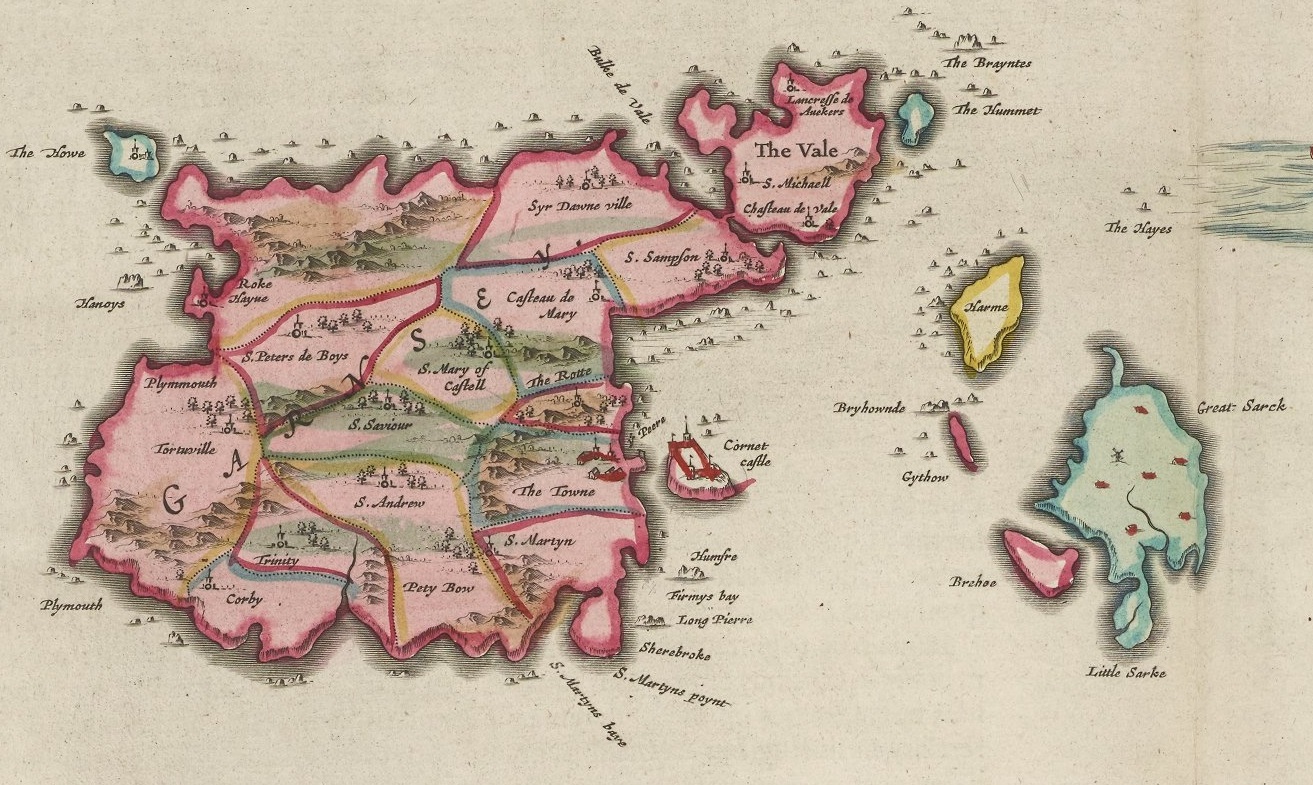
1665 map of Guernsey. |
1671: When Sir Philippe de Carteret comes of age, he seeks to assert his authority as seigneur and obtains an order-in-council suspending the Sark court.
Jan. 9, 1673 (Dec. 30, 1672, O.S.): About 1 o'clock in the morning, lightning strikes the magazine and causes a heavy explosion in Castle Cornet. This marks the end of the castle as official residence of the governors, who first reside in St. Peter Port but soon become non-resident. The office becomes purely nominal, the governors receiving the crown revenues but not interfering in the government of the island, which is wholly entrusted to lieutenant governors.
1674: Edmund Andros succeeds his father Amice (or Amias) as bailiff. During 40 years in the post, he also rises to great power in the North American colonies.
1675: Sir Philippe de Carteret IV obtains another order-in-council whereby the Royal Court of Guernsey is instructed to abolish the Sark court in its existing form, replacing it with one consisting of nominees of the seigneur. The office of seneschal is instituted, replacing the judge and jurats.
1679: Alderney governor Sir George Carteret dies.
1681: Dame Rachel Le Marchant renounces Brechou in favour of the seigneur of Sark.
1682: Carteret's widow sells the residue of the Alderney patent to Sir Edmund Andros for £200. He voluntarily resigns his rights to the crown, in consideration of which a fresh patent is issued in 1683 farming Alderney to him and his heirs for 99 years at an annual rent of £13 6s. 8d.
1687: James II appoints Col. John Legge as Roman Catholic lieutenant governor.
1688: In a Protestant coup, Legge is taken into custody. William and Mary are acknowledged.
Aug. 16 (Aug. 6, O.S.), 1689: Guernseymen complain about the billeting of troops.
Nov. 2 (Oct. 23, O.S.), 1693: The seigneur of Sark, Sir Philippe de Carteret IV, dies. He is succeeded by his son Sir Charles de Carteret.
1695, 1705, 1731: Three major outbreaks of smallpox cause a heavy death-roll.
1704-06: The bailiff, Sir Edmund Andros, also serves as lieutenant governor.
March 2, 1714 (Feb. 19, 1713, O.S.): The bailiff of Guernsey and governor of Alderney, Sir Edmund Andros, dies. He bequeathes his rights to Alderney to his nephew George Andros, who dies on October 31 (20, O.S.) and leaves two minor daughters, Martha and Ann, but Martha also dies and leaves Ann heiress.
June 14 (June 3, O.S.), 1715: The seigneur of Sark (who has also been bailiff of Jersey), Sir Charles de Carteret, dies. He is succeeded (in both positions) by John Carteret, Baron Carteret.
1717: Charles Nowall from London rents Herm and Jethou.
1719: The army garrison is withdrawn; defense of the island devolves on the militia.
1720: John Johnson buys the fief of Sark from Baron Carteret.
1721: Ann Andros dies. The right to Alderney then passes to her aunt of the same name, wife of the island's lieutenant governor John Le Mesurier. Thus begins the Le Mesurier dynasty in Alderney. John dies in 1722, leaving Ann in possession.
1723: James Milner buys the fief of Sark on the death of John Johnson.
1727: The first count of inhabitants is made in order to assess the amount of grain needed during a food shortage. The island's inhabitants number 10,246, of whom 43% live in St. Peter Port.
1729: Ann Le Mesurier dies. In 1730 her son Henry becomes governor of Alderney.
1730: The seigneur of Sark, James Milner, dies. On September 8 (August 28, O.S.), Susanne Le Pelley buys the fief of Sark from Joseph Wilcock, bishop of Gloucester, the executor of Milner.
July 5 (June 24, O.S.), 1733: The dame of Sark, Susanne Le Pelley, dies. She is succeeded by her son Nicolas Le Pelley.
1737: The small islands of Herm, Jethou, Lihou, and the pond called the Grande Mare begin to be leased out to individuals on fee-farm rents for terms of 61 years, renewable every 21 years.
1742: The seigneur of Sark, Nicolas Le Pelley, dies childless and is succeeded by his brother Daniel Le Pelley.
1744: Worn out with feuds with the Le Cocq faction, Henry Le Mesurier exchanges his Alderney patent with his younger brother, John, for lands in Guernsey. John in his turn has such difficulties with "the people, wreckers and pirates by habit and tradition," that in 1747 he flees to Guernsey, fearing for his life. The Guernsey Royal Court extends its protection to him, confirming his title of governor and forbidding the States of Alderney to assemble in his absence.
Oct. 16 (Oct. 5, O.S.), 1744: The British flagship HMS Victory sinks in a storm with the loss of all hands (some 900 men). As wreckage is washed ashore in the Channel Islands, it is believed the ship hit the Casquets, a group of rocks west of Alderney, but the wreck is only found in 2008 - 100 km west of the Casquets.
1752: The seigneur of Sark, Daniel Le Pelley, dies and is succeeded by his son Pierre Le Pelley.
1763: The first of a series of rigorous enactments is made to preserve the purity of the local breed of cattle.
1763: Privateering ventures during the Seven Years' War having provided an outlet for the insubordinate islanders, the profits from these activities have moreover brought such a boom to Alderney that John Le Mesurier exchanges his patent for a new grant of 99 years. Among other improvements, in 1770 he provides the island with its first courthouse, the court having previously met in the open air.
Aug. 13, 1771: Lt.Col. Paulus Aemilius Irving is appointed lieutenant governor in the room of Sir John Mylne, removed.
1776: After Bailiff William Le Marchant attacked Jurat Pierre de Jersey with a knife in open court, 10 jurats petition George III to be allowed to resign. After they are reelected, an order-in-council commands the bailiff to swear them in. Although four remain obdurate, the other six eventually agree to return to the bench.
December 1778: The seigneur of Sark, Pierre Le Pelley, dies and is succeeded by his son of the same name.
Feb. 14, 1784: Lt.Col. William Brown is appointed lieutenant governor.
1789: The first Guernsey newspaper (La Gazette) is published.
1790s: During the French Revolution, a large number of French royalists find refuge in the islands.
1790: Three efficient lighthouses are built on Les Casquets, replacing earlier beacons operating since 1724.
1793-1815: During the French revolutionary and Napoleonic wars the audacity of Guernsey's privateers (Edmund Burke declaring that the islands are entitled to be reckoned "one of the naval powers of the world") bring to the island a prosperity never known before.
1793: Peter Mourant builds the first glasshouse (for grapes and pineapples).
March 12, 1793: The governor of Alderney, John Le Mesurier, dies. He is succeeded on March 16 by his son Peter, who already was lieutenant governor since 1773.
May 17, 1793: Lieutenant Governor Brown dies. On May 25 Col. Thomas Dundas is appointed lieutenant governor.
Oct. 22, 1793: Col. James Henry Craig is appointed lieutenant governor.
Dec. 24, 1793: Col. John Small is appointed lieutenant governor.
1794: The first regular mail service is established.
1794: Guernsey's first theatre (Theatre Royal) opens.
March 17, 1796: Lieutenant Governor Small dies. On March 26 Maj.Gen. Sir Hew Dalrymple is appointed lieutenant governor.
Oct. 4, 1797: Sir Charles Grey is sworn in as governor in succession to the late Jeffery Amherst, Baron Amherst (died August 3).
1799: 6,000 Russians are quartered in Guernsey, part of a force that was fighting alongside the British in Holland, sustained a defeat, and had to be evacuated, the Bill of Rights precluding their landing in Britain. Trouble arises with the soldiery following the deaths of several hundreds of a fever contracted in the Dutch marshes, the demoralized survivors taking to drinking raw spirits and their conduct deteriorating alarmingly, leading in one case to a local man firing on some Russians in his garden and wounding one of them. The troops depart in mid-1800.
1800: A population count shows Guernsey's population as 16,155, "exclusive of sailors in His Majesty's service, privateers, and merchant vessels; also of strangers not permanently settled, who may amount to 2,000 or 3,000." St. Peter Port now makes up 52% of the total.
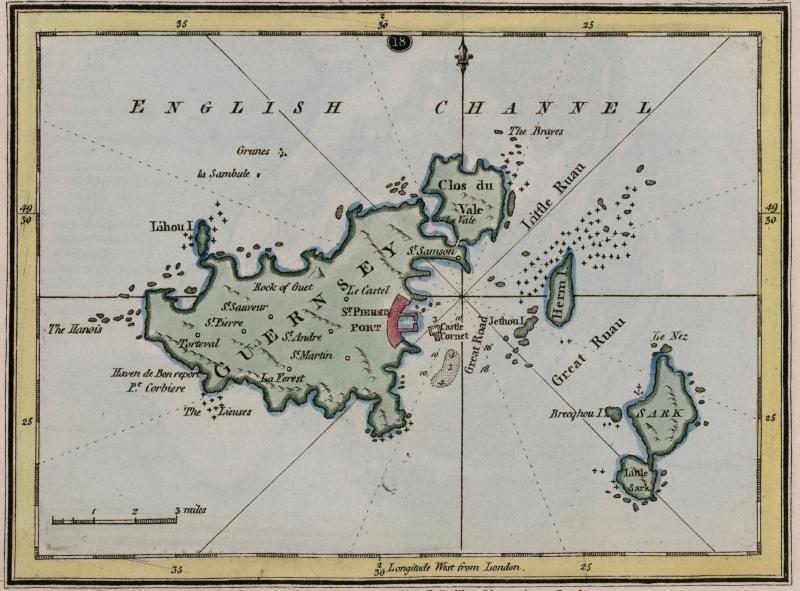
1801 map of Guernsey. |
1803: The narrow channel which at high water used to separate Guernsey into two islands is closed.
Jan. 9, 1803: The governor of Alderney, Peter Le Mesurier, dies. He is succeeded on January 21 by his son John. The latter tries to assume the title of seigneur, but the jurats do not recognize this and his appeal to the Privy Council is rejected in 1814.
May 1803: Maj.Gen. John Doyle is appointed lieutenant governor, in the room of Sir Hew Dalrymple, resigned.
1804: Three Martello towers are built in Guernsey (Fort Saumarez, Fort Grey, and Fort Hommet).
Nov. 14, 1807: The governor, Charles Grey, Earl Grey, dies at his house in Northumberland. In December Lt.Gen. George Pembroke, Earl of Pembroke, is appointed governor.
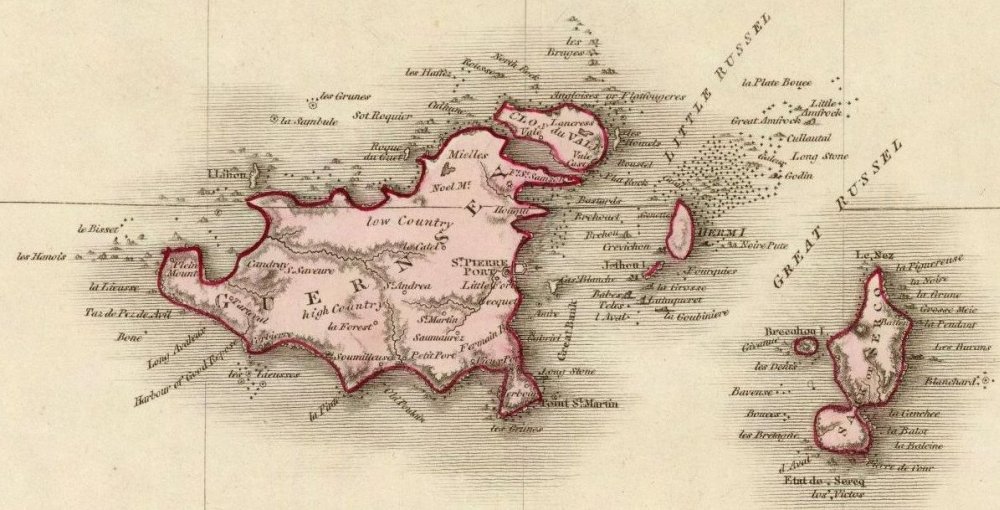
1814 map of Guernsey. |
1810: The U.S. state of Ohio creates a new county named Guernsey, in honour of settlers from the island.
1811: Lord Braybrook imports the first Guernsey cattle herd into England.
1813: The first English-language newspaper (The Star) is published.
1815: The first large ships are launched. The shipbuilding industry lasts on a large scale until the end of the century (nearly 300 vessels being built), slowly wilting in face of the advent of iron ships driven by steam. The efforts to compete are limited to a single Guernsey-built steamer, the (wooden) S.S. Commerce launched in 1874.
1816: The first local currency notes are issued.
March 25, 1816: Maj.Gen. Henry Bayly is appointed lieutenant governor, vice Lt.Gen. Sir John Doyle.
1820: The seigneur of Sark, Pierre Le Pelley, dies and is succeeded by his son, the third of the same name.
May 27/28, 1821: Census population: 21,981 (Guernsey, 20,302; Alderney, 1,154; Sark, 488; Herm, 28; Jethou, 9).
July 23, 1821: Col. Sir John Colborne is appointed lieutenant governor.
June 10, 1823: The Medina arrives at St. Peter Port, the first steamship ever to travel to the Channel Islands, removing a barrier that has long checked intercourse with England and other countries.
1825: John Le Mesurier surrenders Alderney to the crown against an annual payment of £700 for the rest of the lease (i.e., until 1862); the island is placed under the jurisdiction of the lieutenant governor of Guernsey.
Oct. 26, 1827: The governor, Gen. George Pembroke, Earl of Pembroke, dies. On November 16 Sir William Keppel is sworn in as governor.
Aug. 14, 1828: Maj.Gen. John Dawes Ross is appointed lieutenant governor.
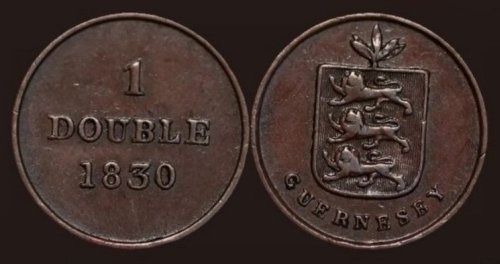
Guernsey 1 double coin of 1830, with the French spelling "Guernesey" (used until 1956). |
1830: The first local coinage of "doubles" is struck, with 8 doubles equivalent to one British penny. Previously French currency was predominantly used, and francs remain for larger values, with 80 doubles equal to a franc, leading to some irregularity as the exchange rate is otherwise 25.2 francs to the pound, so that a pound is equivalent to 2,016 (25.2×80) doubles, but these are 252 (2,016/8) pence, as opposed to the normal 240 pence in a pound. English rentiers settling in Guernsey thus have their income automatically increased by 5%.
1830: The Herm Granite Company is formed. The influx of labourers causes the population to reach three digits.
1831: Economic distress in Alderney leads to a decision to divide all the common lands among island-born families. For this purpose they are divided into lots, classified into groups of "good" and "poor," and the lots are allocated by ballot to the 52 qualified families, each receiving one "good" and one "poor" lot.
January 1831: The militia of Guernsey, Alderney, and Sark is made "royal."
May 29/30, 1831: Census population: 26,128 (Guernsey, 24,349; Alderney, 1,045; Sark, 543; Herm, 177; Jethou, 14).
Dec. 11, 1834: Governor Keppel dies in Paris.
March 1835: The office of governor is abolished. The duties devolve upon the lieutenant governor, who is the personal representative of the British sovereign.
1836: Copper and silver veins are discovered on Sark.
April 1, 1837: It is gazetted under this date that Maj.Gen. Sir James Douglas has been appointed lieutenant governor.
March 1, 1839: The seigneur of Sark, Pierre Le Pelley III, drowns with his boat's crew after embarking for Guernsey in a gale. He is succeeded by his brother Ernest Le Pelley.
1841: The franchise is extended to include taxpayers (i.e., property owners).
June 6/7, 1841: Census population: 28,521 (Guernsey, 26,649; Alderney, 1,038; Sark, 785; Herm, 38; Jethou, 6; Brechou, 5). The population of St. Peter Port is 17,070.
1842: The British government resolves to counter the French threat to British security seen in the extensive fortifications constructed at Cherbourg by converting nearby Alderney into "the Gibraltar of the Channel."
April 1, 1842: Maj.Gen. William Francis Patrick Napier is appointed lieutenant governor.
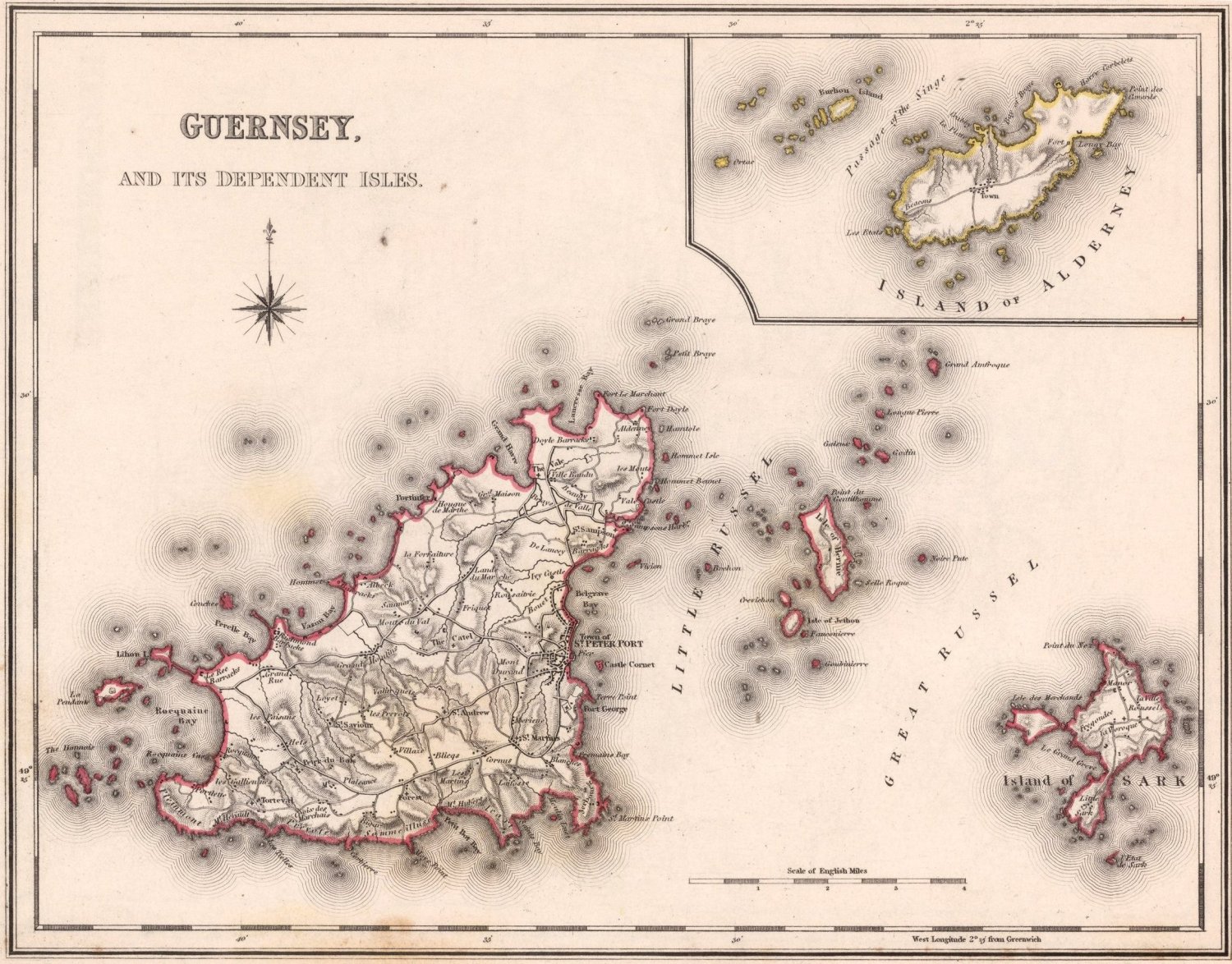
1844 map of Guernsey. |
May 1844: 600 troops are sent to Guernsey on suspicions of a conspiracy against the life of Lieutenant Governor Napier, based on claims by Rev. Daniel Dobrée, of which no further evidence is found. Napier is criticized in the matter, and is also accused of overstepping his authority in other cases.
Dec. 13, 1844: An order-in-council gives the queen's assent to reforms to the States of Deliberation passed by them in June 1843. The parish constables cease as such to be members of the States. In their place delegates (who can be either constables or douzeniers) are sent to individual sittings of the States from the various douzaines (parish authorities). St. Peter Port sends six delegates and the douzaines of the other nine parishes one each. The members, who previously were allowed only to accept or reject the measures proposed by the bailiff, are now allowed to move amendments. The States subsequently emerge as a legislative assembly administering the island through executive committees. The assembly is presided over by the bailiff.
Aug. 24, 1846: Queen Victoria and Prince Albert make a surprise visit to Guernsey. She pointedly snubs Napier, refusing to receive him on her yacht. The visit is commemorated by the construction of the Victoria Tower in 1848.
Jan. 24, 1848: It is gazetted under this date that Maj.Gen. John Bell has been appointed lieutenant governor.
Oct. 26, 1849: The seigneur of Sark, Ernest Le Pelley, dies. He is succeeded by his son Pierre Carey Le Pelley.
August 1850: An application of the clameur de haro by writer Martin F. Tupper saves the ancient parts of the Castle Cornet from demolition. This old Norman legal injunction, though abolished in Normandy in 1583, is still in use in the Channel Islands. It involves kneeling and saying in the hearing of an alleged wrongdoer: "Haro! Haro! Haro! À l'aide, mon Prince, on me fait tort!" ("Hear-ye! Hear-ye! Hear-ye! Come to my aid, my Prince, I am being wronged"), followed by the Lord's Prayer in French, whereupon the other person has to stop immediately until the Royal Court makes a ruling. (It has been thought the word "Haro" derived from the name of Rollo, the first duke of Normandy, but it appears more likely to be a preexisting Norman interjection.)
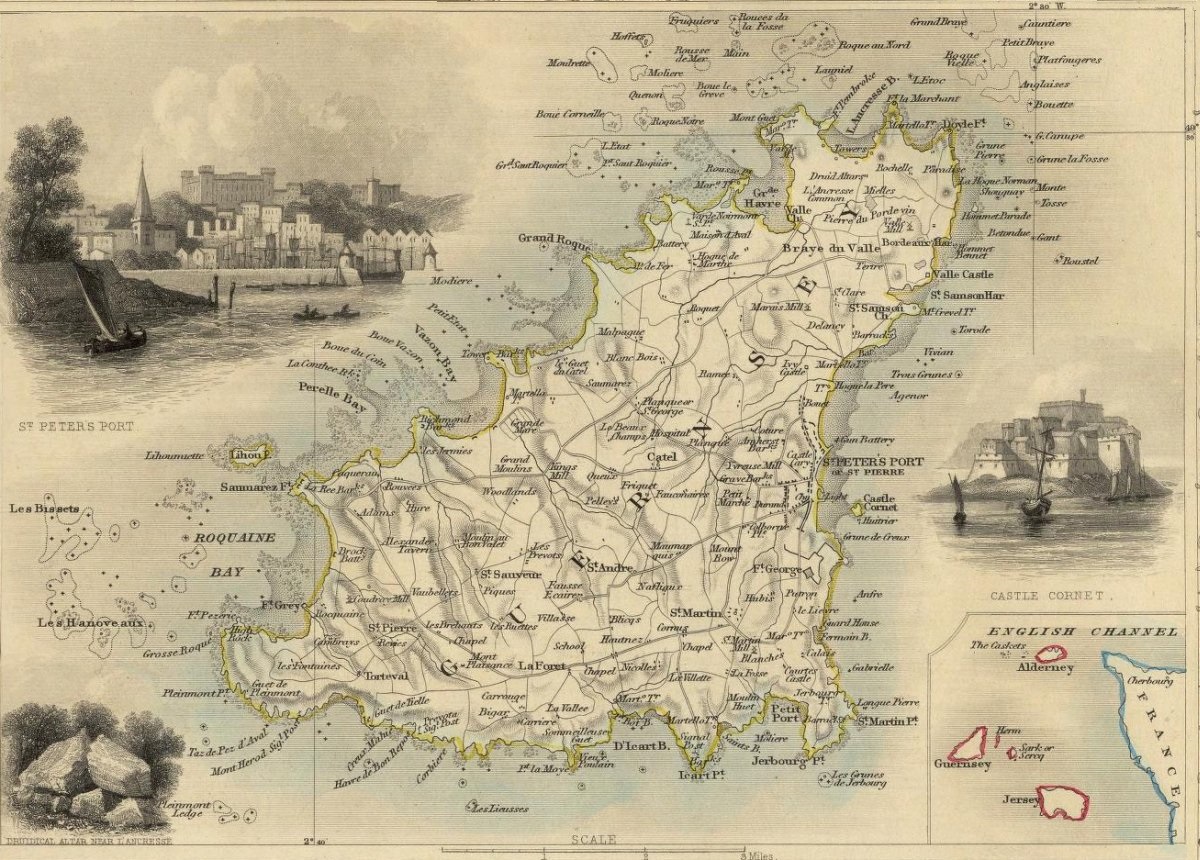
1851 map of Guernsey. |
March 30/31, 1851: Census population: 33,719 (Guernsey, 29,757; Alderney, 3,333; Sark, 580; Herm, 46; Jethou, 3). The population of St. Peter Port is 17,070.
Dec. 4, 1852: As Pierre Carey Le Pelley could not meet the interest payments on a mortgage on the fief, by which his father had raised £4,000 from wealthy local privateer (and tenant of Jethou) John Allaire to maintain mining operations which ultimately failed, the seigneury of Sark is transferred by purchase (for £6,000 minus the £4,000 advanced on mortgage and £616 overdue interest) to Marie Collings, daughter and heiress of Allaire (who died in 1846). Jethou meanwhile is taken over by the States of Guernsey for quarrying.
1853: The world's first pillar boxes appear in Guernsey.
Aug. 25, 1853: The dame of Sark, Marie Collings, dies. The fief passes to her son, Rev. William Thomas Collings.
July 1, 1854: It is gazetted under this date that Maj.Gen. William Knollys has been appointed lieutenant governor.
Aug. 8-10, 1854: Queen Victoria, with Prince Albert, the Prince of Wales, Prince Alfred, Prince Arthur, and Princess Helena, visits Alderney. She is the first sovereign to visit the island, which until the commencement of a breakwater in 1847 was almost separated from the rest of the world.
Oct. 31, 1855: French writer Victor Hugo, expelled from his Jersey exile for criticizing Queen Victoria's visit to Napoléon III, moves to Guernsey, where he lives until Aug. 15, 1870, and writes Les Misérables (1862) and other famous works.
Nov. 22, 1855: Maj.Gen. George Judd Harding is appointed lieutenant governor in the room of William Knollys, resigned.
Aug. 19, 1857: Victoria and Albert make a second visit to Alderney.
1859: A breakwater connecting Castle Cornet with the mainland is finished.
April 1, 1859: Maj.Gen. Marcus John Slade is appointed lieutenant governor.
Aug. 14, 1859: Victoria and Albert make a second visit to Guernsey.
April 7/8, 1861: Census population: 35,365 (Guernsey, 29,804; Alderney, 4,932; Sark, 583; Herm, 41; Jethou, 5). The population of St. Peter Port is 16,388.
April 1, 1864: Maj.Gen. Charles Rochfort Scott is appointed lieutenant governor.
September 1864: The Alderney breakwater is completed. But only six months later the winter gales tear two huge breaches in the wall and the cost of the repair, added to the excessive original cost, appals the English Treasury.
c. 1865: The first tomatoes ("love apples") are grown.
1867-77: Lt.Col. Montague Fielden, a former British MP, is tenant of Herm and Jethou. He is in the habit of smuggling brandy from France to England and uses Jethou as a storage depot. In order to stop further smuggling, the crown subsequently insists that the tenants of the two islands shall be different persons.
May 1, 1869: It is gazetted under this date that Maj.Gen. Edward Charles Frome has been appointed lieutenant governor.
1870s: The Herm granite industry slowly dies.
1870: British coins are also made legal tender. Bank of England notes follow in 1873.
April 2/3, 1871: Census population: 33,969 (Guernsey, 30,593; Alderney, 2,738; Sark, 546; Herm, 83; Brechou, 5; Jethou, 4).
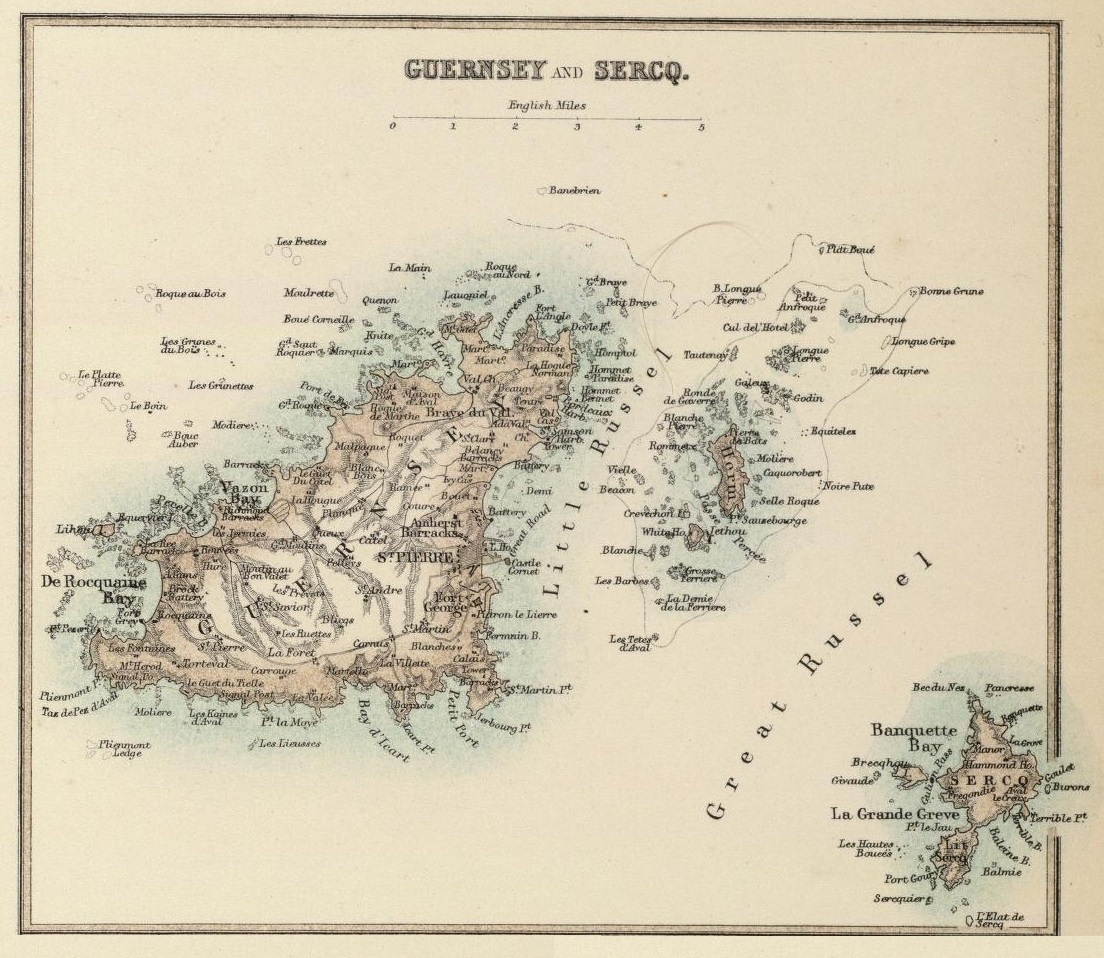
1872 map of Guernsey. |
May 1, 1874: It is gazetted under this date that Maj.Gen. St. George Gerald Foley has been appointed lieutenant governor.
May 1, 1879: It is gazetted under this date that Maj.Gen. Alexander Abercromby Nelson has been appointed lieutenant governor.
April 3/4, 1881: Census population: 35,257 (Guernsey, 32,607; Alderney, 2,048; Sark, 571; Herm, 20; Brechou, 7; Jethou, 4).
March 7, 1882: The seigneur of Sark, William Thomas Collings, dies. He is succeeded by his son William Frederick Collings, whose bizarre behaviour during his 45-year reign brings him several times before the seneschal's court on such charges as assault and battery, abusive language, and breaking windows. The seneschal (Thomas Godfray) does not hesitate to impose upon his seigneur the appropriate penalties for his misdemeanours.
Oct. 10, 1883: Maj.Gen. Henry Andrew Sarel is appointed lieutenant governor.
1884: J. Poat becomes the first person to grow tomatoes as a main crop. Others soon copy him, investing in glasshouses solely for tomatoes.
Nov. 2, 1885: It is gazetted under this date that Maj.Gen. John Henry Ford Elkington has been appointed lieutenant governor.
Feb. 21, 1889: Lieutenant Governor Elkington dies. On March 16 Lt.Gen. Sir Edward Gascoigne Bulwer is appointed lieutenant governor.
1891: Gebhard Fürst Blücher von Wahlstatt, great-grandson of the famous field marshal, becomes tenant of Herm.
April 5/6, 1891: Census population: 37,716 (Guernsey, 35,243; Alderney, 1,857; Sark, 570; Herm, 38; Jethou, 6; Brechou, 2).
March 16, 1894: Lt.Gen. Nathaniel Stevenson is appointed lieutenant governor.
March 16, 1899: Maj.Gen. Michael Henry Saward is appointed lieutenant governor.
May 1899: There is a mutiny among the militia of Guernsey.
1900: The Royal Sark Militia, having degenerated for many years, finally disappears from the Army List.
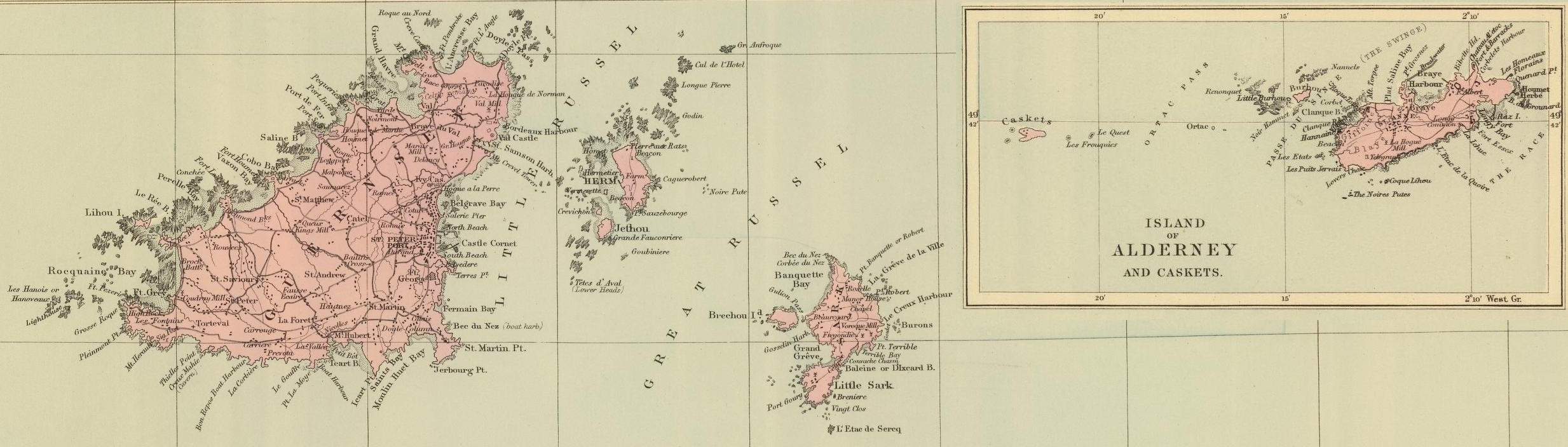
1901 map of Guernsey. |
March 31/April 1, 1901: Census population: 43,042 (Guernsey, 40,446; Alderney, 2,062; Sark, 504; Herm, 25; Jethou, 3; Brechou, 2).
April 1, 1903: It is gazetted under this date that Maj.Gen. Barrington Bulkley Douglas Campbell has been appointed lieutenant governor.
Sept. 23, 1905: A South African War memorial is unveiled in Guernsey by the Duke of Connaught.
April 1, 1908: Maj.Gen. Robert Auld is sworn in as lieutenant governor at a special sitting of the Guernsey Royal Court. At the sitting an order-in-council is read authorizing the construction of a lighthouse and fog signal on the rocks to the north of Guernsey.
Feb. 17, 1911: Lieutenant Governor Auld dies. On May 10 Maj.Gen. Edward Owen Fisher Hamilton is appointed lieutenant governor.
April 2/3, 1911: Census population: 45,001 (Guernsey, 41,823; Alderney, 2,561; Sark, 579; Herm, 33; Lihou, 3; Jethou, 2).
Jan. 28, 1914: In the last witchcraft trial in Guernsey, Mrs. Aimee Lake is sentenced to eight days' imprisonment for disorderly conduct.
April 1914: On the retirement of Lieutenant Governor Hamilton, 300 inhabitants of Guernsey present a cheque for £121 to Lady Hamilton for the purchase of a grand piano. On April 9, Maj.Gen. Henry Merrick Lawson is sworn in as lieutenant governor, the warrant, which was missing the previous day, having arrived.
1914-18: French seaplanes are based in Guernsey during World War I. Fürst Blücher, the tenant of Herm, is interned as an enemy alien.
Nov. 19, 1914: It is gazetted under this date that Gen. Sir Reginald Hart has been appointed lieutenant governor in the room of Lawson, who resigned on appointment as assistant to the chief of the Imperial General Staff.
March 14, 1915: The first island-wide police force begins operation.
November 1917: The Royal Guernsey Light Infantry is hard hit when hundreds die in a German counteroffensive at Cambrai.
End of April 1918: The lieutenant governor reports that the bailiwick, out of a population of 40,000, has furnished to the army 4,150 men, all of Class A, besides 170 to the navy.
June 8, 1918: Lt.Gen. Sir Launcelot Edward Kiggell is appointed lieutenant governor in the room of Sir Reginald Hart, resigned.
1920: Suffrage is made theoretically universal, but with special application for registration required of non-ratepayers.
June 23, 1920: Maj.Gen. Sir John Edward Capper is appointed lieutenant governor, in the room of Kiggell, resigned. Kiggell leaves on June 30 and Capper is sworn in on July 1.
1921: A currency union with the U.K. is established and the use of French francs discontinued. The value of the double is rearranged at 1,920 to the pound.
June 19/20, 1921: Census population: 40,529 (Guernsey, 38,283; Alderney, 1,598; Sark, 611; Herm, 32; Brechou, 3; Lihou, 2).
July 11, 1921: King George V and Queen Mary visit Guernsey.
1922: Income tax is introduced for the first time. Until World War II it goes no higher than 4.375%.
June 20, 1922: King George V signs orders-in-council which amend the Sark constitution. In a concession to democratic government, 12 non-landowning deputies, voted for by all men over 20 and women over 30, are appointed, in addition to the 40 heads of the island's farm-owning families.
1923: The British government puts forward a demand to both bailiwicks for an "annual contribution to the imperial exchequer" towards the cost of imperial defense. This demand provokes considerable bitterness not only because of the high amount asked for (£600,000 per annum) but also because it is in any case considered contrary to the islands' charters and fiscal autonomy.
March 5, 1925: Maj.Gen. Sir Charles John Sackville-West is appointed lieutenant governor, to take office July 1.
Sept. 19, 1926: A war memorial to the 910 Guernseymen who died in the World War is unveiled at the top of Smith Street in St. Peter Port.
1927: The dispute about a defense contribution is settled when the British Treasury accepts one-time "gifts" and agreement is made between the British government and the islands on the prevention of "tax dodging" by persons resident and companies registered in the two bailiwicks.
1927: Hauteville House, where Victor Hugo lived in 1856-70, is donated by Hugo's descendants to the city of Paris.
June 20, 1927: The seigneur of Sark, William Frederick Collings, dies. He is succeeded by his daughter Sibyl Beaumont.
July 1928: The British government, in view of the urgent need for economy, decides to cease its contribution to the upkeep of the Channel Islands militia.
1929: The Royal Alderney Militia Artillery is abolished following the British government's refusal to continue providing financial support. The infantry was already disbanded in 1882.
1929: The dame of Sark (who marries in November to become Sibyl Hathaway) sells Brechou to Angelo Clarke, an English hotelier from Guernsey, and gives him a seat in the Chief Pleas.
March 23, 1929: It is announced that Maj.Gen. Walter Patrick Hore-Ruthven, Baron Ruthven, will succeed Lord Sackville as lieutenant governor on June 5. Ruthven was first designated for Jersey and Maj.Gen. Edward Henry Willis for Guernsey, but the appointees were permitted to exchange posts. Sackville leaves on May 29.
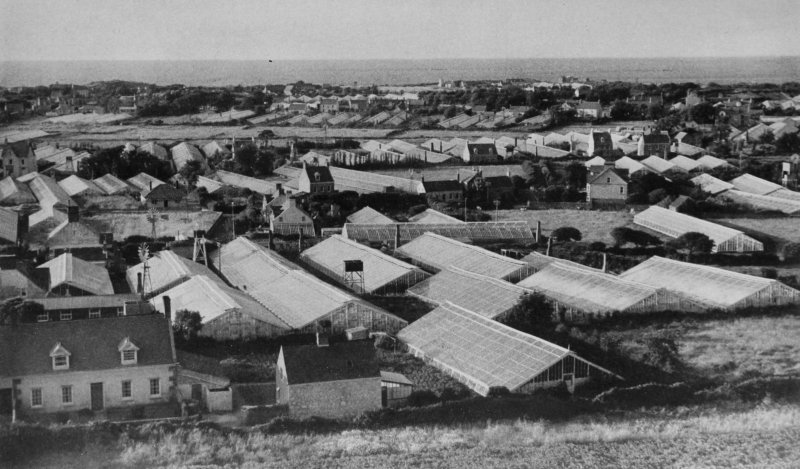
Glasshouses in Guernsey, 1930s. This industry has mushroomed so fast that the original character of the landscape has been greatly altered. |
April 26/27, 1931: Census population: 42,743 (Guernsey, 40,588; Alderney, 1,521; Sark, 571; Herm, 53; Brechou, 6; Jethou, 2; Lihou, 2).
1932: After breeding dogs there for three years, Angelo Clarke sells Brechou to a rich Irishman, Capt. Tom A. Clarke. He builds a very substantial mansion and garden, and other installations, before leaving in 1939; he dies in 1944.
May 24, 1934: It is gazetted under this date that Maj.Gen. Edward Nicholson Broadbent has been appointed lieutenant governor as from June 5.
July 24, 1935: The Prince of Wales visits Guernsey.
October 1935: The first airport on Alderney is established, leading to an increase in tourism.
Feb. 22, 1937: A commission of inquiry, chaired by Sir Abraham Lainé, to report on allegations that prisoners in the island gaol from time to time escape at nights and later return, begins work.
December 1938: Maj.Gen. Alexander Telfer-Smollett is appointed lieutenant governor, effective June 5, 1939.
1939: Over 900 acres of glasshouses are in use, and the export of the tomato crop has risen to 35,038 tons (compared to 13,517 in 1913).
May 1939: The Guernsey airport at La Villaize is officially opened.
May 30, 1939: It is learned that the Guernsey States will be asked to vote £180,000 in three years for the defense of the island. It is proposed that the amount shall be voted as follows: £50,000 in 1940, £60,000 in 1941, and £70,000 in 1942.
September 1939: When war breaks out, the regular army garrison is withdrawn and, as in 1719, the defense of Guernsey is left entirely in the hands of the Militia.
February 1940: The States decides to disband the Militia, urging its members to enlist in various units of the British army. This they do, their numbers swelled by other young men who did not belong to the Militia, to such effect that 10% of the population serve in the forces.
May 1940: It is announced that Telfer-Smollett relinquishes his appointment as lieutenant governor on June 7. His successor is Maj.Gen. John Minshull-Ford. The latter is withdrawn with the armed forces on June 21 and the bailiff, Victor Gosselin Carey, is made acting governor with civil authority. The same day a Controlling Committee is created, which meets for the first time on June 25. Comprising eight islanders with specific portfolios, and headed by Attorney General Ambrose Sherwill, it effectively becomes Guernsey's government before and during the German occupation.
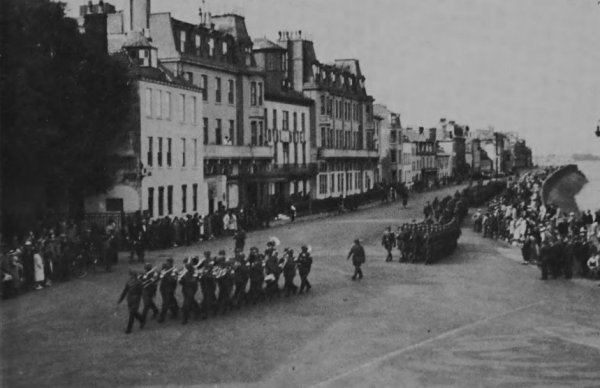
Germans marching past the Royal Hotel, Guernsey, in 1940, soon after they have occupied the island. |
June 28, 1940: German planes attack St. Peter Port harbour. The British government then publicizes the demilitarization of the islands. On June 30 the first planes land at Guernsey airport. 17,000 (some 40%) of the inhabitants of Guernsey were evacuated to England before. In Sark, where the dame, Sibyl Hathaway, called on the islanders to stay, all except 13 did so. In Alderney, however, the decision to evacuate was almost unanimous (the evacuation took place June 23). On July 1 Maj. Albrecht Lanz, first military commander, arrives in Guernsey. Alderney is occupied on July 2 and Sark on July 4.
October 1940: Ambrose Sherwill is deposed as president of the Controlling Committee by the Germans after he aided two British soldiers on a reconnaissance mission. Jurat John Leale takes over as acting president, and becomes president in January 1941.
May 15, 1941: British papers report that Sibyl Hathaway, dame of Sark, who has complete magisterial and legislative powers in the island, has been deported to a German concentration camp as a "reprisal" for offenses by youthful islanders who were "harassing" the Germans on Guernsey. The story, based on a letter (dated Aug. 31, 1940) smuggled from the islands to a British visitor at Halifax, N.S., is false, however, and Hathaway spends the whole of the war on Sark.
Oct. 20, 1941: As Adolf Hitler feels certain that for prestige purposes Britain will attempt to regain the islands, he orders that they are made into an impregnable fortress. Thousands of troops are brought over as well as 18,000 foreign labourers in the Todt Organization, held in atrocious conditions. Alderney in particular is turned into an unsinkable battleship.
May 1942-February 1944: The most sustained and widespread subversive activity carried on during the occupation is the publication of a daily news-sheet giving BBC news under the title of G.U.N.S. (Guernsey Underground News Service). The five main people involved are arrested between February and April 1944; all are sent to German prisons, where two of them, Charles Machon and Joseph Gillingham, die.
1942-43: The Germans deport people of all classes, including all residents born outside the islands (beginning Sept. 24, 1942) and anyone from the islands who has any military background (February 1943; including Sherwill), to internment camps in Germany. This affects 1,003 people from Guernsey and Sark.
Dec. 3, 1942: Maj. Herbert Wallace Le Patourel of Guernsey displays heroism at the Tebourba Gap, Tunisia, in the course of a desperate attempt to clear the enemy from high ground, for which he wins the Victoria Cross. The citation says: "This officer then personally led four volunteers under very heavy fire to the top in a last attempt to dislodge several enemy machine guns. The party was heavily engaged by machine gun fire and Major Le Patourel rallied his men several times and engaged the enemy, silencing several machine gun posts. Finally when the remainder of his party were all killed or wounded, he went forward alone with a pistol and some grenades to attack enemy machine guns at close quarters and from this action he did not return... Major Le Patourel's most gallant conduct and self-sacrifice, his brilliant leadership and tenacious devotion to duty in the face of a determined enemy were beyond praise." It is believed that Le Patourel was killed, and the Victoria Cross is awarded posthumously, but it is discovered later that he was seriously wounded and taken prisoner. (He dies Sept. 4, 1979.)
August 1944: The Allies occupy the Cotentin Peninsula, and the Channel Islands become subject to siege conditions.
May 8, 1945: The bailiff and John Leale are summoned to the German headquarters to be told that the war is over. The surrender documents are signed early on May 9. Shortly afterwards British troops land to a delirious welcome. Sark is liberated on May 10 and Alderney on May 16. War dead from the bailiwick number 221 from Guernsey, 18 from Alderney, and 1 from Sark.
May 17, 1945: Following statements made by local inhabitants, Maj. S. Cotton (chief of the Public Safety Detachment, Island Civil Affairs) commences investigations into the alleged murder by the Germans of over 1,000 Russians and Jews in a concentration camp (now largely demolished by the Germans) known as the Cassette, on Alderney.
June 1945: It is reported that Sark, which never had automobiles before the war, will banish them again when British troops have departed.
June 7, 1945: King George VI and Queen Elizabeth visit Guernsey.
June 8, 1945: Maj.Gen. Philip Neame, V.C., is appointed lieutenant governor. He arrives and is sworn in on August 25, when the military government ceases.
Nov. 12, 1945: A conference on rehabilitating derelict Alderney and the repatriation of the population is held in London between Lieutenant Governor Neame and Alderney civil officials, temporarily working in London.
Dec. 11, 1945: The bailiff, Victor Carey, and the former president of the Controlling Committee, John Leale, are knighted "in recognition of their services during the enemy occupation."
1946: Herm ceases to be a crown holding, being purchased by the States at a cost of £15,000. It is let to a new tenant, A.G. Jefferies, with the proviso that islanders and visitors from Guernsey shall be able to enjoy its beauty and peace.
February 1946: Ambrose Sherwill is appointed bailiff.
March 28, 1946: The lieutenant governors of Guernsey and Jersey, together with the bailiffs and representatives of the islands, attend a conference at the Home Office to discuss arrangements for meeting the indebtedness of the islands arising out of the German occupation, and for meeting the expenditure on the economic reconstruction. For this purpose Guernsey has to face expenditure of slightly under £6,000,000; the government offers a capital sum of £3,300,000 to be used for liquidating part of the indebtedness.
September 1946: A committee of the Privy Council, which was appointed at the request of the islanders to inquire into reform of the constitution of Jersey and Guernsey, spends a week in the islands hearing witnesses. The question of changing the official language from French to English is raised, and in Guernsey a Royal Court subcommittee suggests that the changeover should be gradual and that exceptions, such as the Lord's Prayer and the clameur de haro, should be made.
March 14, 1947: Lieutenant Governor Neame announces that government aid for Alderney will cease from Jan. 1, 1948.
Sept. 2, 1947: A Privy Council committee consisting of Home Secretary James Chuter Ede (chairman), Lord Stansgate, and Osbert Peake, MP, is appointed to consider reforms in Alderney, with particular reference to its form of government, financial position, and economic prospects. The committee concludes its enquiry in the island on September 24.
July 21, 1948: The Guernsey States approves, by 53 votes to 3, a plan for the "adoption" of the neighbouring island of Alderney, whereby Guernsey will take over all social services in Alderney and the latter island will have representation in the Guernsey States. The plan is approved by the Alderney States on July 23, and awaits final confirmation by the Home Office before being put into effect. Alderney, which through "adoption" by Guernsey will lose her autonomous status, has a population of just under 1,000.
1949: The States agrees to introduce national service for 18-year-old youths.
1949: Maj. Peter Wood succeeds to the tenancy of Herm. Further improvements and developments follow, with a resurgence of farming.
1949: John Thomson Donaldson buys Brechou with his brother, Alastair, for £15,000.
January 1949: Sydney Peck Herivel is elected the first president of the States of Alderney. On February 10 an election is held for the nine seats on the new States, contested by 32 candidates. On February 18, the first meeting of the new States is opened by the home secretary.
May 1949: In Alderney it is decided to impose a landing tax on visitors, and on May 18 the first telephone exchange is opened.
June 21, 1949: The Duke and Duchess of Edinburgh, accompanied by the home secretary, James Chuter Ede, visit Alderney and, on June 23, Guernsey (where the Princess Elizabeth Hospital is officially opened) and Sark (where the duke opens a new harbour).
Sept. 13, 1949: The meeting of the Sark Chief Pleas is notable when all elections for people's deputies since 1925 are declared to have been illegal. Alterations to the regulations were made in 1925, but under an order-in-council of June 20, 1922, these should have been submitted to the Privy Council. Elections for new deputies are held on October 1.
Nov. 1, 1949: The report of the Privy Council committee appointed in 1947 to inquire into the state of Alderney is published. After recalling that the island was converted during the war into a German fortress and reoccupied by British forces in May 1945, the report states that when the committee visited it in 1947 it possessed a "markedly battle-scarred appearance," notwithstanding that over £174,000 had been spent by the British government on rehabilitation. Since then certain proposals made by the islanders themselves have been adopted, e.g., some functions of the Alderney States were transferred to Guernsey, the States, however, retaining responsibility for public assistance, agriculture, minor roads, planning, and control of land; telephones were installed; and war-damaged houses were repaired or rebuilt at the British government's expense. Although the population (1,442 in 1939) has now risen from 904 in 1947 to about 1,200, it is clear that unless Alderney offers services and opportunities comparable with those on the larger islands it will fail to retain its younger people or attract fresh residents, and will in time become derelict. The report adds that the island has only one doctor, two whole-time and one part-time nurses, one lawyer (who, as public prosecutor, sometimes conducts both sides of a case), and two small primary schools. The committee's main recommendations are as follows: (1) strenuous efforts to develop the tourist trade (by 1947 already 2½ times the prewar level), including cooperation with the larger islands in publicity for the Channel Islands as a whole; (2) provision of more living accommodation, possibly by adaptation of disused forts, etc.; (3) expansion of the fishing industry, at present exclusively a part-time occupation, but possessing great possibilities; (4) cultivation of fresh land to offset the considerable areas of fertile land taken by the Germans for fortifications; (5) transfer of crown lands and of Alderney harbour from the commissioners of crown lands to the Alderney States; (6) the re-bounding of agricultural land by a qualified surveyor, so as to remove uncertainties about ownership caused by the obliteration of boundary stones during the German occupation. In this connection the report states that the home secretary has already been empowered to appoint a commissioner to re-bound the land, provision having also been made for the voluntary consolidation of scattered holdings. Finally, the committee recommends the use of English for official and commercial documents, and states that French is no longer spoken on Alderney.
Second half of 20th century: Guernsey's population increases owing to its popularity as a tourist destination and its status as a "tax haven," attracting both wealthy individuals and companies operating in the financial services sector.
1950: By the terms of the Royal Court of Guernsey (Miscellaneous Reform Provisions) Law, jurats serve until attaining the age of 70, but may, at the discretion of the court, remain in office up to the age of 75. There are now no sex, religious, or occupational barriers to the assumption of this office, the previous requirements that jurats should be persons of the male sex, "qui se conforment à la religion réformée," and who were neither brewers nor publicans, being abolished by the same law. As for conseillers, they are elected for a six-year term, half of them falling due for election every three years.
January 1950: It is decided to introduce, with the voluntary help of fishermen, a scheme for the propagation of lobsters in artificial hatcheries.
March 1950: Lieutenant Governor Neame is reappointed for a period of three years.
May 1950: It is reported that for the first time for 20 years a resident of Guernsey has raised the clameur de haro, the ancient custom of "crying for justice."
Summer 1950: The Chief Pleas of Sark orders an Irish terrier bitch to be destroyed in accordance with an Elizabethan law which reserves to the seigneur of Sark the right to keep bitches.
August 1950: A speed limit of 35 mph (56 km/h) on all roads is introduced in an effort to reduce the number of accidents.
Oct. 3, 1950: In Sark elections are held for the Court of Chief Pleas. There are 326 voters on the roll and 25 candidates for 12 seats. Earlier in the year the Sark Elections (Validation) Law was approved by the king.
1951: The yield of Guernsey's glasshouse-grown tomatoes is reduced by about 100,000 baskets of 12 lb each from the 1950 crop of more than 7 million.
1951: Guernsey is warned by the president of its Finance Committee, the Rev. Sir John Leale, that the greatest measure of economy must be exercised if the island is not to run into grave financial difficulties. Consequently, such schemes as new schools, a bus terminus, and an incinerator to serve the entire island are temporarily shelved. A scheme for national insurance similar to Jersey's is, however, adopted in spite of great opposition.
1951: The report of a States committee advises against reestablishment of the Militia, largely on grounds of expense.
1951: Guernsey is represented at the Festival of Britain by a team of seven first-grade island cows.
1951: Sark is the location of the film Appointment with Venus. To help the producers of the film an exception was made to the local law forbidding motor traffic on the roads.
1951: Sark's budget shows receipts from local tax on liquor and tobacco of £9,000 and an estimated expense for the entire needs of the island for the coming year of £5,599.
April 8/9, 1951: Census population: 45,496 (Guernsey, 43,554; Alderney, 1,328; Sark, 555; Herm, 36; Jethou, 13; Brechou, 10).
May 1951: Following three years of control of its affairs by Guernsey in a period of financial difficulty, Alderney declares that it has now "found its feet."
1952-53: All the islands have record numbers of visitors during both years.
1952: The Guernsey glasshouse tomato crop is larger than the previous record crop of 7.5 million 12-lb baskets. A law is passed establishing the Guernsey Tomato Marketing Board. Foot and mouth disease infects two farms on Guernsey for the first time in many years. Restrictions are enforced from May 5 to September 1.
1952: The British government offers to sell back to Alderney 1,000 ac used for military purposes since the mid-19th century.
July 29, 1952: The Duke and Duchess of Gloucester visit Guernsey and, on the following day, Alderney.
Dec. 10, 1952: The States of Guernsey decides, by 49 votes to 5, to make a gift of £100,000 to the United Kingdom "in view of the heavy financial burdens at present falling on Her Majesty's government." The president of the island's Finance Committee (the Rev. Sir John Leale), who introduced the proposal, says that the gift is made without any conditions, that it should be regarded as a contribution towards Western defense, and that it might be "the first of a series."
1953: Guernsey glasshouse tomato shipments break all records, being nearly 250,000 12-lb baskets more than the 7.5 million exported in 1952.
May 17, 1953: The appointment of Air Marshal Sir Thomas Elmhirst as lieutenant governor in succession to Lt.Gen. Sir Philip Neame, V.C., whose term of office expires on October 15, is announced by the Home Office. Elmhirst is sworn in October 16.
1954: Guernsey's glasshouse tomato growers break the previous year's record exports by September 1, when these exceed 7,852,414 baskets of 12 lb each. Tomatoes are now grown to supply United Kingdom markets all the year round.
July 1954: The Duke of Gloucester, 1954 president of the English Guernsey Cattle Society, accompanied by the Duchess of Gloucester, visits Guernsey for the local Royal Agricultural and Horticultural Society's cattle show, and also travels to Sark for a similar fixture. Cattle exports from all the islands are good.
Dec. 15, 1954: Robert Woodward Hathaway, the U.S.-born seigneur (jure uxoris) of Sark, dies.
1955: Guernsey's glasshouse tomatoes beat all previous figures: over 9 million 12-lb baskets are sent to English markets. Tomato crops are hit at their peak by a slump.
1955: Exceptionally fine weather is enjoyed throughout the summer on all the islands, each of which has a record-breaking tourist season. Among important visitors to the islands is the U.K. home secretary, Gwilym Lloyd George, with Mrs. Lloyd George and Home Office officials. Other visitors to Guernsey include R.H. McMurtrie, president of the American Guernsey Cattle Club; and E.H. Graham, minister for agriculture in New South Wales, with Mrs. Graham, who buys the island's champion bull for export to Australia.
1955: Legislation for herd-recording is introduced on Guernsey, as well as the limitation of further glasshouse building.
1955: Television is brought to the islands by installation of booster stations by the British Broadcasting Corporation.
1956: More tomatoes than ever are grown under glass on Guernsey, but the season is disappointing due to rain and cold winds which delay growth and spoil markets. Over 9 million baskets of 12 lb each have been exported to English markets by the end of September. Legislation for the prohibition of the erection of any further glasshouses on Guernsey during the next three years is passed by the States, which also sanctions the establishment of an artificial insemination centre for cattle, which begins operation in July. Agricultural shows are well up to standard in quality on all the islands, though at some the entries are slightly less than usual. Many visitors from the United States and elsewhere are present at these events. Distinguished guests during the year are the Princess Royal, who visits Guernsey, Alderney, and Sark. Popularity of all the islands as holiday resorts continues despite disappointing weather during the summer months, there being a considerable increase in traffic by air. Guernsey stages an event similar to the Jersey Battle of Flowers.
1957: Guernsey experiences a successful season for glasshouse tomatoes, the crop being heavier and earlier than usual, as is that of locally grown grapes.
1957: Tourist traffic to all the islands is stated to have been a record. Distinguished visitors include Sir John Glubb who lectures for the British Empire Society, and the bishop of Winchester who visits Sark on May 11.
June 29, 1957: The death occurs, at the age of 86, of Sir Victor Carey, who was bailiff during the period of the German occupation in World War II.
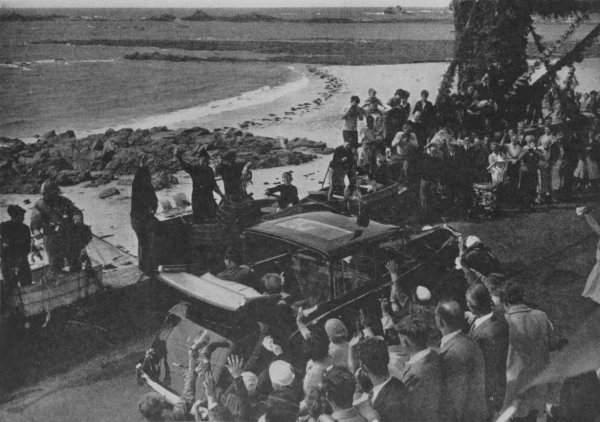
Queen Elizabeth II and the Duke of Edinburgh driving through Guernsey during the course of their three-day visit to the Channel Islands in July 1957. They receive an enthusiastic welcome from the local people and holiday-makers who line their route. |
July 26, 1957: The outstanding event of the year is the visit of Queen Elizabeth II and the Duke of Edinburgh, the first since the queen's accession. The queen visits Guernsey this day and Sark and Alderney on July 27, when the queen's cups for the best cattle on each island are presented by her to the owners.
Oct. 7, 1957: A serious fire breaks out in Sark, when the annexe of Stock's Hotel is destroyed, and the manageress loses her life in an attempt to rescue her dog.
1958: Unsettled weather throughout the year, with absence of sun at the right time, checks Guernsey's flowers and glasshouse tomatoes, exports of such produce being less than in the previous year. A decrease in tourist traffic also slightly affects all the islands.
January 1958: The year opens with a disaster on Alderney where foot and mouth disease breaks out and 217 cattle and 212 pigs are destroyed. Funds are raised voluntarily on the other islands, and the cattle are replaced with herds from Guernsey and one herd from Sark, all of the same breed. The 1958 Alderney Cattle Show is cancelled.
March 10-11, 1958: Unusually heavy falls of snow are experienced, when up to 38 cm of snow is recorded on Alderney.
May 1958: The States of Guernsey vote £350,000 for a distillation plant to convert fresh water from the sea as a reserve supply for fruit and vegetable growers. Consideration is also given to extending the period of prohibition of erection of new glasshouses on Guernsey because of the effects upon insular economic life.
July 11, 1958: Vice-Adm. Sir Geoffrey Robson, lately C.-in-C., South Atlantic, is appointed lieutenant governor. Elmhirst retires in October and is the recipient of many farewell gifts from the islanders. Robson takes office December 11.
June 22, 1959: Princess Margaret visits Sark, and on the following days Guernsey and Alderney.
Dec. 9, 1959: With only four dissenting votes, the 57-member States of Guernsey agrees to reduce the standard rate of income tax in the island from 5s. 2d. in the pound to 4s.
1960: Tomato exports from Guernsey are reduced to 48,345 tons, the lowest for five years.
1960: There is a further marked increase in the number of tourists visiting Guernsey (128,801).
February 1960: The bailiff, Sir Ambrose Sherwill, retires and is succeeded by William H. Arnold, the attorney-general.
Oct. 22, 1960: A new £257,000 sea-water distillation plant is officially opened in Guernsey by the home secretary, R.A. Butler. It is to produce 500,000 gallons of fresh water daily to supplement water from the island's reservoirs and catchment areas and ensure an adequate supply for the tomato and flower-growing industry during drought conditions.
1961: Exports of tomatoes from Guernsey are 45,767 tons, the smallest amount since 1954. Many glasshouse-growers have given up tomatoes for the culture of all-the-year-round roses, carnations, and chrysanthemums.
1961: Half the island's women are asked by the Imperial Cancer Research Fund to take part in an experiment designed to help in the treatment of cancer of the breast.
April 1961: An £80,000 packing station is opened in Guernsey and all tomatoes will in future be inspected and packed for shipment there. The island is also to build a £45,000 horticultural experimental station for the tomato industry.
April 23/24, 1961: Census population: 47,099 (Guernsey, 44,968; Alderney, 1,472; Sark, 550; Herm, 90; Brechou, 11; Jethou, 8).
1962: For the first time in nearly 50 years drift-net fishing for mackerel starts off Guernsey, where there are five trawlers operating the revived fishing industry. The White Fish Authority of the United Kingdom puts forward a series of proposals for the reorganization and development of the industry.
1963: A new social insurance scheme is approved, operating from Jan. 1, 1965, for an increase in the old-age pension of a married couple from 65s. to 80s. a week.
May 9, 1963: Queen Elizabeth the Queen Mother lands in Guernsey for a four-day tour of the Channel Islands.
Aug. 2, 1963: Lt.Gen. Sir Charles Coleman is appointed lieutenant governor. He was G.O.C.-in-C., Eastern Command, before his retirement in 1959. He arrives in Guernsey on Jan. 15, 1964, to be sworn in.
April 29, 1964: By 34 votes to 17, the States of Guernsey vote to abolish the death penalty for murder and to substitute for it a sentence of life imprisonment. During the past 30 years three men and two women have been condemned to death for murder in Guernsey, but none of them was hanged; the last execution in the island took place 110 years ago.
June 12, 1965: The dame of Sark, Sibyl Hathaway, is knighted, thus becoming Dame in another sense.
1966: The "doubles" coinage is discontinued.
1966: Leonard Joseph Matchan, a millionaire businessman, buys Brechou for £44,000.
July 28, 1966: Guernsey celebrates 900 years of association with the British crown.
Nov. 30, 1966: Commander Sydney Herivel is reelected to a seventh three-year term as president of the States of Alderney. He polls 280 votes, against 161 for Group Capt. Edward Odoire, 158 for Lt.Col. M. Packe, and 49 for Maj. C. Basham. Herivel's previous five reelections were unopposed.
Dec. 6, 1966: Elections for 12 deputies are held in Sark.
1967: 38,382 tourists pay the landing tax in Sark.
Feb. 3, 1967: The Alderney parliament votes for a special law to go to the queen-in-council to legalize the election of Herivel as president of the States, because it was held in November but should have been held in December.
June 1968: Prof. Cyril Northcote Parkinson, who has lived in Guernsey for nearly seven years, resigns from the Guernsey Telephone Council, having recently been censured for "piratical pontifications" by Bailiff Sir William Arnold. In April Parkinson spoke of "stormy seas" ahead for the Channel Islands because of the Common Market and questioned the ability of the island administration to deal with the matter.
May 14, 1969: Vice-Adm. Sir Charles Mills is received by the queen upon his appointment as lieutenant governor (as from May 30).
Oct. 1, 1969: The bailiwick becomes an independent postal authority, with its own special stamps. This brings about the discontinuance of the "conveyance stamps" which the tenants of the smaller islands have issued to pay for the conveyance of the mails to Guernsey (initiated after the war by Jefferies in Herm).
Aug. 26, 1970: The resignation of Sydney Peck Herivel as president of the States of Alderney is accepted; he dies the following day. The vice president, Leslie Wells, takes over until a new presidential election is held on September 26. In this, George William Baron is elected president (with 331 votes against 224 for Brig. Patrick Preston and 173 for Group Capt. Edward Odoire), who subsequently accepts appointment as a jurat, declining to vacate either post. Baron's action leads to a resolution being passed by the Alderney States in January 1971 "that a Member of the States should not also hold the office of Jurat."
1971: Alderney regains its own police.
April 25/26, 1971: Census population: 53,734 (Guernsey, 51,351; Alderney, 1,686; Sark, 584; Herm, 96; Jethou, 11; Brechou, 6).
Feb. 15, 1971: Guernsey adopts decimal coinage at the same time as the United Kingdom.
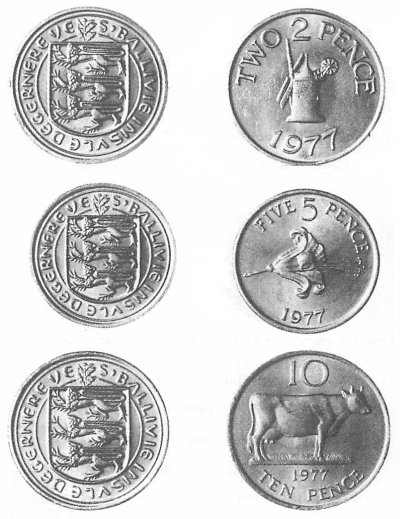
1977 Guernsey coins, showing the seal with the lettering S(IGILLVM) BALLIVIE INSVLE DEGERNEREYE ("Seal of the Bailiwick of the Island of Guernsey"). |
December 1972: The vehement opposition of the two Alderney representatives wins sufficient support in the States of Deliberation to obtain a vote exonerating Alderney from having to impose the increases in spirit and tobacco duties which are being applied to Guernsey. For the first time since the liberation Alderney has been able to assert the right to maintain its own scale of duties independent of the larger island.
Jan. 1, 1973: On Britain joining the bloc, the islands become associated with the European Community, with a unique status.
July 14, 1974: The dame of Sark, Dame Sibyl Hathaway, dies. She is succeeded by her grandson Michael Beaumont.
July 23, 1974: It is gazetted under this date that Vice-Adm. Sir John Martin has been appointed lieutenant governor as from October 4 (when he is sworn in).
September 1974: Legislation is approved by the States of Alderney that a jurat shall not be eligible for the presidency or membership of the States. It is not until Sept. 11, 1975, that the legislation comes into force. George Baron accordingly announces that, not intending to resign his warrant as jurat, he will not seek reelection to the presidency of the States in the December 1975 election.
May 28, 1975: Queen Elizabeth the Queen Mother visits Guernsey.
December 1975: Jon Kay-Mouat is elected president of the States of Alderney.
Spring 1976: As Air France begins a Concorde service to Washington, Alderney becomes subjected to regular sonic booms as the planes decelerate over Alderney on their return from Washington to Paris. This leads to increasing public protests and a formal complaint to the Home Office by Kay-Mouat, president of the States of Alderney. In July 1977 a rerouting of the planes is announced.
April 25/26, 1976: Census population (resident; excluding Alderney and Sark): 53,637 (Guernsey, 53,560; Herm, 69; Jethou, 8).
December 1976: Bailiff Sir John Loveridge opens the Beau Sejour leisure centre which embodies a theatre and concert hall, a cartoon cinema, a swimming pool, a restaurant, bars, and provision for dancing and a wide variety of games and sporting activities.
January 1977: Divorce is legalized in Sark, to the extent that divorces granted elsewhere are accepted.
1978: Guernsey cheese is marketed for the first time.
1978: The tourist count is 331,596 - an increase of 25,710 on 1977.
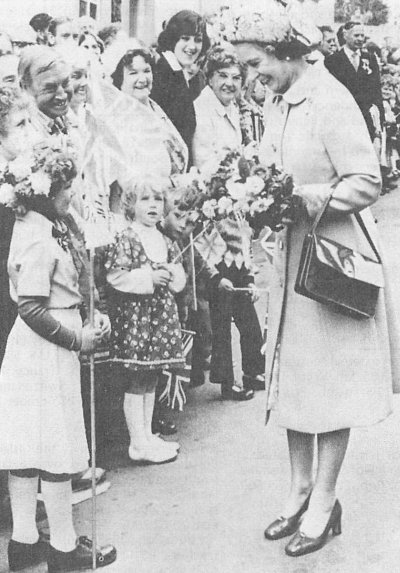
Queen Elizabeth II visits Guernsey on her June 1978 tour of the Channel Islands. |
June 28, 1978: Queen Elizabeth II visits Guernsey and, the following day, Sark and Alderney.
March 3, 1980: It is gazetted under this date that the queen has appointed Air Chief Marshal Sir Peter Le Cheminant as lieutenant governor, effective April 22. He is the first Guernseyman, other than those who have also been bailiffs, to be lieutenant governor since Thomas Andros in 1620-21.
1981: Profits from banking total £20.4 million. Banking and finance contribute 40% of the gross national product. Meanwhile the number of people employed in horticulture has dropped from 4,414 in 1970 to 2,188 at the end of 1981.
April 5/6, 1981: Census population (resident; excluding Alderney and Sark): 53,313 (Guernsey, 53,268; Herm, 37; Jethou, 8).
Dec. 25, 1982: A shipwreck is discovered in St. Peter Port harbour by a local diver. Initially suspected to be a medieval barge, closer inspection in 1983 reveals it to be a Roman ship. It is raised in 1984-86. The ship, carrying a cargo of pitch, caught fire and sank around 280 CE. The pitch set hard when the ship sank and helped to keep the wreck together and preserve its detail, making it the most intact example of its type.
1983: The Sexual Offences (Bailiwick of Guernsey) Law, 1983, decriminalizes homosexuality, with the age of consent set at 21.
1983: Alderney issues its own postage stamps.
May 1984: It is reported that Guernsey is going through a vegetable revolution. Due to cheap fuel for heating provided by the Dutch government, Guernsey will supply only 25,000 tonnes of tomatoes this year, compared with 60,000 in 1974, but instead grows cucumber, asparagus, fennel, and exotic plants such as melons and kiwifruit.
May 30, 1984: Queen Elizabeth the Queen Mother visits Guernsey.
December 1984: Jon Kay-Mouat is reelected unopposed to a fourth term as president of the States of Alderney.
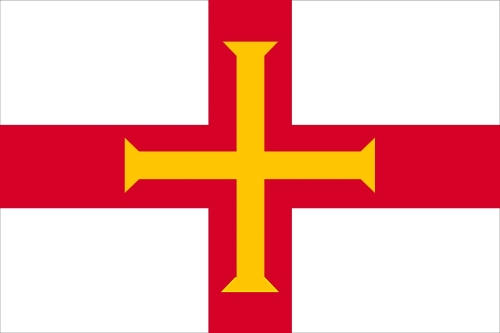
May 9, 1985: A Guernsey flag, designed by a committee, becomes official. Previously the English flag, with the red Cross of St. George, was generally used. The new flag shows the "Guernsey cross" (found on the Bayeux Tapestry, documenting the Norman Conquest) in the centre of the Cross of St. George to show that the islands were part of the original Duchy of Normandy.
Sept. 2, 1985: It is gazetted that the queen has appointed Lt.Gen. Sir Alexander Boswell as lieutenant governor.
March 23/24, 1986: Census population (resident; excluding Alderney and Sark): 55,482 (Guernsey, 55,421; Herm, 59; Jethou, 2).
May 3-4, 1986: Princess Anne visits Guernsey.
Oct. 6, 1987: The tenant of Brechou, Leonard Joseph Matchan, dies.
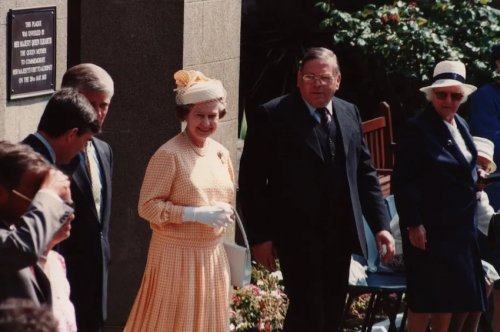
Queen Elizabeth II with Jon Kay-Mouat, president of the States of Alderney, outside the Island Hall of Alderney, May 24, 1989. |
May 23, 1989: The queen and the Duke of Edinburgh visit Guernsey and open the Queen Elizabeth II Marina. On May 24 they visit Sark and Alderney. Alderney commemorates the visit with its first-ever coin issue.
January 1990: Lt.Gen. Sir Michael Wilkins is appointed lieutenant governor. The gazette announcement follows only on November 5.
July 1990: Alderney is divided down the middle over plans to reopen a granite quarry closed since the 1930s.
Aug. 24, 1990: André Gardes, an unemployed nuclear scientist from Rocheville, France, lands on Sark armed with a semi-automatic rifle and posts an order saying he is taking control of the island. Philip Perrée, one of Sark's two part-time police officers, prevents the coup. "As he was putting the magazine into the rifle his hands were full and I had a split second to jump him," Perrée recounts. Gardes is thrown into Sark's two-cell prison and later deported. The rifle ends up in the tiny Sark museum.
April 21/22, 1991: Census population (resident; excluding Alderney and Sark): 58,867 (Guernsey, 58,753; Herm, 113; Jethou, 1).
1993: David Barclay with his twin brother Frederick buys Brechou from the heir of Leonard Matchan.
March 1993: Tempers flare in the U.K. when a French flotilla sails into the main harbour at Guernsey to protest restrictions on fishing near the Channel Islands. Fishing boats from Guernsey and neighbouring Jersey sail into Cherbourg, France, in protest a few days later after officials repudiated the informal agreement reached by the local fishermen.
March 1994: The conseillers, traditionally selected by the parish representatives, are popularly elected for the first time. Eric Walters, a populist senior official of the local branch of the Transport and General Workers' Union, tops the poll.
Oct. 12, 1994: It is gazetted that the queen has appointed Vice-Adm. Sir John Coward as lieutenant governor.
May 9, 1995: The Prince of Wales visits to attend the 50th anniversary celebrations of the liberation of Guernsey.
March 31, 1996: Census population (resident; excluding Alderney and Sark): 58,681 (Guernsey, 58,581; Herm, 97; Jethou, 3).
June 13, 1996: The States of Deliberation votes to legalize abortion, following months of debate which divided the island. The States approves proposals which repeal existing legislation dating from 1910 which made a woman who terminated her pregnancy liable to life imprisonment, and which permit abortion up to the 12th week of pregnancy except in cases where there is a serious risk to the woman or fetus, when termination can take place up to the 24th week. The proposals are subsequently incorporated into a bill which is passed on October 31 by a vote of 34-20 and receives Privy Council approval on March 18, 1997. Abortion was first legalized in Great Britain in 1967.
June 5, 1997: Princess Margaret visits Guernsey.
Jan. 28, 1999: Guernsey lowers the age of consent for homosexual sex from 21 to 18.
Nov. 24, 1999: The Chief Pleas (parliament) of Sark decides to change a 1611 law under which daughters could only inherit property if there were no male heirs. All land had to be left to the eldest son - it could not be split up. The change to the island's constitution was begun by the multimillionaire Barclay brothers, who live on the neighbouring island of Brechou, governed by Sark, and who want to be able to divide their £60 million granite castle on Brechou between all four of their children, three male and one female. The change is instituted to forestall a challenge to the 1611 law at the European Court of Human Rights. The Privy Council in London approves the change on December 14.
Feb. 8, 2000: The European Court of Human Rights rules unanimously that a flower-grower in Guernsey was denied a fair judicial hearing on a planning consent dispute because his appeal was heard by a judge who had been the presiding officer of the island's legislature when relevant executive decisions had been taken. The ruling is seen as casting a question-mark not just over Guernsey's constitutional arrangements, but over the triple role of the U.K. lord chancellor as senior law officer, cabinet minister, and member of the legislature, akin to the uncertainty engendered in Scotland by a court ruling in November 1999 that the tenure of temporary sheriffs (judges) was in breach of the European Convention of Human Rights.
April 12, 2000: In general elections, the structure of the States of Guernsey changes, with 12 new deputies to replace the old office of conseiller, which was abolished when it was decided to do away with island-wide elections. There are now 45 deputies, 10 douzaine representatives, and 2 Alderney representatives.
May 22, 2000: It is gazetted that the queen has appointed Lt.Gen. Sir John Foley as lieutenant governor.
June 2000: Guernsey is included on an OECD blacklist of 35 global tax havens.
Oct. 31, 2000: The Ievoli Sun, an Italian tanker carrying 6,000 tonnes of toxic chemicals, sinks off Alderney during severe storms. Initial fears that the chemicals could pose a major threat to local marine life are soon dispelled.
November 2000: The "Harwood report" (a review of the machinery of government in Guernsey, commissioned in December 1998 and chaired by Peter Harwood) recommends committee downsizing and a form of cabinet government in an effort to strengthen leadership and modernize accountability.
Dec. 9, 2000: Ralph Burridge, Chris Main, Edwin Sebire, Bill Walden, and Colin Williams are elected members of the States of Alderney. Turnout is 65%. The States of Alderney consists of a president and 10 members, all of whom are unpaid; elections are held for half the seats every two years.
April 29, 2001: Census population (resident; excluding Alderney and Sark): 59,807 (Guernsey, 59,710; Herm and Jethou, 97). A separate Alderney census on the same date shows a population of 2,294. The Guernsey census is the last traditional one, as subsequently a method is developed to count the population using administrative records.
July 12, 2001: Queen Elizabeth II and the Duke of Edinburgh visit for the opening of the 201 Squadron Museum at Castle Cornet and the unveiling of the Millennium Stone at L'Ancresse. They also visit Alderney and Sark.
Jan. 19, 2002: Sir Norman Browse is elected as president of the States of Alderney with 55% of the vote, against three other candidates, Louis Jean, Brig. John Russell, and Col. Peter Walter. Turnout is 66.3%. Browse takes office January 23.
March 23, 2002: A 30-strong mob bombards Alderney's police station, injuring two officers, following the arrest of a local musician on suspicion of drunk driving.
March 26, 2003: States members vote for a second major change when the role of the 10 representatives of the island's parish governments, the douzaines, is removed (taking effect May 1, 2004).
January 2004: The Chief Pleas of Sark votes 14-9 to abolish the death penalty. Although the island's court did not have the power to impose the death-by-hanging sentence, it was still on its statute books. Deputy Paul Armorgie says none of the island deputies could find a record of anyone ever having been hanged on Sark.
April 21, 2004: In parliamentary elections, the following are elected: Laurence Charles Morgan; Brian John Gabriel; John Alfred Bannerman Gollop; Carla Steve McNulty Bauer; Barry Leslie Brehaut; Michael Edmund Wills Burbridge; Leon Roy Gallienne; Jack Honeybill; Robert Thoderick Matthews; Jean Aimée Pritchard; Christopher Donald Brock; Wendy Jean Morgan; Diane Eileen Lewis; Lyndon Sean Trott; Daniel Peter Le Cheminant; Samantha Jane Maindonald; Scott John Ogier; Ivan Frederick Rihoy; Ronald John Le Moignan; Geoffrey Hubert Mahu; Peter John Rufus Roffey; David Brian Jones; Mary May Lowe; Graham Guille; Brian Richard de Jersey; Duncan William Staples; Stuart John Falla MBE; Mark Hirzel Dorey; Eric William Walters; Jonathan Paul Le Tocq; Bernard Marcel Flouquet; Alexander Hunter Adam; Thomas Mansell Le Pelley; David Allan Grut; Martin Andrew Ozanne; David de Garis De Lisle; Claire Helen Le Pelley; Peter Raphael Sirett; Alvord Henry Brouard; Michael William Torode; Charles Nigel Kennedy Parkinson; William Mather Bell; Francis John Quin; Janine Michelle Le Sauvage; Michael George O'Hara. Turnout is 64%. On May 1 Laurie Morgan is elected as Guernsey's first chief minister. Morgan first wins 22 votes against 18 for Bernard Flouquet and 6 for Mike Torode, then in a second vote defeats Flouquet 26-19. The other ministers are as follows:
| Treasury and Resources Minister | Lyndon Trott |
| Education Minister | Martin Ozanne |
| Commerce and Employment Minister | Stuart Falla |
| Social Security Minister | Mary Lowe |
| Health and Social Service Minister | Peter Roffey |
| Home Department Minister | Mike Torode |
| Environment Minister | Bernard Flouquet |
| Housing Minister | Dave Jones |
| Public Services Minister | Bill Bell |
| Culture and Leisure Minister | Peter Sirrett |
| Deputy Chief Minister | Bernard Flouquet |
| House Committee Chairman | Dan Le Cheminant |
| Legislation Select Committee Chairman | Claire Le Pelley |
| Public Accounts Committee Chairman | Rhoderick Matthews |
| Scrutiny Committee Chairman | Jean Pritchard |
| Public Sector Remuneration Committee Chairman | Jonathan Le Tocq |
June 12, 2004: Debbie Burgess and Lin Maurice poll 298 and 282 votes respectively during a by-election to the States of Alderney, defeating Gill Lowe in an all-female list of candidates for the posts. The by-election follows the death earlier in the year of Edwin Sebire and the resignation from the States of Colin Williams.
Dec. 11, 2004: Barbara Benfield, Lin Maurice, Bill Walden, Chris Main, and Barry Pengilley are elected members of the States of Alderney.
May 9, 2005: Queen Elizabeth II and the Duke of Edinburgh visit Guernsey as part of the commemoration of the 60th anniversary of the Channel Islands' liberation from Nazi occupation. It is her fifth official visit to Guernsey as queen, and her sixth overall (including the 1949 visit as princess).
June 16, 2005: Geoffrey Rowland is installed as bailiff.
Oct. 18, 2005: Vice Adm. Sir Fabian Malbon is sworn in as lieutenant governor.
Dec. 7, 2005: Sark holds what is expected to be its last election under its ancient system of feudal law; a new constitution is scheduled to go into effect in 2006, under which the role of the seigneur (acting on behalf of the queen) might cease and the island's 40 landowners (tenants) might lose their right to sit in the legislature, which would become fully representative. Seneschal Reg Guille, chairman of the Chief Pleas, complains that the change was ordered by the Department of Constitutional Affairs in London because Sark's feudal constitution was deemed to conflict with the European Convention on Human Rights.
March 8, 2006: The Chief Pleas of Sark votes to reduce its membership from 52 to 28, with 14 seats reserved for landowners and the other 14 made up of elected people's deputies. The public will also vote to decide which landowners are given seats. The previous setup gave all 40 landowning tenants an automatic seat in Chief Pleas, with a further 12 seats for elected deputies. The island came under pressure in 2000 to adopt universal suffrage in accordance with the European Convention on Human Rights. In April 2006 Seigneur Michael Beaumont warns the proposal might not be approved by the U.K. Privy Council. It is thought it could be challenged in the European Court of Human Rights for not being democratic enough.
July 27, 2006: Former lieutenant governor (1969-74) Sir Charles Mills dies.
Aug. 16-Sept. 6, 2006: In a "test of opinion" on Sark, carried out by telephone and post, the question is posed: "Which of the following options for the composition of the Chief Pleas would you prefer?" The result:
| Total number of eligible electors | 468 |
| Total number of votes received | 419 (89.5%) |
| Total number of ballot papers received by post | 333 |
| Total number of telephone votes received | 86 |
| Total number of spoilt/blank ballot papers | 1 |
| Total number of valid votes counted | 418 |
| Number voting for 28 Open Seats | 234 (56.0%) |
| Number voting for 12 Seats for Deputies, 8 Seats for Tenants, 8 Open Seats | 184 (44.0%) |
On October 4 the Chief Pleas rescinds its decision of March 8. It also decides that the elected members of the Chief Pleas shall be known by the title Conseiller.
Nov. 25, 2006: Colin Williams (654 votes), Ian Tugby (627), Richard Willmott (461), Liz Bennett (424), and Richard Cox (352) are elected as members of the States of Alderney, to serve until 2010. Jeremy Sanders (319) and John Postlethwaite (294) are unsuccessful.
Dec. 9, 2006: In Alderney's first-ever election ("plebiscite") for two representatives to the Guernsey States, Bill Walden (259 votes) and Richard Willmott (258) are elected. The current representative, Richard Cox, comes third with 147 votes and Chris Main comes fourth with 58; the two will be alternative representatives. Lin Maurice comes last with 48 votes whilst Barry Pengilley, who withdrew from the election several days earlier, receives 10 votes. Turnout is 31%.
January 2007: Two members of the Chief Pleas of Sark question whether a large enough majority of islanders backed reforms in the 2006 poll and call for a working party to be set up to review the poll.
Feb. 22, 2007: The Chief Pleas of Sark reconsiders its decision on reforms in the light of legal advice from London lawyers suggesting that Sark might have much more leeway to be independent from the European Convention of Human Rights and the U.K. Department of Constitutional Affairs than had previously been thought. The lawyers reckon that if Sark wanted to retain some elements of its feudal system that guarantees seats for landowners, it might be in its legal right to do so.
March 5, 2007: Mike Torode is elected as new chief minister, defeating Peter Roffey by 24 votes to 22 in the third ballot. Two other candidates, Jonathan Le Tocq and Bernard Flouquet, were eliminated after the second vote. The election followed the political fallout over the tendering process for a new clinical block at the Princess Elizabeth Hospital. Former chief minister Morgan resigned with the Policy Council in February after a highly critical report by the Wales Audit Office. It was asked to carry out an independent investigation following concerns that the Policy Council may have used its influence to encourage building firm RG Falla to withdraw, despite its bid being £2.4 million lower than the one accepted. On March 7 the new Policy Council is elected, with two of the resigned ministers losing their positions. Diane Lewis is voted in as the new social security chief, defeating outgoing minister Mary Lowe by 28 votes to 18. David De Lisle takes over as environment minister, replacing Bernard Flouquet. Geoff Mahy replaces Torode at the home department.
April 11, 2007: The Chief Pleas of Sark takes a new decision about its future composition: it is to comprise 16 deputies and 12 tenants elected by universal suffrage for the term of four years from December 2008, and thereafter either (a) 28 deputies elected by universal suffrage, or (b) 16 deputies and 12 tenants elected by universal suffrage; in accordance with the results of a binding referendum to be held before March 31, 2012.
February 2008: After two previous proposals were rejected, the Chief Pleas of Sark finally agrees on changes to the island's system of government which, on April 9, are approved by the U.K. Privy Council. It means that Sark will now be governed by a chamber of 28 elected members. The first elections under the new system are to take place in December.
April 23, 2008: In parliamentary elections, only nonpartisans are elected. Turnout is 40.6%. On May 1 Deputy Lyndon Trott is elected chief minister in a fifth round of voting. He led from the outset; in the first and second polls, Deputy Al Brouard was his nearest rival, while for the rest of the votes he was chased by Deputy Bernard Flouquet. After Deputy David De Lisle and Deputy Carla McNulty Bauer tied in last place in the first poll, an extra ballot was held to determine who of the two is eliminated; McNulty Bauer won 25 votes, while De Lisle won 14 and was eliminated. McNulty Bauer was eliminated in the second ballot, Deputy Hunter Adam in the third, and Brouard in the fourth.
| First | Second | Third | Fourth | Fifth |
| Lyndon Trott | 17 | 18 | 19 | 23 | 27 |
| Bernard Flouquet | 9 | 10 | 13 | 16 | 19 |
| Al Brouard | 11 | 11 | 11 | 8 | - |
| Hunter Adam | 4 | 5 | 4 | - | - |
| Carla McNulty Bauer | 3 | 3 | - | - | - |
| David De Lisle | 3 | - | - | - | - |
On May 6 the ministers are elected as follows:
| Commerce and Employment | Carla McNulty Bauer |
| Culture and Leisure | Mike O'Hara |
| Education | Carol Steere |
| Environment | Peter Sirett |
| Health and Social Services | Hunter Adam |
| Home | Geoff Mahy |
| Housing | Dave Jones |
| Public Services | Bernard Flouquet |
| Social Security | Mark Dorey |
| Treasury and Resources | Charles Parkinson |
| Deputy Chief Minister | Bernard Flouquet |
| House Committee Chairman | Ivan Rihoy |
| Legislation Select Committee Chairman | John Gollop |
| Public Accounts Committee Chairman | Leon Gallienne |
| Scrutiny Committee Chairman | Barry Brehaut |
| Public Sector Remuneration Committee Chairman | Al Brouard |
All are Trott's nominees except Bauer, who defeats nominee Jack Honeybill, 25-22, and O'Hara, who defeats nominee Leon Gallienne, 24-14; Gallienne is then elected a committee chairman instead of nominee Allister Langlois, 25-22.
Dec. 6, 2008: Peter Allen, Boyd Kelly, Geoffrey Sargent, Bill Walden, and John Beaman are elected as members of the Alderney States. (Beaman finished in joint fifth place after polling the same number of votes as Don Oakden; this tie, thought to be unprecedented in the island's political history, led to the returning officer picking the winning candidate's name from a ballot box.) Turnout is 65.6%. States members Bill Walden and Richard Willmott are selected unopposed to represent the island in the Guernsey States. The new members are sworn in on Jan. 14, 2009.
Dec. 10, 2008: Voters on Sark choose 28 conseillers from a total of 57 candidates (about 12% of the island's 474-strong electorate). 412 voters take part (a turnout of 87%), with only two papers spoilt. 9,886 votes are cast, which means the average voter makes use of 24 of their 28 available. The announcement of the final results on December 11 is followed by a separate ballot to determine the length of the service of each of the conseillers, either two or four years. The winning candidates, with number of votes and number of years they are due to serve:
| 1. David Thomas Cocksedge | 334 | 2 |
| 2. Rossford John de Carteret | 316 | 4 |
| 3. Helen Mildred Plummer | 301 | 2 |
| 4. David Woods Melling | 283 | 2 |
| 5. Helen Clair Magell | 280 | 4 |
| 6. Christopher Howard Bateson | 279 | 2 |
| 7. Antony Dunks | 267 | 4 |
| 8. Stephen Laurence Henry | 265 | 4 |
| 9. David Pollard | 262 | 4 |
| 9. Andrew Charles Prevel | 262 | 4 |
| 11. Sandra Williams | 254 | 4 |
| 12. Elizabeth Mary Dewe | 252 | 4 |
| 13. Edric Baker | 249 | 2 |
| 14. Paul Joseph Williams | 248 | 4 |
| 15. Diane Baker | 233 | 2 |
| 16. Richard James Dewe | 231 | 4 |
| 17. Paul Martin Armorgie | 229 | 4 |
| 18. Andrew James Cook | 228 | 2 |
| 19. Charles Noel Donald Maitland | 227 | 4 |
| 20. Michelle Andrée Perrée | 223 | 2 |
| 21. Christopher Robert Nightingale | 214 | 2 |
| 22. Janet Mary Guy | 211 | 2 |
| 22. John Edward Hunt | 211 | 2 |
| 24. Ann Atkinson | 205 | 4 |
| 25. Anthony Granville Ventress | 201 | 2 |
| 26. Stefan Bernd Gomoll | 200 | 2 |
| 27. Christine Dorothy Audrain | 195 | 4 |
| 28. Peter John Cole | 183 | 2 |
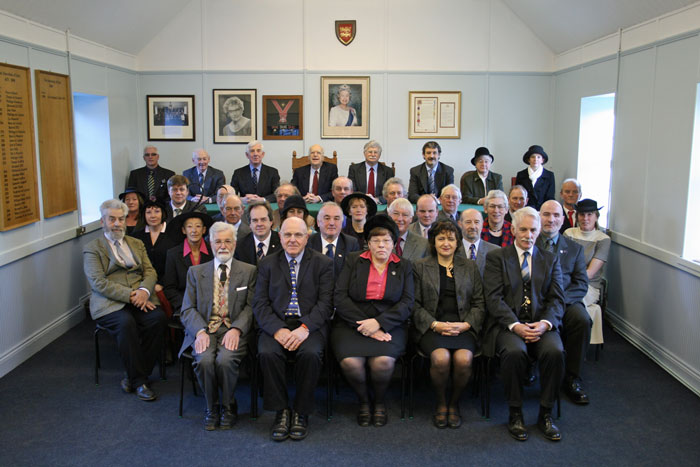
The first sitting of the democratically elected conseillers of Chief Pleas of Sark, January 2009. |
The result is a win for traditionalists and a defeat for most of the pro-modernization candidates backed by wealthy businessmen Sir David and Sir Frederick Barclay, who live in a castle on neighbouring Brechou. Candidates supported by the Barclay twin brothers, whose interests include Telegraph Newspapers and the Ritz Hotel in London, favoured the introduction of electric cars in car-free Sark and other measures to boost tourism. The Barclays respond to their defeat by closing the hotels and other businesses that they own on Sark, although by the end of the year most have been reopened pending the installation of a new island administration. Several wealthy landowners and the neighbouring island of Guernsey question the validity of the new constitution. The new conseillers take the oath of office and oath of allegiance on Jan. 9, 2009.
Dec. 1, 2009: Five Supreme Court judges rule unanimously that the retention by Sark of the feudal offices of seigneur and seneschal does not breach the European Convention of Human Rights. They therefore reject an application by the Barclay brothers.
March 25, 2010: Guernsey lowers the homosexual age of consent from 18 to 16, bringing it to the same level as for heterosexuals.
Oct. 26, 2010: Air Marshal Peter Walker is named as the next lieutenant governor, to take office in April 2011.
Nov. 27, 2010: In elections for 5 of 10 States members in Alderney, Matt Birmingham, Ian Tugby, Paul Arditti, Raymond Berry, and Tony Llewellyn are elected. Turnout is 70%.
Dec. 8, 2010: In elections to the Chief Pleas of Sark, 14 conseillers are elected. Turnout is 79.6%.
Feb. 23, 2011: Lieutenant Governor Sir Fabian Malbon departs. On April 15 Air Marshal Peter Walker is sworn in as lieutenant governor.
May 2011: The queen approves the appointment of Richard Collas as bailiff in succession to Sir Geoffrey Rowland, who will retire in March 2012.
May 31, 2011: Former lieutenant governor (1974-80) Sir John Martin dies.
June 11, 2011: In elections for a new president of the States of Alderney (to serve until Dec. 31, 2012), Stuart Trought wins 58.6% of the vote, Bill Simpson 28.8%, and Paul Arditti 12.6%. Turnout is 65.7%. It is the first contested election since 2002 as Sir Norman Browse was reelected unopposed in 2004 and 2008 before announcing his retirement from the post in May. Trought is sworn in on June 22.
Jan. 25, 2012: Robert Sillars is elected as education minister after the resignation of Carol Steere.
March 23, 2012: Richard Collas is sworn in as bailiff.
April 18, 2012: In parliamentary elections, 45 nonpartisan members are elected. Turnout is 71.4%.
May 1, 2012: Peter Harwood is elected chief minister, winning a vote of 27-20 against Jonathan Le Tocq. On May 8 the ministers are elected as follows:
| Commerce and Employment | Kevin Stewart |
| Culture and Leisure | Mike O'Hara |
| Education | Robert Sillars |
| Environment | Roger Domaille |
| Health and Social Services | Hunter Adam |
| Home | Jonathan Le Tocq |
| Housing | Dave Jones |
| Public Services | Paul Luxon |
| Social Security | Allister Langlois |
| Treasury and Resources | Gavin St. Pier |
| Deputy Chief Minister | Jonathan Le Tocq |
| States Assembly and Constitution Committee Committee Chairman | Matt Fallaize |
| Legislation Select Committee Chairman | Rob Jones |
| Public Accounts Committee Chairman | Heidi Soulsby |
| Scrutiny Committee Chairman | Paul Arditti |
Stewart is the only minister who was not Harwood's candidate, defeating nominee Roger Perrot, 28-19.
July 15, 2012: Former bailiff (1982-92) Sir Charles Frossard dies.
Oct. 23, 2012: The president of the States of Alderney, Stuart Trought, is returned unopposed to his position. His current term finishes at the end of December, but the lack of other contenders for elections which were due on November 3 means he will serve until Dec. 31, 2016.
Nov. 17, 2012: In elections for 5 of 10 States members in Alderney, Louis Jean, Neil Harvey, Francis Simonet, Robert McDowall, and Christopher Rowley are elected. Turnout is 73%.
Dec. 12, 2012: In elections to the Chief Pleas of Sark, 14 conseillers are elected. Turnout is 77.5%.
Feb. 27, 2013: Lt.Col. Reg Guille is sworn in as president of Chief Pleas of Sark, ending the seneschal's dual role after 338 years. Jeremy La Trobe-Bateman takes over the title of seneschal from Guille, but thereby only taking over the role of Sark's chief judge. Chief Pleas agreed in 2010 to split the responsibilities after a 2008 ruling by the U.K. Court of Appeal found it did not comply with human rights laws.
End of April 2013: Census population of Alderney: 1,903 (17% lower than in 2001).
| Area
(sq km) | Population
(2014 est.) |
|---|
| Parishes of Guernsey |
| Câtel (Castel) | 10.2 | 8,785 |
| Forest | 4.1 | 1,586 |
| St. Andrew | 4.5 | 2,411 |
| St. Martin | 7.3 | 6,387 |
| St. Peter | 6.2 | 2,108 |
| St. Peter Port | 6.4 | 18,207 |
| St. Sampson | 6.3 | 8,890 |
| St. Saviour | 6.4 | 2,753 |
| Torteval | 3.1 | 1,028 |
| Vale | 8.9 | 9,415 |
| persons of unknown address | - | 1,051 |
| Other islands |
| Alderney | 7.9 | 1,903 |
| Brechou | 0.3 | 2 |
| Herm | 1.3 | 84 |
| Jethou | 0.2 |
| Lihou | 0.2 | 0 |
| Sark | 5.3 | 542 |
| Total | 78.5 | 65,152 |
Feb. 25, 2014: Chief Minister Peter Harwood resigns. On March 12 Jonathan Le Tocq is elected chief minister, defeating Allister Langlois 22-20. On March 19 Le Tocq proposes Langlois for deputy chief minister and Peter Gillson for home minister, and they are elected on March 26, along with Rob Jones as Scrutiny Committee chairman to replace Paul Arditti, who died January 20.
May 15, 2014: Environment Minister Roger Domaille resigns following the States' decision to introduce paid parking for long-stay spaces, which he calls unfair. On May 28 Yvonne Burford is elected environment minister.
Nov. 22, 2014: In elections for 5 of 10 States members in Alderney, Ian Tugby, Matt Birmingham, Graham McKinley, Norma Paris, and Steve Roberts are elected. Turnout is 69.4%.
Nov. 25, 2014: Only 16 candidates are nominated for 16 seats in Chief Pleas of Sark, meaning there will be no contested election. However, as two of the 16 seats are for a shorter term, a ballot is still held on December 10 to decide how long everyone serves as a conseiller.
2015: There is much debate in Guernsey over deficiencies in the government's delivery of key health care and social services. Separate government reviews criticize aspects of Health and Social Services Department (HSSD) programs and policies regarding maternity care and children at risk from sex offenders. One report finds HSSD guilty of an "appalling" lack of investment in facilities for vulnerable children; another includes an 88-point plan for improving maternity services. Although HSSD overran its budget in 2014 by £4.6 million (about $7 million), it is allocated an additional £3 million (about $4.6 million) in 2015 to address issues raised in the reviews.
June 25, 2015: Former bailiff (1992-99) Sir Graham Dorey dies.
Sept. 6, 2015: Lieutenant Governor Peter Walker dies. The bailiff, Sir Richard Collas, becomes acting lieutenant governor.
March 14, 2016: Vice Adm. Ian Corder is sworn in as lieutenant governor.
April 27, 2016: In parliamentary elections, 38 nonpartisan members are elected. Turnout is 71.9%. Prior to the election, some four dozen of the island's leading businesspeople published an open letter imploring the successful candidates to set aside their political differences so that a multitude of important issues facing Guernsey might be addressed. The election is the first for Guernsey's reorganized government, which includes a reduction in the number of members in the legislature from 45 to 38. Voters oust 10 sitting deputies, including 4 government ministers (Kevin Stewart, Mike O'Hara, Robert Sillars, and Yvonne Burford).
May 4, 2016: Gavin St. Pier is elected president of the Policy and Resources Committee, the position replacing the chief minister in a new government structure. He wins 20 votes against 19 for Peter Ferbrache in a fourth round of voting. On May 6 former chief ministers Jonathan Le Tocq and Lyndon Trott as well as Al Brouard and Jane Stephens are voted onto the committee, Brouard being elected ahead of Lindsay de Sausmarez, who was one of St. Pier's four nominees. On May 26 it is reported that the president (St. Pier) and vice president (Trott) of the committee will also be known by the more familiar titles of chief minister and deputy chief minister, while Le Tocq will be known as lead for external affairs or minister for external affairs.
July 3, 2016: The seigneur of Sark, Michael Beaumont, dies. He is succeeded by his son Maj. Christopher Beaumont.
Oct. 5, 2016: Reg Guille retires as president of Chief Pleas of Sark, being succeeded by Conseiller Arthur Rolfe.
Nov. 1, 2016: Stuart Trought, being unopposed, is declared reelected as president of the States of Alderney.
Nov. 25, 2016: Elections to 17 vacant seats on the Chief Pleas of Sark being scheduled for December 14, but only 12 candidates having been nominated, these are declared elected.
Nov. 26, 2016: In elections for 5 of 10 States members in Alderney, James Dent, Louis Jean, Alex Snowdon, Mike Dean, and Tony Barnes are elected. Turnout is 69%.
Feb. 23, 2017: It is decided to withdraw Guernsey £1 coins from circulation by October. Guernsey £1 notes will continue to be issued alongside the circulation of new U.K. £1 coins.
May 2, 2017: A law enabling same-sex marriages comes into effect.
Jan. 18, 2018: Former chief minister (2004-07) Laurie Morgan dies.
April 8, 2018: Former lieutenant governor (1980-85) Sir Peter Le Cheminant dies.
Aug. 14, 2018: St. Peter Port douzenier Rosie Henderson raises the clameur de haro over the narrowing of a road which, she claims, would "endanger pedestrians and motorists." However, when she attempts to register it in the court, the judge denies the application because she is not the owner of the land.
Oct. 10, 2018: In a referendum on the electoral system, voters are given five options to rank in order of preference. Turnout is 45%. In the final count, Option A wins 6,017 votes (52.5%) against Option C with 5,448 votes (47.5%). This means deputies will be elected in a single island-wide district. At each election, all voters will have 38 votes and will be able to choose from the full list of candidates. Deputies will be elected on the same day to serve for a term of 4 years. Option A campaigner Deputy Carl Meerveld says: "Instead of having a popularity contest at a parish or district level we'll end up with a policy debate at an island level." He hopes the move will encourage party politics.
Dec. 1, 2018: In elections for 5 of 10 States members in Alderney, newcomer Annie Burgess (topping the poll with 665 votes) is elected along with Christian Harris (664), Steve Roberts (658), Graham McKinley (445), and David Earl (435) from 12 candidates. Turnout is 66%.
Dec. 12, 2018: In elections for 9 of 18 conseillers in Sark, 7 newcomers are elected; Conseiller Helen Plummer tops the poll with 205 votes. There were 15 candidates. Turnout is 72%.
June 21, 2019: When his only rival withdraws from the election that would have taken place on June 22, William Tate is declared elected as president of the States of Alderney. He is sworn in on June 28.
Jan. 22, 2020: Arthur Rolfe loses reelection as speaker (as the president became in 2017) of Chief Pleas of Sark to Reg Guille. On January 28 Rolfe, whose term was due to end on February 26, resigns with immediate effect with a damning letter criticizing Sark's "archaic process" and the way most government decisions are made with "utmost secrecy." (He dies on July 13.)
March 9, 2020: The first COVID-19 case in Guernsey is confirmed. The first death occurs March 30.
May 11, 2020: Richard McMahon is sworn in as bailiff.
May 30, 2020: Former lieutenant governor (1994-2000) Sir John Coward dies.
August 2020: Gavin St. Pier, Heidi Soulsby, and Lyndon Trott set up a political group called Guernsey Partnership of Independents.
Oct. 7, 2020: In parliamentary elections (turnout 79.7%), independents win 62.6% of the vote (22 of 38 seats), the Guernsey Partnership of Independents 24.0% (10), the Guernsey Party 10.0% (6), and the Alliance Party Guernsey 3.4% (0). (With 2 Alderney representatives, the total is 40 seats.) On October 16 the parliament elects Peter Ferbrache as president of the Policy and Resources Committee (chief minister); he defeats incumbent Gavin St. Pier 23-17. On October 17 Deputies Heidi Soulsby, Jonathan Le Tocq, Mark Helyar, and David Mahoney are voted onto the committee, all receiving at least 30 votes, ahead of Al Brouard, who receives 11. On October 22 the committee agrees that Soulsby will take up the role of vice president; Jonathan Le Tocq will continue as lead for external relations and constitutional affairs.
Nov. 14, 2020: The president of the States of Alderney, William Tate, is reelected with 69.0% of the vote, against 31.0% for Louis Jean. Turnout is 53%.
Nov. 28, 2020: In elections for half of the 10 seats of the States of Alderney, 5 nonpartisan members are elected (Alex Snowdon, Ian Carter, Kevin Gentle, Rhys Jenkins, Boyd Kelly). Turnout is 56%.
Dec. 4, 2020: Elections for 9 of 18 seats on the Chief Pleas of Sark having been scheduled for December 16, but only 6 candidates having been nominated, these are declared elected, the remaining 3 seats to be filled at a later date.
Jan. 10, 2021: The tenant of Brechou, Sir David Barclay, dies. His brother Sir Frederick Barclay assumes the position.
Nov. 13, 2021: Former lieutenant governor (1985-90) Sir Alexander Boswell dies.
Nov. 24, 2021: Lieutenant Governor Sir Ian Corder departs.
Feb. 15, 2022: Lt.Gen. Richard Cripwell is sworn in as lieutenant governor.
April 27, 2022: A census is taken on Sark. The results announced in September 2023 put the population at 562. The average age is 51.4 years. Only 28% of residents were born in Sark or Guernsey. More than half have moved to the island in the past decade.
Oct. 25, 2022: Vice President Heidi Soulsby resigns from the Policy and Resources Committee, saying "my views and advice have not been valued" by some members. On November 23 Bob Murray is elected a member of the committee in her place; on November 30 Mark Helyar is elected vice president.
Nov. 12, 2022: Elections for 5 of 10 seats on the States of Alderney having been scheduled for November 26, but only 4 candidates having been nominated, these are declared elected (Bill Abel, Steve Roberts, Nigel Vooght, and Bruce Woodhead).
Dec. 2, 2022: Elections for 9 of 18 seats on the Chief Pleas of Sark having been scheduled for December 14, but only 5 candidates having been nominated, these are declared elected, the remaining 4 seats to be filled at a later date.
February 2023: Paul Armorgie becomes speaker of Chief Pleas of Sark.
Feb. 18, 2023: In a by-election for the vacant seat on the States of Alderney, Derwent Smithurst is elected.
Dec. 13, 2023: The Policy and Resources Committee headed by Peter Ferbrache is defeated in a no-confidence vote (23-16). Lyndon Trott is elected in his place, defeating Rob Prow in a third round of voting (21-19) after seeing off Charles Parkinson and Peter Roffey in earlier rounds. He proposes Heidi Soulsby as vice president and Bob Murray, Jonathan Le Tocq, and Sasha Kazantseva-Miller as members, but on December 14 John Gollop is elected instead of Kazantseva-Miller.
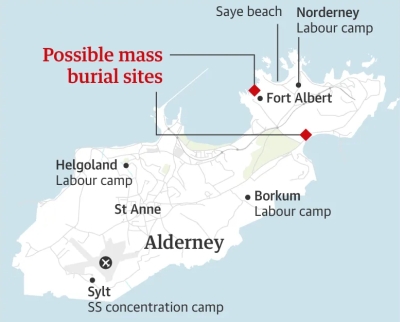
Map showing the locations of the four Nazi camps in Alderney, named after German islands: Sylt, Helgoland, Borkum, Norderney. |
May 22, 2024: An inquiry by Eric Pickles, Baron Pickles, on deaths during the Nazi occupation of Alderney finds that 641-1,027 people died under the "brutality, sadism, and murder" of Nazi rule but that there was no "mini-Auschwitz" on the island.
Sept. 3, 2024: Former chief minister (2007-08) Mike Torode dies.
Nov. 8, 2024: The States votes 20-15 in favour of introducing a goods and services tax, after twice rejecting such plans in 2023. The "GST Plus" package envisions a 5% GST while lowering income-tax rates for earnings under £30,000.
Nov. 16, 2024: In elections to the States of Alderney, 5 independent members are elected (Edward Hill, Iain Macfarlane, Alex Snowdon, Stuart Clark, Kevin Gentle); turnout is 63%. On November 30 William Tate is reelected as president with 64.6% of the vote against 35.4% for Mark Smith; turnout is 51%.
Dec. 11, 2024: Elections are held for 9 of the 18 seats on the Chief Pleas of Sark. Turnout is 66%.
June 18, 2025: In parliamentary elections (turnout 72.1%), independents win 35 seats and Forward Guernsey 3; 2 seats are reserved for Alderney representatives, for a total of 40.
July 1, 2025: Parliament elects Lindsay de Sausmarez as president of the Policy and Resources Committee (chief minister). She receives 22 votes, against 11 for Mark Helyar and 7 for Jonathan Le Tocq. On July 2 Gavin St. Pier, Steve Falla, Charles Parkinson, and Jonathan Le Tocq, all proposed by de Sausmarez, are elected members of the committee. On July 5 St. Pier is elected vice president.
July 21, 2025: Deputy Jonathan Le Tocq is arrested on suspicion of telecommunications offenses. He is soon released but investigations are ongoing and on July 22 he is suspended from the Policy and Resources Committee (P&R). It is subsequently announced that his responsibility for external relations will be shared by the committee; however, on July 28 it is announced that Steve Falla has been assigned the portfolio for the time being. On August 22 Le Tocq is charged with making more than a thousand indecent images of children among other offenses. He resigns from P&R on September 1, forestalling his removal.
August 2025: Sark issues its first postage stamps, under the postal administration of Guernsey. The first issue highlights key moments from the Nazi German occupation and the 80th anniversary of the liberation.
May 12, 2026: Bailiff McMahon says he will retire on August 31. On July 14 the king approves the appointment of Jessica Roland as the first female bailiff. She is sworn in on September 24.
Oct. 2, 2026: A goods and services tax is finally adopted in a 22-17 vote. It will begin at 3% in January 2029, increasing to 5% over four years. It will apply in Guernsey, Herm, and Alderney, but not in Sark.