Rulers: Cocos Islands: History
Cocos Islands
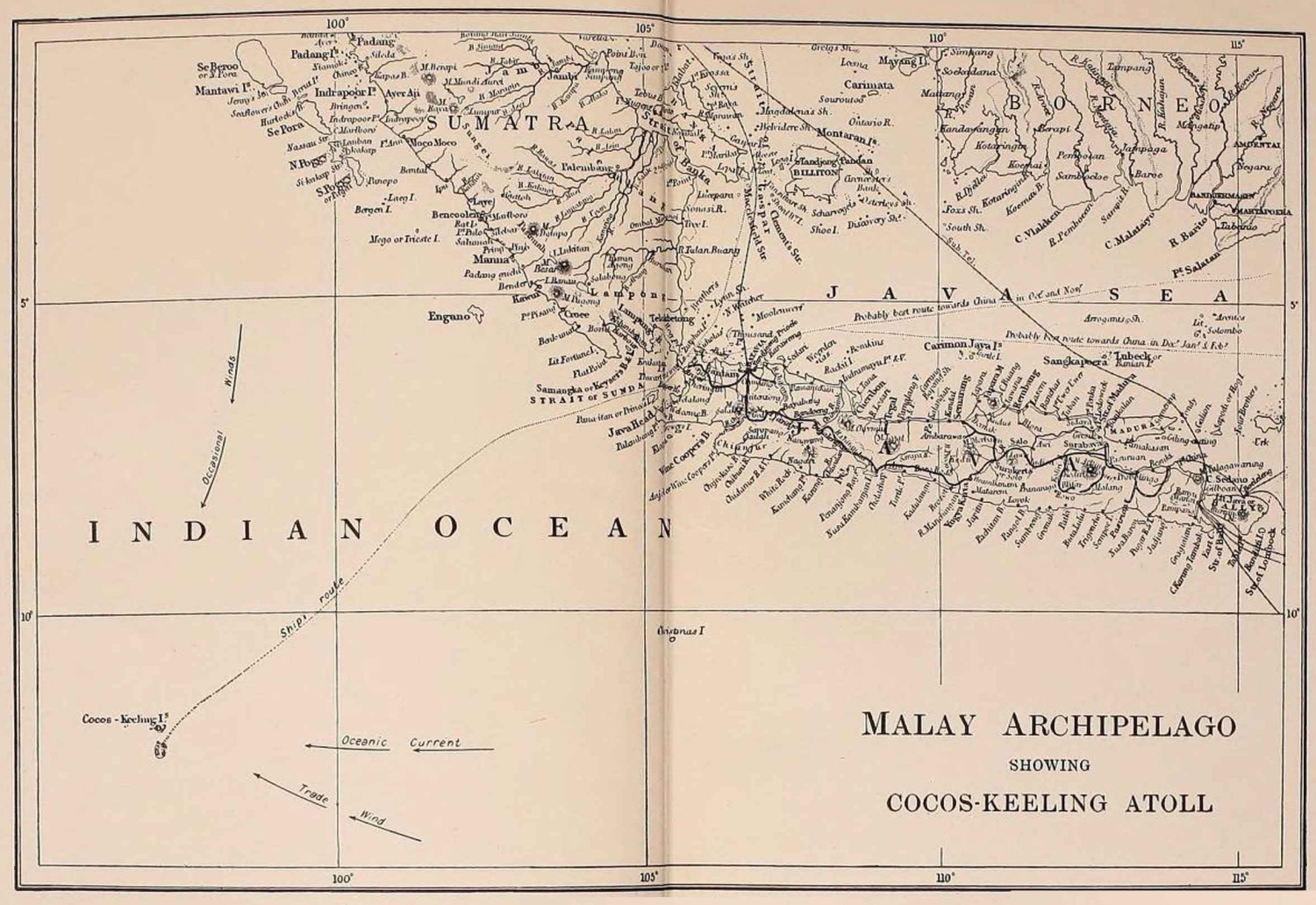
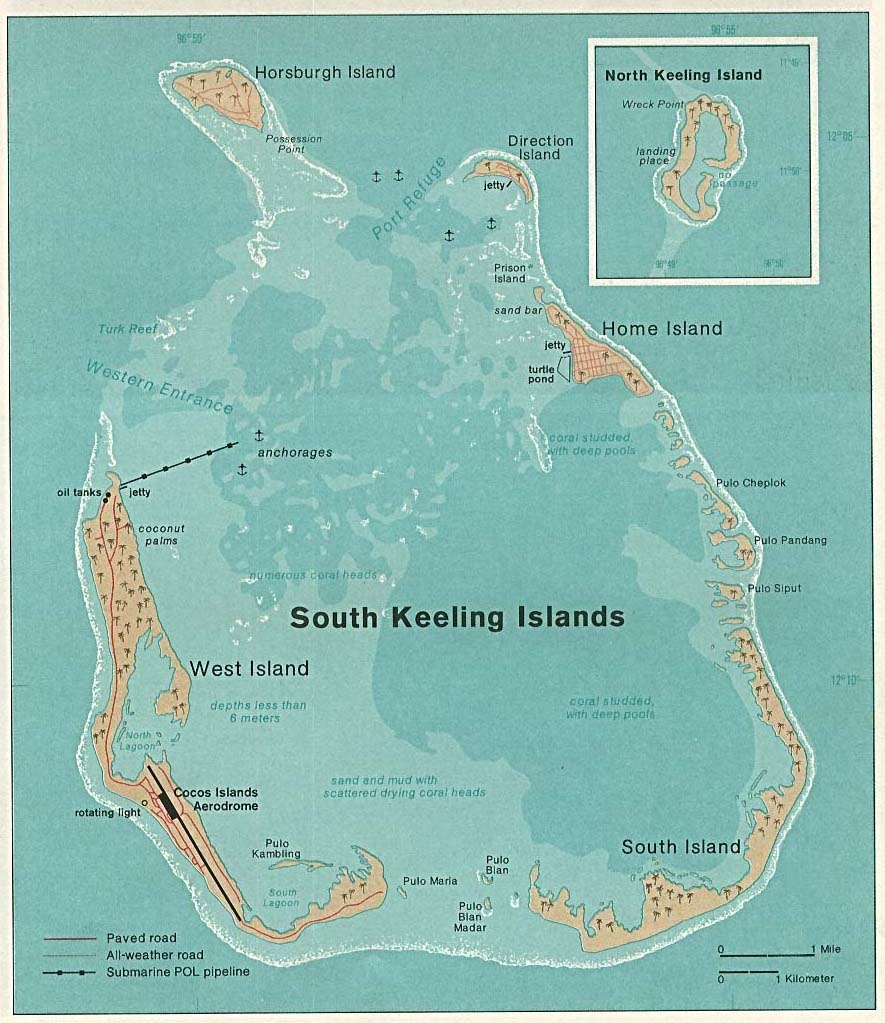
The Cocos (Keeling) Islands (about 27 in number) lie in the Indian Ocean, about 2,900 km northwest of Perth, Western Australia, and 1,000 km southwest of the island of Java, Indonesia. With a total area of only 14 sq km, the islands are strung in a horseshoe curve around a shallow lagoon.
1609: The position of the hitherto uninhabited islands is first accurately plotted by Captain William Keeling (1578?-1620), a mariner of the English East India Company, who is supposed to have sighted the islands, at least the northern atoll, while sailing homeward from Bantam. The northern atoll is subsequently called Keeling's Island, while the southern islands are long known by the name of the Triangular Islands, and the name Cocos is given to them apparently by the Dutch. By 1827 James Horsburgh, the hydrographer to the East India Company (who also names one of the southern islands after himself), unites the two groups of islands in his sailing directory for the region as Cocos or Keeling Islands, and they are variously called one name or the other, and from about 1880 also Cocos-Keeling, or occasionally Keeling-Cocos, Islands.
1631: The islands are correctly placed - though unnamed - in maps published by the Dutch in Amsterdam.
1825: The first settlement, an accidental and temporary one (less than a year), is made by Captain Le Cour and his crew, from the wrecked brig Mauritius, on Direction Island. They carve their names on coconut trees and are ultimately rescued (sometime before November 24 when Captain Driscoll of the Lonach goes ashore on Horsburgh Island and notes the wreckage).
Beginning of June 1826: The first regular settlement is made by an English adventurer named Alexander Hare (b. 1775), formerly British resident (1812-16) at Banjarmasin, Borneo, who brings his Malay harem ("my fiddle faddle which, whether wise or not, I am in the habit of considering necessary") and slaves. He builds a small house to serve as a prison on an insignificant sand bank which becomes known as Prison Island (Pulu Beras), but later lives there himself. He also has settlements on Hare Island (West Island), Horsburgh Island, Direction Island (Pulu Tikus), and Home Island. He has with him an Englishman, James Downie, who acts as a kind of manager or overseer. Downie later gives some account of how Hare ran his affairs: "He kept his people in a sort of pigmy-barrack apartments within the stockades all night. Work was carried on from dawn to dark with half an hour at noon for meal-time. No Sunday was allowed. No private property was allowed for his people, neither movable or immovable, animate or inanimate objects, not even in their own children. These, as soon as out of arms, were brought to Hare's residence, where the boys were confined day and night within a stockade and the girls in a cellarage underneath or adjoining to his sitting apartment, through which the passage led to and from the same. When of age, the former were sent out to work with the men and the latter taken to Hare's couch, whence after a time they were given for wives to men selected to receive them..."
Dec. 15, 1826: The English ship Sir Francis N. Burton is wrecked on the south corner of West Island.
Feb. 27, 1827: Captain John Clunies Ross, a Scottish trader and former employee of Hare, arrives with his family and a party of seamen. In May 1825 Clunies Ross and Hare met at the Cape and made a vague agreement to sail for the Cocos Islands in their respective ships, the Borneo (which Ross himself designed and supervised the construction of) and the Hippomenes, the latter being commanded by John's brother Robert. Clunies Ross arrived Dec. 6, 1825, and waited in vain for the Hippomenes until the 19th, then sailed away for the Cape again, and found that Hare had not long left. After proceeding to London to bring out his family, Clunies Ross set out again for the Cocos Islands and was surprised to find Hare already fully established and playing the role of despot to his heart's content.
November 1827: Clunies Ross raises the British flag over his settlement - moved to South Island (Pulu Atas) in consequence of unfriendly relations with the Hare party which occupies the other islands - and names it New Selma. The early inhabitants also call the islands Borneo Coral Reefs after the vessel.
September 1829: Clunies Ross sends an application for recognition of settlement and incorporation into the British Empire to the governor of Mauritius for transmission to London. The request is refused; the British do not want trouble with the Dutch authorities and foresee difficulties in administering so isolated a settlement.
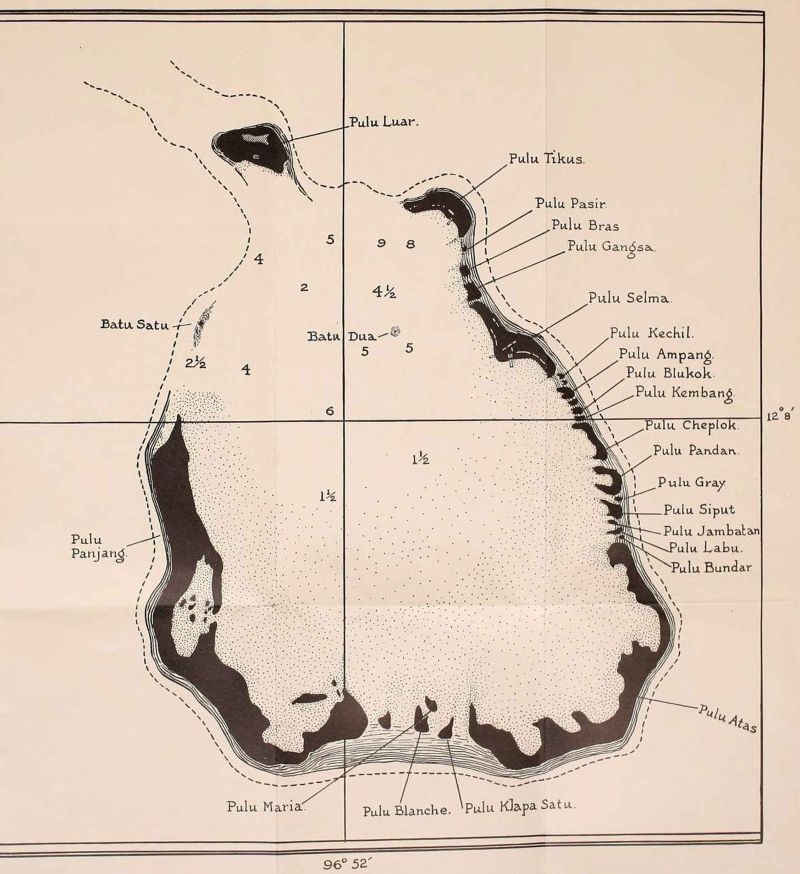
Map showing the Malay names of the islands. |
October-November 1829: A. van der Jagt visits to report on Dutch islands for the Dutch authorities in Batavia (modern Jakarta, Indonesia). He counts 32 islands, named by Clunies Ross so far as they did not have a name before: North or Horsburgh, Direction, Press, Prison, Rice, Button no. 1, Alison, Button no. 2, Ross, Button no. 3, Stewards group, Armstrong, Fairbridge, Goat, Two-Tree, Pool, Scott, Demming or Grave, East Keeling, West Keeling, South, and West or Hare. He reports Hare's group to consist of 36 men, 25 women, and 37 children. New Selma consists of Clunies Ross, his wife and six children, a lady servant, and 13 other inhabitants. At the time of van der Jagt's visit Hare and Clunies Ross are no longer on speaking terms. The Dutch government claims possession in an informal way but the Dutch flag is not flown on Cocos.
March 4-20, 1830: Captain Alexander Arthur Sandilands in HMS Comet visits the islands to report for the British government. Hare reports that "Of old and young men and lads, I have now 32, and about 23 women, besides children and two or three decrepits."
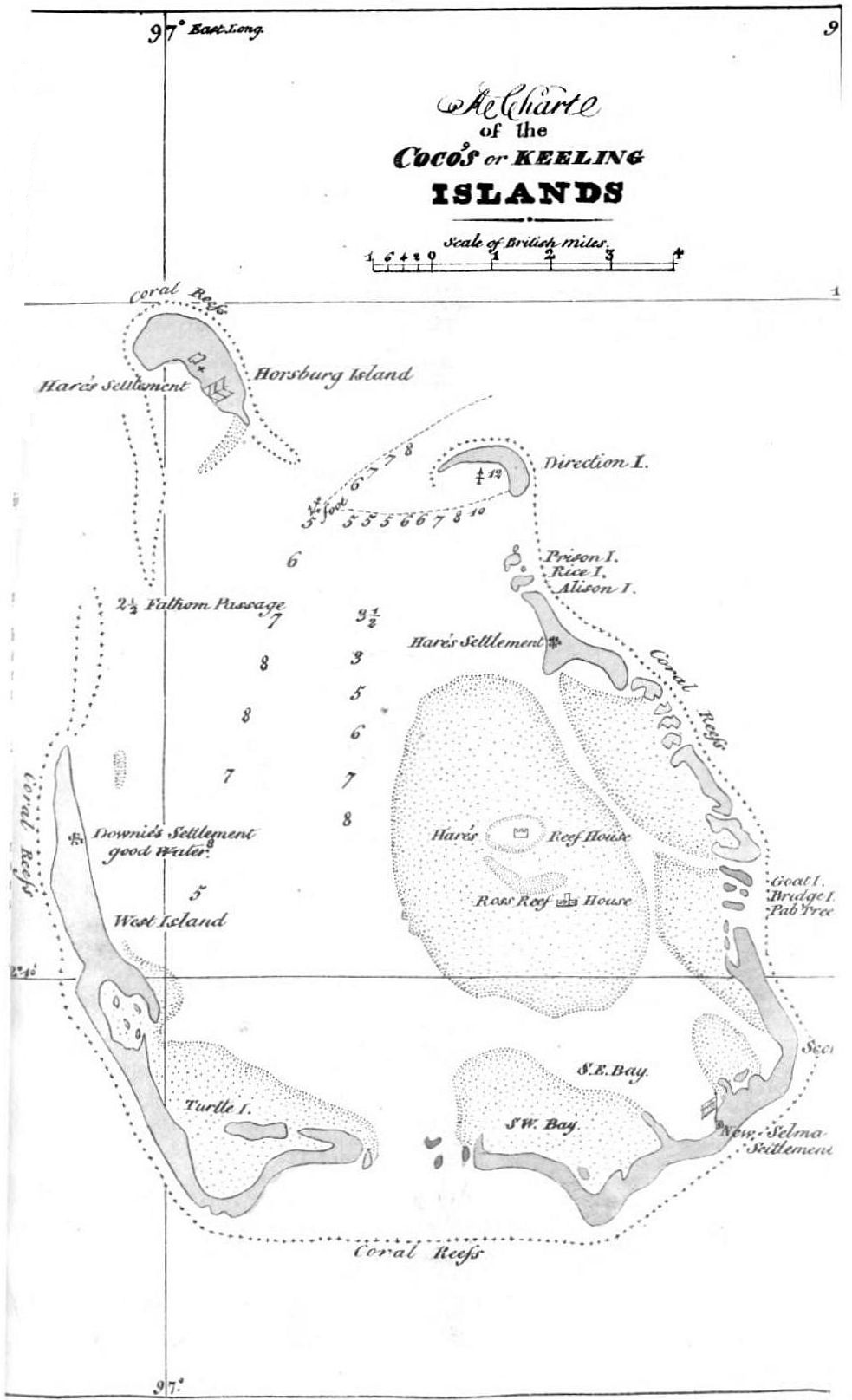
Map from the Hare period. |
March 1831: Hare leaves the islands, his subjects having been dwindling away, those pleading for sanctuary at Home Island not being refused. (He dies, or in any case disappears, some years later. Clunies Ross later claims that Hare died at Bencoolen [modern Bengkulu, Indonesia] Nov. 2, 1834.) Clunies Ross ("Ross Primus") takes possession of all islands. Although he is styled king, his rule is of a more liberal kind.
1833: At about this time Clunies Ross moves his settlement back to what comes to be known as Home Island (Pulu Selma).
June 2, 1834: The British brig Earl of Liverpool is wrecked on the northeastern shore of North Keeling. Her crew is saved.
January 1836: The whaler Trusty comes into the atoll and an American named Joseph Raymond deserts from it. He becomes subject of a petition by Clunies Ross to Adm. Sir Thomas Bladen Capel, naval commander-in-chief, East Indies, in which he calls Raymond a "foreign anarchistical ringleader," who joined with William Leisk, one of the original colonists from the Borneo, in opposing "duly constituted British authority in territory which if not British is at all events not American." Raymond allegedly induced the natives to strike, enlisted other deserters in his cause, and did much damage to the settlement by setting fire to the working sheds and oil factory.
April 1, 1836: British naturalist Charles Darwin arrives on HMS Beagle to make coral-reef observations at the islands. He departs on April 12. Of the settlement he says: "The Malays are now nominally in a state of freedom, and certainly are so as far as regards their personal treatment; but in most other points they are considered as slaves. From their discontented state, from the repeated removals from islet to islet, and perhaps also from a little mismanagement, things are not very prosperous." His notes on the natives are of peculiar interest, and he says: "The houses of the Malays are arranged along the shores of the lagoon. The whole place has rather a desolate aspect, for there were no gardens to show the signs of care and cultivation. The natives belong to different islands in the East India Archipelago, but all speak the same language: we say the inhabitants of Borneo, Celebes, Java, and Sumatra. In colour they resemble the Tahitians, from whom they do not widely differ in features. Some of the women show a good deal of the Chinese character. I liked both their general expression and the sound of voices." Clunies Ross was away at the time of Darwin's visit, and subsequently blames Leisk for the unfavourable impression he gathered.
1837: By this time Clunies Ross has given up his original intention of making the islands a depot for Eastern produce and has turned his attention to the natural products of the atoll. He improves the coconut groves and brings in additional numbers of Malays to assist in harvesting the coconuts for copra. Much of his trade and communications are carried on with Mauritius.
1837: Commander Harding of HMS Pelorus, sent by Admiral Capel, negotiates an apology from Raymond and Leisk, a pardon and expulsion, repatriation of Cocos families who wish to leave, a formal code of law and order, and an increase in wages. A written agreement is dated Dec. 22, 1837.
1837: Population: 138.
1841: The Dutch flag is flown on the Cocos Islands for a time, but the governor-general of the Netherlands East Indies acted without the approval of the home government; the minister for the colonies overrules the decision to claim sovereignty and the flag is removed.
1852: The governor-general of the East Indies reconsiders the question of sovereignty over Cocos but the Dutch naval commander-in-chief opposes the idea and no further action is taken.
May 26, 1854: John Clunies Ross dies at 67. His various writings show him to have been of a philosophic turn of mind, yet he was a man of hard business capacity and of daring activity. He is buried in Home Island and in later years a headstone resembling the Cross of Iona, carved from a block of Scottish granite, is raised over his resting place with the inscription "Ross Primus, First King of the Cocos." Meanwhile he is succeeded by his son John George Clunies Ross ("Ross Secundus"), who was born in London and brought to the islands as a small child in 1827.
March 31, 1857: HMS Juno arrives in the atoll and with the firing of a royal salute, Captain Stephen Fremantle proclaims the islands part of the British dominions. (He is the brother of Captain Charles Fremantle, who took possession of the colony of Western Australia in 1829.) He actually does so by mistake: the islands intended for annexation were the Great and Little Coco Islands located north of the Andaman Islands in the Bay of Bengal. In the face of embarrassing questions from the Netherlands government about the Eastern Seas Treaty, the British Colonial Office for a time favours an apology and a dignified withdrawal from the Cocos Islands, but this view does not prevail. Under British sovereignty, the status of Clunies Ross is naturally altered, he being declared governor, although in practice the change is merely a nominal one.
1863: A cyclone causes severe damage to the settlement. An earlier cyclone is on record for March 1861.
1864: HMS Serpent calls at the islands to conduct a survey of the group and inquire into its affairs. It finds the settlement well on the way to a full recovery.
June 8, 1871: John George Clunies Ross dies after a brief illness, aged about 48. Of quiet and reserved manner, he was engaged in his later years in perfecting the code of island laws compiled by his father. He also became the physician of the islands, despite having no formal medical training. He is succeeded by the eldest of his nine children, George Clunies Ross ("Ross Tertius"), the first locally-born ruler of the islands, who however was educated in Guernsey and Scotland and only returned to Cocos to render assistance in repairing the destruction of the cyclone. During the closing days of his father's reign, trouble broke out among a section of the imported Bantamese coolies, and the disturbances culminated in the murder of a woman, which George sought to avenge. A climax was reached when he faced the alleged murderer, the ringleader of the malcontents, outside the governor's house. When the ringleader made a step towards him, George struck him to the ground with a cutlass, which produced an instantaneous effect on the malcontents. The man was subsequently handed over to authorities in Java. At his father's death, George did not tacitly assume the governorship but called the people together and asked them to elect their ruler; the islanders were not slow to make their choice.
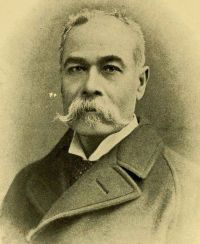
George Clunies Ross. |
1875: George Clunies Ross stops the practice of importing Bantamese convict labour.
Jan. 28, 1876: A severe cyclone with tidal wave accompanied by earth tremor causes heavy damage. Sulphurous liquid wells up in the lagoon killing fish and coral. Four years of modernizing work - including the construction of brick factories for the preparation of coconut oil, sent to Java to be used as lamp-oil - are thus brought to naught. Clunies Ross once again puts all his energies into rebuilding.
Sept. 10, 1878: By letters-patent of this date, and a proclamation in the Ceylon Gazette of November 1878, the Cocos are placed under the governor of Ceylon, "to prevent any foreign power stepping in and taking possession of them for the purposes of settlement or for a coaling station."
1879: Naturalist Henry Ogg Forbes remains for 22 days at the islands. He finds a happy and contented colony on the high road to recovery of its lost fortunes.
1880-88: Beri-beri is a serious problem, causing over 50 deaths.
Feb. 4, 1884: George Clunies Ross sails for Europe on the excellent locally-built schooner J.G.C. Ross, launched earlier in the year. He arrives in London in August; after making arrangements for the care of his children, he sails back.
August 1885: Before the return of Clunies Ross, HMS Espoir arrives at the islands and Ernest Woodford Birch goes ashore to make a thorough examination of the colony on behalf of the government of the Straits Settlements.
August 1886: HMS Zephyr makes a visit of inspection with the object of granting to Clunies Ross new letters-patent dated Feb. 1, 1886, revoking those of Sept. 10, 1878, by which the islands had been placed under the government of Ceylon. On August 24 the new letters-patent are read to the people by A.P. Talbot, the islands now being attached to the Straits Settlements, and a grant-in-fee of the islands is given to Clunies Ross. The indenture of Queen Victoria dated July 7, 1886, grants the islands in perpetuity to the Clunies Ross family, reserving powers to the crown to resume possession of land for "public purposes without making any compensation" and to conduct cable communications.
1888: The native population is 538.
August-October 1888: Naturalist Henry Brougham Guppy remains for 10 weeks at the islands.
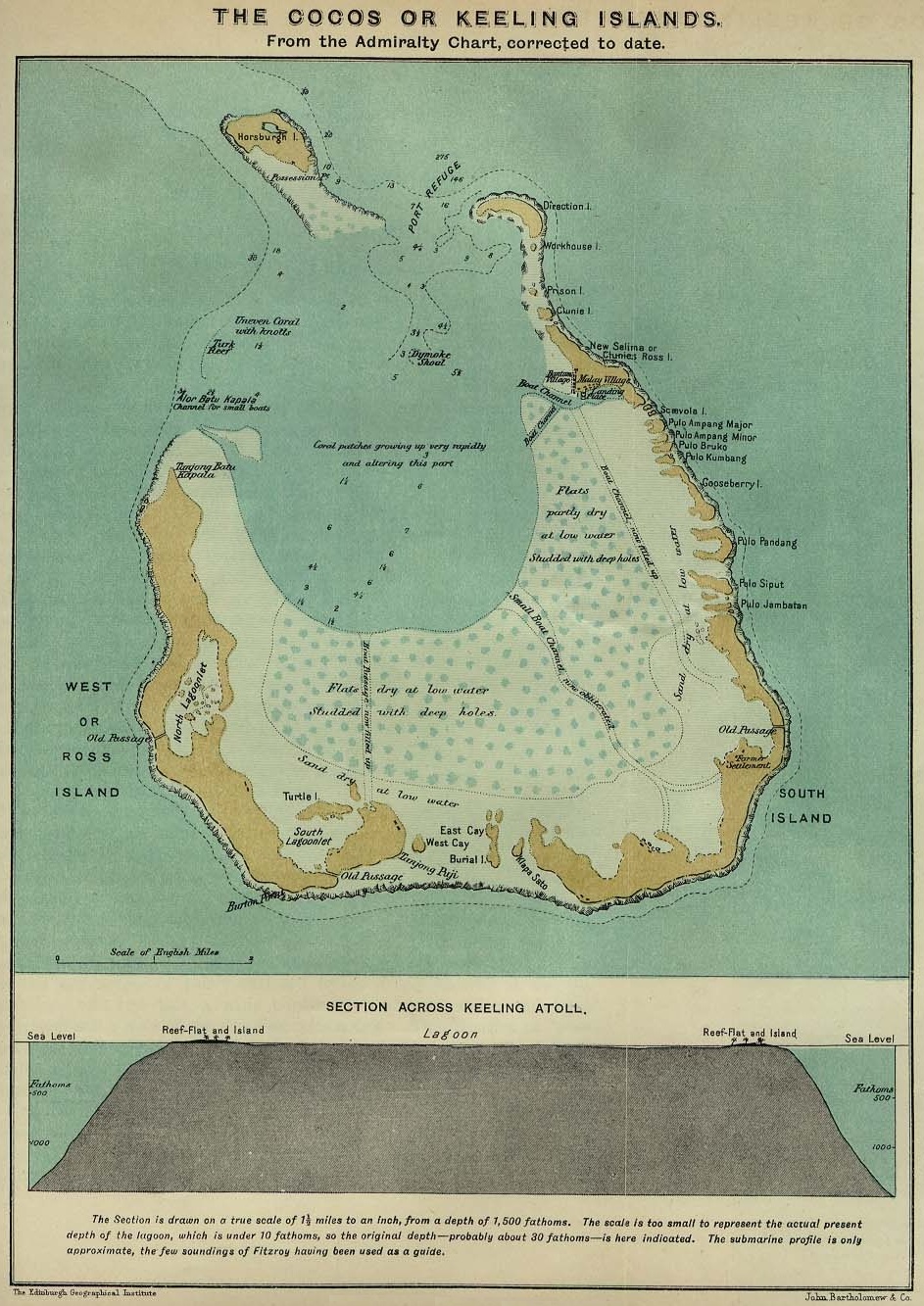
1889 map of the islands. |
November 1888: Clunies Ross takes his brother Andrew and a party of Cocos-born men to Christmas Island. He makes a clearing in the neighbourhood of Flying Fish Cove, builds houses and work-sheds, and lays the foundations of a colony. In 1889 he makes application to the Straits Settlements government for a grant of land there. But as phosphate has been discovered on Christmas Island, he has to give way to external business interests. In 1891 he merely becomes a part owner of a lease of the island.
February 1892: An Italian barque bearing the name Luigi Raffo puts into the atoll in a leaking condition and is soon driven upon the rocks and wrecked. Her crew of 18 soon gives Clunies Ross serious trouble, creating disorder in the villages and becoming a nuisance to the point that he sees no alternative to send them packing. He places the J.G.C. Ross at their disposal, putting aboard a Norwegian captain and eight Cocos-born men. On February 29 they sail from the lagoon; the ship's return is looked for with anxiety, but nothing more is ever heard from her. The belief is that the Cocos men and their captain were put overboard, and the Italians disguised her and sailed away, for when inquiries were made, it was found that the ship named Luigi Raffo was quietly lying in Genoa at the time of her supposed wreck upon the reef of Cocos-Keeling; it appears as though the ship in which the Italians came was a pirated and disguised one.
1893: Oceania House, a two-storied family mansion at the southwest corner of Home Island, is completed.
February 1893: About 30,000 coconut palms are destroyed by a cyclone.
1894: Hugh Clifford, of the Malayan Civil Service, visits Cocos for an official inspection. His report concludes: "Specially have I endeavoured to express my admiration of the extraordinary power of dealing with the natives which Mr. Ross displays. He is at once firm, just, and kind with the islanders, and the fact that he rules a population of some 600 souls with no sort of force at back, that no serious crime has been committed for years, and that he has succeeded in earning and keeping the regard as well as the respect of his people speaks for itself."
1895: The Christmas Island Phosphate Company is formed. The Clunies Ross family is granted a 50% share. The working of the island is taken over by the company in 1897, and the plantations of coffee, bananas, and pepper have to go.
July 17, 1897: The vessel Spray, captained by Joshua Slocum who set out from Boston in 1895 to become the first man ever to sail around the world alone, arrives at the islands. A few days later HMS Iphegenia arrives on an inspection tour among the Straits Settlements, and the presence of two ships gives rise to a considerable celebration. (Slocum completes his voyage in 1898.)
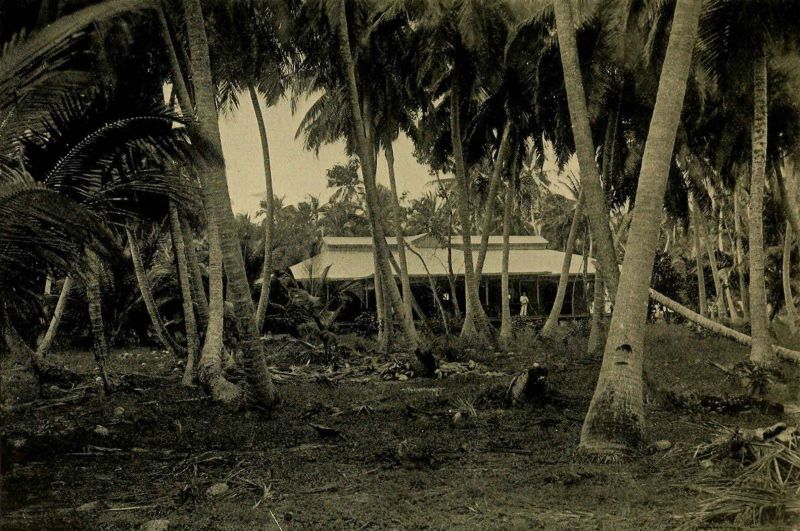
Bungalow of the telegraph station on Direction Island. |
1901: A cable station is established on Direction Island.
March 4, 1902: There is a less violent cyclone; however, an estimated 300,000 palms are destroyed.
July 15, 1903: The Cocos are attached to the British crown colony of Singapore (within the Straits Settlements).
June 1905-September 1906: Naturalist Frederick Wood-Jones works as a doctor on Cocos, marries a Clunies Ross daughter, and later provides a popular account of the natural history and social life on the atoll.
Nov. 27, 1909: A severe cyclone with tidal wave leaves only 5 buildings standing in the settlement. Over 200,000 coconut palms are estimated destroyed.
April 1910: George Clunies Ross, whose ill health has been aggravated by the hardships of the cyclone, sails for England, where he dies on July 7. He is succeeded by his son Sydney Clunies-Ross (Ross IV) - who seems to be the first to commonly hyphenate the name Clunies-Ross.
March 1911: A wireless station to be used for exchanging messages with ships passing the islands is opened.
1912: The Imarat, a local court (without standing under Straits Settlements law), finds the Bantamese labourer Aspin guilty of murder. He and his accomplice are sentenced to death. They are taken out in a barge behind Horsburgh Island, where heavy chains are tied to them before they are thrown overboard to drown. The Colonial Office never learns about the executions until 1938.
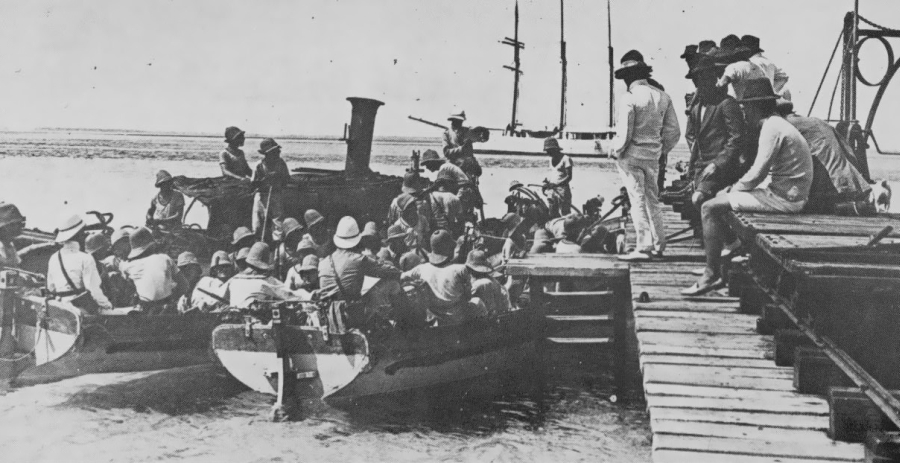
Watched by "enemy" cable staff, German raiding party on Direction Island prepares to escape on the Ayesha, 1914. |
Nov. 9, 1914: During World War I the German cruiser Emden, which landed a raiding party on Direction Island to destroy cable and wireless equipment, is destroyed by the Australian cruiser Sydney on the shore of North Keeling - Australia's first major naval victory. The German raiding party escapes in the Clunies-Ross schooner Ayesha.
December 1918: Following the end of the war, a new wireless mast is erected on Direction Island.
1920: The consolidation of the two sections of the kampong (village area) is completed.
1920-22: Copra prices plummet. From 1922 to 1929 the estate operates at a loss.
1926: A new, more modern cable is laid from Cocos to Australia.
April 1, 1931: The census of Malaya includes Cocos and gives the Malay population as 1,082 (551 male, 531 female).
Dec. 21, 1936: One Llewelyn Wynn-Williams writes to the Anti-Slavery and Aborigines Protection Society, asking them whether the state of affairs described in an interview with Clunies-Ross published in the London Daily Sketch on December 15 "constitutes a state of slavery." The Society approaches the Colonial Office and asks for an assurance that there is no truth in the account of Clunies-Ross's autocratic powers and use of the whip. He was quoted in the paper as saying: "There are no prisons in the Cocos Islands, and when my stick is ineffective, a whip is sufficient to restore order. The Malayans are all natural thieves and liars, but to control them is not difficult." The reply of the Colonial Office is evasive, as it has no recent information about conditions on Cocos.
1936-41: 186 Cocos Malays emigrate to Singapore.
1937: A formal inspection is carried out by the Christmas Island district officer, G.W. Webb. He reports: "I am quite convinced that the islanders form a happy and peaceful community, quite contented with their lot... Mr. Ross is in a way an autocrat, but a beneficent one. And his hand rests so lightly on his people that they do not feel it... If someone less scrupulous than Mr. Ross were in command, of course, there might be a different story to tell." The Colonial Office, however, recognizes as objectionable features "the complete autocracy of Mr. Clunies-Ross and complete dependence on him of every man woman and child in the place; presumably no means of escape if any Islander did want to leave the realm of Mr. Clunies-Ross, and no money or other resources to enable a new start to be made outside the Islands; no education, no laws, and no redress for any injustice, real or imaginary." It is decided to investigate the possibility of regularizing Clunies-Ross's rule and to have periodic visits of inspection. When the new Christmas Island district officer, Richard Broome, meets Ross on Cocos in November 1938, the latter flatly tells him that he does not want any powers from Singapore, because "he does not regard us as having any jurisdiction in his domain."
March 19, 1940: At a conference at the Colonial Office, Clunies-Ross repeats his aversion to "interference from Singapore" and says that he is "afraid that the proposed measures might affect his prestige in the eyes of his local people." On April 24 Clunies-Ross has a meeting with the Anti-Slavery Society.
1940-41: Zoologist Carl Alexander Gibson-Hill serves as a medical officer on Cocos and makes the most detailed and comprehensive observations, leading to extensive publications on the natural history of the atoll and the social customs of its inhabitants. He writes: "In 1941 the mood of the people in the kampong was to take what was given to them, and do without what was not. The whole place had an aura of decay... The stores and even the owner's house seemed to be decaying quietly and unobtrusively... The settlement was an aged person, slowly slipping out of life, and nearly content to see it go."
1941: Population: 1,450.
March 1941: In World War II, Cocos is garrisoned by a detachment from the Ceylon Garrison Artillery based with their battery at Horsburgh Island, and a platoon of Ceylon Light Infantry based at Direction Island in defense of the cable station.
March 3, 1942: A Japanese cruiser shells Direction Island from close range.
Night of May 8-9, 1942: A mutiny by Ceylonese soldiers on Horsburgh Island fails. Three of the men are later executed in Ceylon.
July 1, 1942: Following the fall of Singapore in February, the islands are placed under the governor of Ceylon.
Aug. 5, 1944: A Japanese plane attacks Home Island, killing two people and destroying about 30 houses. Clunies-Ross, deeply shocked, his credibility as protector of his people shattered (he had promised the Japanese would not attack Home Island), dies on August 14. Just three days later, a military administrator, Lt.Col. John Edward Bendelow Jessamine, is appointed, who is directed to "maintain the existing system of administration as far as possible." He arrives on September 1.
1945: At peak there are 8,300 military personnel at Cocos.
Feb. 18-May 31, 1945: Commander G.M.L. Williams of the Royal Navy Volunteer Reserve is military administrator.
March-May 1945: British forces construct an airstrip on West Island.
July 28, 1945: Lt.Col. E.M. Jones-Lloyd succeeds Lt.Col. John Allen Harvey as military administrator.
Sept. 22, 1945: The deposed Japanese-backed sultan of Selangor, Musa Ghiathuddin Riayat Shah, is flown into Cocos. He leaves in early May 1946.
January 1946: Population: 1,626.
February 1946: The airstrip is closed; all remaining troops (about 3,160) are withdrawn from April 7 to May 24. The military occupation period brought temporary prosperity to the Home Island community, but the underlying economic and demographic problems remain. There are simply too many people on Cocos to be supported by the copra industry. However, as a result of their wartime experiences, the people have reached a higher level of sophistication and material and social expectation than ever before.
April 1, 1946: The Straits Settlements are dissolved, Singapore (including Cocos) becoming a separate colony. On April 3 civil administration is reestablished, and a resident administrator, David Alford Somerville, responsible to the governor of Singapore is appointed. There are several changes in the post in subsequent years.
July 6, 1946: John Cecil Clunies-Ross (Ross V), who was being educated in England at the time of his father's death, returns to Cocos with his mother, Rose (who in 1945 was appointed trustee of the estate), on board HMS Swiftsure.
Early 1947: Rose Clunies-Ross raises the subject of emigration, saying she wants 800 people to go. This admission that the family is unable to provide for its people undermines the legitimacy of Clunies-Ross rule.
1948-51: Due to the depressed state of the islands' economy, over 1,600 islanders move from the territory at the expense of the Clunies-Ross estate and the Singapore government, some going to Christmas Island and Singapore but most electing to go to British North Borneo. The Home Island population is reduced from 1,802 at the beginning of 1948 to 374 in January 1952. One of the four mosques is closed permanently.
June 21, 1949: The British high commissioner in Canberra conveys the formal response to an Australian request about using the Cocos airstrip. Whitehall considers that improvements to the airstrip to a standard required for a scheduled international service are of no interest to it in the foreseeable future. It sees no objection in principle to the use of the airstrip by Qantas Empire Airways, should the Australian government be willing to make the necessary improvements.
Nov. 28, 1949: With his 21st birthday, John Cecil Clunies-Ross comes into his Cocos inheritance.
Aug. 24, 1950: The acting Australian prime minister raises the possibility of transfer of sovereignty, writing to the British prime minister: "I feel that the limited nature of Australian control which you would be willing to concede should we decide to proceed with the investment required to reestablish the airstrip scarcely corresponds with the substantial nature of this investment. In the circumstances it would be appreciated if the statement of your government's position as conveyed by your high commissioner on June 21, 1949, might be reconsidered. The Australian government is prepared to contemplate assuming a wider measure of responsibility for a group of islands which are of considerable strategic importance to our country. In fact the most satisfactory solution from our point of view might well be the transfer of sovereignty over these islands to Australia."
September 1950: Roderick MacLean, of the Malayan Civil Service, arrives on Cocos as administrator, serving until December 1951.
Sept. 18, 1950: The Australian Daily Telegraph runs a large article headlined "Cocos is valuable airport in peace and war." It claims that the Korean War has made the British see the necessity of getting the island base in the Indian Ocean into use again: "In World War III, Cocos could become a giant aircraft carrier in the Indian Ocean - as Malta was in the Mediterranean in the last war." The same newspaper reports on October 19 a statement from the Australian minister for air in which he says that the Clunies-Ross family has refused permission because "it wished to keep the island isolated from the rest of the world."
June 22, 1951: The British colonial secretary, James Griffiths, announces in a parliamentary written answer that the Cocos Islands will be transferred from British to Australian control at the request of the Australian government. The colonial secretary states that the Australian government recently expressed the wish to develop for civil aviation purposes an airstrip constructed in the Cocos Islands for the Royal Air Force during World War II, and that, in view of the strategic advantages which would accrue to the Commonwealth as a whole from the development of the airstrip - which would involve substantial expenditure by the Australian government - the U.K. government, after consultation with the government of Singapore, agreed that the islands should be transferred to Australia. After recalling that the islands had been leased by the crown in 1886 to George Clunies-Ross and his successors in perpetuity, the statement adds that the transfer from British to Australian control will not impair the title of the leaseholder; that in recent years a considerable number of the 1,200 inhabitants, most of whom are Malays, expressed the desire to emigrate since the islands are overpopulated; that emigration to North Borneo has been proceeding since 1948 under arrangements made between the Singapore and North Borneo governments; that it is intended that all inhabitants wishing to emigrate shall have the opportunity of doing so before the transfer to Australian control; and that the Australian government has agreed to enact legislation giving Australian citizenship to those electing to remain on the islands after the transfer.
July 30, 1951: The Commonwealth Relations Office recommends to the Australian government "the use in future of the title 'Cocos (Keeling) Islands.' This has the advantage of avoiding the possible confusion with the other group of 'Cocos' Islands in the Bay of Bengal. It would also do something to relieve the anxiety of Mr E.H. Keeling, MP, who is anxious to perpetuate the memory of that ancestor of his who, as you are doubtless aware, first discovered these islands."
Aug. 21, 1951: The Australian minister for civil aviation announces that the commonwealth government has approved capital expenditure of A£690,000 for the modernization of the wartime aerodrome, and the provision of facilities for a regular passenger service between Australia and South Africa which Qantas Empire Airways hopes to open by March 1952, and which is to link Perth with Johannesburg via the Cocos Islands and Mauritius.
Aug. 25 and 26, 1951: The governor of Singapore (where there was some press comment during July about the failure of the British government to consult the islanders or to adequately consult the Singapore Legislative Council about the transfer, and about the future status of the islanders if they wanted to enter Australia), accompanied by the Australian commissioner in Singapore, Tom Critchley, and others, visits Cocos. The governor's party meets with headmen from the Clunies-Ross estate on Home Island to make sure that they understand the reason for the transfer to Australia and to discuss the emigration of those who want to go to North Borneo. He explains that the king of England is also the sovereign of Australia, so that, while the government will be different, the king will be the same. The headmen think that the king can do whatever he wishes and that they will go along with his wishes.
Nov. 2, 1951: Clunies-Ross signs an agreement to sell 149 ha on West Island to the Australian government for the construction of an international-standard airfield.
Late 1951: At this time only Oceania House, the administrator's house, and the "Toko" (estate store) have electricity. There is still no sewerage system.
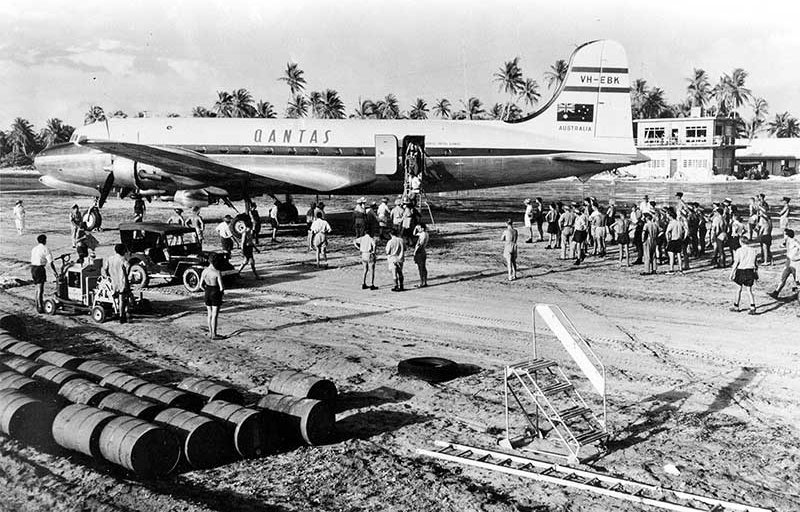
New airfield under construction, 1952. |
July 26, 1952: The new runway, 3,000 m long, is completed.
Sept. 1-4, 1952: Qantas Empire Airways makes its inaugural flight from Sydney to South Africa via Cocos.
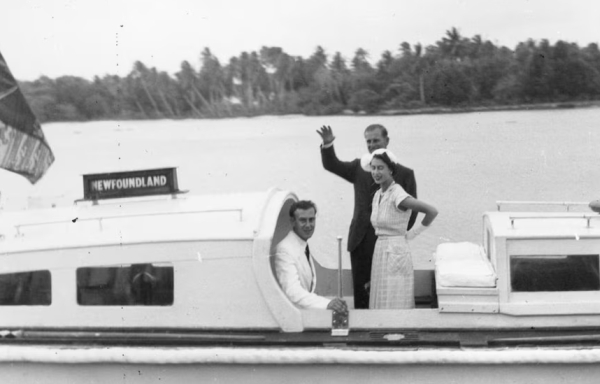
Prince Philip waves goodbye as he and Queen Elizabeth II, accompanied by John Cecil Clunies-Ross, return to their ship from Home Island, 1954. |
April 5, 1954: Queen Elizabeth II and the Duke of Edinburgh visit the islands on the yacht Britannia.
Nov. 2, 1954: The Cocos (Keeling) Islands (Request and Consent) Bill is introduced in the Australian House of Representatives. The reason for this is that the Statute of Westminster (1931) provides that "no Act of Parliament of the United Kingdom passed after the commencement of this Act shall extend or be deemed to extend to a Dominion as part of the law of that Dominion unless it is expressly declared in that Act that that Dominion has requested and consented to the enactment thereof." The bill is passed with little debate, and assented to on November 18.
March 29, 1955: The United Kingdom's Cocos Islands Bill is enacted.
June 8, 1955: The Cocos (Keeling) Islands Bill is introduced into the Australian parliament. It is again passed with little debate, and assented to on June 16. During the passage the minister for territories, Paul Hasluck, states that the rights of the Clunies-Ross family (the traditional rulers of the islands) will remain unaltered; that Singapore laws in force at the time of the transfer will be continued; and that the Malay institutions, customs, and usages of the islands will be preserved.
Nov. 23, 1955: The islands pass from British Singapore to Australia pursuant to a British order-in-council of October 28 and an Australian governor-general's proclamation of November 3. Lieutenant-Commander Harold James Hull, of the Royal Australian Naval Reserve, is appointed official representative by the Australian government, to govern the islands under instructions from the minister for territories. The islands are officially referred to as the "Territory of Cocos (Keeling) Islands."
Nov. 16, 1957: A petition by almost the whole male population of Home Island to Representative Hull asks for the removal of the estate manager Patrick Keegan. He leaves a few days later. The position of estate manager is filled by Gerry Clunies-Ross, a distant cousin of John Cecil, from 1958 to 1963, being then succeeded by Jim Dixon.
1958-59: 111 discontented Home Islanders emigrate to Christmas Island. The Home Island population drops from 481 at the end of 1957 to 407 in mid-1959.
1961: Clunies-Ross introduces the birth-control pill to the islanders, slowing population growth.
1962: By this time a local broadcasting station, VKW ("Radio Cocos"), is in operation.
June 30, 1963: The Cocos Islanders living on Home Island number 453.
July 31, 1966: The Direction Island cable station closes and telecommunications are transferred to West Island.
Late 1966: The runway is re-surfaced to enable Cocos also to handle the passage of Boeing 707 aircraft.
March 28, 1967: The last Australia-to-South Africa commercial flight passes through Cocos (aircraft now being able to fly the route nonstop) and is replaced by a chartered "milk run" between Perth and Cocos operated every three weeks by TAA and Ansett-ANA.
June 30, 1967: Population: 631, comprising 480 Cocos Malays and 151 Europeans.
Jan. 21, 1968: Cyclone Doreen devastates Cocos, destroying 67,000 coconut palms.
June 30, 1971: The population of Home Island is 497, comprising 493 Cocos Malays, Clunies-Ross, Jim Dixon, his wife Anne, and their infant daughter.
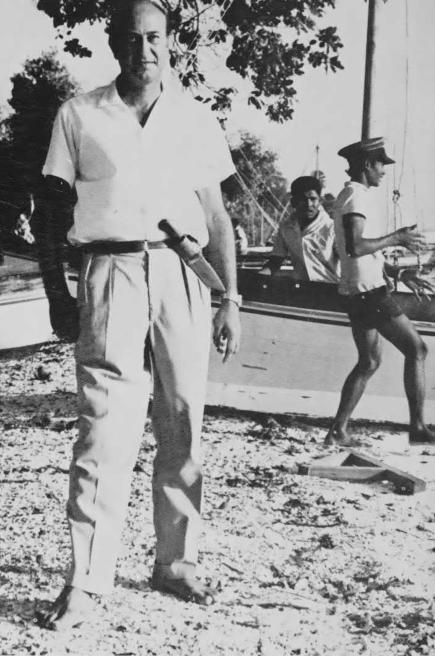
John Cecil Clunies-Ross at Home Island, 1972. |
Aug. 30, 1972: The Australian and its tabloid stablemate Daily Telegraph publish front-page stories quoting from two reports in the files of the Department of External Territories. Both reports are critical of conditions in the domain of Clunies-Ross. The earlier report was written by the administrator of Christmas Island in 1970 and recounted complaints by Christmas Island Cocos Malays about conditions on Home Island. The other report was by Alan Kerr, a senior officer in the department who had visited Cocos in November 1971 to talk to Clunies-Ross about a range of matters including "commonwealth interference." Kerr wrote about the relationship between Clunies-Ross and the Cocos Malays: "Although they appeared happy and contented they seemed to me to be very servile... Mr. Clunies-Ross and his manager and their wives seemed to me to go about their affairs as though no one else existed on the island. I must say that I could not help but liken the situation to what I would imagine life would be like for slaves on the estate of a benevolent slave owner in Southern America." Clunies-Ross, who regards himself as absolute sovereign over the inhabitants, whom he restricts from leaving and pays as little as A$2 a week, expects the Australian government either to buy him out (with an eight-figure sum) or to leave the islands to independence under his rule.
April 1973: Australian minister for external territories William Morrison visits Cocos. In a press statement in Canberra on April 17 he says: "I found not so much a closed, as a closed-off society. Its essential character is the intertwining over generations of the Cocos Malays and the Clunies-Ross family and this interdependence is accepted by both." He says conditions "would have to be worked out to ensure an ultimate objective of self-government for the community... Such arrangements would necessarily involve the election of representatives responsible to the community."
June 30, 1974: Population: 643 (Home Island 520, West Island 123).
August 1974: A UN mission visits the territory at the invitation of the Australian government. One worker, Bilton bin Nickery (1946?-2010), says Clunies-Ross told the people to tell the UN mission they were happy; others disagree but admit that about 10% of the community is discontented about the situation on the estate. In November the mission issues a report strongly criticizing what it calls the "anachronistic and feudal" relationship between Clunies-Ross and the Cocos Malay community. In its recommendations the report inter alia stresses the need to devise appropriate means to end the links between the Clunies-Ross estate and the affairs of the Cocos Malay community, to clarify the precise role of Clunies-Ross in the territory, and to define clearly the political status of Home Island in relation to the Australian government. It also urges the latter to democratize the political life of the territory, and to take all necessary measures to enable the people to understand their political status with a view to being able freely to express their true wishes and aspirations regarding their future.
Early 1975: The status of the islands is discussed with Indonesia and Singapore.
Early 1975: Dubney bin Bohin (b. 1924), who migrated to Christmas Island in 1951 and moves easily between the Malay and European worlds, returns to the Cocos Islands and provides a cutting edge for Home Island dissidence, although Clunies-Ross does not allow him to set "half a foot" there and he never leaves West Island during his stay.
May 20, 1975: It is announced that Australian representation in the territory will be upgraded with the creation of the post of administrator, that Robert James Linford will be the first administrator, and that Dubney will be his adviser on Home Island affairs - an appointment against which Clunies-Ross immediately protests. The change becomes effective on July 23 when the Official Representative Ordinance 1955-61 is repealed and replaced by the Administration Ordinance 1975.
September 1975: The Labor government of Gough Whitlam introduces an ordinance in the Australian parliament establishing the legal basis for the territory's acquisition. However, an offer made to purchase the islands for A$3,500,000 is rejected by the owner, John Cecil Clunies-Ross, who is reported to have asked for A$30,000,000.
Oct. 16, 1975: An Interim Advisory Council, chaired by the administrator, holds its first meeting. In November several members resign after Clunies-Ross (having hardened his position after the fall of the Whitlam government) insisted that no one could be loyal to him and serve on the Council also.
1976: As in 1958, the Australian government helps Clunies-Ross solve the problem of a dissident group by assisting them to emigrate. However, officials reaffirm their intention to carry through the takeover of the estate, and protracted discussions begin.
June 16, 1977: The Australian government announces a number of policy decisions aimed at ensuring the political, social, and economic advancement of the Cocos Islanders. The major decisions are that the inhabitants of the territory shall have the right to their own land on Home Island; that there shall be a form of representative local government; the principle of freedom of movement and association is endorsed without reservation; there shall be improvement in education and living standard generally; and provision of Australian citizenship to all residents wishing to become Australian citizens be simplified.
June 30, 1977: Population: 444 (Home Island 319, West Island 125).
November 1977: Linford and Dubney leave Cocos. On November 16 Charles Ivens Buffett takes office as administrator, Dubney's replacement being Hawkins bin Bytol, who soon creates a stir with his Cocos Malay radio programmes.
March 18, 1978: The first elections are held to the Interim Advisory Council.
July 2, 1978: It is announced that Clunies-Ross is to sell his plantations and relinquish his authority over the islands to Australia for A$6,250,000. The territory's economy is almost entirely dependent on the production and export of copra grown by the Clunies-Ross estate, this being virtually the sole source of employment for the Cocos Malay population of about 350. Although the Australian dollar is the territory's legal currency, the estate labourers are paid in a local currency, the rupiah, which is only exchangeable at a company store. Wages were paid in plastic tokens until November 1977, when a metal coinage was introduced bearing the effigy of the first Clunies-Ross. The entire Cocos Malay population lives on Home Island, the headquarters of the Clunies-Ross estate, while all the approximately 100 Europeans, with the exception of the Clunies-Ross family, live on West Island, which is the territory's administrative centre. The transfer takes effect on September 1, Clunies-Ross retaining his family home (Oceania House) and surrounding grounds on Home Island (approximately 5 hectares in total). He acts as interim manager of the copra plantation to Jan. 31, 1979. Australia introduces Australian currency and takes steps toward establishing Cocos Malay self-government.
Jan. 16, 1979: The Cocos Islands Co-operative Society Limited is registered. It will conduct the business enterprises of the Cocos people: copra production, building maintenance and construction, stevedoring and lighterage services, retailing, provision of accommodation, and catering services.
June 30, 1979: Population: 560 (Home Island 310, West Island 250).
July 25, 1979: The Interim Advisory Council becomes the Cocos (Keeling) Islands Council. On July 29 ownership of the village area of Home Island is transferred to the Council to be held in trust for the residents.
Sept. 3, 1979: The Cocos Islands Postal Service, including a philatelic bureau, is established. Revenue from the service is to be used for the benefit of the community.
Oct. 20, 1979: The second Cocos (Keeling) Islands Council is elected.
1980: Legislation providing for compulsory education for 6- to 15-year-olds is introduced.
March 1980: The Council resolves to construct and conduct a museum. The administrator consents in June, and the museum building is completed in 1981.
1981: A high-security animal quarantine station commences operation on West Island. Farm animals imported into Australia must spend a quarantine period there before entering the mainland.
June 30, 1981: Census population: 555 (males 298, females 257), including Cocos Malay 320, European 143. The ethnic division correlates largely with the religious one: Muslim 314, Christian 124.
Oct. 17, 1981: Elections to the third Council are held. Members are: Wahin bin Bynie (chairman), Not bin Geba (deputy chairman), Chongkin bin Sebie, Blacket bin Sloan, Lakina bin Neville, Saraya bin Watson, Keegan bin Haig, and Zabeneh binte Alpan (secretary).
1983: The islanders begin to press for a decision to be made about their future. The government is still involved in a court battle to gain possession of certain property that Clunies-Ross retains on the islands, but the inhabitants ask Australia to organize an act of self-determination under UN auspices.
Oct. 22, 1983: Elections to the fourth Council are held. The elected councillors are Parson bin Yapat (chairman), Wahin bin Bynie (deputy chairman), Rabuhu bin Anthoney (secretary), Mocksen bin Satar, Alpan bin Puria, Batte binte Liedie, Omal bin Ebnue.
April 6, 1984: The UN supervises a referendum in the Cocos Islands in which 231 islanders vote in favour of integration with Australia, compared with 21 who vote for free association and 9 for independence (which Clunies-Ross campaigned for). The referendum was observed by a team of four from the UN Committee on Decolonization. Its leader was Ambassador Abdul Koroma of Sierra Leone. They criticize the Australian government for failing to inform islanders adequately of the choices facing them, given the high rate of illiteracy that exists in the islands. The government made a commitment to raise services and standards of living to comparable mainland Australian levels as soon as possible but in no more than ten years, that is by 1994. The Commonwealth Grants Commission was selected as the independent arbiter to monitor progress in achieving this goal. Cocos Islanders subsequently can vote in Australian federal elections as part of the Northern Territory electoral division (from 2001, the Lingiari division, which includes all of the Northern Territory except the Darwin area).
Sept. 18, 1984: Australia deeds most of the territory's area to the Council to hold in trust for the benefit of Home Islanders. The land trust thus comprises almost 85% of the area of the South Keeling Islands, with 15% being crown land and a negligible proportion (3 ha) private freehold on West Island.
October 1984: The High Court in Canberra rules that the Australian government is not empowered to make a compulsory purchase of the remaining land on the islands belonging to Clunies-Ross.
Oct. 22, 1985: The fifth Council is elected: Parson bin Yapat (chairperson), Cree bin Haig (deputy chairperson), Wahin bin Bynie, Bika bin Bynie, Not bin Geba, Rabuhu bin Anthoney, Alpan bin Puria.
November 1985: John Cecil Clunies-Ross leaves the islands to reside in Perth, Western Australia. His son John George ("Johnny"), who would have become the sixth "king of Cocos," still resides on West Island in 2015.
1986: The Grants Commission issues a report. Following its consideration and extensive consultations with the Cocos community and its legal representatives, the government agrees on a package of changes to bring standards and conditions on Cocos into line with mainland standards.
June 30, 1986: Census population: 616 (West Island 414, Home Island 202).
1987: The copra industry is declared unprofitable. Copra production ceases in 1988.
March 7, 1991: The Australian prime minister and leaders of the Cocos Island community sign a memorandum of understanding which sets out the range of measures required to achieve equivalent standards of living in the territory.
June 30, 1991: Census population: 647. About two-thirds of the population live on Home Island, one-third on West Island.
July 1, 1992: The Territories Law Reform Act comes into effect by which the Australian government applies Western Australian laws to the Cocos (Keeling) Islands. The Local Government (Transition) Ordinance 1992 establishes the Shire of Cocos (Keeling) Islands by absorbing the Cocos (Keeling) Islands Council. It is to operate as if it were a Western Australian local government.
September 1992: A television service, broadcasting Indonesian satellite television programmes and videotapes of Australian television programmes, begins operating on an intermittent basis.
May 1, 1993: In the first full election to the new Shire, seven councillors are elected: Ibram bin Not, Haji Zaitol bin Wallie, Woren bin Dedian, Balmut bin Pirus, Ronald James Grant, Haji Wahin bin Bynie, and Amatnoor bin Anthoney. Grant becomes president and Zaitol deputy president.
Mid-1993: The Clunies-Ross family is declared bankrupt, following unsuccessful investment in a shipping venture, and the Australian government takes possession of the remaining property of Clunies-Ross, known as Lot 14 on Home Island.
Deecmber 1995: As the location of several rare ecosystems - including an intact coral atoll environment - North Keeling Island and its surrounding waters are designated a protected area, Pulu Keeling National Park. The area has one of the largest breeding colonies of red-footed boobies in the world and is also important for frigate birds, common noddies, and white terns, as well as the endangered subspecies the Cocos buff-banded rail. Public access to the park is strictly controlled.
June 30, 1996: Census population: 655 (males 338, females 317). About 80% are residents on Home Island. The 130 remaining residents live on West Island, where the main commonwealth facilities, including the airport, are located. They are mostly Australians from the mainland on two- or three-year postings.
Oct. 1, 1997: Ron Harvey takes office as administrator of both Christmas Island and the Cocos Islands, known together as the Australian Indian Ocean Territories. Henceforth the two territories share a single administrator, based at Christmas Island. He is assisted by two official secretaries, one in each territory (for Cocos, Maureen Ellis 1997-98, Chris Nagel 1998-99, and Debra Blaskett 1999-2000), but in the early 2000s that position is also unified and based on Christmas Island.
1998: Census population: 621.
May 1999: Election turnout is 85.4%.
2000: A clam farm is established.
Early 2000: The islands' Internet domain name suffix (".cc") is sold to Clear Channel, a U.S. radio group, thus providing additional revenue.
August 2000: The Australian government determines that its preferred long-term solution for the Indian Ocean Territories is their incorporation into an existing state or territory, with Western Australia as the preferred option, and that their institutional frameworks should be aligned with those of remote communities on the mainland.
2001: An estimated 19% of the total labour force is unemployed, 60% of whom are under the age of 30. The Shire and the Co-operative Society are the principal employers. The conversion of a disused quarantine station into a business centre is under consideration.
May 2001: Election turnout is 76.3%.
Aug. 7, 2001: Census population: 621 (males 334, females 287).
September 2001: Following an increase in the numbers of illegal immigrants reaching Australian waters (see Christmas Island), legislation is enacted removing the Cocos Islands and other territories from Australia's official migration zone. In October the Australian government sends contingency supplies to the islands as a precaution, should it be necessary to accommodate more asylum seekers. This development provokes concern among many Cocos residents that the former quarantine station used as a detention centre might become a permanent asylum-processing facility under the order of the Australian government. In December, 123 Sri Lankan and Vietnamese asylum seekers are housed at the station, which was built to accommodate only 40. They are transferred to Christmas Island in February 2002. The government admits that the establishment of an asylum-processing facility on Cocos might become necessary.
2001-02: The administration and the Shire provide support for a study investigating the potential economic benefits of various coconut products, including the production of high-quality carbon from coconut kernels and the manufacture of furniture from coconut palm wood. By 2002 the Cocos Islands no longer export any goods or produce.
May 3, 2003: Election turnout is 82.1%.
August-October 2003: A small tourist industry having developed, during these three months there are a total of 76 non-resident arrivals, of whom 28 are travelling on business and 19 are visiting relatives.
October 2003: A ship carrying 52,000 Australian sheep is diverted to the Cocos Islands, having been refused entry in Saudi Arabia, where inspectors claimed to have found high levels of disease among the animals. Many islanders express concern over the arrangement and the territory's lack of facilities to deal with the situation.
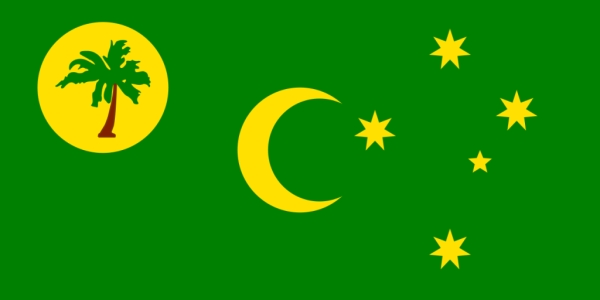
April 6, 2004: A Cocos Islands flag, designed by teenager Mohammed Minkom, is officially proclaimed.
July 2004: Some controversy arises when it is revealed that the Australian government has drawn up plans to develop a resort on the Cocos Islands without undertaking any consultation with the islanders.
May 7, 2005: Election turnout is 60.2%.
Aug. 8, 2006: Census population: 572.
October 2007: After a continuous 6½-year period as Shire president (since May 2001, having served previously in 1993-94, Radal bin Feyrel, Mohammad-Said Chongkin, and Yakin Capstan holding the office in the interim), Ron Grant does not stand for reelection. In the following years the post is held successively by Mohammad-Said Chongkin (2007-09), Shane Charlston (2009), Balmut Pirus (2009-11), and Aindil Minkom (2011-15).
May 16, 2008: Former administrator (1950-51) Roderick MacLean dies.
July 2009: An edict reportedly issued by the Shire banning employees and students from speaking Cocos Malay causes considerable consternation among the Malay residents. Those found speaking languages other than English in the workplace or at school are liable to penalties. The ban exacerbates the growing tensions between the majority Cocos Malay population and Australian public servants, deployed from the mainland, with regard to pay claims and cultural attitudes. In October an employee of the Shire's finance department who was protesting against the ban is dismissed for alleged unauthorized use of Shire equipment. The employee, Alan Medous, is reported to be planning court action against the acting Shire chief executive, Melinda Lyndon; the federal government refuses to become involved in the dispute.
Dec. 10, 2010: The Territories Law Reform Act 2010 includes provision for the comprehensive application of the laws of Western Australia to the Cocos Islands.
2011: Incidents begin to be increasingly reported of seaborne Sri Lankan migrants attempting to reach mainland Australia via the Cocos Islands. Under "Operation Sovereign Borders," initiated by the Australian government from 2013, maritime military intervention is deployed to turn boats carrying migrants and asylum seekers away from Australian waters.
Oct. 15, 2011: In elections to the Shire, Yakin Capstan, Shane Charlston, and Balmut Pirus are elected as councillors to serve until October 2013, and Charlie Arkrie, Kenneth Zakaria Lakina, and Aindil Minkom for terms until October 2015.
March 2012: A report in the Washington Post claims that, as part of an agreement on closer military cooperation between Australia and the United States, it is planned to base U.S. surveillance aircraft on the Cocos Islands. However, the Australian minister of defence, Stephen Smith, insists that, although the use of the Cocos Islands has been mooted, this is very much a "long-term prospect," which would notably require a A$75-100 million upgrade of the territory's runway, and no decision has yet been made.
Oct. 19, 2013: In elections to the Shire, Yakin Capstan, John George Clunies-Ross, Mohd Noor Jadah, and Balmut Pirus are elected for terms until October 2017.
Oct. 13, 2014: Aaron Bowman takes office as chief executive officer, succeeding Peter Clarke.
2015: Haji Wahin Bynie, also known as Nek Haji Fazerie, dies. He played a pivotal role liaising with the UN Special Committee on Decolonization in the 1984 Act of Self-Determination. He was president of the Cocos (Keeling) Islands Council as well as an imam on Home Island.
Oct. 17, 2015: In elections to the Shire, Seriwati Iku, Jan (Ayesha) Young, and Woren Dedian are elected for terms until October 2019. Balmut Pirus subsequently is appointed Shire president and Yakin Capstan deputy president.
Aug. 9, 2016: Census population: 544 (404 on Home Island, 140 on West Island). People aged 65 years and over make up 15.5% of the population, up from 8.7% in 2006.
January 2017: The premier of Western Australia, Colin Barnett, announces that his government is in discussions with the federal government about the possibility of the Cocos Islands becoming a part of the state; however, in June Premier Mark McGowan, who succeeded Barnett in March, states that his government will not continue the talks.
August 2017: The report of an inquiry initiated by Australia's Joint Standing Committee on the National Capital and External Territories into the strategic importance of the Indian Ocean territories is presented. It raises the possibility of reciprocal U.S. access to the airport on Cocos Island (the runway of which is to be upgraded), given its proximity to the U.S. military base on Diego Garcia.
Oct. 21, 2017: In elections to the Shire, Noor Anthoney, Aindil Minkom, Shane Charlston, and Tony Lacy are elected for terms expiring October 2021. Seriwati Iku is subsequently appointed Shire president, the first woman to hold the position.
June 2018: Andrea Selvey becomes chief executive officer.
Sept. 12, 2018: Former administrator (1990-92) Barry Cunningham dies.
Oct. 19, 2019: In Shire elections, Jamil Ibram (150 votes), Mazlan Hamiril (127), and Seriwati Iku (123) are elected for terms expiring October 2023. Aindil Minkom is subsequently elected Shire president and Iku as deputy president.
March 18, 2020: Administrator Natasha Griggs declares a state of emergency in the Cocos Islands, in an attempt to protect the territory from the global pandemic of the novel coronavirus disease (COVID-19); a travel ban is imposed and residents returning to the islands have to self-isolate for 14 days after arrival.
May 11, 2021: Australia announces the creation of two marine parks around Christmas Island and the Cocos Islands, together covering 740,000 sq km, an area bigger than France.
Sept. 13, 2021: John Cecil Clunies-Ross dies at Perth, aged 92.
Oct. 16, 2021: In elections to the Shire, Aindil Minkom, Tony Lacy, Ayesha Young, and Helen Liu are elected for terms expiring October 2025.
March 19, 2022: The first case of COVID-19 in the Cocos Islands is reported. No deaths are attributed to the virus.
Sept. 1, 2023: It is reported that Australia plans to start construction in 2024 on an expanded airfield on the island, to carry heavier military aircraft, including the submarine-hunting P-8A Poseidon.
Oct. 21, 2023: In elections to the Shire, Mohammed Isa Minkom, Azah Badlu, and Osman Sloan are elected for terms expiring October 2027 and Signa Knight for a term expiring October 2025.
Aug. 5, 2024: It is reported that the islands are listed along with the Philippines, Timor-Leste, and Papua New Guinea for anticipated construction projects under the U.S. Pacific Deterrence Initiative, designed to enhance U.S. force posture and infrastructure to counter China.
Oct. 18, 2025: In elections to the Shire, Levi John Fowler, Ayesha Young, Tony Lacy, and Signa Knight are elected unopposed for terms expiring October 2029. On October 22 Isa Minkom is elected Shire president.